4 layers17.8 × 51.6 mm

 customMK/Bonsai-C71
An open-source ARM-based microcontroller board
Bonsai C4 is an open-source printed circuit board by customMK, from the customMK/Bonsai-C repository on GitHub. It is a 4-layer board of 17.8 × 51.6 mm with 59 parts on 69 nets, routed with 1,229 tracks and 163 vias.
It is built around the STM32F411CEU6, W25Q128JVSIQ and SN74LV1T34DCKR, with the AAP2967-33VIR1, MB85RS64PNF-G-JNERE1 and SRV05-4 among its other parts. Its parts include 14 capacitors, 11 connectors, 9 resistors, 7 ICs and 5 diodes. It belongs with the STM32 boards of this library.


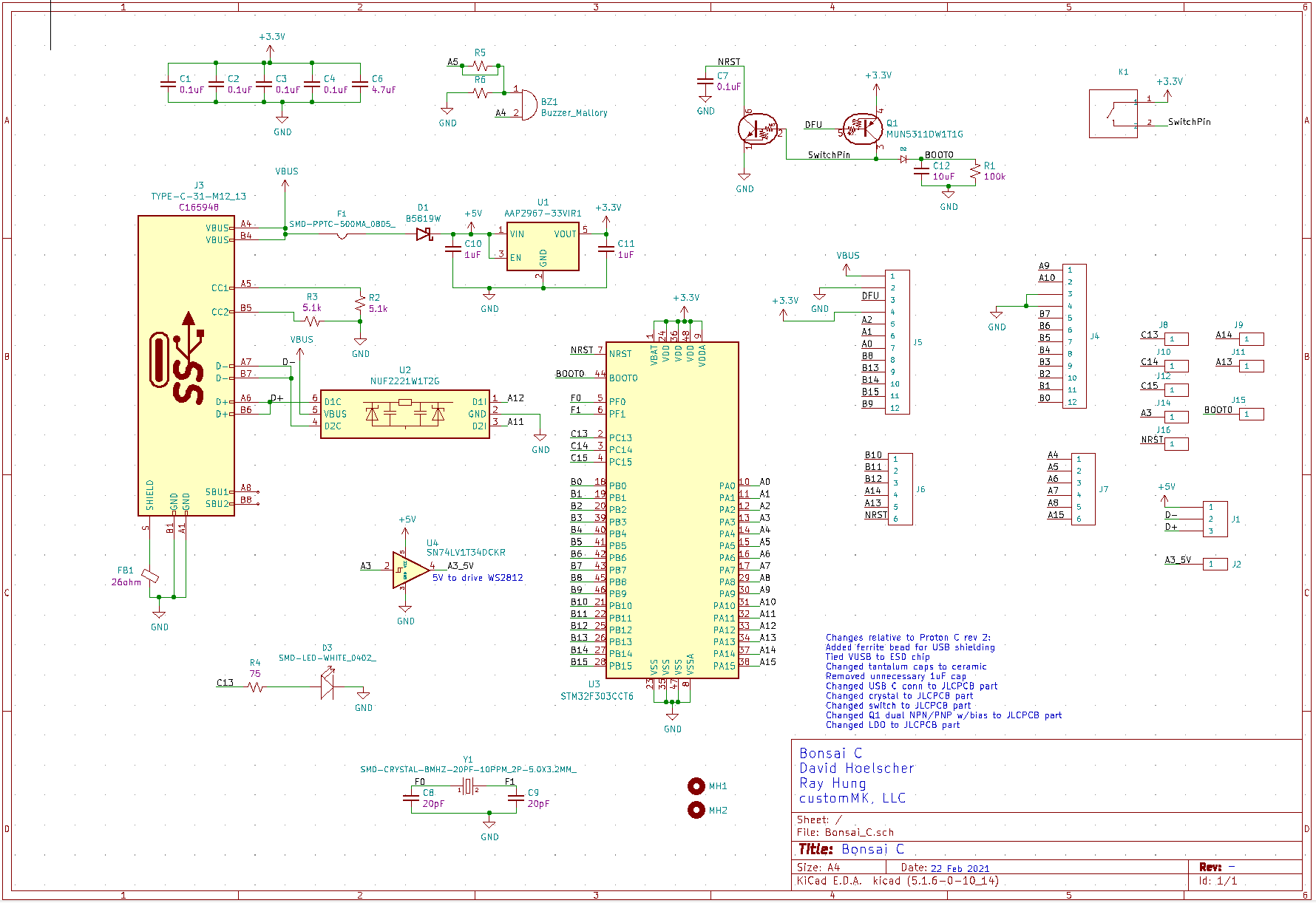
Bonsai C3 schematic
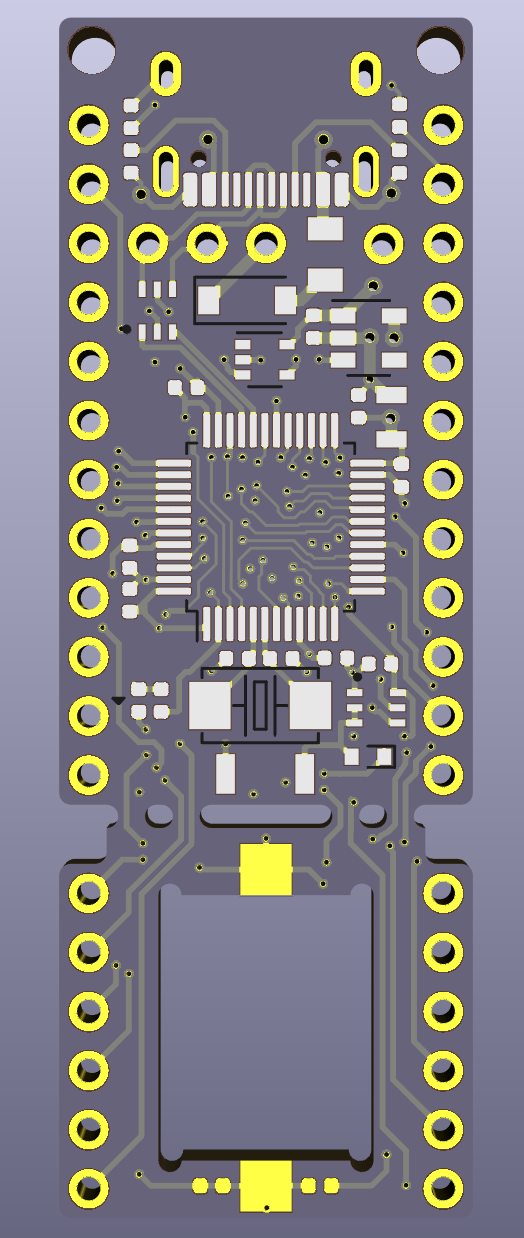
Bonsai C3 fabricated by JLCPCB (disregard the extra width, 20mm minimum width used to be JLCPCB requirement)

Bonsai C3 PCB front
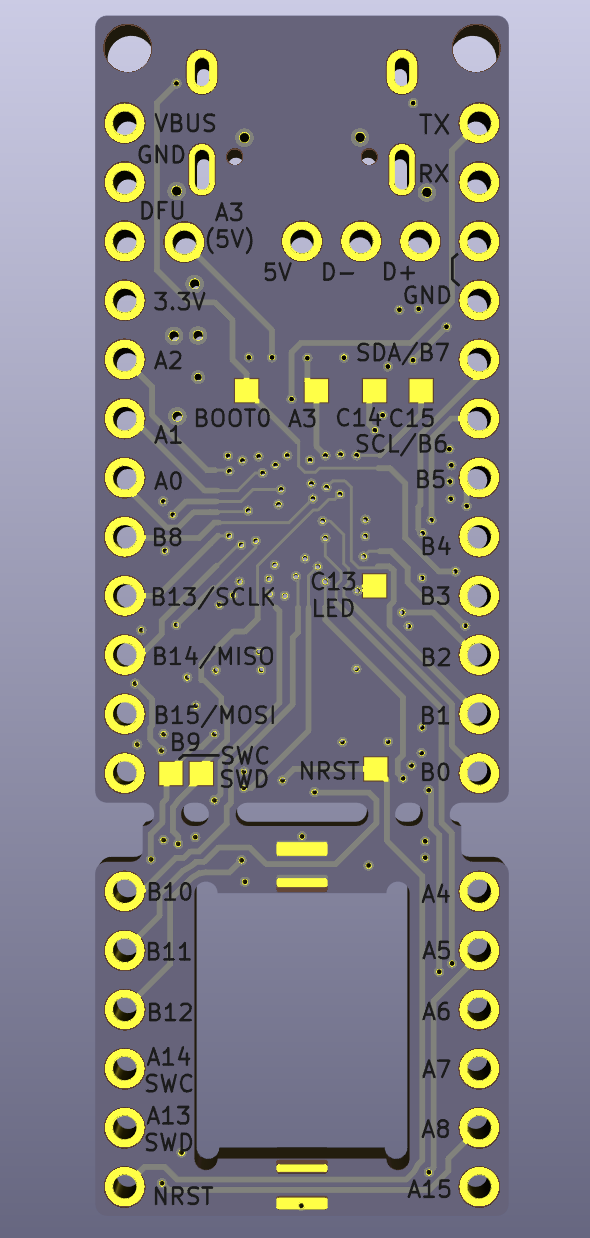
Bonsai C3 PCB back
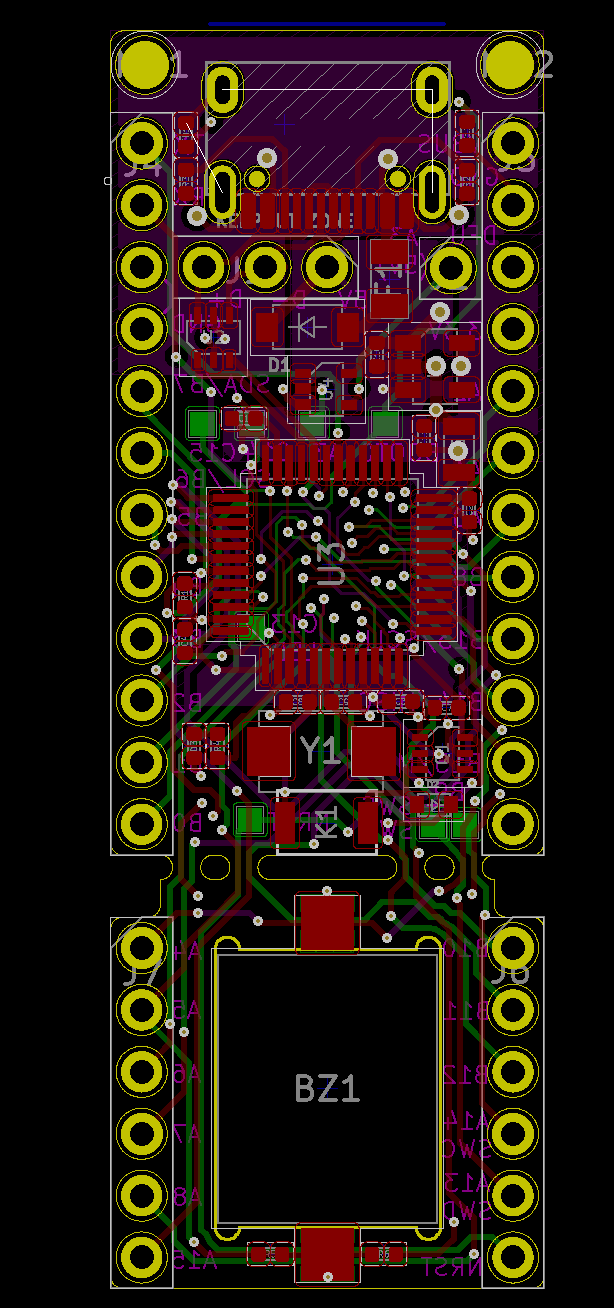
Bonsai C3 layers
Bonsai C3 is a general-purpose ARM-based microcontroller board. It was designed to help with the protoype and development of mechanical keyboards, but is versatile enough to be used in a variety of other applications. Mechanical keyboards can use Bonsai C3 as a "plug in" microcontroller board to their own designs sans-microcontroller, or they can incorporate the Bonsai C schmatic and layout directly into a complete keyboard PCB design.
Bonsai C3 is designed to be a drop-in-replacement to Proton C, and as such, they are functionally equivalent. However, there are several subtle design differences in contrast to Proton C:
Bonsai C3 is a four layer PCB design.
If you plan to fabricate the Bonsai C3 design "as-is" without modificiation, within the "build" folder are two different zip files to make it easier to achieve this:
To use the lower cost STM32F303CB microcontroller instead of STM32F303CC, simply edit the BOM file; the footprint is identical between the CC and CB variants.
If you are unable to source the microcontroller directly, keep in mind that with the right equipment (hot air rework station) it is possible to transplant microcontroller from other boards you may have. If you plan to program (and let end users reflash) the microcontroller over USB by using QMK Toolbox, you will want you select a microcontroller that includes an embedded USB bootloader, of which there are relatively few options to choose from:
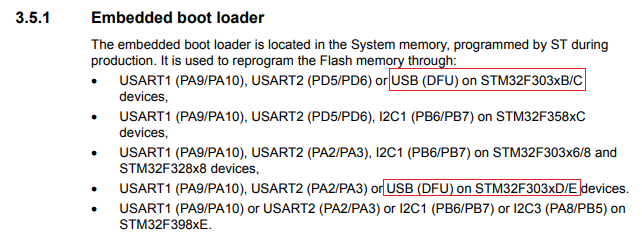
See here for more information, particularly yiancar's comment on Oct 22, 2018.
If you are willing to forego programming over the USB connector, and instead find it acceptable to use a low-cost SWD programmer (like ST-LINK) to flash new firmware onto the microcontroller, then there are many many more microcontroller options to choose from.
Open sourced under the CERN 2.0 permissive license.
| Qty | Value | Footprint | References |
|---|---|---|---|
| 7 | cap_100nF_16v_0402 | Bonsai_C4:C_0402_1005Metric | C1, C2, C3, C4, C5, C7, C13 |
| 4 | PAD_SQUARE_1MM | Bonsai_C4:PAD_SQUARE_1MM | J8, J14, J15, J16 |
| 4 | SolderJumper_3_Bridged12 | Jumper:SolderJumper-3_P1.3mm_Bridged12_RoundedPad1.0x1.5mm | JP1, JP2, JP3, JP4 |
| 2 | 2mm_mounting_hole | Bonsai_C4:MountingHole_2mm | MH1, MH2 |
| 2 | HEADER-VERT_12P-2.54_ | Bonsai_C4:PinHeader_1x12_P2.54mm_Vertical | J4, J5 |
| 2 | HEADER-VERT_6P-2.54_ | Bonsai_C4:PinHeader_1x06_P2.54mm_Vertical | J6, J7 |
| 2 | MUN5311DW1T1G | Bonsai_C4:SOT-363_SC-70-6_SC-88 | Q1, Q2 |
| 2 | PMEG2010AEB | Bonsai_C4:D_SOD-523 | D1, D5 |
| 2 | SN74LV1T34DCKR | Bonsai_C4:SOT-353_SC-70-5 | U4, U5 |
| 2 | cap_1uF_10v_0402 | Bonsai_C4:C_0402_1005Metric | C10, C11 |
| 2 | cap_20pF_50v_0402 | Bonsai_C4:C_0402_1005Metric | C8, C9 |
| 2 | cap_4.7uF_10v_0402 | Bonsai_C4:C_0402_1005Metric | C6, C14 |
| 2 | r_100k_0402_1p | Bonsai_C4:R_0402_1005Metric | R1, R8 |
| 2 | r_5.1k_0402_1p | Bonsai_C4:R_0402_1005Metric | R2, R3 |
| 2 | r_75_0402_1p | Bonsai_C4:R_0402_1005Metric | R4, R7 |
| 1 | 1N4148 | Bonsai_C4:D_SOD-523 | D2 |
| 1 | AAP2967-33VIR1 | Bonsai_C4:SOT-23-5 | U1 |
| 1 | HEADER-VERT_1P-2.54_ | Bonsai_C4:PinHeader_1x01_P2.54mm_Vertical | J2 |
| 1 | HEADER-VERT_3P-2.54_ | Bonsai_C4:PinHeader_1x03_P2.54mm_Vertical | J1 |
| 1 | LOGO | CustomMKLibrary:logo_higherres_vs_cu_0.5x0.15in_silk | G4 |
| 1 | MB85RS64PNF-G-JNERE1 | Bonsai_C4:SOP-8_3.9x4.9mm_P1.27mm | U7 |
| 1 | SMD-CRYSTAL-8MHZ-20PF-10PPM_2P-5.0X3.2MM_ | Bonsai_C4:X2-SMD-5.0X3.2X1.3MM | Y1 |
| 1 | SMD-LED-WHITE_0402_ | Bonsai_C4:LED_0402 | D3 |
| 1 | SMD-PPTC-500MA_0805_ | Bonsai_C4:F0805 | F1 |
| 1 | SMD-SWITCH-TACTILE-SPST-NO_4P-3.0MMx2.6MM_ | Bonsai_C4:SW4-SMD-3.0X2.6X0.7MM | K1 |
| 1 | SMF5.0A | Bonsai_C4:D_SOD-123FL | D4 |
| 1 | SRV05-4 | Bonsai_C4:SOT-23-6 | U2 |
| 1 | STM32F411CEU6 | Bonsai_C4:QFN-48-1EP_7x7mm_P0.5mm_EP5.6x5.6mm_ThermalVias | U3 |
| 1 | TYPE-C-31-M12_13 | Bonsai_C4:TYPE-C-31-M-12 | J3 |
| 1 | W25Q128JVSIQ | Bonsai_C4:SOIC-8_5.23x5.23mm_P1.27mm | U6 |
| 1 | cap_10uF_10v_0402 | Bonsai_C4:C_0402_1005Metric | C12 |
| 1 | fb_0402_26ohm | Bonsai_C4:R_0402_1005Metric | FB1 |
| 1 | r_10k_0402_1p | Bonsai_C4:R_0402_1005Metric | R6 |
| 1 | r_4.7k_0402_1p | Bonsai_C4:R_0402_1005Metric | R5 |
| 1 | r_470_0402_1p | Bonsai_C4:R_0402_1005Metric | R9 |


Matrixite/MatrixDrive
MatrixDrive is a USB-loadable Mega Drive/Genesis cartridge

Bemeier/bmcv
Macro CV controller for eurorack inspired by the Emblematic Systems Catalyst

punkfab/pcb-corpus
235 real KiCad boards from open-source hardware repositories, prepared as a placement and routing benchmark


hasenbanck/fate
An adapter to connect a high voltage electrostatic amplifier to an ADC for audio measurement

It measures 17.8 × 51.6 mm and has 4 copper layers, 1.6 mm thick.
59 parts, built around the STM32F411CEU6, W25Q128JVSIQ, SN74LV1T34DCKR and AAP2967-33VIR1. The full list of its parts is on this page, with links to each part's symbol and footprint where PCBKit's library has them.
From the customMK/Bonsai-C repository on GitHub, at the commit this page was made from: the board is C4 extended/Bonsai_C4.kicad_pcb. PCBKit opens the board in the browser, with nothing to install.
Its repository states no licence, so its author keeps all rights: ask customMK before reusing the design.