2 layers36 × 47 mm
 cuspaceflight/strix10
Avionics system for the Martlet IV rocket.
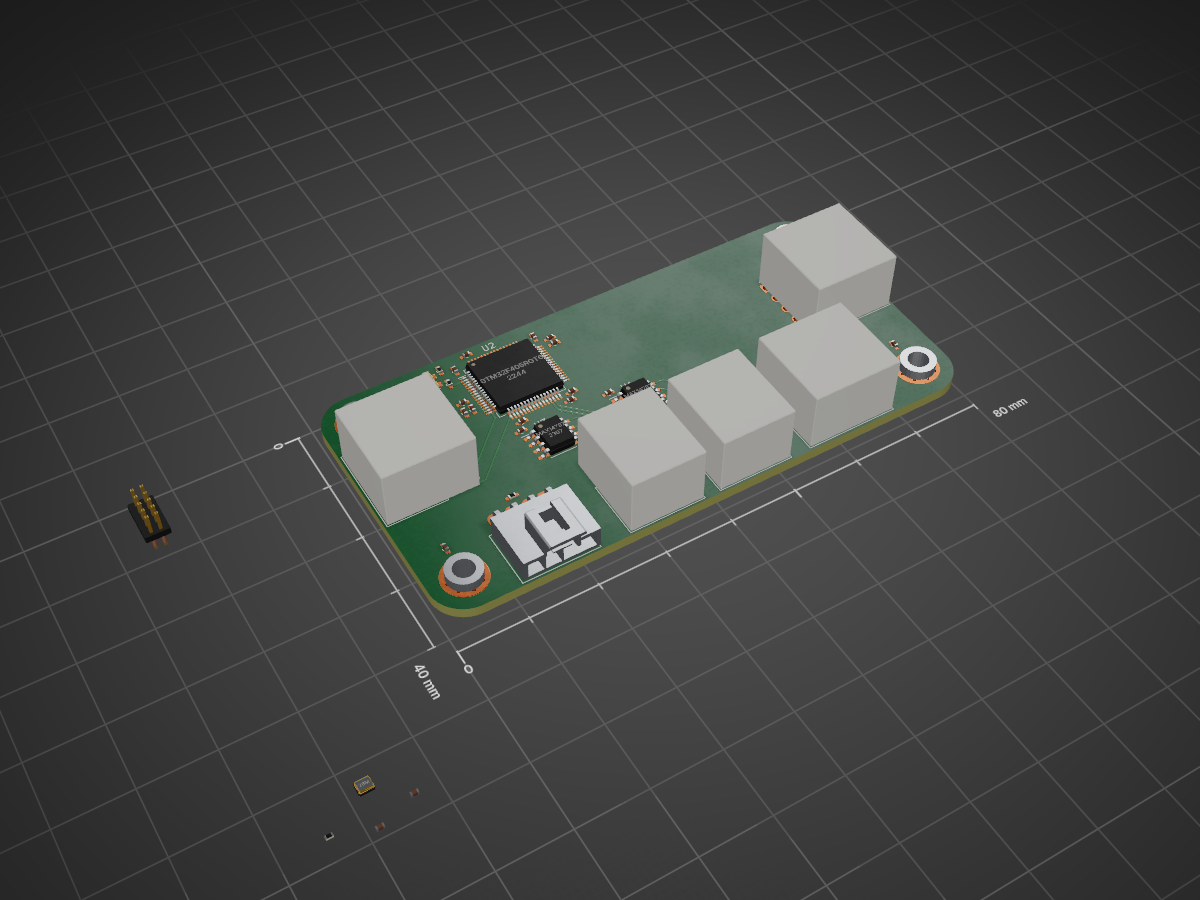
Flight computer is an open-source printed circuit board by cuspaceflight, from the cuspaceflight/strix repository on GitHub. It is a 2-layer board of 80 × 40 mm with 46 parts on 81 nets, routed with 73 tracks and 1 via.
It is built around the STM32F405RGT6 and MAX14787EGSA+. Its parts include 19 capacitors, 7 diodes, 7 connectors, 5 resistors and 3 ICs. It belongs with the STM32 boards of this library.



This repository contains the schematics and firmware for the Martlet IV Avionics system - Project Strix.
Project Strix is a single-board flight computer designed to carry out essential tasks during the launch of Martlet IV. Powered by an ARM Cortex-M4, Strix is able to perform a plethora of functions in real time, and respond to dynamic events as they happen.
The system must be able to
*Note that a commercial off-the-shelf 'Stratologger' altimeter will also be wired to the parachutes and will also be able to deploy them for redundancy.
The system is composed of several sub-modules, all connected to the central microcontroller for unified control.
The onboard altimeter uses two redundant IMUs and barometric pressure sensors to accurately determine the altitude of the rocket.
The sensor front-ends take data from the Pulsar engine sensors and converts them into voltages readable by the microcontroller's onboard ADCs. The subsystem supports the following sensors:
| Sensor | Quantity | Model |
|---|---|---|
| Pressure Tranducer | 2 | Omega PXM319-070GI |
| Thermocouple | 4 | RS Pro K-type welded tip 1/0.315m 5m (762-1118) |
The radio subsystem handles the onboard two-way ISM-band radio, which allows Strix to both send telemetry to ground control and receive telecommands. A modular architecture allows for precice control of output power to ensure the rocket operates within local limits. The subsystem also contains a GPS receiver, which assists in location of the rocket after landing.
The modular power supply provides regulated 1.8V, 3.3V, and 12V power to the flight computer and blackbox. Power is delivered from 2x 18650 Li-ion cells, which can be recharged on the pad before switching to internal power.
The space allowed for the system is shown below (dimensions in mm):
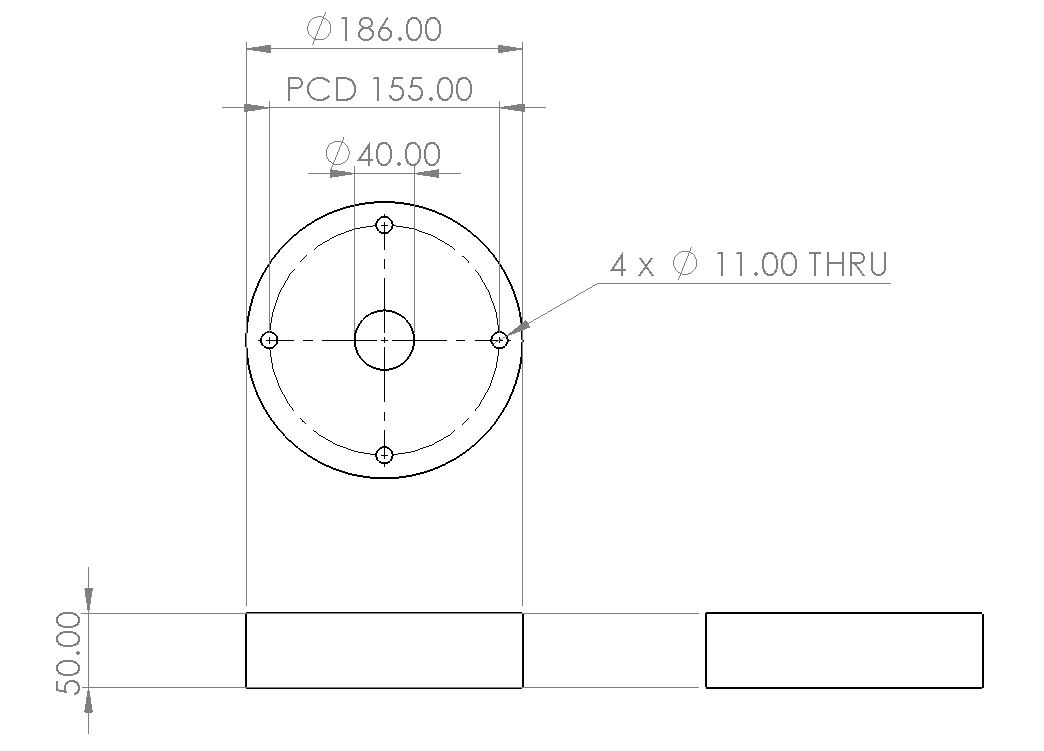
The module must also not take up the entire space; some area or a hole must be left empty to allow other cables to pass through the rocket (in addition to the central hole).
The module, including any batteries and mounting hardware, should have as little mass as possible - it must weigh no more than 500g.
| Qty | Value | Footprint | References |
|---|---|---|---|
| 11 | 100n | Strix:C_0402 | C4, C5, C6, C7, C8, C10, C12, C16, C17, C18, C19 |
| 5 | D_ESD | Strix:D_0402 | D3, D4, D5, D6, D7 |
| 4 | MountingHole_Pad | Strix:MountingHole_Pad | H1, H2, H3, H4 |
| 3 | 100 | Strix:R_0402 | R1, R4, R5 |
| 2 | 0.1u | Strix:C_0402 | C3, C15 |
| 2 | 10p | Strix:C_0402 | C1, C2 |
| 2 | 120 | Strix:R_0402 | R2, R3 |
| 2 | 2u2 | Strix:C_0402 | C13, C14 |
| 2 | MAX14787E | Strix:MAX14787E | U1, U3 |
| 1 | 1u | Strix:C_0402 | C11 |
| 1 | 26M | Strix:Xtal_SMD_2016 | Y1 |
| 1 | 4u7 | Strix:C_0402 | C9 |
| 1 | BLACKBOX | Strix:Molex_Nano-Fit_105314-1108 | J7 |
| 1 | DATALOGGER | Strix:Molex_Nano-Fit_105314-1110 | J6 |
| 1 | GND CTRL | Strix:Molex_Nano-Fit_105314-1108 | J3 |
| 1 | PWR | Strix:Molex_Nano-Fit_105313-1104 | J2 |
| 1 | PYRO | Strix:Molex_Nano-Fit_105314-1110 | J5 |
| 1 | RADIO | Strix:Molex_Nano-Fit_105314-1110 | J4 |
| 1 | RED | Strix:LED_0603 | D2 |
| 1 | STM32F405RGT6 | Strix:STM32F405RGT6 | U2 |
| 1 | SWD | Strix:Header_SWD | J1 |
| 1 | YLW | Strix:LED_0603 | D1 |
It measures 80 × 40 mm and has 2 copper layers, 1.6 mm thick.
46 parts, built around the STM32F405RGT6 and MAX14787EGSA+. The full list of its parts is on this page, with links to each part's symbol and footprint where PCBKit's library has them.
From the cuspaceflight/strix repository on GitHub, at the commit this page was made from: the board is schematics/02 flight-computer/flight-computer.kicad_pcb and its schematic schematics/01 psu/psu.kicad_sch. PCBKit opens the board in the browser, with nothing to install.
Its repository states no licence, so its author keeps all rights: ask cuspaceflight before reusing the design.

cuspaceflight/royale
Control and Instrumentation Systems for the White Giant test stand

shamansystems/Cheap-FOCer-2
Low-Cost Motor Controller based on the VESC 6

pms67/LittleBrain-STM32F4-Sensorboard
STM32F4-based PCB interfacing with a variety of sensors.

nordstream3/FOC
Date | Manufacturer | amount | includes | shipping & tax | price | -------- | -------- | -------- | -------- | -------- | -------- | 2024-01-17 | JLCPCB | 10 boards | All assembled excl fets and caps | YES, to EU |…

OPRobots/FujitoraBot
Robotracer - siguelíneas de alto rendimiento; con succión, tracción brushless en sistema tetra y procesador STM32F4


rogerclarkmelbourne/STM32_Pill_Boards
Various STM32 boards in a form factor similar to the Maple Mini or Blue Pill board
