2 layers213.5 × 98.3 mm

 crides/fissure66
A 46/36/40 key split keyboard
Fissure is an open-source printed circuit board by crides, from the crides/fissure repository on GitHub, published under the MIT licence. It is a 2-layer board of 131.5 × 184.4 mm with 239 parts on 283 nets, routed with 3,322 tracks and 589 vias.
It is built around the W25Q128JVSIQ, TLV62568DBV and BQ24075RGT, with the DW01A, FS8205 and SRV05-4 among its other parts. Its parts include 52 diodes, 44 switches, 36 resistors, 17 capacitors and 16 ICs. It belongs with the keyboards and input boards of this library.


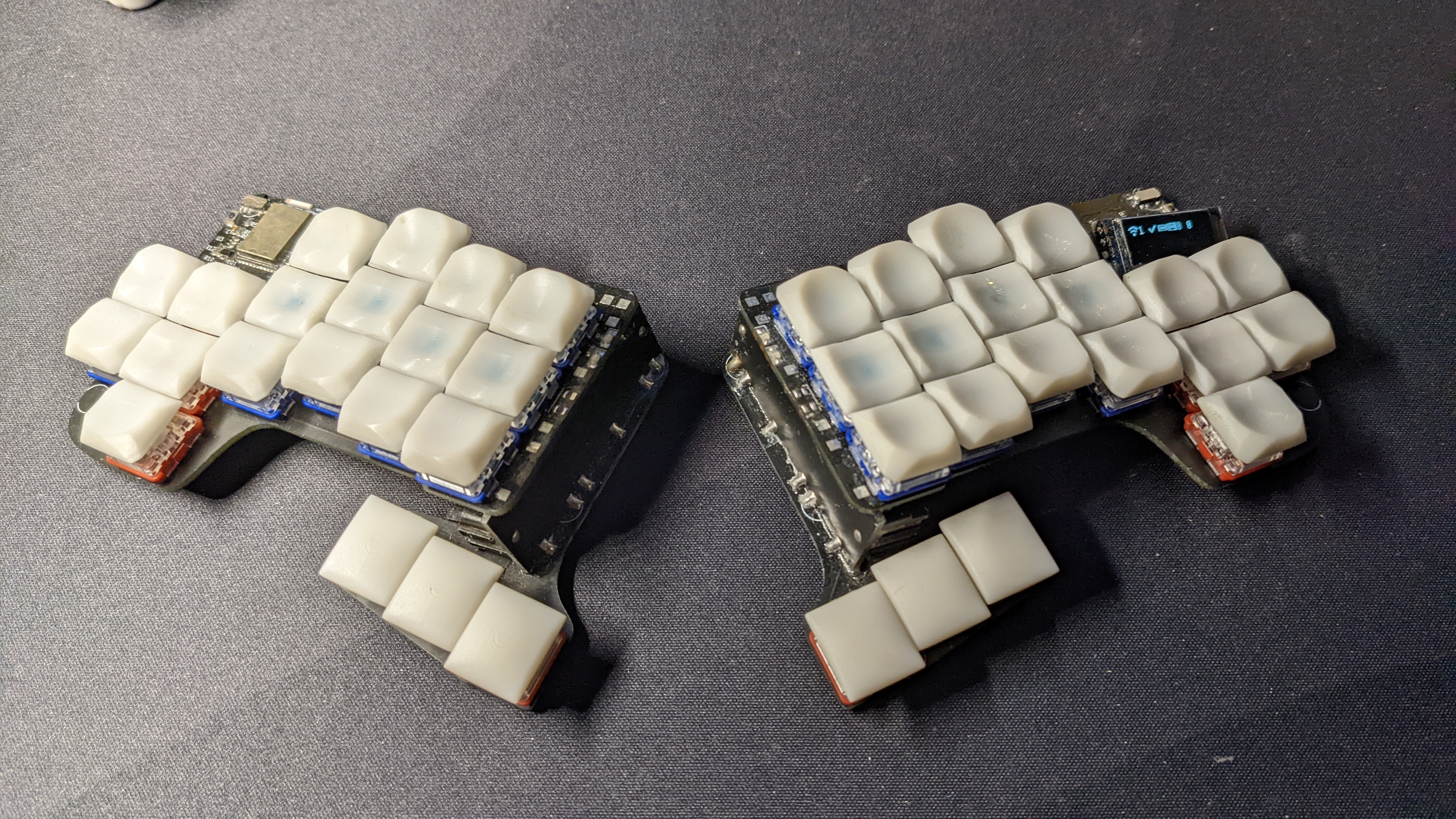
My Choc-only split keyboard for desktop use with constant experiments. See below for current keymap
You can find firmware, PCB design and gerber files for past versions if you want to build your own (I'm not used to version controlling PCB files, so if you have problems with them, please let me know). The firmware of this keyboard is based on QMK firmware. The PCB files are in pcb/, and firmwares in qmk/.
For a list of all of the past versions, see here. Fun fact: only the first version has 46 keys, which came down to 36 after two weeks of using when I desoldered the top number row.
For a list of past keymaps, you'll have to do it manually as Keyboard Layout Editor doesn't support viewing versions of a keymap. Since the saved keymap is hosted on gist, you can check out all the past versions of the gist, copy the contents of each file back into KLE to view the past keymaps.
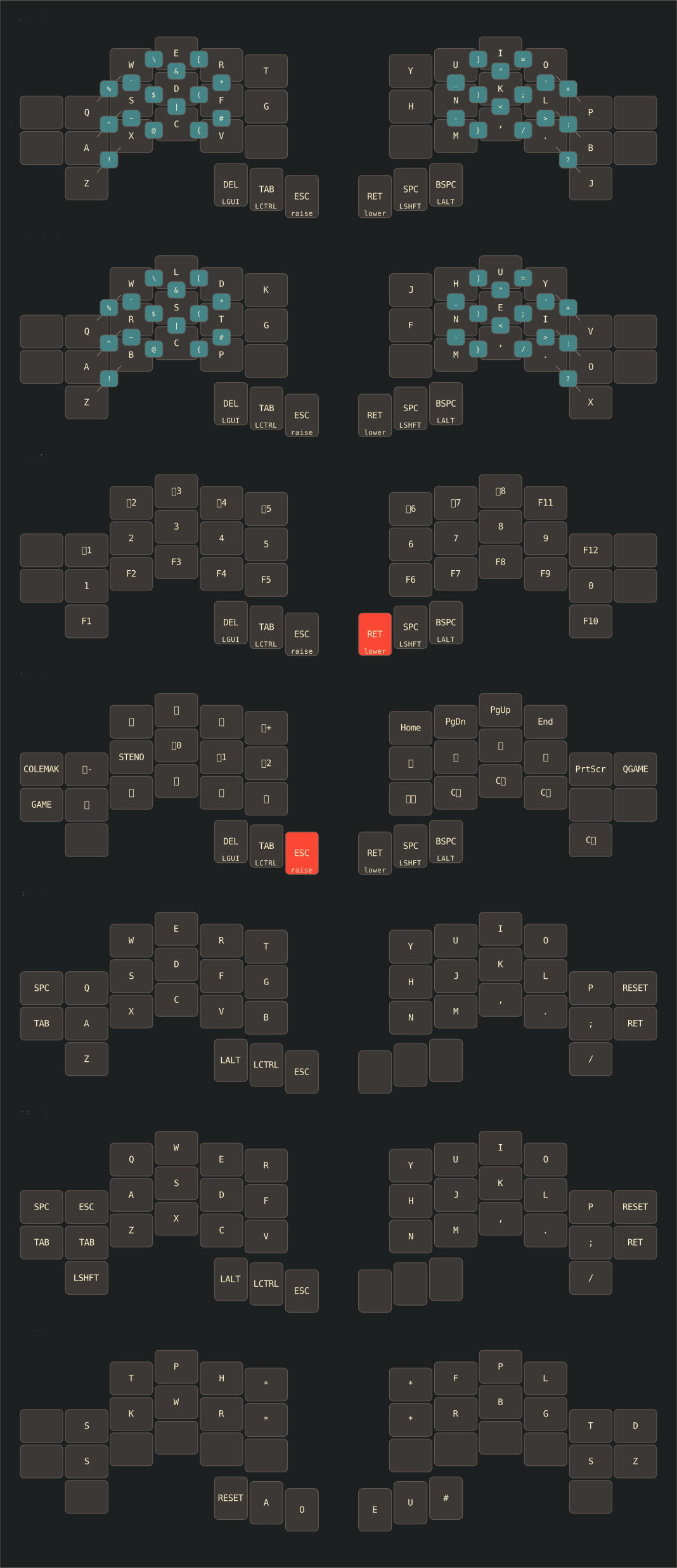
(generated using https://github.com/caksoylar/keymap-drawer with tweaked colors, source is in keymap.yaml. Note the existence of the lower outer pinky keys is a limitation of the graphic generator. equivalent version on KLE)
| Qty | Value | Footprint | References |
|---|---|---|---|
| 40 | LED_BGRA | LED_SMD:LED_ASMB-KTF0-0A306 | LED1, LED2, LED10, LED11, LED12, LED13, LED14, LED15, LED16, LED17, LED18, LED19, LED20, LED21, LED22, LED23 +24 |
| 13 | 100k | Resistor_SMD:R_0603_1608Metric | R3, R5, R8, R10, R11, R12, R18, R19, R20, R21, R24, R25, R26 |
| 12 | diode-choc | pg1350:pg1350-S | K3, K8, K13, K18, K19, K20, K23, K28, K33, K38, K39, K40 |
| 10 | 1SS309 | Package_TO_SOT_SMD:SOT-23-5 | D3, D4, D5, D6, D7, D8, D9, D10, D11, D12 |
| 10 | diode-choc | pg1350:pg1350-SN | K1, K6, K11, K16, K17, K25, K30, K35, K36, K37 |
| 9 | diode-choc | pg1350:pg1350-SR | K4, K9, K14, K21, K24, K26, K29, K31, K34 |
| 9 | diode-choc | pg1350:pg1350-SL | K2, K5, K7, K10, K12, K15, K22, K27, K32 |
| 8 | 4.7uF | Capacitor_SMD:C_0603_1608Metric | C1, C2, C3, C4, C5, C13, C14, C15 |
| 8 | 5.1k | Resistor_SMD:R_0603_1608Metric | R7, R9, R13, R14, R29, R30, R35, R36 |
| 7 | 10k | Resistor_SMD:R_0603_1608Metric | R1, R2, R4, R15, R16, R22, R23 |
| 6 | soldered-nuts:M2 | H1, H2, H3, H4, H5, H6 | |
| 6 | 1k | Resistor_SMD:R_0603_1608Metric | R6, R17, R27, R28, R33, R34 |
| 4 | Conn_01x12_Pin | fissure:bridge-conn | J3, J4, J12, J16 |
| 4 | Conn_01x12_Socket | fissure:bridge | J6, J7, J11, J17 |
| 3 | 100nF | Capacitor_SMD:C_0603_1608Metric | C6, C7, C8 |
| 2 | 0.1uF | Capacitor_SMD:C_0603_1608Metric | C16, C17 |
| 2 | 100 | Resistor_SMD:R_0603_1608Metric | R31, R32 |
| 2 | 10nF | Capacitor_SMD:C_0603_1608Metric | C9, C11 |
| 2 | 10uF | Capacitor_SMD:C_0603_1608Metric | C10, C12 |
| 2 | 10uH | Inductor_SMD:L_0603_1608Metric | L1, L3 |
| 2 | AO3400A | Package_TO_SOT_SMD:SOT-23 | Q1, Q2 |
| 2 | BQ24075 | Package_DFN_QFN:VQFN-16-1EP_3x3mm_P0.5mm_EP1.68x1.68mm_ThermalVias | U3, U9 |
| 2 | Battery_Cell | Connector_JST:JST_PH_S2B-PH-SM4-TB_1x02-1MP_P2.00mm_Horizontal | BT1, BT2 |
| 2 | DW01A | Package_TO_SOT_SMD:SOT-23-6 | U11, U14 |
| 2 | FS8205 | Package_TO_SOT_SMD:SOT-23-6 | U15, U16 |
| 2 | IS31FL3729 | Package_DFN_QFN:QFN-32-1EP_4x4mm_P0.4mm_EP2.9x2.9mm_ThermalVias | U6, U13 |
| 2 | RED | LED_SMD:LED_0805_2012Metric | D1, D2 |
| 2 | SRV05-4 | Package_TO_SOT_SMD:SOT-23-6 | U7, U8 |
| 2 | SW_Push | Button_Switch_SMD:SW_SPST_B3U-1000P | SW1, SW2 |
| 2 | SW_SPDT | Button_Switch_SMD:SW_SPDT_PCM12 | SW3, SW4 |
| 2 | USB_C_Receptacle_USB2.0 | Connector_USB:USB_C_Receptacle_HRO_TYPE-C-31-M-12 | J2, J8 |
| 2 | W25Q128JVS | Package_SO:SOIC-8_5.23x5.23mm_P1.27mm | U2, U10 |
| 2 | debug-port | misc:debug-port-single-side | J1, J9 |
| 2 | e73-2gm08s1c | mcu:e73-2g4m08s1c-shrunk | U1, U12 |
| 1 | 2.2uH | Inductor_SMD:L_1008_2520Metric | L2 |
| 1 | 3V3 | TestPoint:TestPoint_THTPad_D1.0mm_Drill0.5mm | TP7 |
| 1 | CS | TestPoint:TestPoint_THTPad_D1.0mm_Drill0.5mm | TP1 |
| 1 | GND | TestPoint:TestPoint_THTPad_D1.0mm_Drill0.5mm | TP8 |
| 1 | LOGO | LOGO | G*** |
| 1 | MISO | TestPoint:TestPoint_THTPad_D1.0mm_Drill0.5mm | TP3 |
| 1 | MOSI | TestPoint:TestPoint_THTPad_D1.0mm_Drill0.5mm | TP4 |
| 1 | PMW3610 | sensor:PMW3610 | U5 |
| 1 | SCL | TestPoint:TestPoint_THTPad_D1.0mm_Drill0.5mm | TP6 |
| 1 | SCLK | TestPoint:TestPoint_THTPad_D1.0mm_Drill0.5mm | TP2 |
| 1 | SDA | TestPoint:TestPoint_THTPad_D1.0mm_Drill0.5mm | TP5 |
| 1 | TLV62568DBV | Package_TO_SOT_SMD:SOT-23-5 | U4 |
| 1 | cirque-trackpad | Connector_FFC-FPC:Hirose_FH12-12S-0.5SH_1x12-1MP_P0.50mm_Horizontal | J5 |
| 1 | github | fissure:github | QR***** |
The 201 most common of 239 parts.


Hob-dev/Pockey
A play on the word "Pocket", this keyboard is meant to be ultra-portable ultra-low profile using Cherry ULP, with a magnetic enclosure mechanism that let's you fit the keyboard in your pocket.


mornepousse/Niphargus
Niphargus — a slim, indestructible wireless split keyboard. ESP32 + nRF24, wired fallback, and an emergency kit hidden behind the USB port. The successor to the Rouge-Gorge.


It measures 131.5 × 184.4 mm and has 2 copper layers, 1.6 mm thick.
239 parts, built around the W25Q128JVSIQ, TLV62568DBV, BQ24075RGT and DW01A. The full list of its parts is on this page, with links to each part's symbol and footprint where PCBKit's library has them.
From the crides/fissure repository on GitHub, at the commit this page was made from: the board is pcb/fissure/fissure.kicad_pcb and its schematic pcb/fissure/fissure.kicad_sch. PCBKit opens the board in the browser, with nothing to install.
Its repository publishes it under the MIT licence: you may reuse it on that licence's terms (keep the author's notice, and for a copyleft licence share your changes alike).