
2 layers197.3 × 121.2 mm
TeensyMaestro Main PCB
rimuadmin/TeensyMaestro-Hardware
Hardware for the TeensyMaestro
115 parts13CERN-OHL-P-2.0

 arthurkowskii/AKOR_01
having fun building a synth ! C++ programming, PCB design with KiCad, and hands-on hardware work in what some people call “the real world.”
AKOR 01 is an open-source printed circuit board by arthurkowskii, from the arthurkowskii/AKOR_01 repository on GitHub. It is a 2-layer board of 114.5 × 162.3 mm with 64 parts on 80 nets, routed with 659 tracks and 31 vias.
It is built around the MCP23017-E/SP. Its parts include 21 diodes, 21 switches, 5 resistors, 2 capacitors and 2 connectors. It belongs with the RP2040 boards of this library.
AKOR_01 is a compact hardware controller for playing notes, chords, and simple sequences.
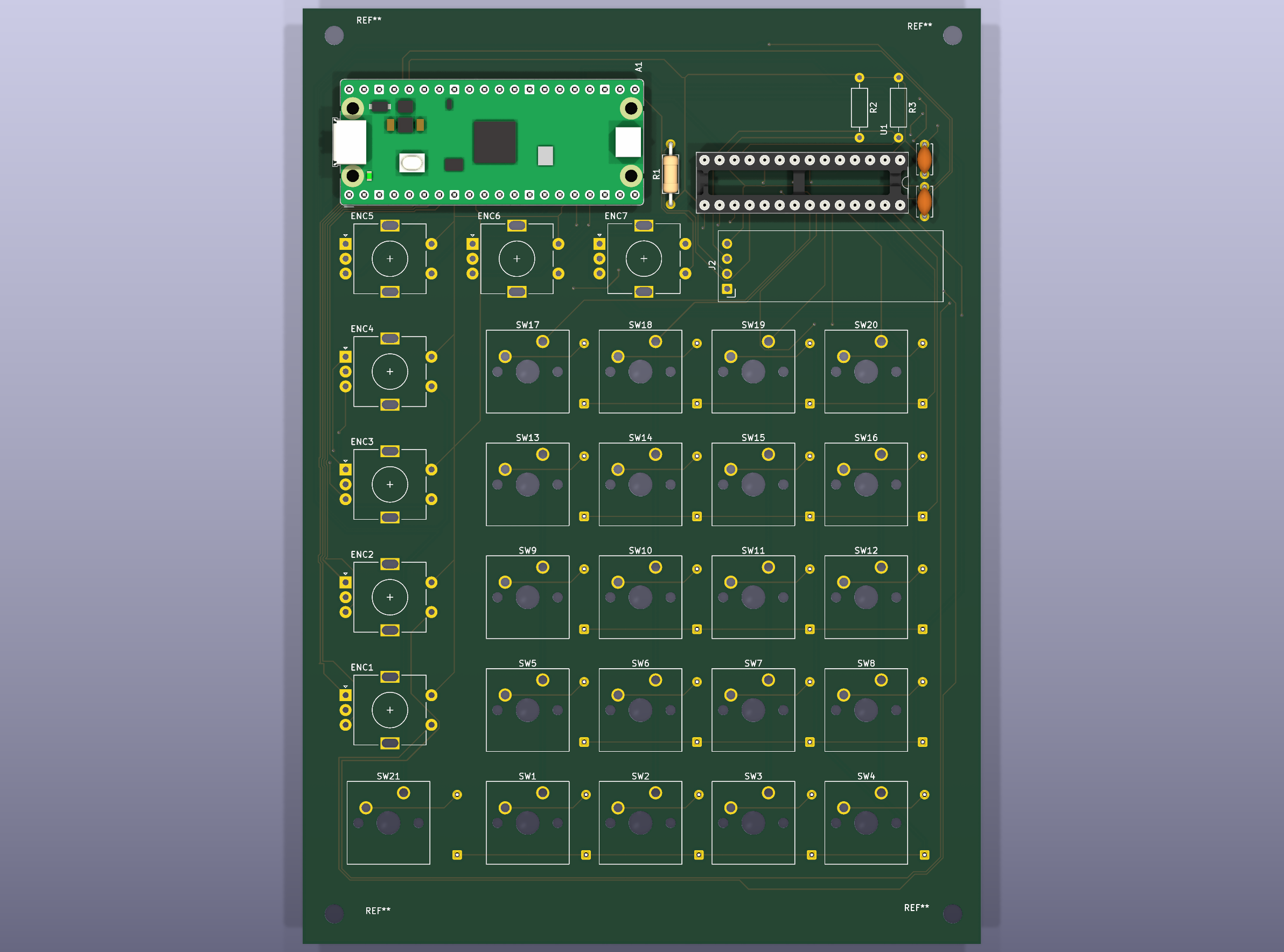
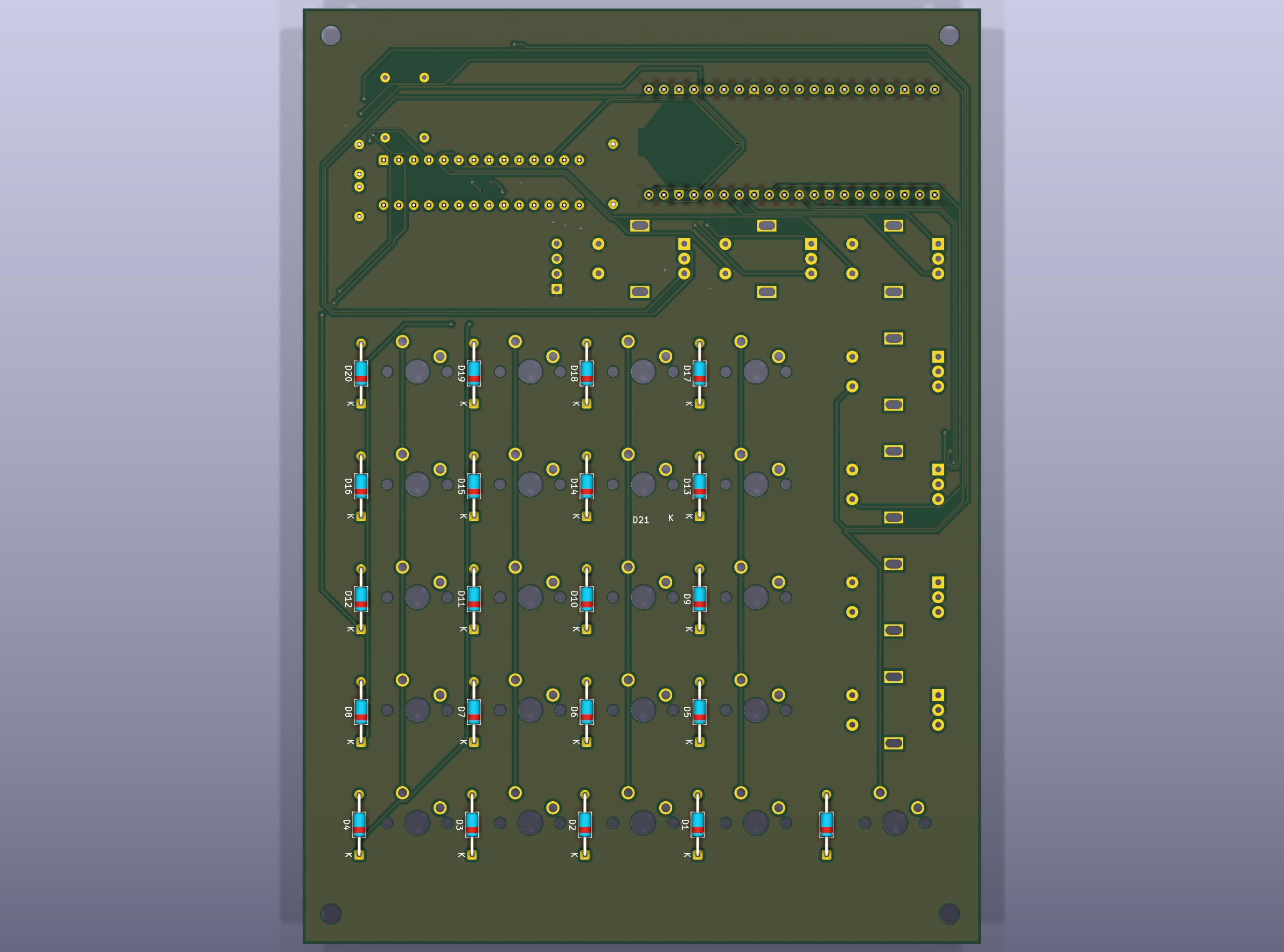
These renders show the current NO_LED PCB revision: the RGB subsystem is absent, the matrix and encoder controls are routed, and the diode matrix is on the solder side.
The confirmed V0 interface contains a 4 × 5 performance grid plus Shift (21 MX switches total), seven push encoders, and an OLED display.
V0 is an independent USB-MIDI controller based on Raspberry Pi Pico 2 H.
A future standalone synthesizer is a separate V2 project. V2 is intentionally not a compatibility constraint for the V0 PCB.
The intended signal allocation is:
A/B: 14 direct Pico GPIO inputs;The existing C++ prototype can:
That offline audio work is preserved for the separate V2. The V0 software goal is musical-state handling, control scanning, OLED feedback, and USB MIDI Note On/Off/Panic.
The NO_LED PCB layout has completed its routing and DRC checkpoint. It still requires a mechanical review and Gerber/NC Drill inspection before any fabrication order.
main is the single build source: NO_LED V0 PCB (incl. MIDI DIN-5) + firmware.archive/rgb-led (commandes RGB, préservée). archive/no-led-old preserves the pre-DIN5 NO_LED branch (also deleted).hardware/BOM_AKOR_01.csv = buying/assembly list exported from Notion Composants AKOR_01, scoped to the NO_LED build only.| Qty | Value | Footprint | References |
|---|---|---|---|
| 21 | 1N4148 | Diode_THT:D_DO-35_SOD27_P10.16mm_Horizontal | D1, D2, D3, D4, D10, D11, D12, D13, D14, D15, D16, D17, D18, D19, D20, D21 +5 |
| 21 | SW_Push_45deg | Button_Switch_Keyboard:SW_Cherry_MX_1.00u_PCB | SW1, SW2, SW3, SW4, SW10, SW11, SW12, SW13, SW14, SW15, SW16, SW17, SW18, SW19, SW20, SW21 +5 |
| 7 | RotaryEncoder_Switch | Rotary_Encoder:RotaryEncoder_Alps_EC11E-Switch_Vertical_H20mm | ENC1, ENC2, ENC3, ENC4, ENC5, ENC6, ENC7 |
| 2 | 100nF | Capacitor_THT:C_Disc_D5.0mm_W2.5mm_P5.00mm | C1, C3 |
| 2 | 4.7k | Resistor_THT:R_Axial_DIN0207_L6.3mm_D2.5mm_P10.16mm_Horizontal | R2, R3 |
| 1 | 10 | Resistor_THT:R_Axial_DIN0207_L6.3mm_D2.5mm_P10.16mm_Horizontal | R5 |
| 1 | 10k | Resistor_THT:R_Axial_DIN0207_L6.3mm_D2.5mm_P10.16mm_Horizontal | R1 |
| 1 | 33 | Resistor_THT:R_Axial_DIN0207_L6.3mm_D2.5mm_P10.16mm_Horizontal | R4 |
| 1 | Conn_01x04_Pin | Display:ER_OLEDM0.91_1x-I2C | J2 |
| 1 | DIN-5_180degree | SYNTH_01_fp:MIDI_DIN5 | J1 |
| 1 | MCP23017-E/SP | Package_DIP:DIP-28_W7.62mm_Socket | U1 |
| 1 | Raspberry Pi Pico 2 H | Module:RaspberryPi_Pico_Common_THT | A1 |
The 60 most common of 64 parts.
It measures 114.5 × 162.3 mm and has 2 copper layers, 1.6 mm thick.
64 parts, built around the MCP23017-E/SP. The full list of its parts is on this page, with links to each part's symbol and footprint where PCBKit's library has them.
From the arthurkowskii/AKOR_01 repository on GitHub, at the commit this page was made from: the board is hardware/AKOR_01.kicad_pcb and its schematic hardware/AKOR_01.kicad_sch. PCBKit opens the board in the browser, with nothing to install.
Its repository states no licence, so its author keeps all rights: ask arthurkowskii before reusing the design.
rimuadmin/TeensyMaestro-Hardware
Hardware for the TeensyMaestro


Alli-Ekundayo/scpt-rl
SCPT-RL trains a cross-attention transformer policy to place PCB components sequentially on a discrete grid. Training has two phases:


Kalilinuxloverr/Desk-Mate
Wall-E-artiger Schreibtisch-Begleiter: Ampel fuer Claude Code & Downloads, Motorfader, Augen-Displays. ESP32-S3, Swift, KiCad, 3D-Druck.


hackclub/OnBoard
💡 Join 1,000 teenagers and make your first PCB with a $100 grant!

drandyhaas/KiCadRoutingTools
A set of Python/Rust tools to aid routing in KiCad