2 layers38.1 × 57.2 mm
 arrowtype/80forty5
The utility of an 80% keyboard in a 40% layout
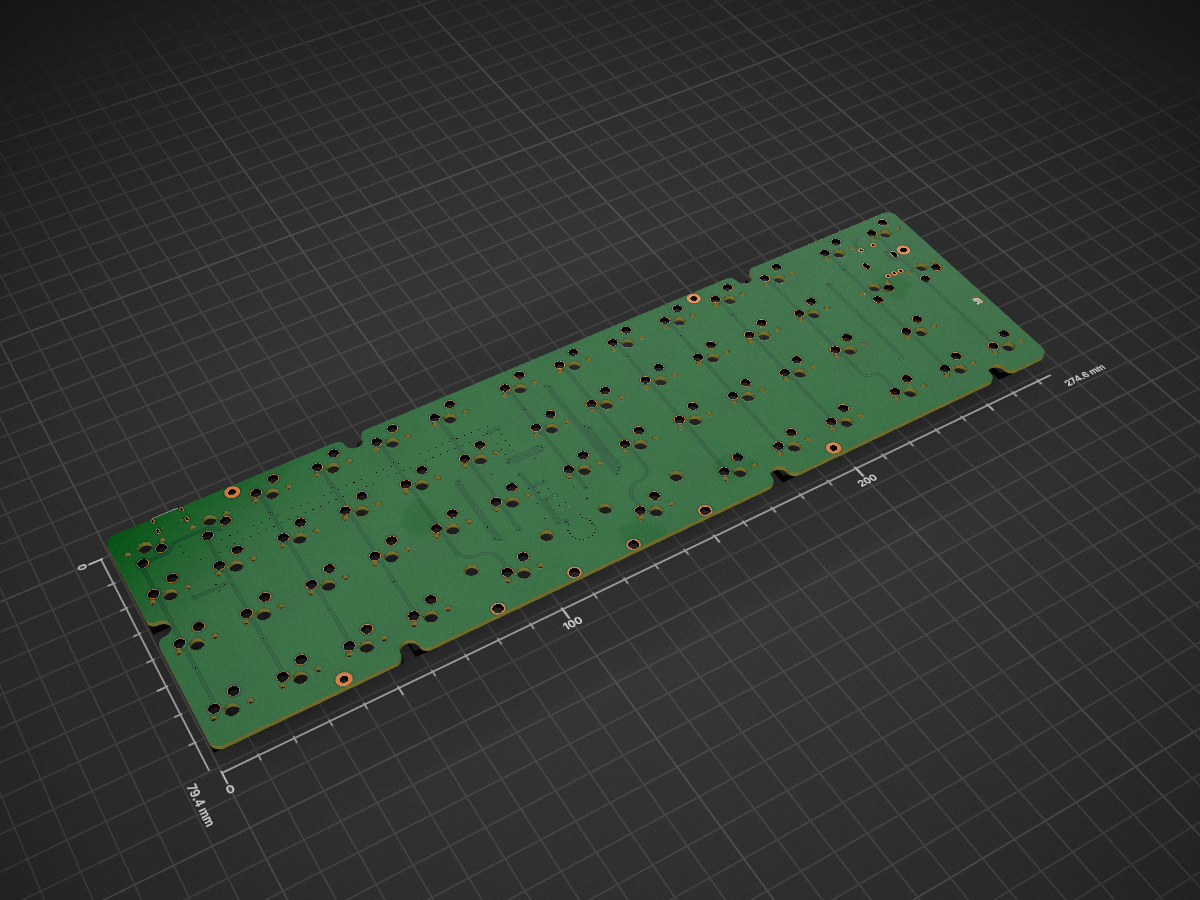
Fortyeighty is an open-source printed circuit board by arrowtype, from the arrowtype/80forty repository on GitHub, published under the MIT licence. It is a 2-layer board of 274.6 × 79.4 mm with 148 parts on 113 nets, routed with 464 tracks and 174 vias.
It is built around the W25Q128JVSIQ, SRV05-4 and SK6812MINI-E. Its parts include 54 diodes, 15 capacitors, 9 resistors, 4 ICs and 3 switches. It belongs with the keyboards and input boards and the RP2040 boards of this library.


The utility of an 80% keyboard in a 40% form factor.
Inspired by the design of the OP-1 Synthesizer, the explorative spirit of the 40% & 30% keyboard community (especially boards like ChonkyKong, CutiePie, and Ortho Cajal), and the tactile reference points and minimized finger-travel of many split, ergonomic keyboards. The 80forty was partly motivated by the appearance of Deadline Studio DOYS keycaps, but it works with any MX-compatible keycaps.
The 80forty has a layout that is ortholinear and minimal, but still retains the keys that are helpful for everyday computing and specialized tasks like graphic design applications (i.e. arrow keys, bottom mod keys, and outer columns allowing for e.g. dedicated shift and backspace keys). It also allows either a knob or a 2x2 macropad above the arrow keys.
Supports low-profile KS33 switches (with hotswap sockets) as well as MX switches (soldered/mill-maxed).

Version 1 uses either a stacked acrylic or ”skeleton” FR4 plate design.
While the PCB supports either KS33 or MX switches, the current case designs have only been settled for the KS33 switches. MX switches require more space, and would likely require larger middle case layers.
This case uses the standard FR4 top plate of the 80forty, and sandwiches it in a few layers of 5mm, lasercut acrylic.
This case uses the standard FR4 top and bottom plates of the 80forty, with standoffs providing middle separation for the switches.
Configurable with either 1 large knob or 4 macro keys.
80forty is configurable in Vial, so the keymap can be whatever you want! However, here are two example layouts to show what might be common approaches to such a keyboard.
The 2-unit spacebars are intended to serve double duty: to input Space when tapped, or to shift to respective layers when held.
Vial/QMK also allow for “key combos.” So, for instance, it is possible to forgo a dedicated Escape key and instead assign this to Tilde + Q.
The project was conceived to allow a sleek, low-profile, CNC aluminum case design. This is still a goal, but there is no current timeline for this version.
In the slightly nearer term, the intention is to prototype this case with 3D printing. If anyone out there is interested in creating this 3D case and contributing it to the project, let us know in the issues or in a pull request!
Concept, layout, case design, and PCB graphics by Stephen Nixon / ArrowType.
Engineering, code, and PCB specifications and ordering by Noah Kiser / Kiser Designs.
| Qty | Value | Footprint | References |
|---|---|---|---|
| 53 | D_Small | Diode_SMD:D_SOD-123 | D1, D2, D10, D11, D12, D13, D14, D15, D16, D17, D18, D19, D20, D21, D22, D23 +37 |
| 53 | MX-NoLED | PCM_marbastlib-mx:SW_MX_HS_1u | MX1, MX2, MX10, MX11, MX12, MX13, MX14, MX15, MX16, MX17, MX18, MX19, MX20, MX21, MX22, MX23 +37 |
| 8 | 100n | Capacitor_SMD:C_0402_1005Metric | C3, C6, C7, C8, C9, C10, C11, C15 |
| 5 | 5.1k | Resistor_SMD:R_0402_1005Metric | R1, R2, R3, R4, R6 |
| 5 | MountingHole_Pad | MountingHole:MountingHole_2.2mm_M2_Pad_TopOnly | H1, H2, H3, H4, H5 |
| 4 | 1u | Capacitor_SMD:C_0402_1005Metric | C1, C2, C4, C5 |
| 2 | 1k | Resistor_SMD:R_0402_1005Metric | R5, R9 |
| 2 | 22p | Capacitor_SMD:C_0402_1005Metric | C12, C13 |
| 2 | 27 | Resistor_SMD:R_0402_1005Metric | R7, R8 |
| 2 | MX_stab | PCM_marbastlib-mx:STAB_MX_P_2u | S1, S2 |
| 2 | SW_SPST | Button_Switch_SMD:SW_SPST_TL3342 | SWR1, SWR2 |
| 1 | 10u | Capacitor_SMD:C_0402_1005Metric | C14 |
| 1 | Crystal_GND24_Small | Crystal:Crystal_SMD_3225-4Pin_3.2x2.5mm | Y1 |
| 1 | Fuse_Small | Fuse:Fuse_1206_3216Metric | F1 |
| 1 | RP2040TR7 | Package_DFN_QFN:QFN-56-1EP_7x7mm_P0.4mm_EP3.2x3.2mm | U4 |
| 1 | RotaryEncoder_Switch | Rotary_Encoder:RotaryEncoder_Alps_EC11E-Switch_Vertical_H20mm | SW1 |
| 1 | SK6812MINI-E | PCM_marbastlib-various:LED_6028R | LED1 |
| 1 | SRV05-4 | PCM_marbastlib-various:SOT-23-6-routable | U2 |
| 1 | USB_C_Receptacle_USB2.0 | Connector_USB:USB_C_Receptacle_HRO_TYPE-C-31-M-12 | J1 |
| 1 | W25Q128JVS | Package_SO:SOIC-8_5.23x5.23mm_P1.27mm | U3 |
| 1 | XC6206PxxxMR | Package_TO_SOT_SMD:SOT-23 | U1 |


wwintjong/macropad
My take on a macropad that I think will suit me. The layout is a 5x4 keys with hot-swappable switch and LED. Current iteration has no knobs or display implemented, but that is an idea for future versions.


TweetyDaBird/Fat-Chameleon
A Grid Ortho keyboard for BM40, JJ40/JJ50 cases inspired by Planck and Preonic
It measures 274.6 × 79.4 mm and has 2 copper layers, 1.6 mm thick.
148 parts, built around the W25Q128JVSIQ, SRV05-4 and SK6812MINI-E. The full list of its parts is on this page, with links to each part's symbol and footprint where PCBKit's library has them.
From the arrowtype/80forty repository on GitHub, at the commit this page was made from: the board is fortyeighty/fortyeighty.kicad_pcb and its schematic HS_KS-SLD_MX/HS_KS-SLD_MX.kicad_sch. PCBKit opens the board in the browser, with nothing to install.
Its repository publishes it under the MIT licence: you may reuse it on that licence's terms (keep the author's notice, and for a copyleft licence share your changes alike).