2 layers100 × 95.3 mm
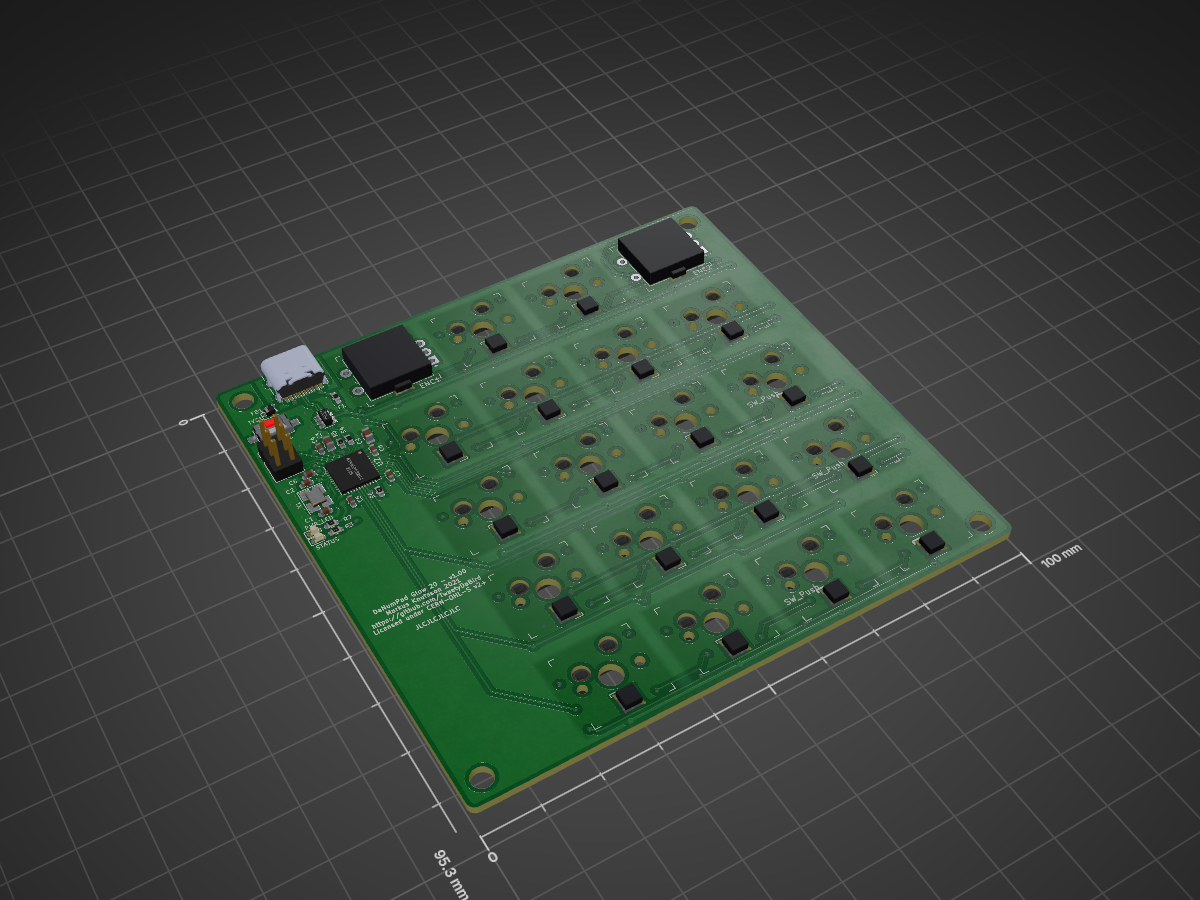
 TweetyDaBird/DaNumPad19
A Numpad
DaNumPad Glow 20 is an open-source printed circuit board by TweetyDaBird, from the TweetyDaBird/DaNumPad repository on GitHub. It is a 2-layer board of 100 × 95.3 mm with 117 parts on 74 nets, routed with 713 tracks and 161 vias.
It is built around the ATMEGA32U4, SRV05-4 and 1N4148W, with the SK6812MINI-E, 0467.750NRHF and BLM15PX121SN1D11 among its other parts. Its parts include 33 capacitors, 20 diodes, 20 switches, 7 resistors and 2 ICs. It belongs with the keyboards and input boards and the AVR (ATmega, ATtiny) and nRF52 and nRF5x boards of this library.


A 'family' of mechanical numpad/macro pads that can be configured either as a classic 17-key numpad, or as a 20 key (5x4) macro pad.
Available as two variations, wired and wireless with identical footprint, using the same plate but different PCB.
| Qty | Value | Footprint | References |
|---|---|---|---|
| 29 | 100nF | Capacitor_SMD:C_0603_1608Metric | C10, C11, C12, C13, C14, C15, C16, C17, C18, C19, C20, C21, C22, C23, C24, C25 +13 |
| 20 | 1N4148W | Diode_SMD:D_SOD-123 | D1, D2, D3, D4, D5, D10, D11, D12, D13, D14, D15, D16, D17, D18, D19, D20 +4 |
| 20 | SK6812mini | Keyboard Library:SK6812MINI_Midmount | RGB1, RGB2, RGB3, RGB4, RGB5, RGB10, RGB11, RGB12, RGB13, RGB14, RGB15, RGB16, RGB17, RGB18, RGB19, RGB20 +4 |
| 20 | SW_Push | keyswitches:Kailh_socket_MX_RGB | SW1, SW2, SW3, SW4, SW5, SW10, SW11, SW12, SW13, SW14, SW15, SW16, SW17, SW18, SW19, SW20 +4 |
| 4 | MountingHole | MountingHole:MountingHole_3.7mm | H1, H2, H3, H4 |
| 2 | 12pF | Capacitor_SMD:C_0603_1608Metric | C1, C2 |
| 2 | 22 | Resistor_SMD:R_0603_1608Metric | R4, R5 |
| 2 | 33 | Resistor_SMD:R_0603_1608Metric | R3, R7 |
| 2 | 5.1K | Resistor_SMD:R_0603_1608Metric | R1, R2 |
| 2 | Rotary_Encoder_Switch_GND | Keyboard Library:RotaryEncoder_Alps_EC11E-Switch_Vertical_H20mm | ENC1, ENC2 |
| 1 | 0467.750NRHF | Fuse:Fuse_0603_1608Metric_Castellated | F1 |
| 1 | 10k | Resistor_SMD:R_0603_1608Metric | R6 |
| 1 | 1uF | Capacitor_SMD:C_0805_2012Metric | C3 |
| 1 | 4.7uF | Capacitor_SMD:C_0805_2012Metric | C9 |
| 1 | ATmega32U4 | Package_DFN_QFN:QFN-44-1EP_7x7mm_P0.5mm_EP5.15x5.15mm | U2 |
| 1 | BLM15PX121SN1D | Resistor_SMD:R_0402_1005Metric_Pad0.72x0.64mm_HandSolder | FB1 |
| 1 | BSD3C051V | Diode_SMD:D_SOD-323 | TVS1 |
| 1 | Conn_01x06 | Connector_PinHeader_2.54mm:PinHeader_2x03_P2.54mm_Vertical | J2 |
| 1 | PWR_LED | LED_SMD:LED_0603_1608Metric | LED_2 |
| 1 | SRV05-4 | Package_TO_SOT_SMD:SOT-23-6 | U1 |
| 1 | STATUS_LED | LED_SMD:LED_0603_1608Metric | LED_1 |
| 1 | TS-A002 | Keyboard Library:SW_SPST_CK_RS282G05A3 | reset1 |
| 1 | USB_C_Receptacle_USB2.0 | Connector_USB:USB_C_Receptacle_HRO_TYPE-C-31-M-12 | J1 |
| 1 | X322516MLB4SI | Crystal:Crystal_SMD_3225-4Pin_3.2x2.5mm_HandSoldering | X1 |


ldcyes/OpenDuck
已完成可编辑原理图、真实四层 PCB 和本地库。阶梯板面积 4510 mm²,比原 65×60 + 32×30 mm 两板总面积 4860 mm² 少 350 mm²(7.20%)。原 TDK 模块本体、四个安装孔和原 TDK 器件位置保留,回生电容采用原料号卧装,J1 因实际拔插通道冲突改为同系列 BM08 顶插。当前为工程候选,未制造,未完成热、回生瞬态、低电量或行走验收。


ebastler/E80-1800
QMK compatible PCB replacement for Cherry G80-1800

ssbb/pipra
30-key low profile electro-capacitive wireless split keyboard.
It measures 100 × 95.3 mm and has 2 copper layers, 1.6 mm thick.
117 parts, built around the ATMEGA32U4, SRV05-4, 1N4148W and SK6812MINI-E. The full list of its parts is on this page, with links to each part's symbol and footprint where PCBKit's library has them.
From the TweetyDaBird/DaNumPad repository on GitHub, at the commit this page was made from: the board is DaNumPad Glow 20/DaNumPad Glow 20.kicad_pcb. PCBKit opens the board in the browser, with nothing to install.
Its repository states no licence, so its author keeps all rights: ask TweetyDaBird before reusing the design.