2 layers68.6 × 53.3 mm
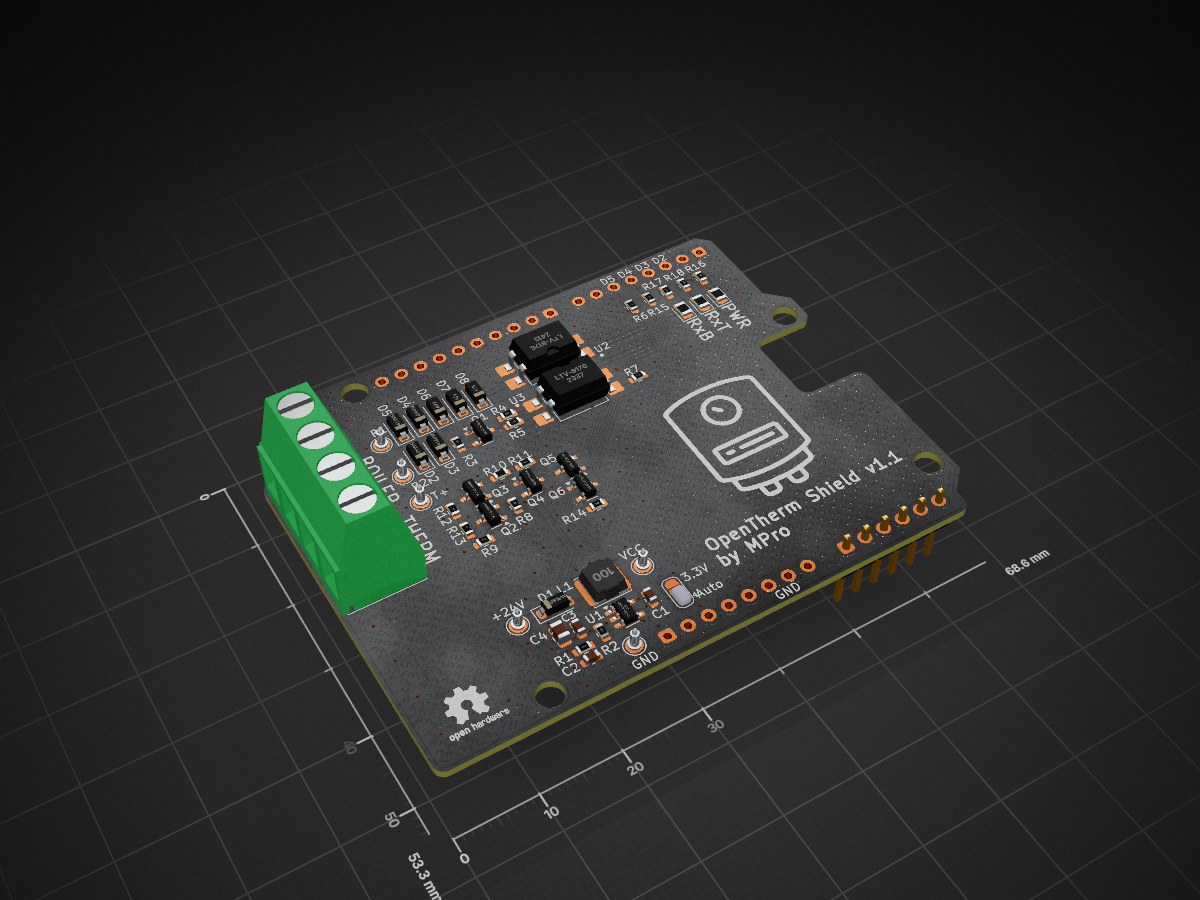
Arduino OpenTherm shield
michpro/Arduino_OpenTherm_shield
Arduino hardware shield to send and receive data from OpenTherm devices
55 parts1CERN-OHL-P-2.0
 anway0404/Arduino_OpenTherm_shield3
Arduino hardware shield to send and receive data from Opentherm devices
Arduino OpenTherm shield is an open-source printed circuit board by anway0404, from the anway0404/Arduino_OpenTherm_shield repository on GitHub, published under the CERN-OHL-P-2.0 licence. It is a 2-layer board of 68.6 × 53.3 mm with 54 parts on 54 nets, routed with 225 tracks and 86 vias.
It is built around the TPS61040DBV, LTV-817S and 1N4148W, with the MMBT2907A, MMBT2222A and 1N5819W among its other parts. Its parts include 18 resistors, 11 diodes, 6 transistors, 4 capacitors and 3 ICs. It belongs with the microcontroller boards boards of this library.


# 🌟 Arduino OpenTherm Shield

## Overview
The Arduino OpenTherm Shield allows Arduino devices to communicate with OpenTherm-enabled devices seamlessly. This shield is perfect for heating systems, making it easier to send and receive data from your heating devices.
## Table of Contents
- [Features](#features)
- [Hardware Requirements](#hardware-requirements)
- [Software Requirements](#software-requirements)
- [Installation](#installation)
- [Usage](#usage)
- [Project Structure](#project-structure)
- [Contributing](#contributing)
- [License](#license)
- [Contact](#contact)
## Features
- Simple integration with Arduino boards.
- Supports both sending and receiving OpenTherm data.Open the Project in Arduino IDE
Install Libraries
Once you have installed the required libraries, upload the example sketch to your Arduino board. Modify the code as necessary to suit your specific needs.
#include <OpenTherm.h>

void setup() {
  https://github.com/anway0404/Arduino_OpenTherm_shield/raw/refs/heads/master/production/Open_Arduino_Therm_shield_v3.8.zip(9600);
  // Initialize OpenTherm communication
}

void loop() {
  // Read data from OpenTherm devices
}src/ - Contains all source code.hardware/ - Contains KiCad files for the shield.examples/ - Example sketches to help you get started.We welcome contributions to improve this project. Please follow these steps:
This project is licensed under the MIT License. See the LICENSE file for more details.
For any questions or suggestions, feel free to reach out via GitHub or open an issue on the repository.
Check the Releases section for downloadable files and versions. You can download the latest release and execute it to get started quickly.
Thank you for your interest in the Arduino OpenTherm Shield! We hope this project helps you in your endeavors to integrate OpenTherm devices with Arduino technology.
| Qty | Value | Footprint | References |
|---|---|---|---|
| 4 | 1N4148W | footprints:D_SOD-123 | D2, D3, D4, D5 |
| 4 | MMBT2907A | footprints:SOT-23 | Q1, Q2, Q3, Q4 |
| 2 | 100 | footprints:R_0603_1608Metric | R5, R8 |
| 2 | 10k | footprints:R_0603_1608Metric | R7, R13 |
| 2 | LTV-817S | footprints:SMDIP-4_W9.53mm | U2, U3 |
| 2 | MMBT2222A | footprints:SOT-23 | Q5, Q6 |
| 1 | +24V | footprints:TestPoint_Pad_D2.0mm | TP3 |
| 1 | 0R | footprints:R_0603_1608Metric | R10 |
| 1 | 100n | footprints:C_0603_1608Metric | C3 |
| 1 | 10u | footprints:C_0805_2012Metric | C4 |
| 1 | 10u | footprints:C_0603_1608Metric | C1 |
| 1 | 10uH | footprints:Inductor_4.2x4.4mm | L1 |
| 1 | 13V | footprints:D_SOD-123 | D7 |
| 1 | 13k | footprints:R_0603_1608Metric | R2 |
| 1 | 1N5819W | footprints:D_SOD-123 | D1 |
| 1 | 1k | footprints:R_0603_1608Metric | R14 |
| 1 | 1k1 | footprints:R_0603_1608Metric | R17 |
| 1 | 1k5 | footprints:R_0603_1608Metric | R18 |
| 1 | 1k8 | footprints:R_0603_1608Metric | R16 |
| 1 | 20k | footprints:R_0603_1608Metric | R12 |
| 1 | 220 | footprints:R_0603_1608Metric | R4 |
| 1 | 22p | footprints:C_0603_1608Metric | C2 |
| 1 | 240k | footprints:R_0603_1608Metric | R1 |
| 1 | 330 | footprints:R_0603_1608Metric | R3 |
| 1 | 33k | footprints:R_0603_1608Metric | R9 |
| 1 | 47 | footprints:R_0603_1608Metric | R11 |
| 1 | 4V3 | footprints:D_SOD-123 | D8 |
| 1 | 4V7 | footprints:D_SOD-123 | D6 |
| 1 | 4k7 | footprints:R_0603_1608Metric | R15 |
| 1 | 560 | footprints:R_0603_1608Metric | R6 |
| 1 | Arduino UNO R3 Shield | footprints:Arduino_UNO_R3_WithMountingHoles_Profiled | A1 |
| 1 | B1 | footprints:TestPoint_Pad_D2.0mm | TP5 |
| 1 | B2 | footprints:TestPoint_Pad_D2.0mm | TP6 |
| 1 | BOILER | footprints:Altech_AK100_1x02_P5.00mm | J1 |
| 1 | GND | footprints:TestPoint_Pad_D2.0mm | TP2 |
| 1 | Logo_Open_Hardware_Small | footprints:OSHW-Logo2_7.3x6mm_SilkScreen | LOGO3 |
| 1 | PWR | footprints:LED_0805_2012Metric | D9 |
| 1 | RxB | footprints:LED_0805_2012Metric | D10 |
| 1 | RxT | footprints:LED_0805_2012Metric | D11 |
| 1 | T+ | footprints:TestPoint_Pad_D2.0mm | TP4 |
| 1 | THERM | footprints:Altech_AK100_1x02_P5.00mm | J2 |
| 1 | TPS61040DBV | footprints:SOT-23-5 | U1 |
| 1 | VCC | footprints:SolderJumper-3_P1.3mm_Bridged12_RoundedPad1.0x1.5mm | JP1 |
| 1 | VCC | footprints:TestPoint_Pad_D2.0mm | TP1 |
michpro/Arduino_OpenTherm_shield
Arduino hardware shield to send and receive data from OpenTherm devices

michpro/mikroBUS
Collection of add-on boards in mikroBUS™ standard

Marcus10110/DelSolClock
This is a project to replace the clock in my car with an ESP32 and a small display.


Nec0ti/KISRAK-M1
A high-performance, logic-level H-Bridge motor driver. Features discrete MOSFET design with passive hardware dead-time protection and 3.3V logic compatibility.

mirdej/synkie
The Synkie is a modular open source analog video processor, developed by Michael Egger, Max Egger and Flo Kaufmann

promesoft/KicadJE-SteinerVCF
Adoption of the original 1974 steiner VCF THT+SMD - And ICL8083 VCO RevB

It measures 68.6 × 53.3 mm and has 2 copper layers, 1 mm thick.
54 parts, built around the TPS61040DBV, LTV-817S, 1N4148W and MMBT2907A. The full list of its parts is on this page, with links to each part's symbol and footprint where PCBKit's library has them.
From the anway0404/Arduino_OpenTherm_shield repository on GitHub, at the commit this page was made from: the board is Arduino_OpenTherm_shield.kicad_pcb and its schematic Arduino_OpenTherm_shield.kicad_sch. PCBKit opens the board in the browser, with nothing to install.
Its repository publishes it under the CERN-OHL-P-2.0 licence: you may reuse it on that licence's terms (keep the author's notice, and for a copyleft licence share your changes alike).