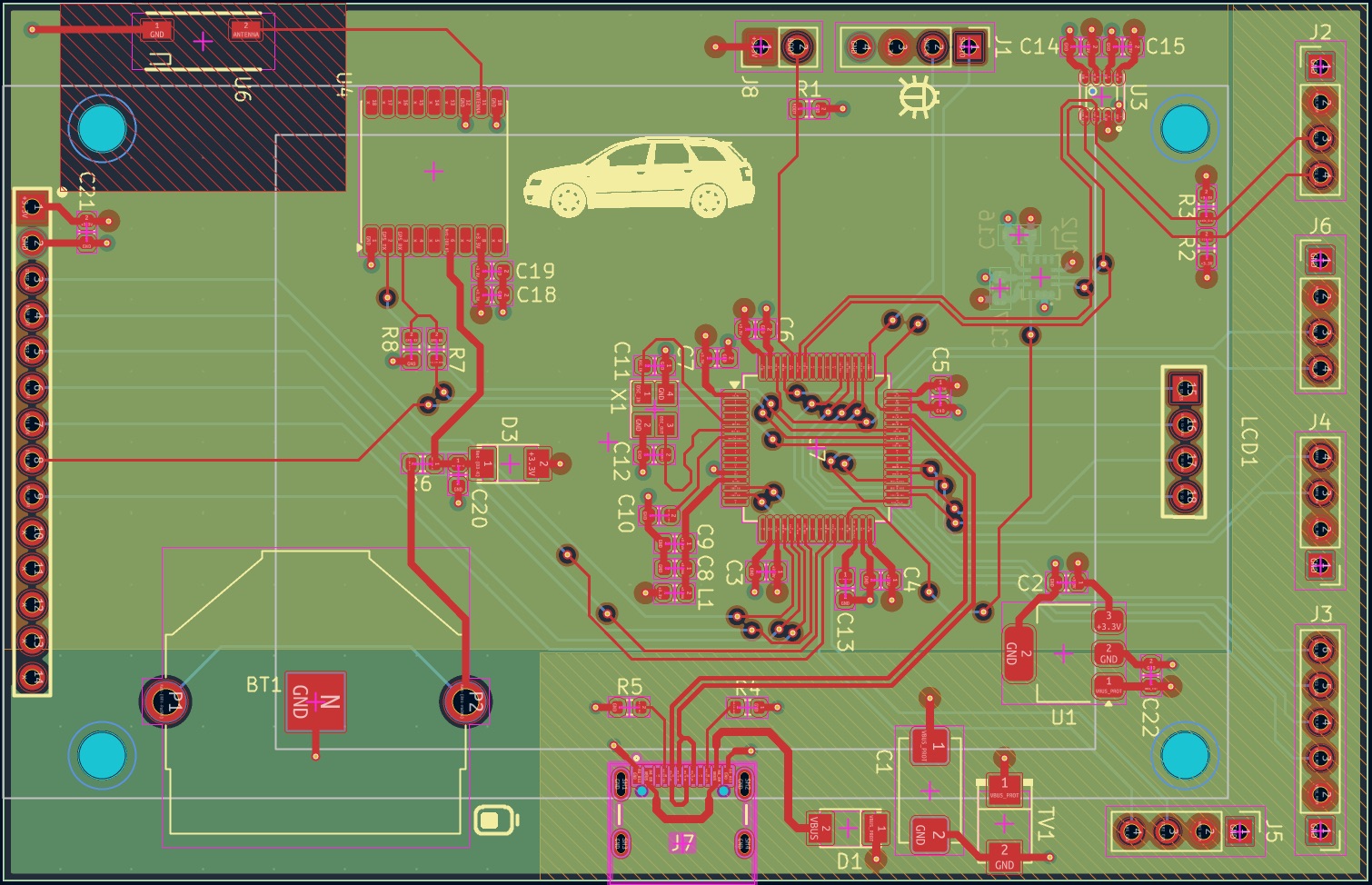
4 layers80.5 × 50 mm

 andreiii04/in-car-dashboard
Custom STM32 in-car telemetry display: G-meter, GPS speed and cabin weather on a 2.8" TFT, with each drive logged to SD.
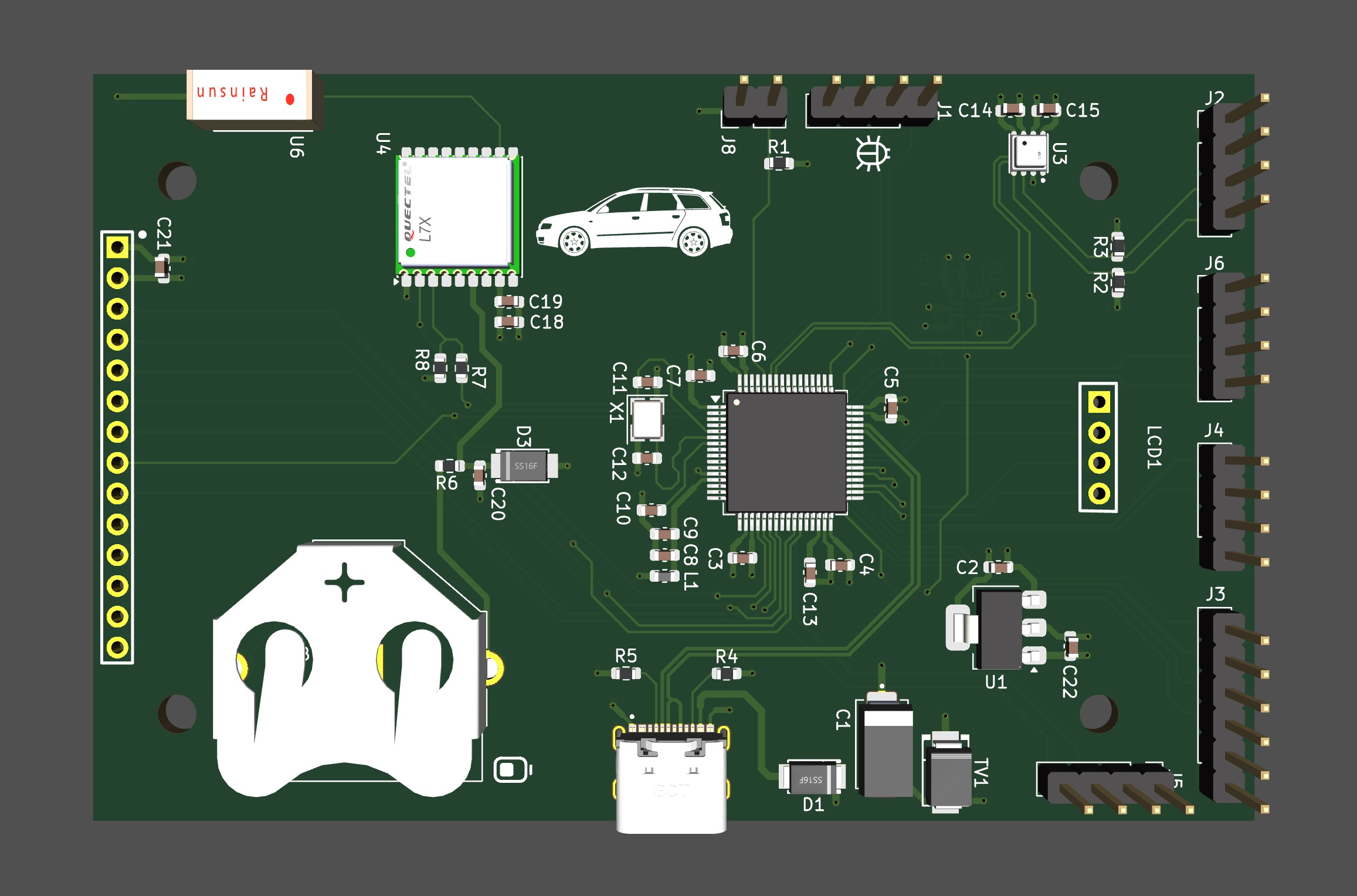
In car dashboard is an open-source printed circuit board by andreiii04, from the andreiii04/in-car-dashboard repository on GitHub, published under the MIT licence. It is a 4-layer board of 61.6 × 95.8 mm with 51 parts on 84 nets, routed with 584 tracks and 88 vias.
It is built around the L76L-M33, BME680 and PMEG10020AELP, with the PMEG3050EP and SMBJ5.0A among its other parts. Its parts include 22 capacitors, 8 resistors, 8 connectors, 6 ICs and 2 diodes. It belongs with the radio and wireless and sensors and measurement boards and the STM32 boards of this library.


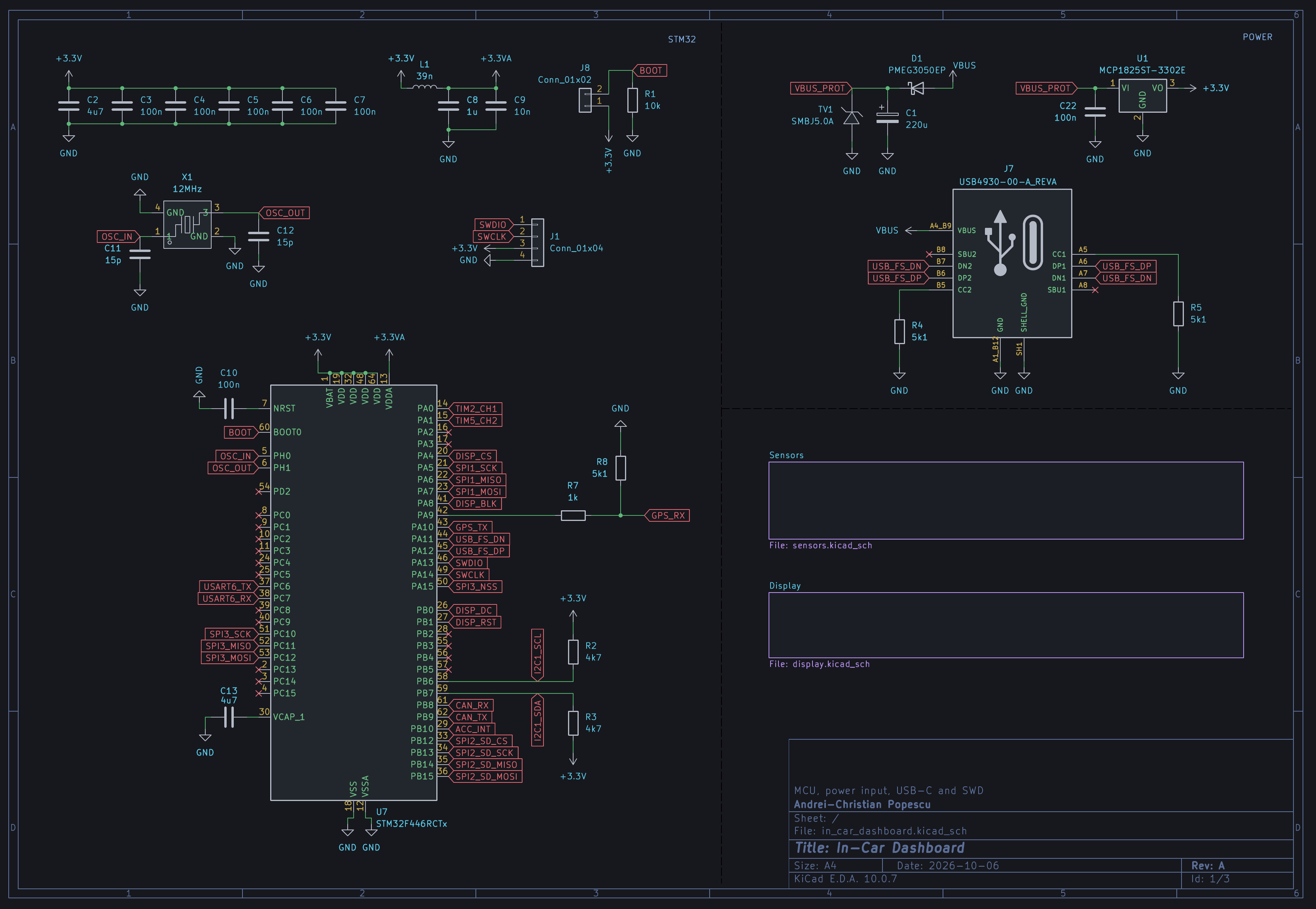
A standalone telemetry display for a car: a custom 4-layer STM32 board with a 2.8" TFT, a 6-axis IMU, an environmental sensor and a GPS module. It powers from the car's 12 V socket through an ordinary USB-C car charger, starts a fresh session on every power-on with no buttons, shows live driving numbers, and writes a summary of each drive to an SD card.
Live, on the screen
Per drive, on the SD card — one file, SESSIONS.JSON, a single valid JSON document with one fixed-size block per drive:
faults section with every init result and error counter, so a drive that went wrong says so in its own recordThe record is rewritten in place every 10 s, because the car cuts power without warning. A cut can only ever damage the current drive's block, and the two writes that move the closing bracket are ordered so an interrupted one repairs itself on the next boot.
| Part | Role | Interface |
|---|---|---|
| STMicroelectronics STM32F446RCT6 | Cortex-M4F MCU, 180 MHz, 256 KB flash, 128 KB RAM | — |
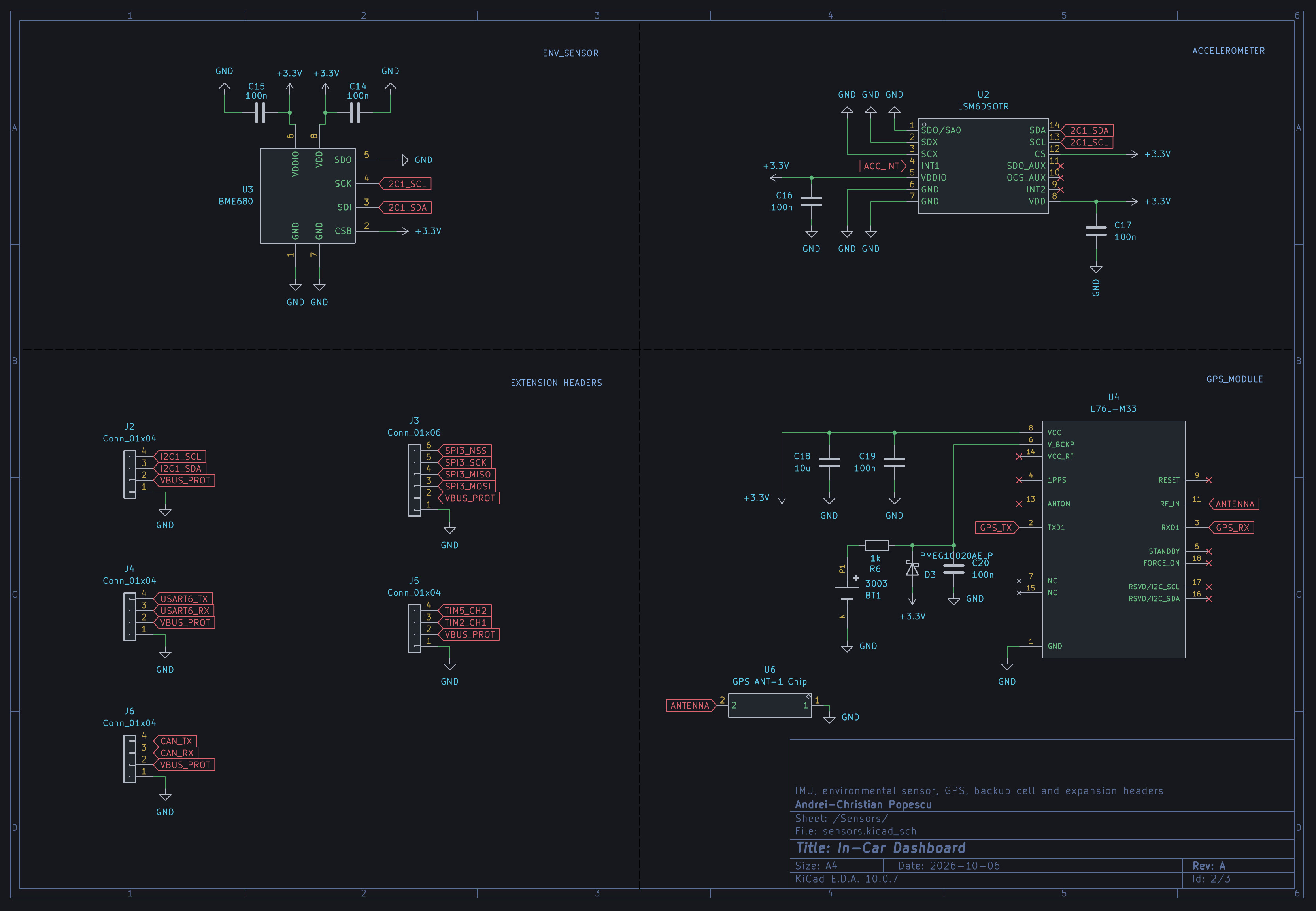
| STMicroelectronics LSM6DSOTR | 6-axis accelerometer + gyroscope | I2C1, data-ready on INT1 |
| Bosch Sensortec BME680 | Temperature, pressure, humidity, gas; air quality through Bosch BSEC | I2C1 |
| Quectel L76L-M33 | GPS + GLONASS receiver, 5 Hz NMEA (1 Hz fallback) | USART1, 115200 baud (boots at 9600) |
| GPS ANT-1 chip antenna | Passive GNSS antenna | RF_IN |
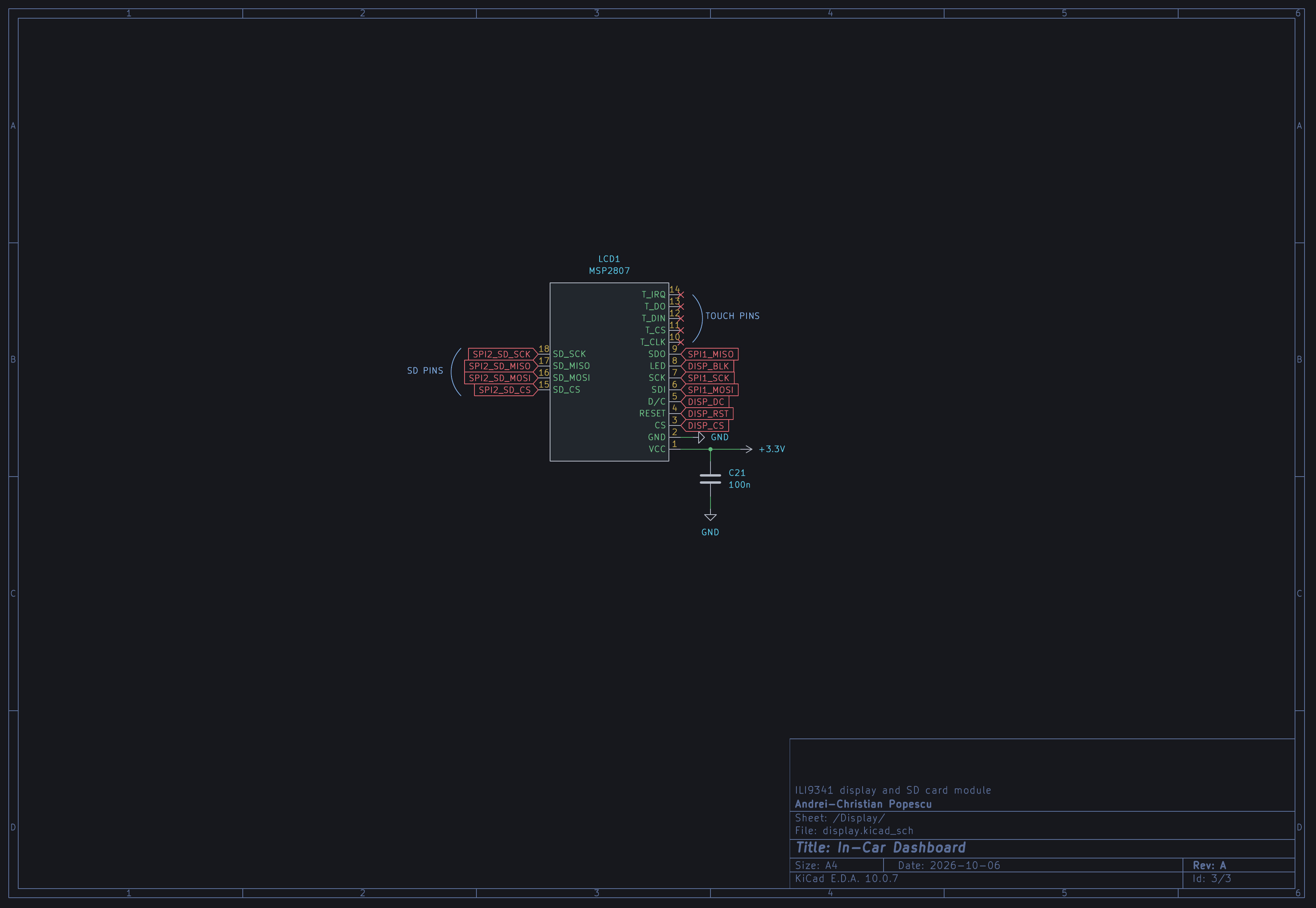
| KMRTM28028-SPI / MSP2807 | 2.8" 320×240 TFT, ILI9341 driver, full-size SD socket | SPI1 (display), SPI2 (SD) |
| Microchip MCP1825ST-3302E | 3.3 V LDO | — |
| GCT USB4930-00-A | USB-C: power, and a USB CDC debug console | USB OTG FS |
| Keystone 3003 | Coin-cell holder for the GPS backup supply | V_BCKP |
Protection on the 5 V input: a series Schottky against reverse polarity, a TVS diode and a 220 µF tantalum bulk capacitor. Five expansion headers (I2C, SPI3/I2S3, USART6, CAN1, two 32-bit timer channels) carry the protected 5 V rail for future add-on boards. Flashing and debugging go through a 4-pin SWD header with an ST-Link.
docs/bom.csv, with manufacturer part numbers.
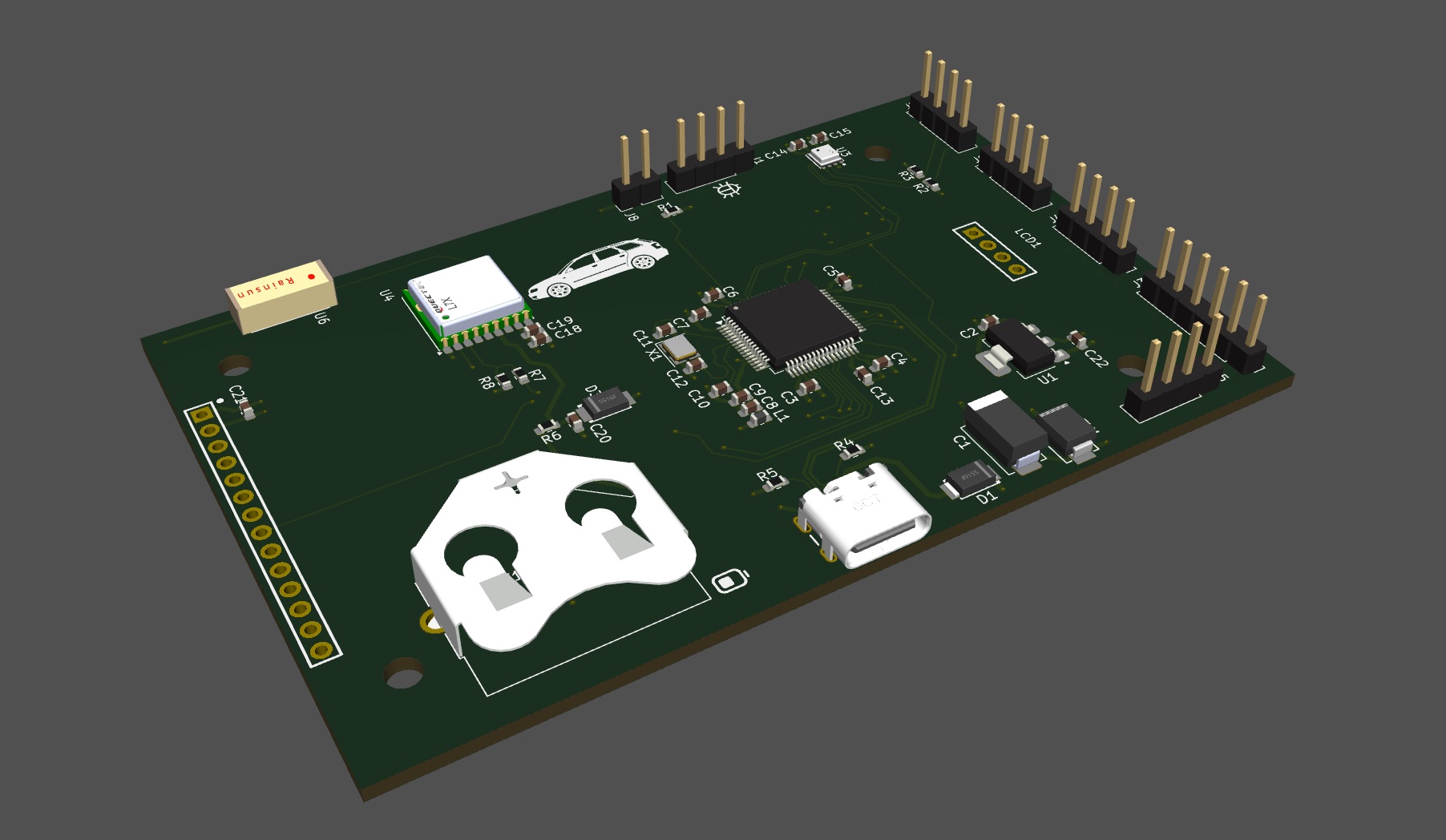
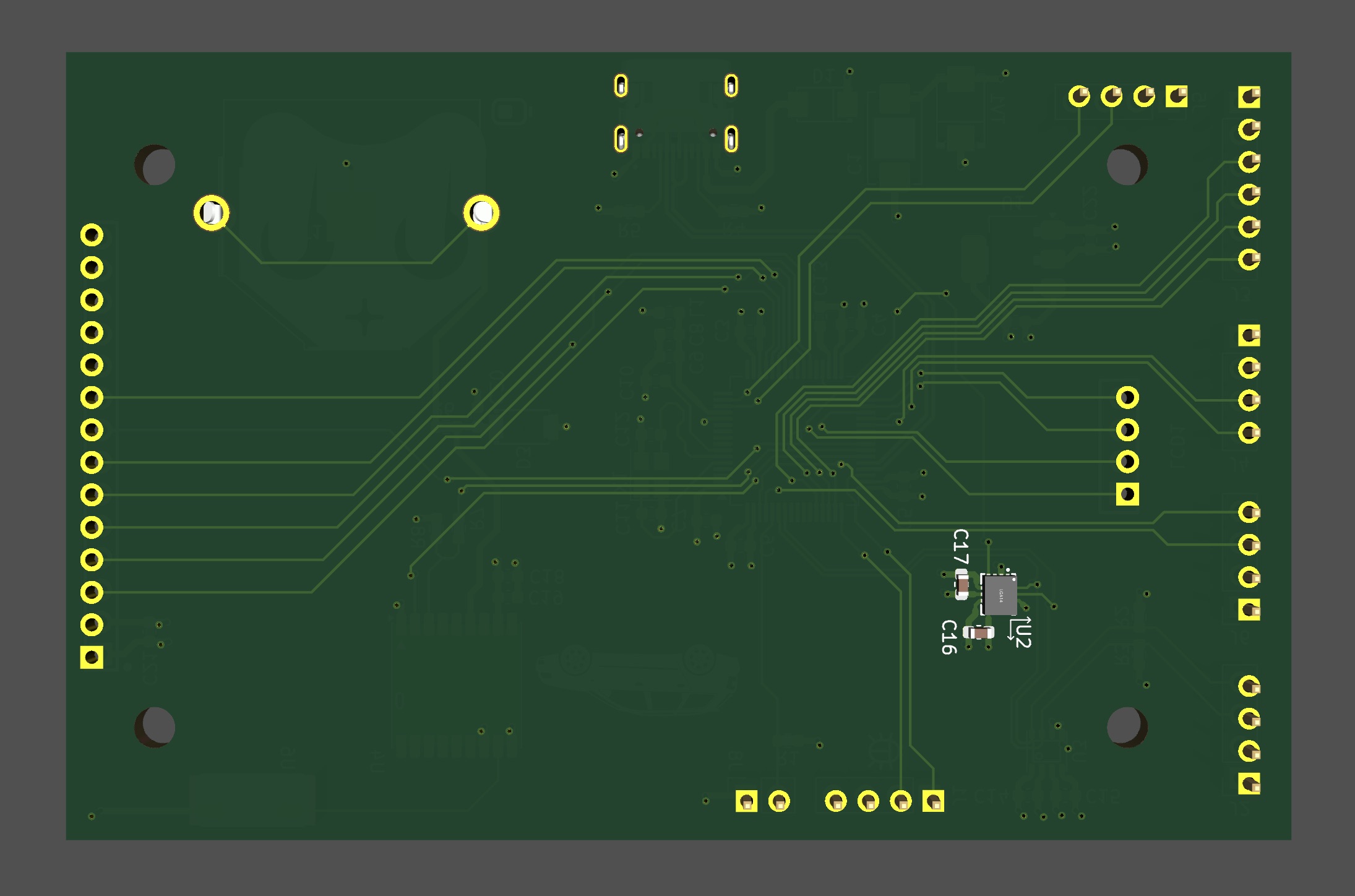
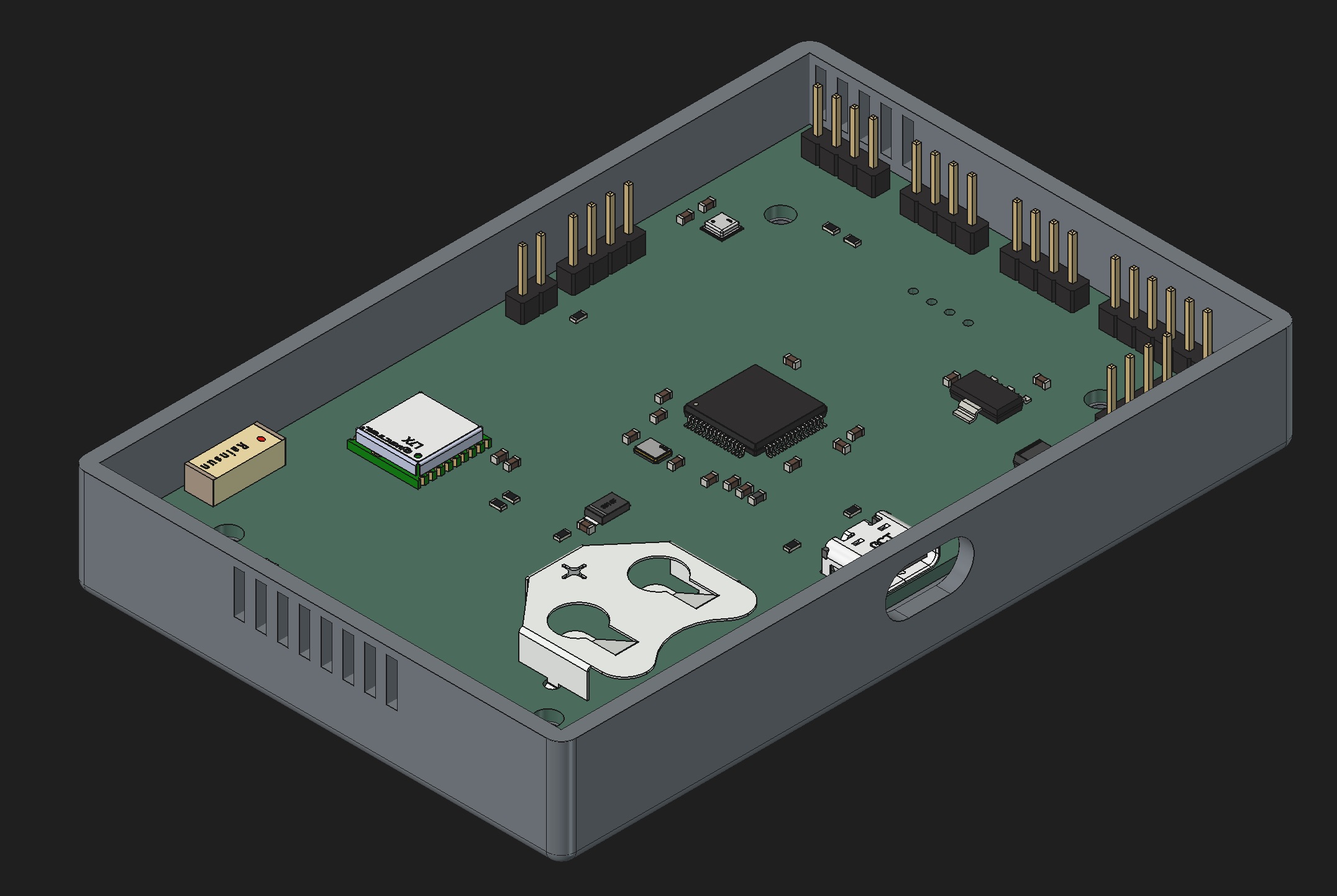
Display mounting. The display module is not soldered to the board and does not appear in the renders: female 2.54 mm sockets are soldered into all 18 LCD1 positions (the 14-pin display and touch row and the 4-pin SD row), and male headers on the module's own PCB plug into them, so the screen stacks face-up on top of the main board and can be lifted off. The board's four M3 holes match the module's 44 × 76.08 mm hole pattern, so one set of screws through the lid clamps the display, printed spacer tubes and board together (see Case).
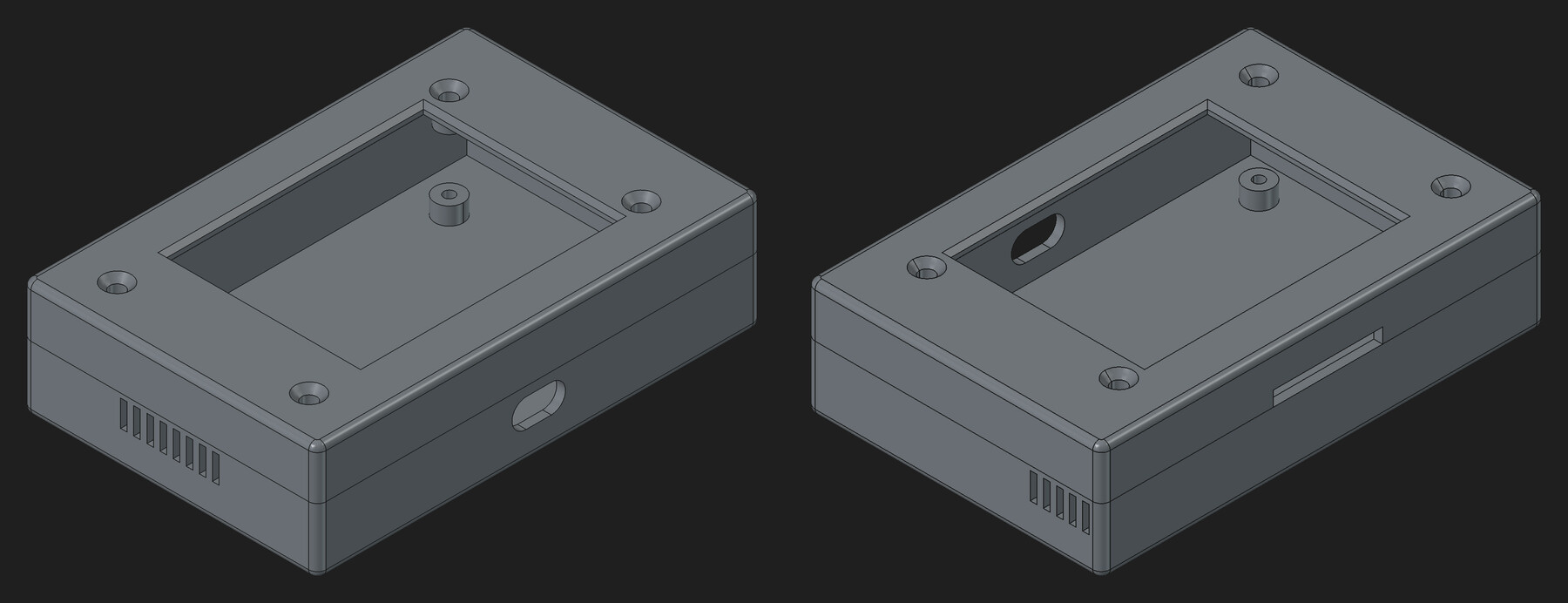
A two-part 3D-printed enclosure. The bottom tray holds the board on four bosses, with the USB-C opening on one side, intake vents at the BME680 end and exhaust vents at the far end. The lid carries the display window and a notch for the SD card. Four printed spacer tubes sit between the board and the display, and four countersunk self-tapping screws clamp the whole stack from the lid down into the bosses, so the only visible fasteners are flush in the lid. The lid stays clear of the lifted GPS antenna. The tray is printed and test-fitted; the lid and spacers are modelled but not printed yet.
Sources (FreeCAD 1.1): bottom_tray.FCStd, top_case.FCStd, spacer_tube.FCStd, with a STEP export of each next to it for other CAD tools. Dimensions, load path and print settings are in docs/dash_case.md.
0xFF. The firmware treats the ID check as advisory; writes work normally.C on STM32 HAL (CubeMX-generated init) and FreeRTOS through CMSIS-RTOS2, built with CMake and arm-none-eabi-gcc.
A boot task runs the whole init, then starts one task per job and ends. From highest priority to lowest:
Each task publishes what it knows into one shared snapshot behind a mutex, and the display, console and logger read copies of it. A card write can take up to 250 ms; with the logger at the bottom, it no longer delays a single IMU sample.
| Stack | Modules |
|---|---|
| Sensors | i2c_bus → vendor drivers (ST lsm6dso, Bosch BME68x) → platform glue → imu, env; air (Bosch BSEC: IAQ, eCO2, breath VOC, heat-compensated temperature and humidity) |
| GPS | uart_bus (interrupt-driven ring buffer, baud switched at runtime) → nmea (parser and PMTK command builder) → gps |
| Fusion and statistics | attitude (complementary filter, full Euler kinematics, mount rotation), trip (distance, peaks, lean, rollover margins, GPS-dropout coasting), elevation (GPS altitude fused with barometric pressure) |
| Display | lcd (ILI9341 over SPI) → gfx (band renderer, dirty rectangles) → screen |
| Storage | sd_spi (SD SPI mode, CRC on every command and block) → FatFs → session_record → session_log; air_slot → air_store (BSEC's learned state in BSEC.BIN, two CRC-checked slots written in turn) |
| Console | usb_serial (printf over USB CDC) → console |
| RTOS | app_tasks (boot sequence and task loops), app_state (shared snapshot, queues, I2C mutex), watchdog (per-task check-ins) |
Everything with no hardware in it is host-testable and tested on a PC, 300 checks across eight modules: nmea, attitude, trip, elevation, gfx, sd_crc, session_record, air_slot. Expected values come from independent derivations rather than restatements of the code under test. Car- and mount-specific constants (axis map, calibration, wheelbase, track, centre-of-gravity height) live in one header, firmware/App/fusion/vehicle_axes.h, explained in docs/vehicle_info.md.
Some decisions worth knowing before changing anything:
The reasoning behind these and most other choices, written down while I learned embedded from scratch, is in docs/notes.md; code comments that say "see docs/notes.md" point there.
firmware/            STM32 firmware (CMake, CubeMX project dashboard_firmware.ioc)
  App/               hand-written code, one folder per subsystem:
    sensors/         I2C bus, LSM6DSO and BME680
    gps/             UART ring, NMEA parser, GPS module
    fusion/          pitch/roll, trip stats, elevation, the car's constants
    display/         ILI9341 driver, band renderer, screen layout
    storage/         SD card over SPI, session record and log
    console/         USB serial console
    rtos/            FreeRTOS tasks, shared state, watchdog
    drivers/         vendor sensor drivers (ST, Bosch), unmodified; BSEC goes in drivers/bsec/
    fonts/           generated bitmap fonts
  Core/ Drivers/ FATFS/ Middlewares/ USB_DEVICE/   CubeMX- and ST-generated
  tests/             host tests, each file carries its own compile line
  tools/             font generator
hardware/
  pcb/               KiCad 10 project in_car_dashboard
  libraries/         custom symbols, footprints and 3D models used by the board
  case/              FreeCAD sources and STEP exports of the tray, lid and spacer tubes
docs/                case design note, the car's numbers and what each one is used for, my notes
from building it, schematic and board pictures, renders, BOMRequirements: CMake ≥ 3.22, Ninja, and arm-none-eabi-gcc on the PATH (STM32CubeCLT provides all three).
cd firmware
cmake --preset Debug
cmake --build build/Debug
The output is build/Debug/dashboard_firmware.elf.
Air quality needs Bosch's BSEC2 library, which is not in this repository (it is closed source under Bosch's licence). Without it the firmware still builds and runs: the BME680 gives raw temperature, humidity, pressure and gas resistance, and the IAQ field stays empty. To add it, download BSEC2 2.6.1.0 from Bosch Sensortec's BSEC page (a licence click-through), unzip it and copy the whole package to firmware/App/drivers/bsec/, so that firmware/App/drivers/bsec/algo/bsec_IAQ/bin/gcc/Cortex_M4F/libalgobsec.a exists. CMake finds it on the next configure (BSEC found - air quality on) and links the Cortex-M4F hard-float build with the bme680_iaq_33v_3s_4d config. The folder is in .gitignore.
Flash it over SWD with an ST-Link: from an IDE (CLion with the STM32 plugin, or STM32CubeIDE), or with STM32CubeProgrammer. Without a probe, the chip's own USB bootloader works over the same USB-C cable: hold BOOT0 high while plugging in, then
cd firmware
arm-none-eabi-objcopy -O binary build/Debug/dashboard_firmware.elf firmware.bin
dfu-util -l
dfu-util -a 0 -s 0x08000000:leave -D firmware.bin
dfu-util -l should list @Internal Flash. The serial console is the USB-C port itself, at /dev/cu.usbmodem* on macOS; the baud rate is ignored.
Host tests build with any C11 compiler. For example:
cd firmware
cc -std=c11 -Wall -Wextra -I App/fusion -I App/gps tests/test_trip.c App/fusion/trip.c -lm -o /tmp/test_trip && /tmp/test_trip
Each file in tests/ has its own line in its header.
hardware/pcb/in_car_dashboard.kicad_pro in KiCad 10. The project's symbol and footprint paths are relative to the project, so the custom parts in hardware/libraries/ resolve on any machine; everything else comes from KiCad's standard libraries. The 3D models of the custom parts are not included, since they come from third parties: the board opens, checks and exports normally, and those parts just show without a body in the 3D viewer. To get them back, download the STEP models from the manufacturers and put each in hardware/libraries/<library>/<library>.3dshapes/ under the file name its footprint asks for..FCStd files in hardware/case/ in FreeCAD 1.1, or the .step files in any CAD tool. The tray prints floor down, the lid top face down and the spacer tubes upright, all without supports.Not included in the repository; all are available from the manufacturers:
Working on the bench and in the car. Bring-up is complete: console, sensors, calibration, GPS, attitude, interrupt-paced sampling, display, SD logging, the main loop, its move onto FreeRTOS, and air quality through Bosch's BSEC. The first long drive, 118.5 km, matched the route distance and ran with every fault counter at zero.
Still to do:
The hardware design, case, firmware and documentation in this repository are released under the MIT License.
The custom symbols and footprints in hardware/libraries/ were drawn from, or adapted from, manufacturer and EasyEDA / SnapEDA sources; their 3D models are not redistributed here.
Third-party code keeps its own licence:
firmware/Drivers/CMSIS/LICENSE.txtfirmware/Drivers/STM32F4xx_HAL_Driver/LICENSE.txtfirmware/Middlewares/ST/STM32_USB_Device_Library/LICENSE.txtlsm6dso-pid repository| Qty | Value | Footprint | References |
|---|---|---|---|
| 14 | 100n | Capacitor_SMD:C_0603_1608Metric | C3, C4, C5, C6, C7, C10, C14, C15, C16, C17, C19, C20, C21, C22 |
| 5 | Conn_01x04 | Connector_PinHeader_2.54mm:PinHeader_1x04_P2.54mm_Vertical | J1, J2, J4, J5, J6 |
| 3 | 5k1 | Resistor_SMD:R_0603_1608Metric | R4, R5, R8 |
| 2 | 15p | Capacitor_SMD:C_0603_1608Metric | C11, C12 |
| 2 | 1k | Resistor_SMD:R_0603_1608Metric | R6, R7 |
| 2 | 4k7 | Resistor_SMD:R_0603_1608Metric | R2, R3 |
| 2 | 4u7 | Capacitor_SMD:C_0603_1608Metric | C2, C13 |
| 1 | 10k | Resistor_SMD:R_0603_1608Metric | R1 |
| 1 | 10n | Capacitor_SMD:C_0603_1608Metric | C9 |
| 1 | 10u | Capacitor_SMD:C_0603_1608Metric | C18 |
| 1 | 12MHz | Crystal:Crystal_SMD_Abracon_ABM8AIG-4Pin_3.2x2.5mm | X1 |
| 1 | 1u | Capacitor_SMD:C_0603_1608Metric | C8 |
| 1 | 220u | supply_cap:220u_tantalum_cap | C1 |
| 1 | 3003 | battery_holder:BAT_3003 | BT1 |
| 1 | 39n | Inductor_SMD:L_0603_1608Metric | L1 |
| 1 | BME680 | env_sensor:LGA-8_L3.0-W3.0-P0.80-TR | U3 |
| 1 | Conn_01x02 | Connector_PinHeader_2.54mm:PinHeader_1x02_P2.54mm_Vertical | J8 |
| 1 | Conn_01x06 | Connector_PinHeader_2.54mm:PinHeader_1x06_P2.54mm_Vertical | J3 |
| 1 | GPS ANT-1 Chip | gps_antenna:GPS_ANT-1_Chip_SMD | U6 |
| 1 | L76L-M33 | RF_GPS:Quectel_L76 | U4 |
| 1 | LSM6DSOTR | accelerometer_gyro:LGA-14_L3.0-W2.5-P0.50-TL | U2 |
| 1 | MCP1825ST-3302E | Package_TO_SOT_SMD:SOT-223-3_TabPin2 | U1 |
| 1 | MSP2807 | ili9341_display:ILI9341_display | LCD1 |
| 1 | PMEG10020AELP | charge_schottky:SMAF_L3.8-W2.5-LS4.7-RD | D3 |
| 1 | PMEG3050EP | supply_schottky:SMAF_L3.8-W2.5-LS4.7-RD | D1 |
| 1 | SMBJ5.0A | tvs_diode:SMB_L4.6-W3.6-LS5.3-RD | TV1 |
| 1 | STM32F446RCTx | Package_QFP:LQFP-64_10x10mm_P0.5mm | U7 |
| 1 | USB4930-00-A_REVA | usb_c:GCT_USB4930-00-A_REVA | J7 |

rolandvs/ais_transponder
A real, functioning low-power AIS transponder (class B)

bartkepl/CanGnssNode
Polowy węzeł pozycyjny z modułem GNSS Quectel L76-L (GPS/GLONASS/Galileo/QZSS) i czujnikiem orientacji (akcelerometr + magnetometr), komunikujący się cyfrowo przez CAN 2.0B.


SpaceTeam/uHoubolt_PCB_LiIon_Charger
Small sized PCB (19mm x 20mm). Used to control and monitor the charging process of a connected LiIon Battery.


GryphonRacingFSAE/GRC22
Repository for all firmware and related software on our 2022-2024 car

OLIMEX/ESP32-POE-ISO
ESP32 Power Over Ethernet board with 3000VDC Galvanic insulation
It measures 61.6 × 95.8 mm and has 4 copper layers, 1.6 mm thick.
51 parts, built around the L76L-M33, BME680, PMEG10020AELP and PMEG3050EP. The full list of its parts is on this page, with links to each part's symbol and footprint where PCBKit's library has them.
From the andreiii04/in-car-dashboard repository on GitHub, at the commit this page was made from: the board is hardware/pcb/in_car_dashboard.kicad_pcb and its schematic hardware/pcb/display.kicad_sch. PCBKit opens the board in the browser, with nothing to install.
Its repository publishes it under the MIT licence: you may reuse it on that licence's terms (keep the author's notice, and for a copyleft licence share your changes alike).