Skip to the content
PCBKitNew board
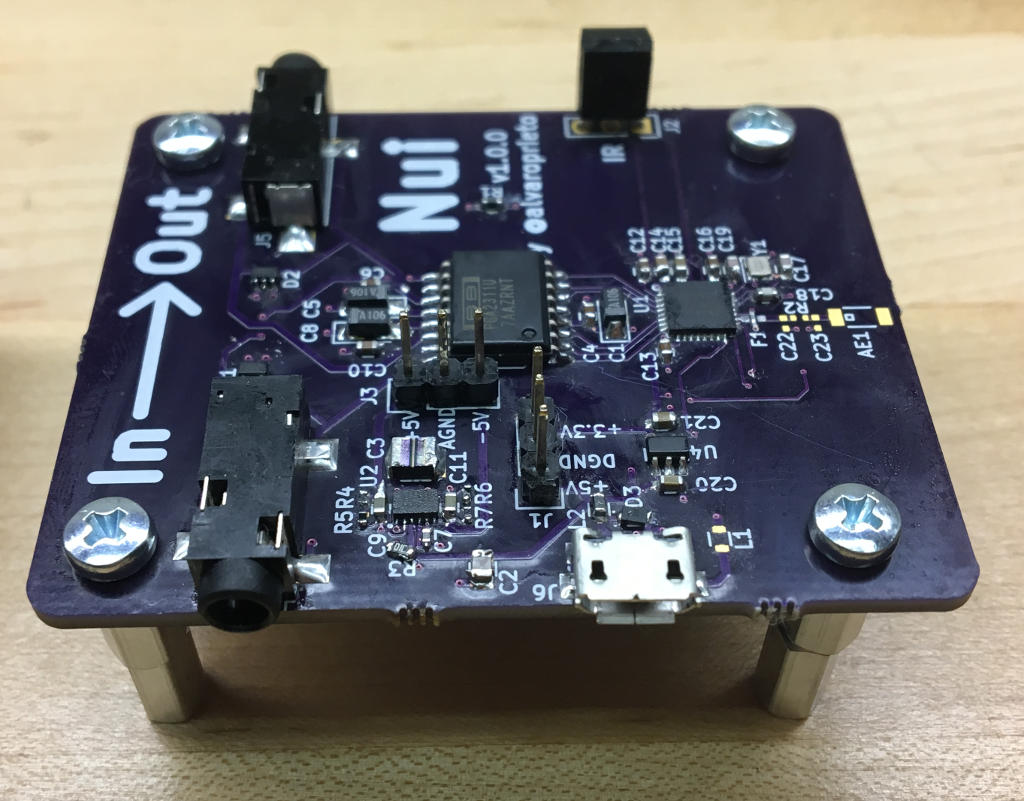
2 layers50.8 × 61 mmNui, the printed circuit board in 3D

Nui is an IR(evntually also BLE) controlled volume controller for analog audio. It sits between your audio source and speakers and can amplify or reduce the volume using IR commands (and evntually BLE).
Size
50.8 × 61 mm
Copper layers
2
Thickness
1.6 mm
Parts
53
Nets
57
Pads
208
Tracks, vias
400, 62
Pours
2
Routed
Yes
KiCad
KiCad 4
Created
2 Jan 2018
Updated
7 Apr 2018

Overview

Nui is an open-source printed circuit board by alvarop, from the alvarop/nui repository on GitHub, published under the MIT licence. It is a 2-layer board of 50.8 × 61 mm with 53 parts on 57 nets, routed with 400 tracks and 62 vias.

It is built around the NRF52810-QCAA-R, 2450FM07A0029T and PGA2311P, with the LM27762DSS and SP1002-02JTG among its other parts. Its parts include 23 capacitors, 7 resistors, 7 connectors, 4 ICs and 3 diodes. It belongs with the nRF52 and nRF5x boards of this library.

Main components

5

README

README.md

Nui

Overview

Nui is an IR(evntually also BLE) controlled volume controller for analog audio. It sits between your audio source and speakers and can amplify or reduce the volume using IR commands (and evntually BLE).

Nui v1.0

Why do I need this, you may ask?

It all started because I have my trusty Logitech Z-2300 speakers and subwoofer I purchased back arond 2004/5. They still work great, but instead of being on my computer, they are used for my TV. Unfortunately, the TV's line out doesn't honor the TV's volume and is always outputting at max volume. Sure, I can get up and change the volume on the speakers themselves, but wouldn't it be more convenient to do it with the TV remote?!

That's how the Nui project started. It sits between my TV and my speakers and now I don't have to get up to change the volume :D

Version 0.0.1 (Teensy version)

Hardware

  • The board files can be found here

Firmware

  • The arduino/teensy code can be found here

Version 1.0.0 (NRF52 version)

Hardware

  • The board files can be found here

Firmware

  • The NRF52 code can be found here

Parts

53
QtyValueFootprintReferences
30.1uFCapacitors_SMD:C_0603C12, C13, C16
3100nFCapacitors_SMD:C_0603C4, C6, C10
310uFCapacitors_Tantalum_SMD:CP_Tantalum_Case-A_EIA-3216-18_ReflowC1, C5, C8
31uFCapacitors_SMD:C_0603C15, C20, C21
212pfCapacitors_SMD:C_0603C17, C19
22.2uFCapacitors_SMD:C_0603C9, C11
2DNPCapacitors_SMD:C_0402_NoSilkC22, C23
2FilterResistors_SMD:R_0603L1, L2
2SP1002-02JTGalvarop:SP1002-02JTGD1, D2
10Capacitors_SMD:C_0603R1
10Resistors_SMD:R_0402_NoSilkR2
11.58MResistors_SMD:R_0402_NoSilkR7
11.74MResistors_SMD:R_0402_NoSilkR4
1100pfCapacitors_SMD:C_0603C18
110kResistors_SMD:R_0402_NoSilkR3
11uFCapacitors_SMD:C_1210C3
12.2uFCapacitors_SMD:C_0402_NoSilkC7
12450FM07A0029Talvarop:2450FM07A0029TF1
132MhzCrystals:Crystal_SMD_2016-4pin_2.0x1.6mmY1
14.7uFCapacitors_SMD:C_0805C2
14.7uFCapacitors_SMD:C_0603C14
1511kResistors_SMD:R_0402_NoSilkR6
1549kResistors_SMD:R_0402_NoSilkR5
1ARM-SWDalvarop:ARM_SWD_SMDJ7
1A_PWRPin_Headers:Pin_Header_Straight_1x03J3
1Antennaalvarop:AMCA31-2R450G-S1F-T3AE1
1D_PWRPin_Headers:Pin_Header_Straight_1x03J1
1IR_RCVPin_Headers:Pin_Header_Straight_1x03J2
1Inputalvarop:SJ-3524-SMT-TRJ4
1LM27762alvarop:LM27762U2
1MIC550Xalvarop:SOT-23(M5)U4
1NRF52810-QCAAalvarop:NRF52810_QCAA_QFN32U1
1Outputalvarop:SJ-3524-SMT-TRJ5
1PGA2311alvarop:PGA2311-SOICU3
1TVSDiodes_SMD:D_0603D3
1USB_OTGalvarop:USB_MICRO_BJ6

The 49 most common of 53 parts.

Questions

How big is the Nui PCB?

It measures 50.8 × 61 mm and has 2 copper layers, 1.6 mm thick.

What parts does the Nui use?

53 parts, built around the NRF52810-QCAA-R, 2450FM07A0029T, PGA2311P and LM27762DSS. The full list of its parts is on this page, with links to each part's symbol and footprint where PCBKit's library has them.

Where can I download the Nui KiCad files?

From the alvarop/nui repository on GitHub, at the commit this page was made from: the board is hw/nui.kicad_pcb. PCBKit opens the board in the browser, with nothing to install.

Can I use the Nui design in my own project?

Its repository publishes it under the MIT licence: you may reuse it on that licence's terms (keep the author's notice, and for a copyleft licence share your changes alike).

Similar boards

  • 2 layers55.9 × 36.8 mmCANT, the printed circuit board in 3D

    CANT

    bitbane/CANT

    The CANT project is designed to allow people to screw around with CAN easily at layers 1/2. All of the stuff that is normally handled by a CAN controller that is baked into sillicon is up for grabs.

    15 parts51BSD-3-Clause
  • 2 layersController, the printed circuit board in 3D

    Controller

    alvarop/ostur

    This is a work in progress for a cheese cave controller system. The goal is to be able to control a mini fridge to get the right conditions for cheesemaking.

    89 parts8MIT
  • 2 layers28 × 25 mmDI2C Endpoint, the printed circuit board in 3D

    DI2C Endpoint

    PereiraO28/Differential-I2C-Endpoint-Board

    Converts a standard I2C signal into a Differential I2C signal. This improves signal integrity over long distances while using the same hardware as I2C.

    33 partsCERN-OHL-P-2.0
  • 2 layers70 × 100 mmLED driver, the printed circuit board in 3D

    LED driver

    formicidae-tracker/hardware

    Hardware repository for the FORT system

    118 parts1
  • 4 layersTrackball ball, the printed circuit board in 3D

    Trackball ball

    ntindle/trackball

    Ultimate Mouse: fully custom trackball with a free-spinning active ball (capacitive touch ring, nRF52810, inductive charging) and a dual-PMW3360 base (nRF52840, USB-C, HID + custom driver). No mechanical wheel.

    92 parts1
  • 2 layers77.5 × 38 mmAir Conditioner Energy Saver V2, the printed circuit board in 3D

    Air Conditioner Energy Saver V2

    tomrodinger/air_conditioner_energy_saver

    This are all the open sources for a device that automatically controls your AC unit to turn it on or off

    66 parts
  • 4 layers190 × 135 mmAudio DSP, the printed circuit board in 3D

    Audio DSP

    HeinVerhallen/Audio-DSP

    545 parts