4 layers100 × 100 mm
Fsr array
Aightech/e-skin
A bioinspired electronic skin system for robotic applications, combining FSR (force-sensing resistor) arrays and accelerometer arrays.
94 parts2GPL-3.0
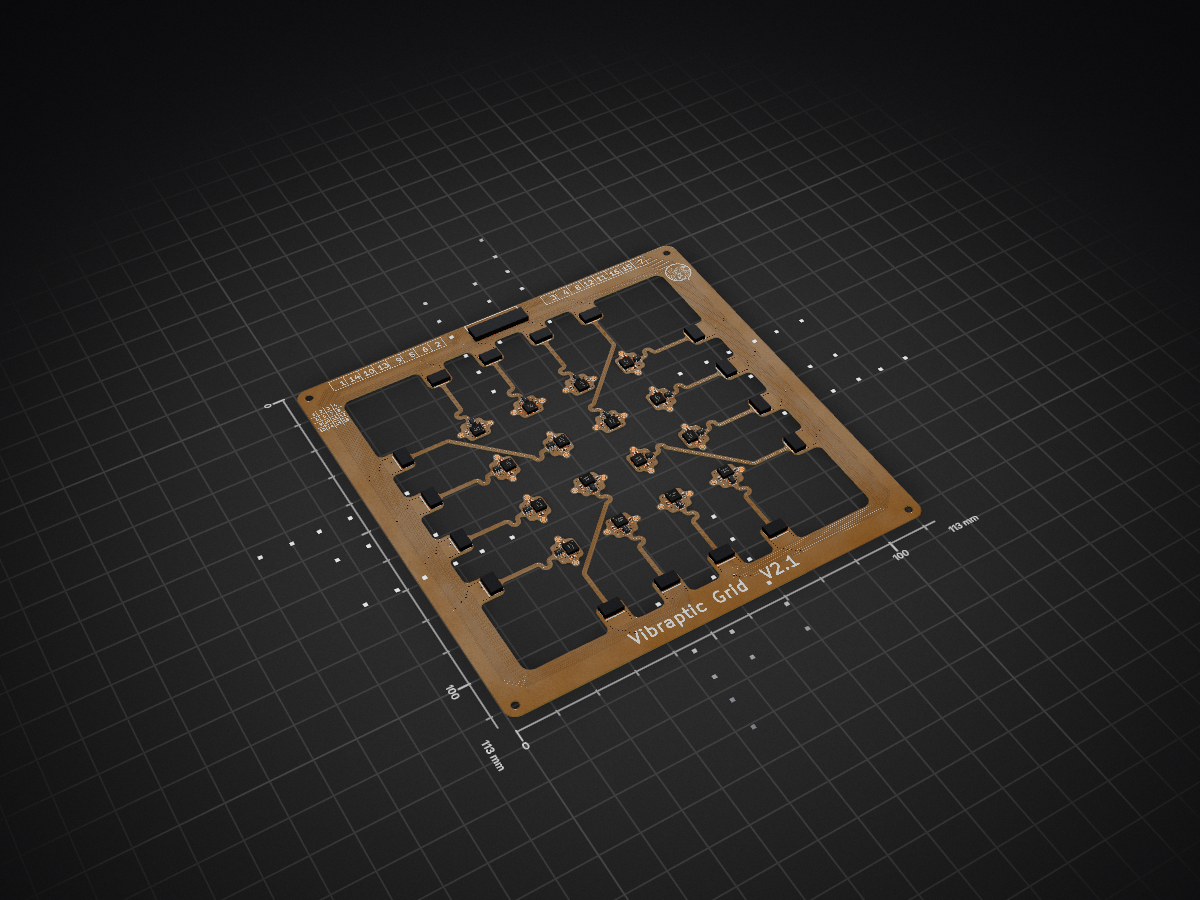
 Aightech/e-skin2
A bioinspired electronic skin system for robotic applications, combining FSR (force-sensing resistor) arrays and accelerometer arrays.
LIS3DH array is an open-source printed circuit board by Aightech, from the Aightech/e-skin repository on GitHub, published under the GPL-3.0 licence. It is a 2-layer board of 113 × 113 mm with 146 parts on 150 nets, routed with 2,354 tracks and 447 vias.
It is built around the LIS3DH, SN74LVC1G32DCKR(AT) and HC-FPC-05-09-6RLTAG, with the AFC01-S22FCA-00 among its other parts. Its parts include 32 capacitors and 32 ICs.


A bioinspired electronic skin system for robotic applications, combining FSR (force-sensing resistor) arrays and accelerometer arrays.
The electronic board uses two multiplexers and two 16-channel ADCs to read the FSRs. The multiplexers select the row or column of the FSR array, while the ADCs read the sensor values. A Teensy 4.1 controls the multiplexers and ADCs and sends data to the computer via USB or Ethernet.
Operation modes:
Sampling rate: ~400 KHz/channel (1562.5 Hz for a 16x16 array)
e-skin/
├── host/           # C++/Qt host application
│   ├── src/        # Source code (main.cpp)
│   └── lib/        # Git submodules (com_client, built_lsl)
├── src/            # Teensy firmware
│   └── Eskin/      # Main production firmware
├── models/         # KiCAD PCB designs
│   ├── KiCAD/              # Main control board (MUX + ADC)
│   ├── customSquare16x16/  # 16x16 FSR array
│   ├── customSquare8x8/    # 8x8 FSR array
│   ├── LIS2DH_array/       # LIS2DH accelerometer array
│   ├── KX134_array/        # KX134 accelerometer array
│   └── inskinacc/          # In-skin accelerometer
└── script/ # Python/MATLAB data acquisition scriptspip install -r script/requirements.txtcd host
mkdir build && cd build
cmake .. && make
./FSR_array -h # Show usageUpload src/Eskin/Eskin.ino to Teensy 4.1 using Arduino IDE or PlatformIO.
/dev/ttyACM0 (Linux) or COMx (Windows)pip install -r script/requirements.txt
python script/record.py <port> <array_size>
# Example: python script/record.py /dev/ttyACM0 16Initialize submodules:
git submodule update --init --recursiveSee main.cpp for an example of how to use the communication library.
See CONTRIBUTING.md for details on our code of conduct and the process for submitting pull requests.
| Qty | Value | Footprint | References |
|---|---|---|---|
| 64 | TestPoint | TestPoint:TestPoint_Pad_D1.0mm | TP1, TP2, TP10, TP11, TP12, TP13, TP14, TP15, TP16, TP17, TP18, TP19, TP20, TP21, TP22, TP23 +48 |
| 16 | 100n | Capacitor_SMD:C_0402_1005Metric_Pad0.74x0.62mm_HandSolder | C1, C3, C5, C7, C9, C11, C13, C15, C17, C19, C21, C23, C25, C27, C29, C31 |
| 16 | 1u | Capacitor_SMD:C_0402_1005Metric_Pad0.74x0.62mm_HandSolder | C2, C4, C6, C8, C10, C12, C14, C16, C18, C20, C22, C24, C26, C28, C30, C32 |
| 16 | HC-FPC-05-09-6RLTAG | 00_lcsc:FPC-SMD_6P-P0.50_HC-FPC-05-09-6RLTAG | FPC1, FPC2, FPC3, FPC4, FPC5, FPC6, FPC7, FPC8, FPC9, FPC10, FPC11, FPC12, FPC13, FPC14, FPC15, FPC16 |
| 16 | LIS3DH | 00_custom-footprints:LGA-16_3x3mm_P0.5mm_LayoutBorder3x5y | U1, U2, U3, U4, U5, U6, U7, U8, U9, U10, U11, U12, U13, U14, U15, U16 |
| 16 | SN74LVC1G32DCKR | 00_lcsc:SOT-353_L2.1-W1.3-P0.65-LS2.3-BR | U17, U18, U19, U20, U21, U22, U23, U24, U25, U26, U27, U28, U29, U30, U31, U32 |
| 1 | AFC01-S22FCA-00 | 00_lcsc:FPC-SMD_P0.5-22P_FGS-XJ-H2.0 | FPC17 |
| 1 | LOGO | LOGO | G*** |
It measures 113 × 113 mm and has 2 copper layers, 0.08 mm thick.
146 parts, built around the LIS3DH, SN74LVC1G32DCKR(AT), HC-FPC-05-09-6RLTAG and AFC01-S22FCA-00. The full list of its parts is on this page, with links to each part's symbol and footprint where PCBKit's library has them.
From the Aightech/e-skin repository on GitHub, at the commit this page was made from: the board is models/LIS3DH_array/LIS3DH_array.kicad_pcb and its schematic models/FSRray/FSRray.kicad_sch. PCBKit opens the board in the browser, with nothing to install.
Its repository publishes it under the GPL-3.0 licence: you may reuse it on that licence's terms (keep the author's notice, and for a copyleft licence share your changes alike).
Aightech/e-skin
A bioinspired electronic skin system for robotic applications, combining FSR (force-sensing resistor) arrays and accelerometer arrays.

Aightech/e-skin
A bioinspired electronic skin system for robotic applications, combining FSR (force-sensing resistor) arrays and accelerometer arrays.

Aightech/e-skin
A bioinspired electronic skin system for robotic applications, combining FSR (force-sensing resistor) arrays and accelerometer arrays.

Aightech/e-skin
A bioinspired electronic skin system for robotic applications, combining FSR (force-sensing resistor) arrays and accelerometer arrays.

Aightech/e-skin
A bioinspired electronic skin system for robotic applications, combining FSR (force-sensing resistor) arrays and accelerometer arrays.

Aightech/e-skin
A bioinspired electronic skin system for robotic applications, combining FSR (force-sensing resistor) arrays and accelerometer arrays.

Aightech/e-skin
A bioinspired electronic skin system for robotic applications, combining FSR (force-sensing resistor) arrays and accelerometer arrays.

Aightech/e-skin
A bioinspired electronic skin system for robotic applications, combining FSR (force-sensing resistor) arrays and accelerometer arrays.

Aightech/e-skin
A bioinspired electronic skin system for robotic applications, combining FSR (force-sensing resistor) arrays and accelerometer arrays.

Aightech/e-skin
A bioinspired electronic skin system for robotic applications, combining FSR (force-sensing resistor) arrays and accelerometer arrays.

Aightech/e-skin
A bioinspired electronic skin system for robotic applications, combining FSR (force-sensing resistor) arrays and accelerometer arrays.


Mo3tasemO/Graduation_Project
This repository will be for the Graduation Project.


Rack-Robotics/Powercore-V2.0
Open-Source wire EDM power supply by Rack Robotics, Inc.


Shaxzodm2611/4-bit-Adder-Interface-Board
A custom PCB designed to mimic the function of a CPU. Entirely made from discrete logic ICs.