
2 layers38.1 × 20.3 mm

 Agilack/pmod10
This repository holds multiple PMOD modules projects
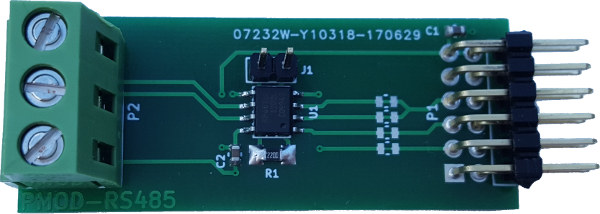
Pmod rs485 is an open-source printed circuit board by Agilack, from the Agilack/pmod repository on GitHub. It is a 2-layer board of 50.8 × 20.3 mm with 11 parts on 13 nets, routed with 87 tracks and 7 vias.
It is built around the SN65HVD72D. Its parts include 5 resistors, 3 connectors, 2 capacitors and 1 IC. It belongs with the interfaces and adapters boards of this library.
This repository contains multiple projects of PMOD modules. All of them are used for communications.
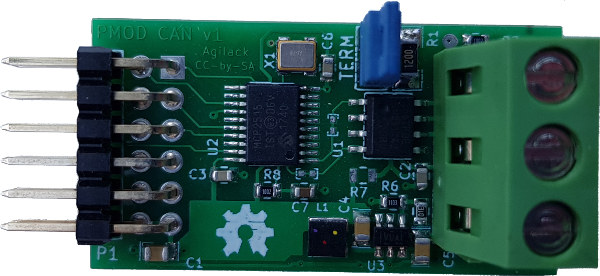
This module is a peripheral interface to connect a CAN bus.
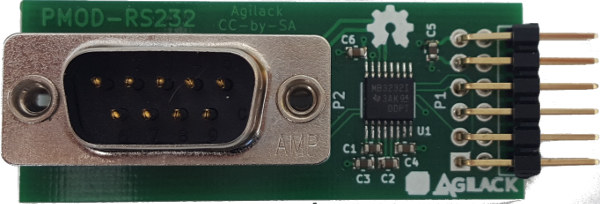
This module is a RS232 interface. The PMOD side is a type4a interface and the other side is a DB9 male connector. The module contains a level shifter (basically a MAX3232) to allow interfacing RS232 signal levels on a board with TTL levels.
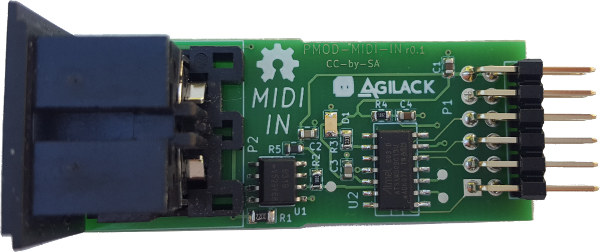
This module can be used to connect a MIDI device to a board with PMOD interface. The MIDI port is an input, so only instruments that send datas can be connected (tested with a keyboard)
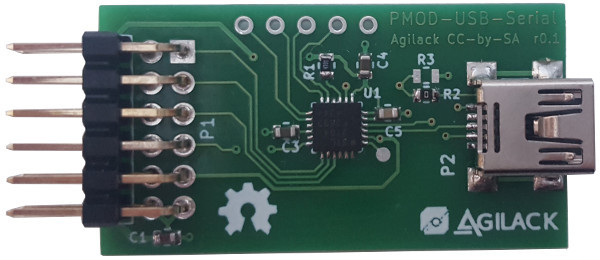
This module is an usb-serial adapter (PMOD peripheral). Based on a Silicon Labs chip, no specific driver is required to use it on most OS.
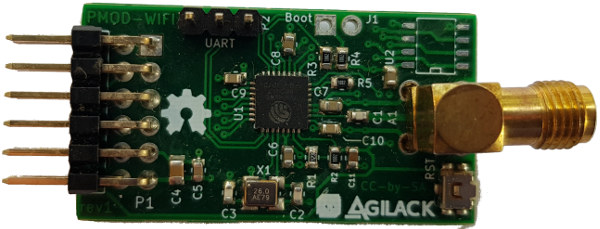
This module is a Wifi interface (PMOD peripheral). Based on the very popular espressif chip (ESP8285 or ESP8266)
All electronics parts are released under Creative Commons Attribution Share Alike 3.0 license.
All firmwares and softwares included with modules are realeased under GNU General Public Licence v3 (GNU GPLv3)
| Qty | Value | Footprint | References |
|---|---|---|---|
| 4 | 0 | pmod-rs485:SMD0603 | R2, R3, R4, R5 |
| 1 | 120 | pmod-rs485:SMD1206 | R1 |
| 1 | 1uF | cowstick:SMD0603 | C1 |
| 1 | 1uF | pmod-rs485:SMD0603 | C2 |
| 1 | CONN_3 | pmod-rs485:CONN_MC000035 | P2 |
| 1 | JUMPER | pmod-rs485:CONN_2 | J1 |
| 1 | PMOD | pmod-rs232:CONN_PMOD-Male | P1 |
| 1 | SN65HVD72 | pmod-rs485:SMD_SO8E | U1 |


Miceuz/rs485-moist-sensor
Digital (RS485 - based) soil moisture and temperature sensor

RainDrop-lora/raindrop
Soil moisture monitoring system on LoRaWAN network

Miceuz/rs485-breakout
A tiny development board to quickly prototype RS485/Modbus devices


Technariumas/smalsiukas
The conversion of a forklift truck to a line following robot.

punkfab/pcb-corpus
235 real KiCad boards from open-source hardware repositories, prepared as a placement and routing benchmark

google/mozc-devices
Circuit diagrams and firmware source code for Gboard DIY keyboards

It measures 50.8 × 20.3 mm and has 2 copper layers, 1.6 mm thick.
11 parts, built around the SN65HVD72D. The full list of its parts is on this page, with links to each part's symbol and footprint where PCBKit's library has them.
From the Agilack/pmod repository on GitHub, at the commit this page was made from: the board is rs485/prj-kicad/pmod-rs485.kicad_pcb. PCBKit opens the board in the browser, with nothing to install.
Its repository states no licence, so its author keeps all rights: ask Agilack before reusing the design.