
2 layers119 × 53 mm
JudgeBoard
Wright4TheJob/PiKwonDo
A Raspberry Pi-based system for scoring TaeKwonDo sparring matches.
33 parts2MIT
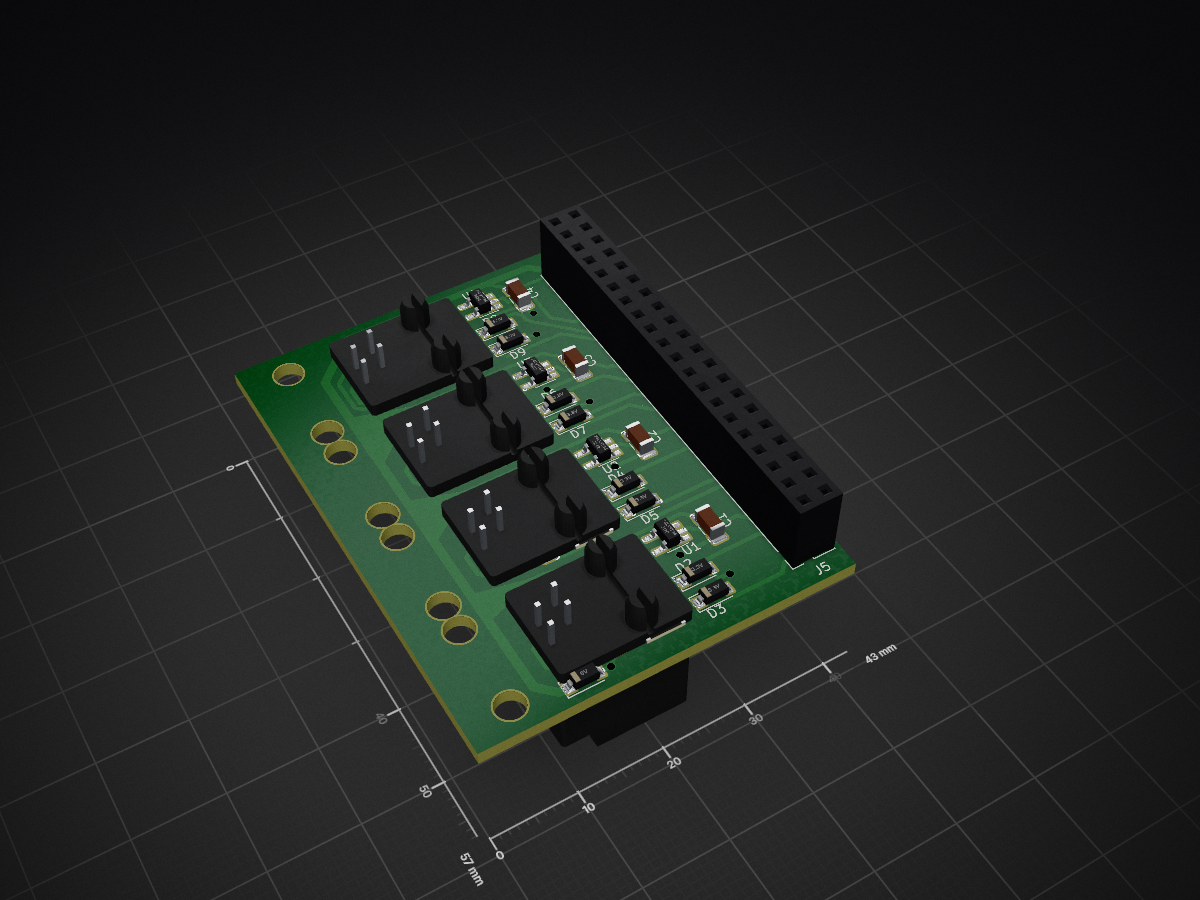
 Wright4TheJob/PiKwonDo2
A Raspberry Pi-based system for scoring TaeKwonDo sparring matches.
PiKwonDoHAT is an open-source printed circuit board by Wright4TheJob, from the Wright4TheJob/PiKwonDo repository on GitHub, published under the MIT licence. It is a 2-layer board of 43 × 57 mm with 42 parts on 30 nets, routed with 300 tracks and 8 vias.
It is built around the 74LV1T34GW. Its parts include 12 capacitors, 12 resistors, 9 diodes, 5 connectors and 4 ICs.
A Raspberry Pi-based system for scoring TaeKwonDo sparring matches.
The goal of this project is to create an inexpensive system for scoring TaeKwonDo sparring. This system is intended to be small and easily modified to suit the needs of individual Dojangs. The system is currently designed for electronic scoring manually triggered by corner judges.
Phase 1 of the judging system will use judge triggers connected by wires to the central controller. Phase 2 is intended to use wireless judge trigger systems or mobile phone connectivity.
While the system is designed to mimic expensive World TaeKwonDo-approved systems, it is not certified for official tournament use.

 Bill of Materials:

The project is under alpha development. Software has been developed but has yet to be tested with the hardware. Electronics are designed for single-sided PCB routing and have all completed initial design but have not been tested yet. Cases are designed for 3D printing. Hardware and software folders have individual README files with more particular statuses and todo items.
All design files and software are provided "as-is." Any stable releases will be bundled for easy download, but this does not guarantee suitability for your particular setup.
The judging software and UI is written in python and QT. A dedicated thread scans the status of judge controller buttons. Game logic and UI are run as the primary thread.
Controllers use shift registers to store and sequentially read out the values of the buttons in each controller. Judge controllers have 10 buttons and the timer controller has 5. PCBs are designed for single-side milling, with traces no smaller than 0.4mm and trace gaps of 0.3mm. Through-hole components are used for hand soldering and occasional jumper wires are used.
The system is designed and tested on a Raspberry Pi 3B+. Physical wiring uses phone jacks and standard 4-conductor phone cables for data communication to judging triggers. Cases are designed for 3D printing and modeled in Solidworks.
| Qty | Value | Footprint | References |
|---|---|---|---|
| 8 | 10 | Resistors_SMD:R_1206_HandSoldering | R1, R2, R4, R5, R7, R8, R10, R11 |
| 8 | 3.3V | Diode_SMD:D_SOD-123 | D2, D3, D4, D5, D6, D7, D8, D9 |
| 8 | 470pF | Capacitor_SMD:C_1206_3216Metric_Pad1.42x1.75mm_HandSolder | C5, C6, C7, C8, C9, C10, C11, C12 |
| 4 | 10nF | Capacitor_SMD:C_1206_3216Metric_Pad1.42x1.75mm_HandSolder | C1, C2, C3, C4 |
| 4 | 470 | Resistors_SMD:R_1206_HandSoldering | R3, R6, R9, R12 |
| 4 | 74LV1T34 | TO_SOT_Packages_SMD:SOT-23-5_HandSoldering | U1, U2, U3, U4 |
| 4 | RJ10 | Local_lib:RJ14 | J1, J2, J3, J4 |
| 1 | 5V | Diode_SMD:D_SOD-123 | D1 |
| 1 | Conn_02x20_Odd_Even | Connector_PinSocket_2.54mm:PinSocket_2x20_P2.54mm_Vertical | J5 |
Wright4TheJob/PiKwonDo
A Raspberry Pi-based system for scoring TaeKwonDo sparring matches.

Wright4TheJob/PiKwonDo
A Raspberry Pi-based system for scoring TaeKwonDo sparring matches.

westlicht/performer-hardware
PER|FORMER Eurorack Sequencer - Hardware Design Files

dan-rodrigues/ym2610-pcb
FPGA-based PCB to control a YM2610 sound synthesis chip.

M0LTE/pi-transceiver
An attempt to build a complete ham radio transceiver around a Raspberry Pi


rusefi/rusefi
rusefi - GPL internal combustion engine control unit


hackclub/sprig
🍃 Learn to code by making games in a JavaScript web-based game editor.

jamro/tiny-engineer
A small desktop robot that brings an AI coding assistant to life, physically acting out when it reads files, thinks, writes code, and finishes work.
It measures 43 × 57 mm and has 2 copper layers, 1.6 mm thick.
42 parts, built around the 74LV1T34GW. The full list of its parts is on this page, with links to each part's symbol and footprint where PCBKit's library has them.
From the Wright4TheJob/PiKwonDo repository on GitHub, at the commit this page was made from: the board is Electronics/PiKwonDoHAT/PiKwonDoHAT.kicad_pcb. PCBKit opens the board in the browser, with nothing to install.
Its repository publishes it under the MIT licence: you may reuse it on that licence's terms (keep the author's notice, and for a copyleft licence share your changes alike).