Software, mechanical design and hardware for ROV
- Size
- 80 × 38.1 mm
- Copper layers
- 2
- Thickness
- 1.6 mm
- Parts
- 92
- Nets
- 65
- Pads
- 258
- Tracks, vias
- 383, 63
- Pours
- 10
- Routed
- Yes
- KiCad
- KiCad 6 (file 20211014)
- Created
- 18 Jul 2021
- Updated
- 25 Mar 2022
Overview
Motor v3 is an open-source printed circuit board by UoM-Robotics-Society, from the UoM-Robotics-Society/ROV-project repository on GitHub. It is a 2-layer board of 80 × 38.1 mm with 92 parts on 65 nets, routed with 383 tracks and 63 vias.
It is built around the NCP5901D, LM358 and IRLR8726, with the MMSD4148 and BAS21 among its other parts. Its parts include 38 resistors, 23 capacitors, 12 connectors, 8 transistors and 6 diodes. It belongs with the robots and motor control boards of this library.
Main components
5NCP5901D
SOIC-8-10℃~+125℃ 11ns 16ns 2 3.5A 4.5V~13.2V Enable shutdown、Interleaved conduction protection、Dead-time control Half-Bridge MOSFET SOIC-8 Gate Drivers ROHSonsemiGate DriversLM358
SOP-8-18V~18V 0℃~+70℃ 1.2MHz 10nA 2 24mA 3V~36V 500uA 50nA 5mV 80dB Built-in compensation SOP-8 Operational Amplifier ROHSMSKSEMIOperational AmplifierIRLR8726
TO-252-55℃~+175℃ 1 N-channel 1.4V 103nC@10V 181W 3.88mΩ@10V 30V 352pF 392pF 5.672nF 90A TO-252 MOSFETs ROHSTECH PUBLICMOSFETsMMSD4148
SOD-123-55℃~+150℃@(Tj) 100V 1V@10mA 200mA 425mW 4ns 5uA@75V Independent SOD-123 Switching Diodes ROHSonsemiSwitching DiodesBAS21
SOT-231.25V@200mA 100nA@100V 200mA 250V 9A Independent SOT-23 Diodes - General Purpose ROHSNexperiaSwitching Diodes
README
README.mdROV-project
Description
This repository contains the software, hardware and 3D design for the ROV project.
Project introduction and motivation
Goal is to create Remotely Operated Vehicle for underwater environments. ROV should :
- should operate safely in underwater environment up to reasonably low water depth ( construction should be waterproof, designed in mind to deal with the possibility of flooding)
- be able to be controlled by the User on ground station ( using something like GUI or physical devices like joystick/xbox controller etc. )
- provide useful data from sensors to User ( video feedback, attitude ( orientation ), other somehow relevant sensors )
- design should be flexible for possible modification in future
Diagram
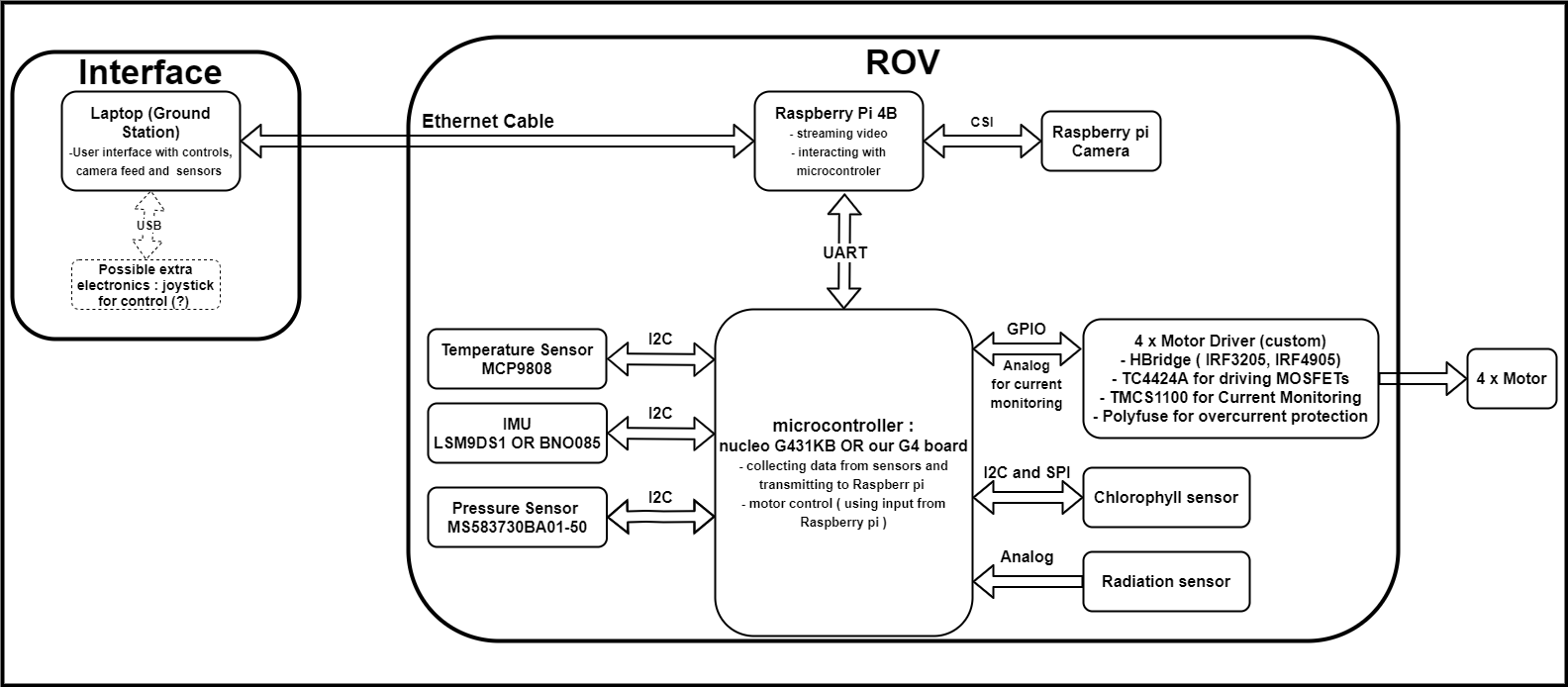
Whole system of the ROV is presented on the image below :

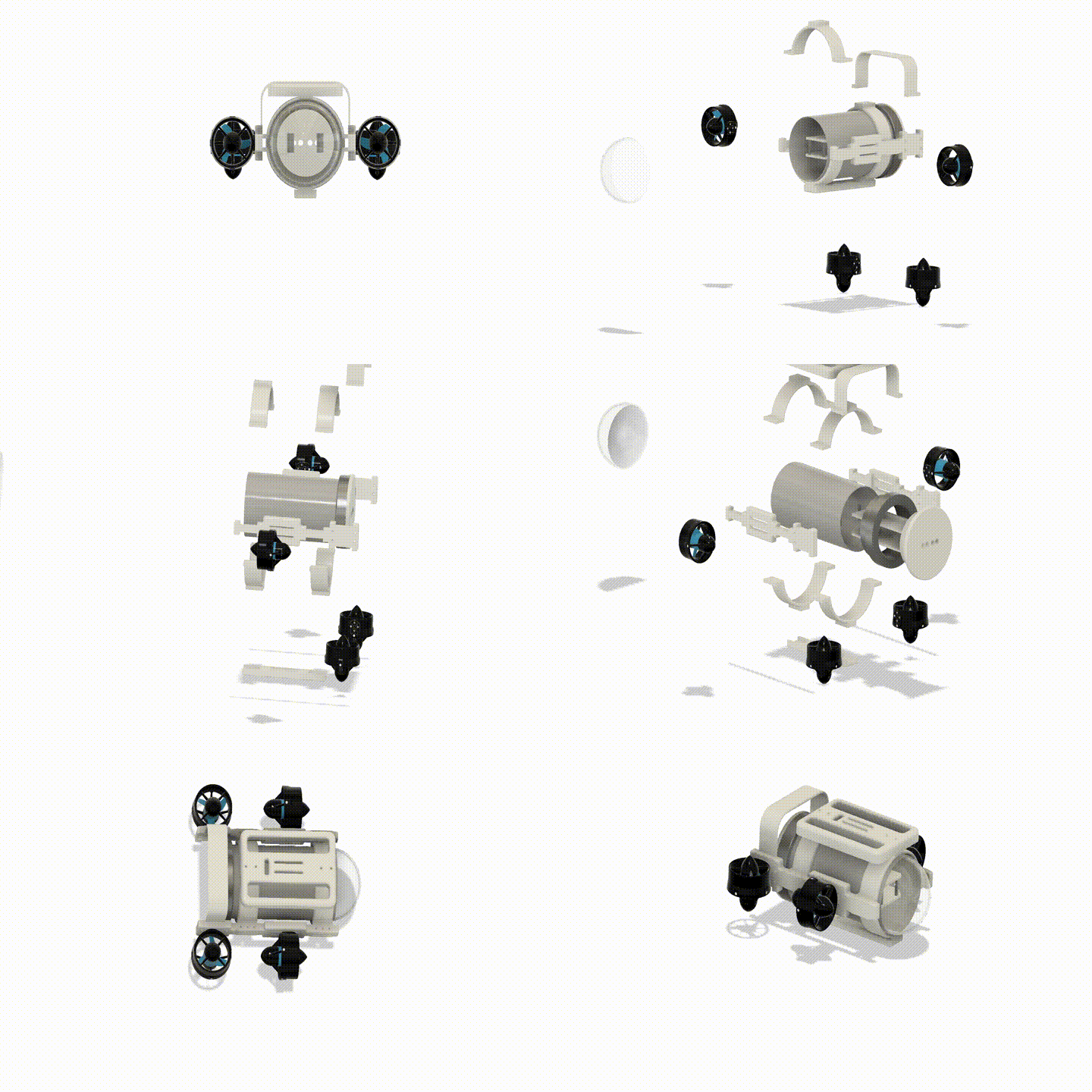
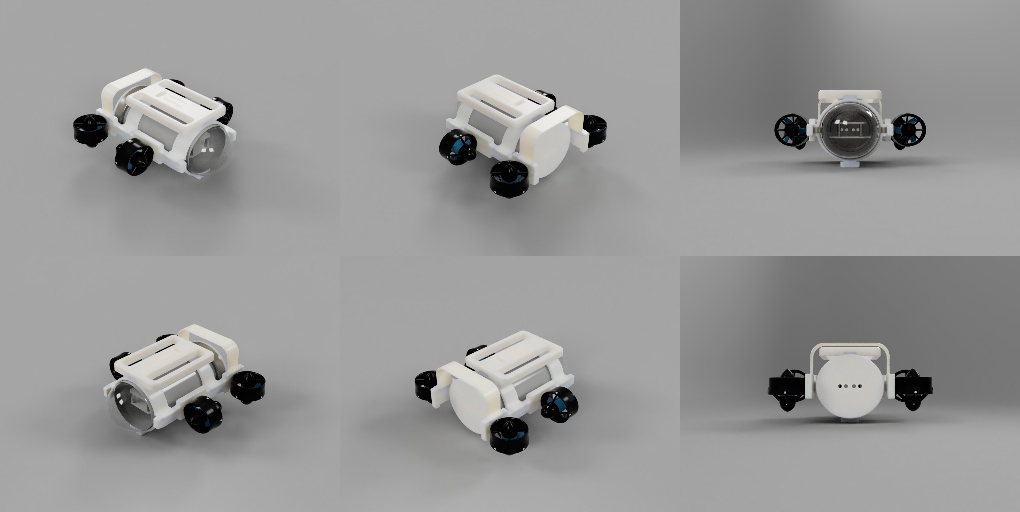
Mechanical Design
Design


whole mechanical design is done by mechanical team of ROV team
Waterproofing
Components Description
Ground Station
- Main device with which User will interact will be laptop ( or other device to which we can connect Ethernet cable and will provide easy interaction ). Using laptop/other workstation provides few benefits :
- Most of the "heavy stuff" will be done on the workstation that we can control and only necessary software will run in the actual ROV
- makes the system very flexible : lots of possible expansion in the future ( fancy control like joysticks ? We can create own device and plug to USB or add support for xbox controller. Some computer vision algorithms for the camera ? the workstation can have GPU on it, we can provide quite a lot of computation power ( rather than relying on raspberry pi or other single board computer ))
Communication
- Ethernet should allow fast ( Raspberry pi has 1Gbit Ethernet port ), reliable and long distance communication ( and works underwater since it's just a cable ). We can also use Ethernet to power the device ( "Power over Ethernet")
- All other communication within ROV uses standard and popular data transmission protocols
- According to David, possiblity of extension to wireless
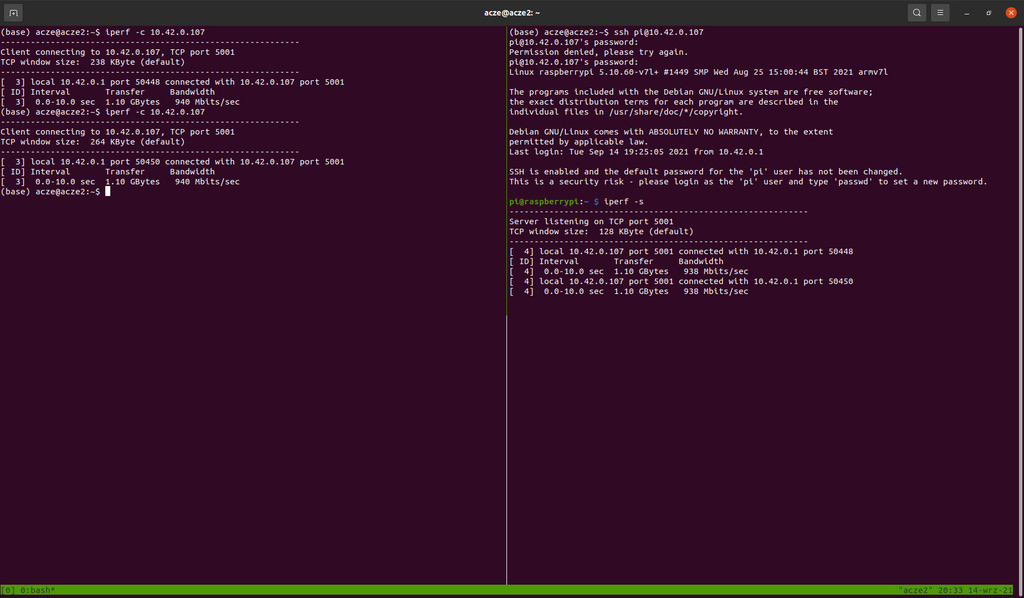
Raspberry pi connected to laptop over 20 meter ethernet cable. Currently just streams video ( 1080p) over MQTT, bandwidth test below :

Single Board Computer ( Raspberry Pi 4b)
- Extremely popular platform with support for good quality, real time video streaming and interacting with hardware ( using Serial communication ). Great community support and very fast to learn ( also Computer Science departament uses it in teaching )
- Can be programmed in few languages ( C, C++, python, probably others ), although python is used for the fast and easy development ( limitations of python like GIL can be removed by using multiprocessing etc.).
Microcontroller ( STM32G4)
- Microcontroller from new G4 line from STMicroelectronics. Not popular line, not "battle-tested" but cheap, high-performance microcontroller with lots of peripherals and can be programmed in Mbed Environment or HAL. Although there are popular choices ( pico's, arduino atmega's, ESP32's other stm's) it can be great opportunity to learn new platform that seems to be targeted for more industrial applications ( and overall learn something new and fun). Other than that, it has lots of features per pound ( 3.5 pound before chip shortage). The design doesn't realy that much on the microcontroller ( it requires few good timers, I2C, UART, SPI, reasonable ADC, most of the microcontrollers provide that) so we can change to other platform if the chosen microcontroller won't prove it's worth.
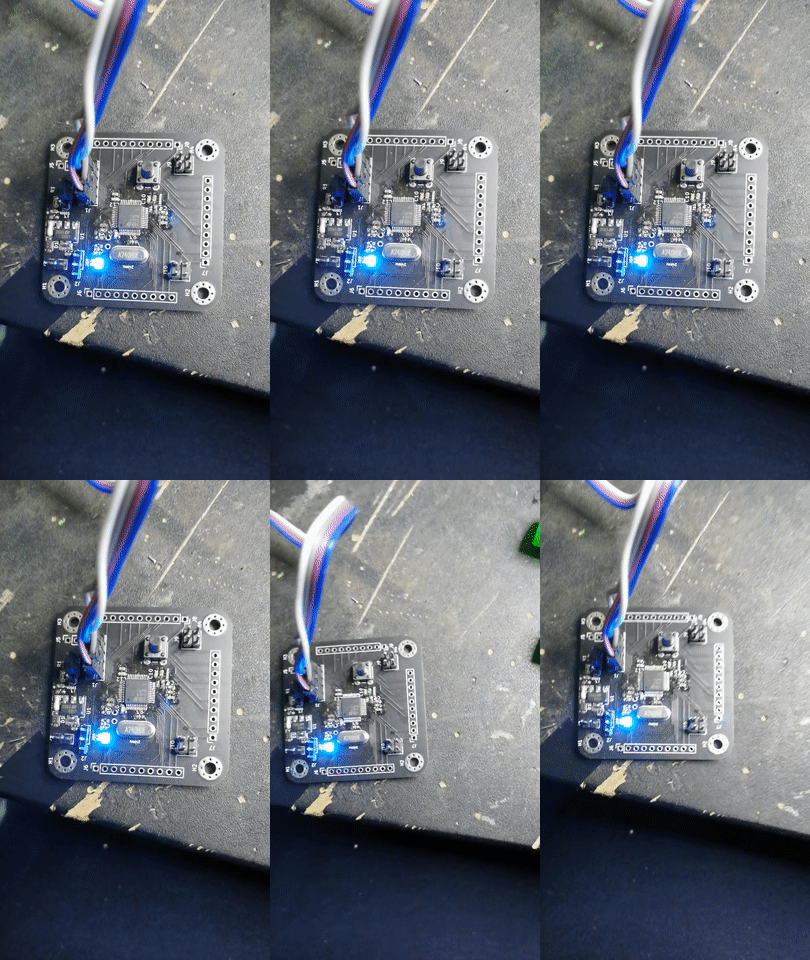
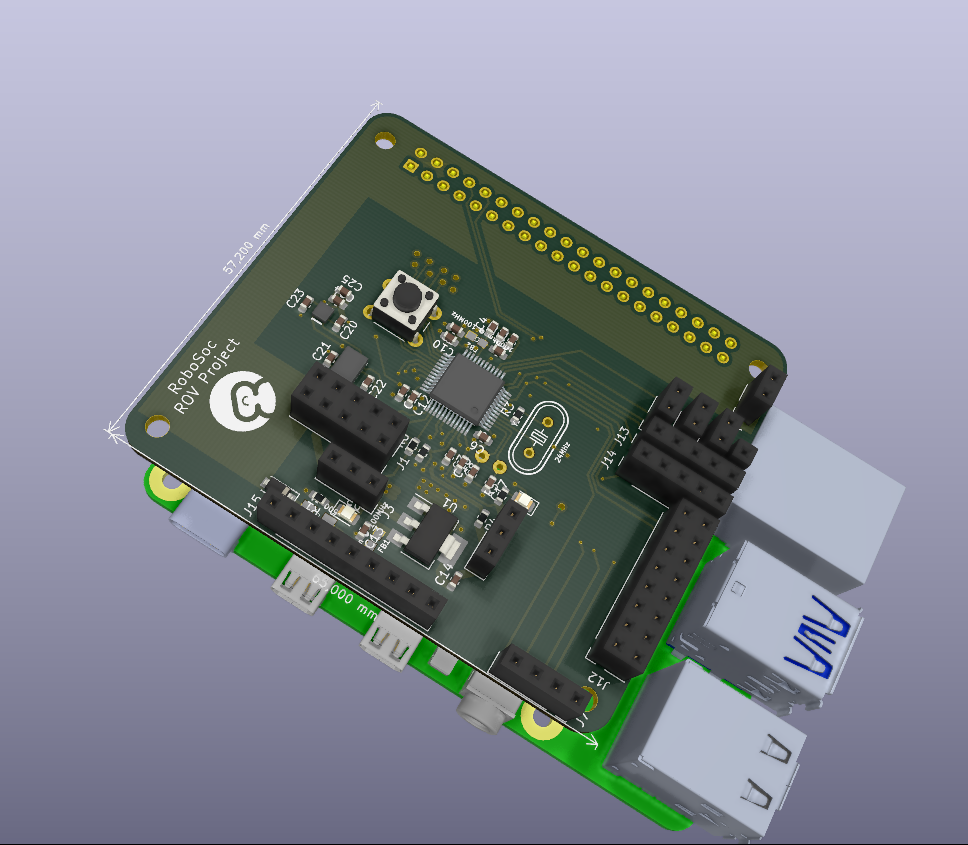
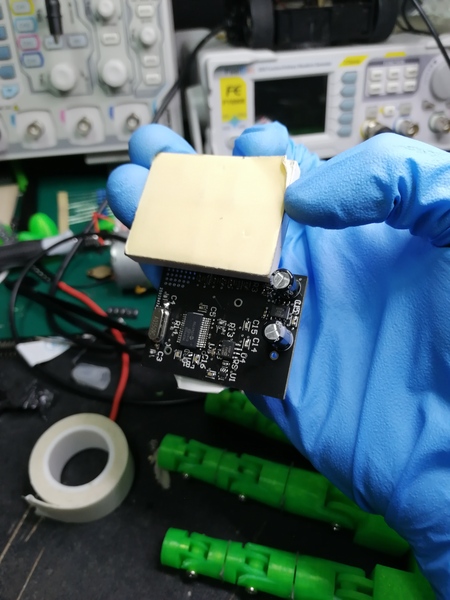
Current microcontroller board :
Render of the final board that will go hopefully in the final design

Motors
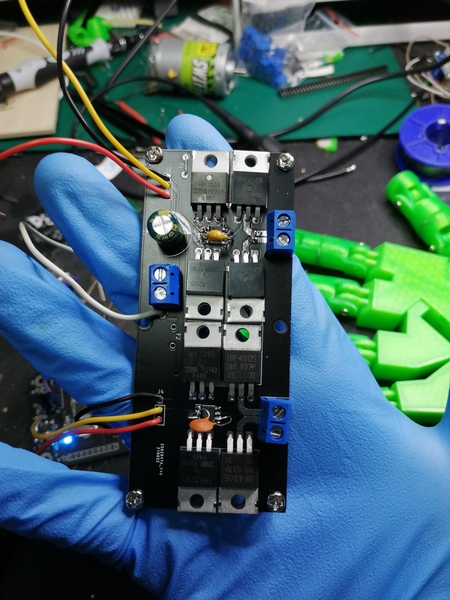
- Lots of possible choices ( We orderd the dual shaft ,mabuchi like(DC motor),~30W from robotshop). Custom driver created for the motors using Hbridge circuit. Main drawback is that we need to solder/design/debug it but advantage is that it provides quite a bit of extra features that we included in our design : overcurrent protection ( using polyfuse ), high amperage and reasonably low power losses ( dependent on mosfets ), protection of Microcontroller pins ( using Mosfet driver to drive large mosfets from Hbridge) and current monitoring ( output voltage of TMCS1100 sensor is proportional to the current that flows through the mosfets). All of the features could possibly help us debugging, monitoring and hopefully help with safety when dealing with large motors.
- Possibility of adding encoders in the future
Current Motor driver :

Sensors
- Other than driving platform we wanted to provide range of measurements:
- Temperature sensor is standard.
- Pressure sensor is not popular sensor, designed specifically for underwater environment ( up to 300m ) which provides high resolution ( and it's low cost compared to other underwater sensors ).
- MARG sensor ( accelerometer, gyroscope, magnetometer). Using the data we can use AHRS algorithm ( experimented with Madgwick Filter which will be probably used in the design) we can visualize the orientation of the ROV on display on the laptop / ground station Madgwick Report.
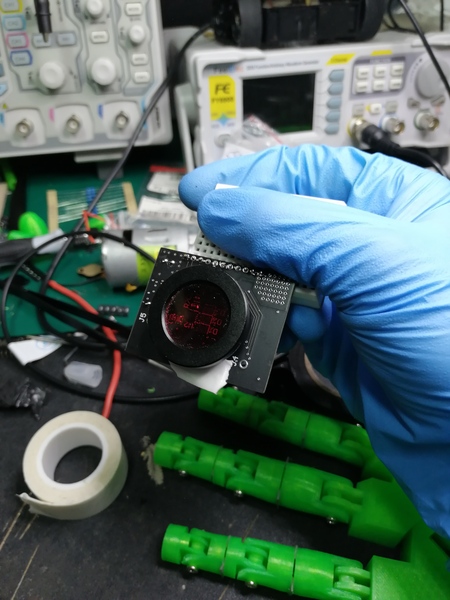
- Chlorophyll sensor. Custom sensor using the fluorescence measurement that should allow us to estimate the chlorophyll concentration. Chlorophyll concentration helps scientists to estimate health of the lake/other water containers [TODO point to document with more details].
- Radiation sensor : was in the first design because of initial project idea from Sellafield. Seems like challenging project and cool expansion to the project. Initial design created from the Elektor magazine article about Radiation detection. General reference used for it was "Radiation detection and measurement" and opengeiger website
Sensors :
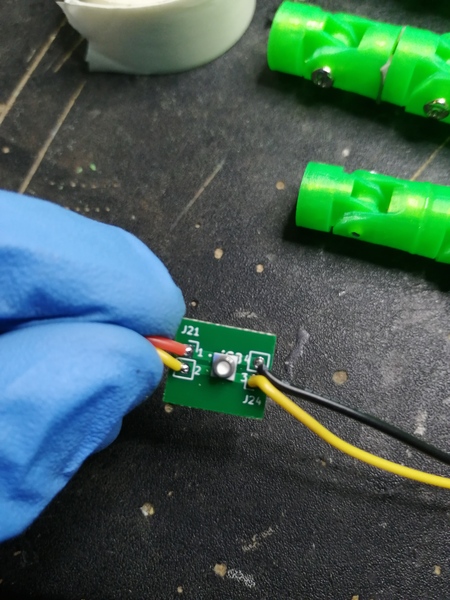
Chlorophyll sensor :

Pressure Sensor :

Parts
92| Qty | Value | Footprint | References |
|---|---|---|---|
| 9 | 0 | Resistor_SMD:R_0603_1608Metric | R12, R13, R14, R17, R19, R22, R31, R32, R33 |
| 8 | IRLR8726 | Package_TO_SOT_SMD:TO-252-2 | Q1, Q2, Q3, Q4, Q5, Q6, Q7, Q8 |
| 7 | Conn_01x02_Male | Connector_PinHeader_1.27mm:PinHeader_1x02_P1.27mm_Vertical | J1, J2, J5, J9, J10, J11, J12 |
| 4 | 10k | Resistor_SMD:R_0603_1608Metric | R21, R25, R28, R37 |
| 4 | 1uF | Capacitor_SMD:C_0603_1608Metric_Pad1.08x0.95mm_HandSolder | C22, C23, C24, C25 |
| 4 | 2.2 | Resistor_SMD:R_0603_1608Metric | R5, R11, R24, R30 |
| 4 | 2.7nF | Capacitor_SMD:C_0603_1608Metric_Pad1.08x0.95mm_HandSolder | C10, C11, C18, C19 |
| 4 | 27nF | Capacitor_SMD:C_0603_1608Metric_Pad1.08x0.95mm_HandSolder | C9, C12, C16, C20 |
| 4 | MMSD4148 | Diode_SMD:D_SOD-123 | D1, D2, D4, D5 |
| 4 | NCP5901 | components:DFN8_NCP3901 | U2, U3, U4, U5 |
| 3 | 0 | Resistor_SMD:R_0603_1608Metric_Pad0.98x0.95mm_HandSolder | R2, R3, R4 |
| 3 | 1 | Resistor_SMD:R_0603_1608Metric | R15, R16, R34 |
| 3 | 1u | Capacitor_SMD:C_0603_1608Metric_Pad1.08x0.95mm_HandSolder | C8, C13, C21 |
| 2 | 100k | Resistor_SMD:R_0603_1608Metric | R18, R35 |
| 2 | 10k | Resistor_SMD:R_0603_1608Metric_Pad0.98x0.95mm_HandSolder | R6, R9 |
| 2 | 10u | Capacitor_SMD:C_0603_1608Metric_Pad1.08x0.95mm_HandSolder | C14, C26 |
| 2 | 1k | Resistor_SMD:R_0603_1608Metric | R23, R38 |
| 2 | 30k | Resistor_SMD:R_0603_1608Metric_Pad0.98x0.95mm_HandSolder | R7, R10 |
| 2 | 30k | Resistor_SMD:R_0603_1608Metric | R26, R29 |
| 2 | 4k7 | Resistor_SMD:R_0603_1608Metric | R20, R36 |
| 2 | BAS21 | Package_TO_SOT_SMD:SOT-23 | D3, D6 |
| 2 | Conn_01x01_Male | Connector_PinHeader_1.27mm:PinHeader_1x01_P1.27mm_Vertical | J4, J6 |
| 2 | Motor | TerminalBlock:TerminalBlock_bornier-2_P5.08mm | J7, J8 |
| 1 | 0.1uF | Capacitor_SMD:C_0603_1608Metric_Pad1.08x0.95mm_HandSolder | C6 |
| 1 | 1 | Resistor_SMD:R_0603_1608Metric_Pad0.98x0.95mm_HandSolder | R1 |
| 1 | 100n | Capacitor_SMD:C_0603_1608Metric | C17 |
| 1 | 100n | Capacitor_SMD:C_0603_1608Metric_Pad1.08x0.95mm_HandSolder | C27 |
| 1 | 10uF | Capacitor_SMD:C_0603_1608Metric_Pad1.08x0.95mm_HandSolder | C7 |
| 1 | 1u | Capacitor_SMD:C_0603_1608Metric | C15 |
| 1 | 2mohm | Resistor_SMD:R_2512_6332Metric | R8 |
| 1 | 2mohm | Resistor_SMD:R_2512_6332Metric_Pad1.40x3.35mm_HandSolder | R27 |
| 1 | 470uF | Capacitor_SMD:CP_Elec_10x10 | C1 |
| 1 | LM358 | Package_SO:PowerIntegrations_SO-8 | U1 |
| 1 | Screw_Terminal_01x02 | TerminalBlock:TerminalBlock_bornier-2_P5.08mm | J3 |
More from UoM-Robotics-Society/ROV-project
6- 4 layers57.2 × 65 mm

- 4 layers50 × 50 mm

- 2 layers33 × 23 mm

Radiation sensor
UoM-Robotics-Society/ROV-project
Software, mechanical design and hardware for ROV
33 parts14 - 2 layers58.6 × 67.4 mm

Flight controller
UoM-Robotics-Society/ROV-project
Software, mechanical design and hardware for ROV
29 parts14 - 2 layers20 × 20 mm

Chlorophyll sensor v2
UoM-Robotics-Society/ROV-project
Software, mechanical design and hardware for ROV
22 parts14 - 2 layers19 × 18 mm

Similar boards
- 2 layers195 × 150 mm

- 2 layers148.6 × 82 mm

Main dj filter fx
yminp/dj-filter-fx
A voltage-controlled DJ filter unit with LFO-like envelope function
164 parts - 2 layers100 × 100 mm

HeatTable Base v0.9
DerSpatz/PCB-reflow-solder-table
Table version of the PCB heat plate with advanced features and swappable heat plate
82 parts14MIT - 2 layers62.5 × 62 mm

Usb pd mch hotplate
quasiengineer/usb-pd-mch-hotplate
Archive with gerber files and drill locations could be found here
47 parts6 - 2 layers65 × 55 mm

MiniSumoPCB
LaboratorioGluon/MiniSumoDeNaranja
Minisumo para la competición OSHDEM 2023
74 parts5GPL-2.0 - 2 layers127.5 × 62 mm

Avionics project
TUSI-KHU/2026-nura-avionics
Embedded flight controller for the 2026 NURA competition.
75 parts2Apache-2.0 - 2 layers26 × 22 mm

- 2 layers226.4 × 128.4 mm

Bab top
trublion/turtable_control_board_hbridge
HW control board for turntable. Controls a DC motor with a H-bridge, reads an analog audio signal envelope, dual-PCB design.
109 partsMIT
Questions
How big is the Motor v3 PCB?
It measures 80 × 38.1 mm and has 2 copper layers, 1.6 mm thick.
What parts does the Motor v3 use?
92 parts, built around the NCP5901D, LM358, IRLR8726 and MMSD4148. The full list of its parts is on this page, with links to each part's symbol and footprint where PCBKit's library has them.
Where can I download the Motor v3 KiCad files?
From the UoM-Robotics-Society/ROV-project repository on GitHub, at the commit this page was made from: the board is hardware/motor-full-bridges/motor-v3.kicad_pcb and its schematic hardware/LED/LED.kicad_sch. PCBKit opens the board in the browser, with nothing to install.
Can I use the Motor v3 design in my own project?
Its repository states no licence, so its author keeps all rights: ask UoM-Robotics-Society before reusing the design.