2 layers287.8 × 126.7 mm

 Umi4Life/gekimax3
hybrid rhythm game keypad controller
Gekimax is an open-source printed circuit board by Umi4Life, from the Umi4Life/gekimax repository on GitHub, published under the CERN-OHL-S-2.0 licence. It is a 2-layer board of 253.5 × 80 mm with 92 parts on 72 nets, routed with 798 tracks and 92 vias.
It is built around the SK6812MINI-E and WS2812B. Its parts include 28 capacitors, 27 diodes, 21 switches, 3 resistors and 2 connectors. It belongs with the keyboards and input boards and the RP2040 boards of this library.


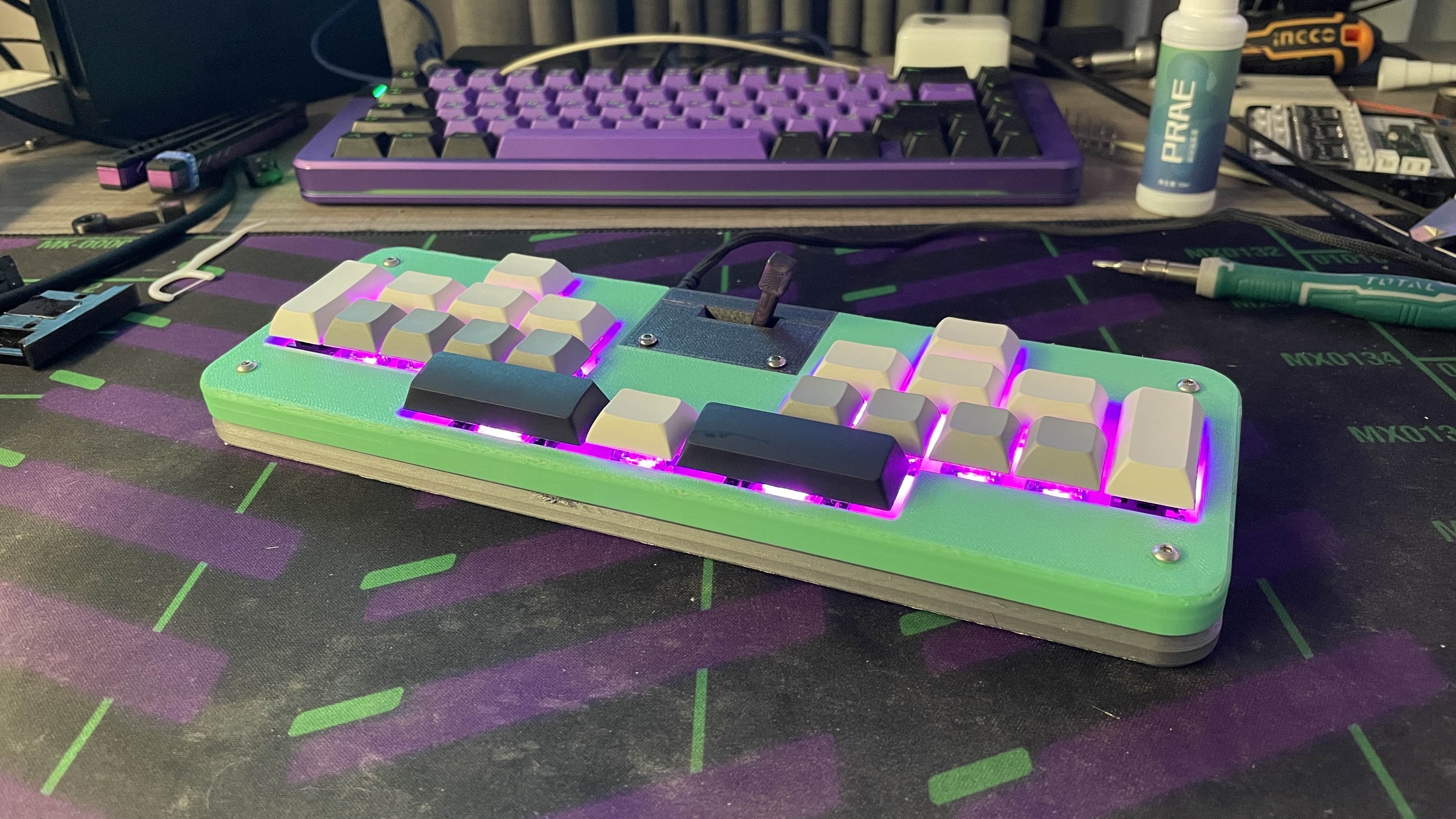
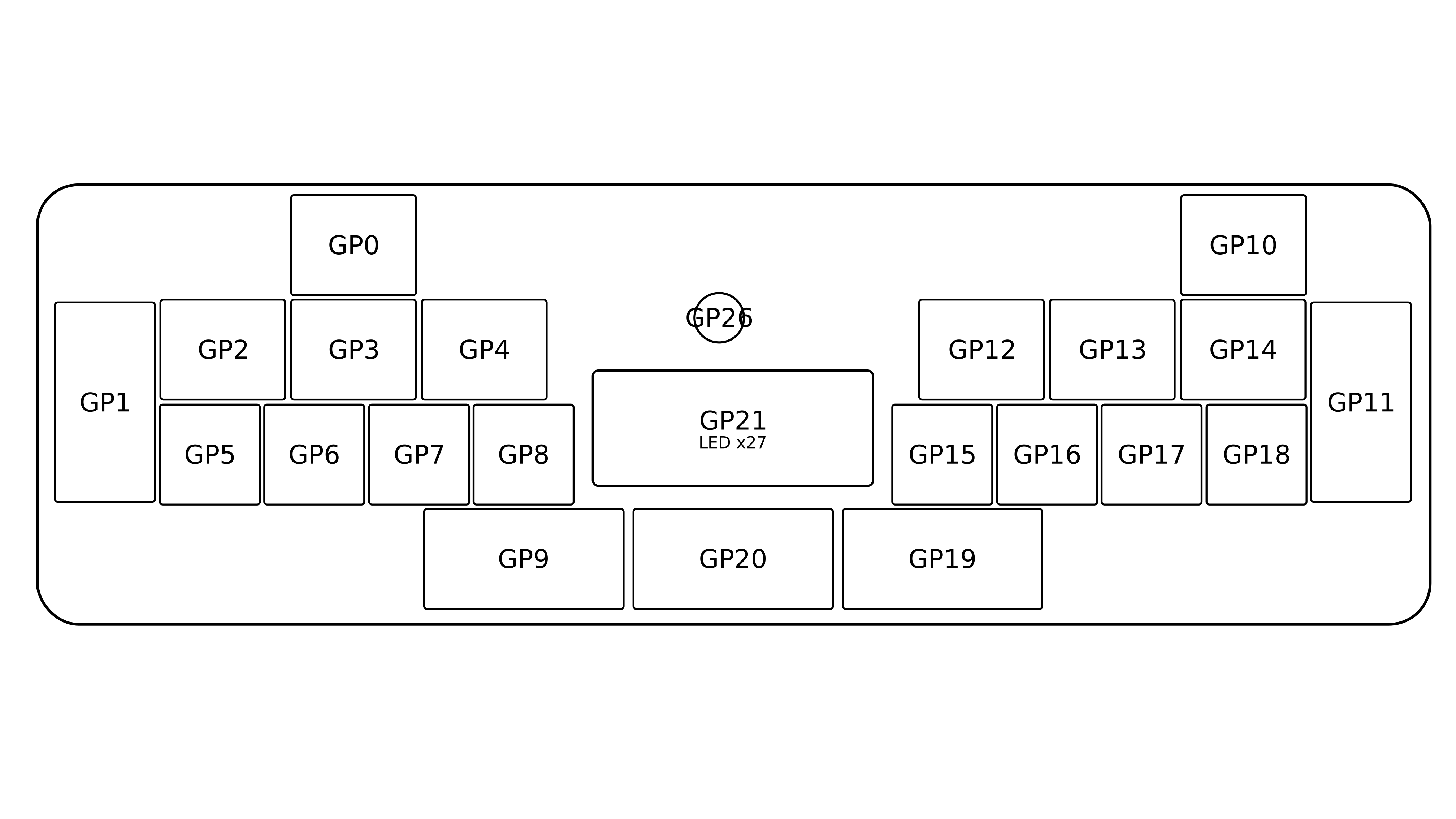
generic rhythm game keypad controller with a lever
| Part | Amount |
|---|---|
| RK09L11 Rotary Potentiometer | 1 |
| 100nF Capacitor 0805 | 28 |
| SK6812MINI-E LED | 21 |
| USB-C Connector | 5 |
| 220Ω Resistor 0603 | 1 |
| 5.1KΩ Resistor 0603 | 2 |
RK09 potentiometer may need some disassembly and modding to remove detent
| Part | Amount |
|---|---|
| Raspberry Pi Pico | 1 |
| M3 Heat Insert | 6 |
| M3 Nut | 2 |
| M3x15-16mm Countersunk Screw | 8 |
| M3x40 Button Head Screw | 1 |
| Rubber Feet | 4 |
| Rubber sheet/padding for lever | 1 |
| Keyboard Switches | 21 |
| Hot Swap Socket | 21 |
| Plate Mount Stabilizer | 4 |
| 1U keycaps | 8 |
| 1.25U keycaps | 9 |
| 2U keycaps | 2 |
| 2.75U keycaps | 2 |
| Qty | Value | Footprint | References |
|---|---|---|---|
| 28 | 100n | Capacitor_SMD:C_0805_2012Metric_Pad1.18x1.45mm_HandSolder | C0, C1, C2, C10, C11, C12, C13, C14, C15, C16, C17, C18, C19, C20, C21, C22 +12 |
| 21 | SK6812MINI | PCM_marbastlib-mx:LED_MX_6028R | D1, D2, D3, D4, D10, D11, D12, D13, D14, D15, D16, D17, D18, D19, D20, D21 +5 |
| 6 | MountingHole_3.2mm_M3 | MountingHole:MountingHole_3.2mm_M3 | M1, M2, M3, M4, M5, M6 |
| 6 | WS2812B | PCM_marbastlib-xp-various:LED_WS2812_4020 | D22, D23, D24, D25, D26, D27 |
| 2 | 5.1kΩ | Resistor_SMD:R_0603_1608Metric_Pad0.98x0.95mm_HandSolder | R1, R2 |
| 2 | LOGO | LOGO | G***, G*** |
| 1 | 220Ω | Resistor_SMD:R_0603_1608Metric_Pad0.98x0.95mm_HandSolder | R3 |
| 1 | HRO-TYPE-C-31-M-12 | Type-C:HRO-TYPE-C-31-M-12-HandSoldering | USB1 |
| 1 | LEFT_1 | MX_Hotswap:MX-Hotswap-1U | SW6 |
| 1 | LEFT_2 | MX_Hotswap:MX-Hotswap-1U | SW7 |
| 1 | LEFT_3 | MX_Hotswap:MX-Hotswap-1U | SW8 |
| 1 | LEFT_4 | MX_Hotswap:MX-Hotswap-1U | SW9 |
| 1 | LEFT_A | MX_Hotswap:MX-Hotswap-1.25U | SW3 |
| 1 | LEFT_B | MX_Hotswap:MX-Hotswap-1.25U | SW4 |
| 1 | LEFT_C | MX_Hotswap:MX-Hotswap-1.25U | SW5 |
| 1 | LEFT_EX | Connector_JST:JST_GH_SM05B-GHS-TB_1x05-1MP_P1.25mm_Horizontal | J1 |
| 1 | LEFT_SIDE | MX_Hotswap:MX-Hotswap-2U | SW2 |
| 1 | LEFT_SPACE | MX_Hotswap:MX-Hotswap-2U | SW10 |
| 1 | LEFT_TOP | MX_Hotswap:MX-Hotswap-1.25U | SW1 |
| 1 | LEVER | Potentiometer_THT:Potentiometer_Alps_RK09L_Single_Horizontal | RV1 |
| 1 | MID_SPACE | MX_Hotswap:MX-Hotswap-2U | SW21 |
| 1 | Pico | RPi_Pico:RPi_Pico_SMD | U1 |
| 1 | RIGHT_1 | MX_Hotswap:MX-Hotswap-1U | SW16 |
| 1 | RIGHT_2 | MX_Hotswap:MX-Hotswap-1U | SW17 |
| 1 | RIGHT_3 | MX_Hotswap:MX-Hotswap-1U | SW18 |
| 1 | RIGHT_4 | MX_Hotswap:MX-Hotswap-1U | SW19 |
| 1 | RIGHT_A | MX_Hotswap:MX-Hotswap-1.25U | SW13 |
| 1 | RIGHT_B | MX_Hotswap:MX-Hotswap-1.25U | SW14 |
| 1 | RIGHT_C | MX_Hotswap:MX-Hotswap-1.25U | SW15 |
| 1 | RIGHT_EX | Connector_JST:JST_GH_SM05B-GHS-TB_1x05-1MP_P1.25mm_Horizontal | J2 |
| 1 | RIGHT_SIDE | MX_Hotswap:MX-Hotswap-2U | SW12 |
| 1 | RIGHT_SPACE | MX_Hotswap:MX-Hotswap-2U | SW20 |
| 1 | RIGHT_TOP | MX_Hotswap:MX-Hotswap-1.25U | SW11 |


joshajohnson/Hub20
Hub20 is a numpad with a bunch of features you never knew you needed.


Taro-Hayashi/Handyman
ここの二つのキースイッチは足がPro Microと干渉するので短く切ります。 差し込んだ状態で短く切りましょう。 Choc V2の場合は3本の足を、Choc V1では2本の足と固定用品の一つを短くします。 全てのスイッチをはんだ付けします。

oceanKeebs/KeebPort
KeebPort, a split Keyboard architecture using a single micro controller as a central "port"


It measures 253.5 × 80 mm and has 2 copper layers, 1.6 mm thick.
92 parts, built around the SK6812MINI-E and WS2812B. The full list of its parts is on this page, with links to each part's symbol and footprint where PCBKit's library has them.
From the Umi4Life/gekimax repository on GitHub, at the commit this page was made from: the board is gekimax-pcb/gekimax.kicad_pcb and its schematic gekimax-pcb/gekimax.kicad_sch. PCBKit opens the board in the browser, with nothing to install.
Its repository publishes it under the CERN-OHL-S-2.0 licence: you may reuse it on that licence's terms (keep the author's notice, and for a copyleft licence share your changes alike).