2 layers54 × 12.5 mm
BrodBoost C2
axiometa/BrodBoost-C2
USB - C Breadboard Powersupply: BrodBoost-C
31 parts36CERN-OHL-S-2.0

 Samprab06/ESAP-Tetris
Tetris implementation for the ESP32 microcontroller with integrated audio support, TFT display rendering, and SD card file access.
Gamegirl is an open-source printed circuit board by Samprab06, from the Samprab06/ESAP-Tetris repository on GitHub. It is a 2-layer board of 160 × 70.3 mm with 60 parts on 65 nets, routed with 567 tracks and 58 vias.
It is built around the CH340C, ESP32-WROOM-32 and AP2112K-3.3, with the MUN5211DW1 and TYPEC-304A-ACP16O among its other parts. Its parts include 18 resistors, 13 capacitors, 10 switches, 3 ICs and 3 connectors. It belongs with the audio and music and lEDs and displays boards and the ESP32 boards of this library.


A complete, feature-packed Tetris game implementation for the ESP32 microcontroller featuring a custom PCB design, real-time graphics rendering on an ILI9341 SPI TFT display, I2S audio playback, SD card asset loading and a future multiplayer implementation
The project features a custom-designed PCB tailored for handheld gameplay with optimized power delivery, hardware debouncing, and an auto-programming USB-C interface.
| Back View (Component Side) | Front View (Controls) |
|---|---|
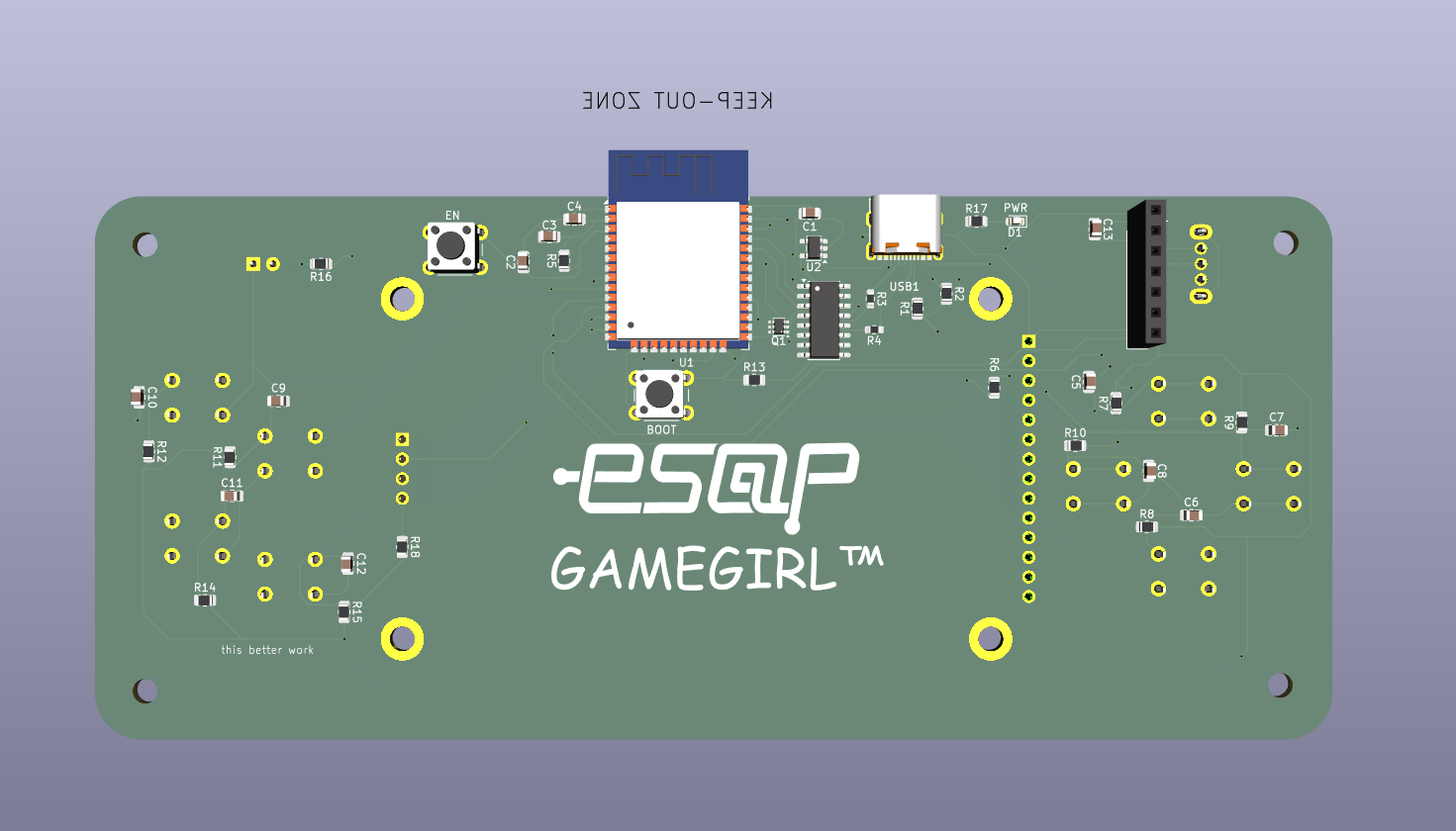 | 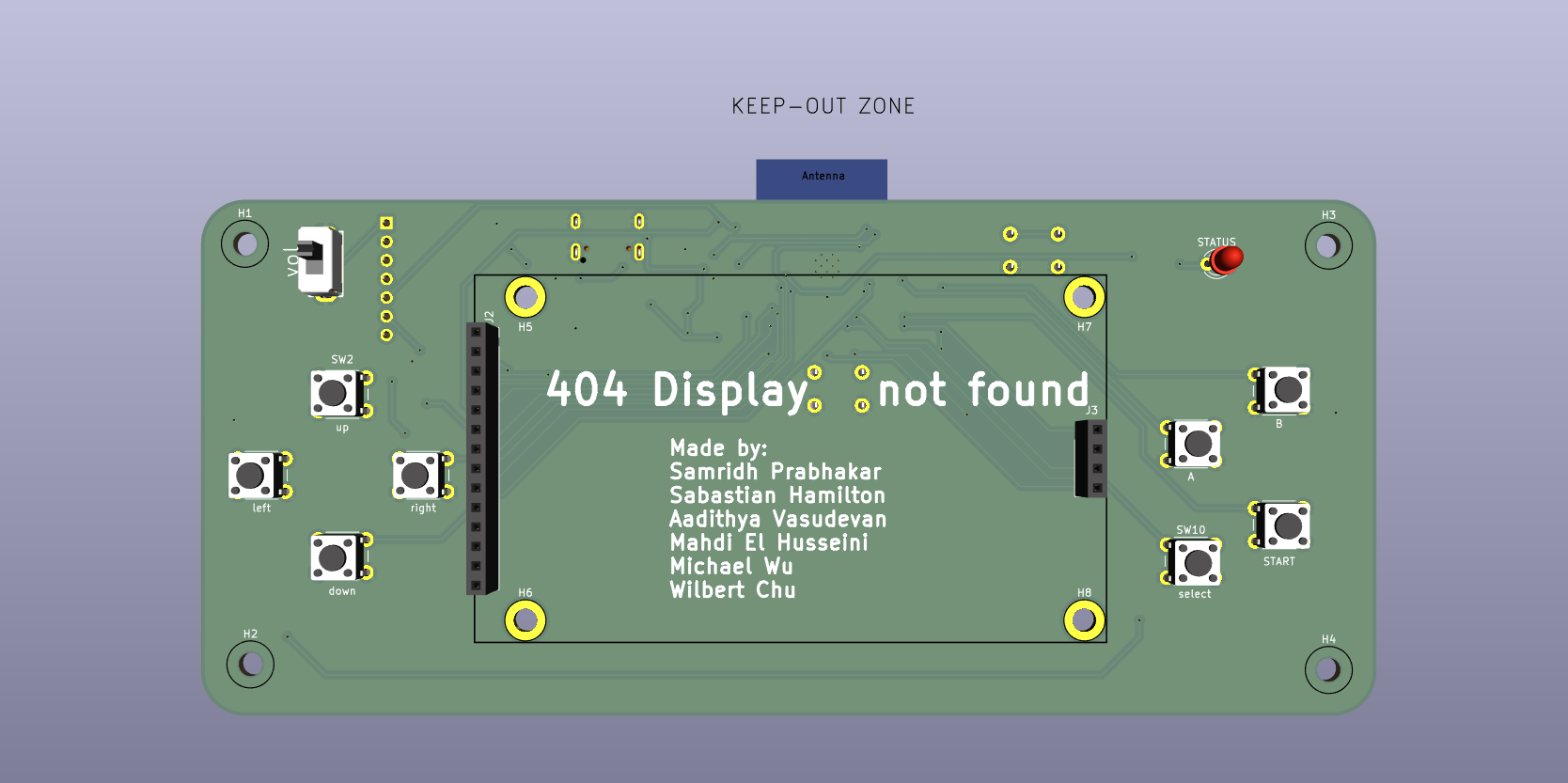 |
CH340C USB-to-UART converter with dual NPN auto-reset circuitry (MUN5211DW1) for seamless hands-free code uploads via USB Type-C.AP2112K-3.3 LDO regulator supplying up to 600mA at 3.3V with dedicated ground plane thermal heat sinking. USB Type-C CC1/CC2 5.1kΩ pull-down resistors for 5V C-to-C charger support.VSPI bus. Includes 10kΩ pull-up resistor on CS (GPIO5).HSPI bus. Includes 10kΩ pull-up resistor on CS (GPIO15).SW12) for hardware gain/volume control.| ESP32 Pin | Signal Name | Display Function |
|---|---|---|
| GPIO 23 | MOSI | Serial Data Input |
| GPIO 19 | MISO | Serial Data Output |
| GPIO 18 | SCK | Serial Clock |
| GPIO 5 | CS | Chip Select (10kΩ Pull-Up) |
| GPIO 2 | DC | Data / Command Select |
| GPIO 4 | RST | Reset |
| 3.3V | LED | Display Backlight Power |
| ESP32 Pin | Signal Name | SD Card Function |
|---|---|---|
| GPIO 13 | MOSI | Data Input |
| GPIO 17 | MISO | Data Output |
| GPIO 14 | SCK | Clock |
| GPIO 15 | CS | Chip Select (10kΩ Pull-Up) |
| GPIO Pin | Function | Hardware Circuit |
|---|---|---|
| GPIO 36 (VP) | Left | 10kΩ Pull-Up + 0.1µF Debounce |
| GPIO 39 (VN) | Right | 10kΩ Pull-Up + 0.1µF Debounce |
| GPIO 34 | Down | 10kΩ Pull-Up + 0.1µF Debounce |
| GPIO 35 | Up / Rotate | 10kΩ Pull-Up + 0.1µF Debounce |
| GPIO 32 | Button A | 10kΩ Pull-Up + 0.1µF Debounce |
| GPIO 33 | Button B | 10kΩ Pull-Up + 0.1µF Debounce |
| GPIO 27 | Start | 10kΩ Pull-Up + 0.1µF Debounce |
| GPIO 16 | Select | 10kΩ Pull-Up + 0.1µF Debounce |
The software is structured as a PlatformIO project
ESAP_Tetris/
├── PCB/                     # KiCad 10 PCB schematics, board layouts & gerbers
│   ├── pcb_front.png
│   └── pcb_back.png
├── include/                 # Header files
│   ├── main.hpp
│   ├── logic.h
│   ├── display.h
│   ├── audio.h
│   └── sdcard.h
├── src/                     # Source implementations
│   ├── main.cpp             # FreeRTOS task initialization & main loop
│   ├── logic.cpp            # Tetris game rules & state machine
│   ├── display.cpp          # TFT graphics rendering
│   ├── audio.cpp            # I2S audio decoding & streaming
│   └── sdcard.cpp           # SD card file system interface
├── platformio.ini           # PlatformIO configuration
└── README.md # Project documentationgit clone https://github.com/Samprab06/ESAP-Tetris.git
cd ESAP-Tetrispio run -t uploadpio device monitorThis project is open-source and provided for educational and personal use.
| Qty | Value | Footprint | References |
|---|---|---|---|
| 12 | 10k | Resistor_SMD:R_0805_2012Metric | R5, R6, R7, R8, R9, R10, R11, R12, R13, R14, R15, R18 |
| 10 | 0.1u | Capacitor_SMD:C_0805_2012Metric | C2, C3, C5, C6, C7, C8, C9, C10, C11, C12 |
| 4 | MountingHole | MountingHole:MountingHole_3.2mm_M3_DIN965_Pad | H5, H6, H7, H8 |
| 4 | MountingHole | MountingHole:MountingHole_3.2mm_M3 | H1, H2, H3, H4 |
| 3 | 10u | Capacitor_SMD:C_0805_2012Metric | C1, C4, C13 |
| 2 | 1k | Resistor_SMD:R_0805_2012Metric | R16, R17 |
| 2 | 27 | Resistor_SMD:R_0603_1608Metric | R3, R4 |
| 2 | 5.1k | Resistor_SMD:R_0805_2012Metric | R1, R2 |
| 1 | A | Button_Switch_THT:SW_PUSH_6mm | SW6 |
| 1 | AP2112K-3.3 | Package_TO_SOT_SMD:SOT-23-5 | U2 |
| 1 | B | Button_Switch_THT:SW_PUSH_6mm | SW7 |
| 1 | BOOT | Button_Switch_THT:SW_PUSH_6mm | SW8 |
| 1 | CH340C | Package_SO:SOIC-16_3.9x9.9mm_P1.27mm | U4 |
| 1 | Conn_01x04_Socket | Connector_PinSocket_2.54mm:PinSocket_1x04_P2.54mm_Vertical | J3 |
| 1 | Conn_01x07_Socket | Connector_PinSocket_2.54mm:PinSocket_1x07_P2.54mm_Vertical | J1 |
| 1 | Conn_01x14_Socket | Connector_PinSocket_2.54mm:PinSocket_1x14_P2.54mm_Vertical | J2 |
| 1 | EN | Button_Switch_THT:SW_PUSH_6mm | SW1 |
| 1 | ESP32-WROOM-32 | RF_Module:ESP32-WROOM-32 | U1 |
| 1 | MUN5211DW1 | Package_TO_SOT_SMD:SOT-363_SC-70-6 | Q1 |
| 1 | PWR | LED_SMD:LED_0603_1608Metric | D1 |
| 1 | SS12D07VG4 087 | easyeda2kicad:SW-TH_SS12D07VG4 | SW12 |
| 1 | STATUS | LED_THT:LED_D3.0mm | D2 |
| 1 | TYPEC-304A-ACP16O | easyeda2kicad:USB-SMD_TYPEC-304A-ACP16O | USB1 |
| 1 | down | Button_Switch_THT:SW_PUSH_6mm | SW3 |
| 1 | left | Button_Switch_THT:SW_PUSH_6mm | SW4 |
| 1 | right | Button_Switch_THT:SW_PUSH_6mm | SW5 |
| 1 | select | Button_Switch_THT:SW_PUSH_6mm | SW10 |
| 1 | start | Button_Switch_THT:SW_PUSH_6mm | START |
| 1 | up | Button_Switch_THT:SW_PUSH_6mm | SW2 |
axiometa/BrodBoost-C2
USB - C Breadboard Powersupply: BrodBoost-C

Benedikt3141/Smart-Irrigation-System
A smart irrigation system for irrigation of up to 6 plants. It monitors the moisture, temperature, CO2 concentration, air quality ... and displays the data on a 2.4" TFT Display using an ESP32 DevKit C as processor.

matveylapin/CopterCat_cm4
Полётный контроллер для стандарта FMU-v6u. Обычно на дронах для программирования устанавливают полётный контроллер, одноплатный компьютер и иногда arduino.

t3mschm2d/esp32-tiny-led-controller
The main goal of this project is to develop an OpenHardware board for controlling digital LED strips. The control shall be done via Homeassistant and esphome.The PCB is based around an ESP32-U4WDH microcontroller and…

Duckle29/PWM-to-fan
A small board for controlling two DC fans from an open-drain inverted PWM output.

sensslen/Cfg.CameraControl.Hardware
Hardware needed to control a lanc camera with a PTZ head


It measures 160 × 70.3 mm and has 2 copper layers, 1.6 mm thick.
60 parts, built around the CH340C, ESP32-WROOM-32, AP2112K-3.3 and MUN5211DW1. The full list of its parts is on this page, with links to each part's symbol and footprint where PCBKit's library has them.
From the Samprab06/ESAP-Tetris repository on GitHub, at the commit this page was made from: the board is PCB/gamegirl.kicad_pcb and its schematic PCB/gamegirl.kicad_sch. PCBKit opens the board in the browser, with nothing to install.
Its repository states no licence, so its author keeps all rights: ask Samprab06 before reusing the design.