Skip to the content
2 layers69.5 × 25 mmB3.1, the printed circuit board in 3D

This is intended as a human input device (like a keyboard) that predicts your intention from muscle signals. Using a neural network, trained through a process where you press keys at the exact same time that you make…

Size
69.5 × 25 mm
Copper layers
2
Thickness
1.6 mm
Parts
56
Nets
39
Pads
122
Tracks, vias
380, 20
Pours
1
Routed
Yes
KiCad
KiCad 5 (file 20171130)
Created
12 Feb 2023
Updated
1 Feb 2024

Overview

B3.1 is an open-source printed circuit board by Neurotechnology-Exploration-Team, from the Neurotechnology-Exploration-Team/Psylink-NXT repository on GitHub, published under the GPL-3.0 licence. It is a 2-layer board of 69.5 × 25 mm with 56 parts on 39 nets, routed with 380 tracks and 20 vias.

It is built around the INA128U. Its parts include 12 capacitors, 12 resistors, 4 ICs and 3 connectors.

Main components

1

README

README.md

PsyLink

A myoelectric neural interface.

This is intended as a human input device (like a keyboard) that predicts your intention from muscle signals. Using a neural network, trained through a process where you press keys at the exact same time that you make movements with the limb wearing the device, it learns correlations between the muscle signals and intended keys, and can press them for you.

Software used to create/edit/run these files

  • Schematics, PCB Layouts: KiCad 5.1.5e
  • Arduino IDE 1.8.19
    • ArduinoBLE 1.2.1
    • Arduino_LSM9DS1 1.1.0
  • Python 3.8
    • For library versions, see the respective requirements.txt file
  • GnuRadio 3.8.1.0

Datasheet

This describes prototype 4.
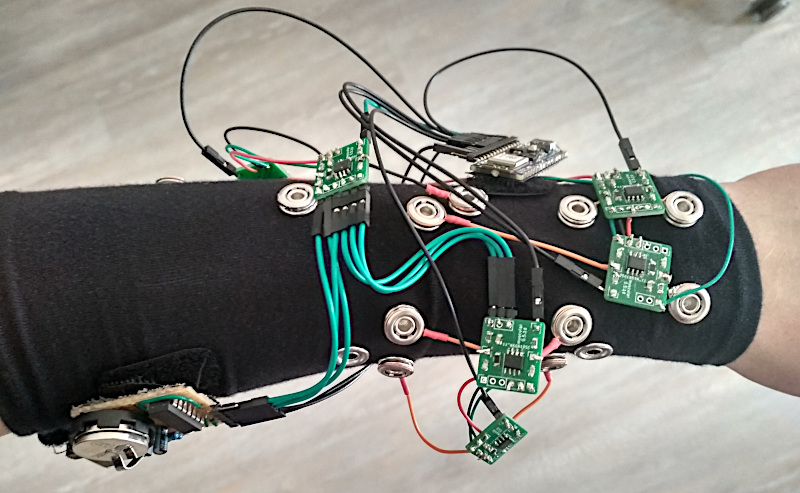
photo of the device

  • Features:
    • Battery-powered
    • Wireless, using Bluetooth Low Energy (BLE)
    • Supports 17 electrodes (8 pairs + 1 ground)
    • Transmits 8 signals at 8-bit resolution, 500Hz sampling rate
    • Linux graphical user interface for:
      • Mapping keyboard key presses to muscle signals
      • Training a neural network to predict key presses from signals
      • Simulating key presses based on neural network predictions
    • GNURadio integration for plotting the raw signals + FFT
  • Hardware overview:
  • Software dependencies:
  • Components:
  • Power ratings
    • Supply Voltage: 4.5-6V
    • Power dissipation:
      • Idle: ~86.9mW (16.9mA x 5.14V)
      • Transmitting at 6-7kB/s: 92.5mW (18.0mA x 5.14V)
  • Weight: ~85g (at 9.81m/s² gravitational acceleration)

License

Copyright (C) 2022 Roman Zimbelmann

This program is free software: you can redistribute it and/or modify it under the terms of the GNU General Public License version 3 as published by the Free Software Foundation.

This program is distributed in the hope that it will be useful, but WITHOUT ANY WARRANTY; without even the implied warranty of MERCHANTABILITY or FITNESS FOR A PARTICULAR PURPOSE. See the GNU General Public License for more details.

You should have received a copy of the GNU General Public License along with this program. If not, see https://www.gnu.org/licenses/.

Parts

56
QtyValueFootprintReferences
8100pFCapacitor_SMD:C_0805_2012Metric_Pad1.15x1.40mm_HandSolderC1, C2, C3, C4, C5, C6, C7, C8
81M/1%Resistor_SMD:R_0805_2012Metric_Pad1.15x1.40mm_HandSolderR1, R2, R3, R4, R5, R6, R7, R8
8ElectrodeMountingHole:MountingHole_3.7mm_PadEL1, EL2, EL3, EL4, EL5, EL6, EL7, EL8
8ElectrodeTestPinConnector_PinHeader_2.54mm:PinHeader_1x01_P2.54mm_VerticalEX1, EX2, EX3, EX4, EX5, EX6, EX7, EX8
8Jumper_NO_SmallJumper:SolderJumper-2_P1.3mm_Open_RoundedPad1.0x1.5mmJP1, JP2, JP3, JP4, JP5, JP6, JP7, JP8
4100nFCapacitor_SMD:C_0805_2012Metric_Pad1.15x1.40mm_HandSolderC9, C10, C11, C12
41K/1%Resistor_SMD:R_0805_2012Metric_Pad1.15x1.40mm_HandSolderR9, R10, R11, R12
4INA128Package_SO:SOIC-8_3.9x4.9mm_P1.27mmU1, U2, U3, U4
1
1OutputPinsConnector_PinHeader_2.54mm:PinHeader_1x04_P2.54mm_VerticalJ3
1PowerInputConnector_PinHeader_2.54mm:PinHeader_1x03_P2.54mm_VerticalJ1
1PowerPassThruConnector_PinHeader_2.54mm:PinHeader_1x03_P2.54mm_VerticalJ2

More from Neurotechnology-Exploration-Team/Psylink-NXT

8
  • 2 layers69.5 × 25 mmB3.2, the printed circuit board in 3D

    B3.2

    Neurotechnology-Exploration-Team/Psylink-NXT

    This is intended as a human input device (like a keyboard) that predicts your intention from muscle signals. Using a neural network, trained through a process where you press keys at the exact same time that you make…

    56 parts2GPL-3.0
  • 2 layers69.5 × 25 mmSchematics, the printed circuit board in 3D

    Schematics

    Neurotechnology-Exploration-Team/Psylink-NXT

    This is intended as a human input device (like a keyboard) that predicts your intention from muscle signals. Using a neural network, trained through a process where you press keys at the exact same time that you make…

    48 parts2GPL-3.0
  • 2 layers90 × 32.6 mmBp4.1, the printed circuit board in 3D

    Bp4.1

    Neurotechnology-Exploration-Team/Psylink-NXT

    This is intended as a human input device (like a keyboard) that predicts your intention from muscle signals. Using a neural network, trained through a process where you press keys at the exact same time that you make…

    44 parts2GPL-3.0
  • 2 layers90 × 32.6 mmBp4.2, the printed circuit board in 3D

    Bp4.2

    Neurotechnology-Exploration-Team/Psylink-NXT

    This is intended as a human input device (like a keyboard) that predicts your intention from muscle signals. Using a neural network, trained through a process where you press keys at the exact same time that you make…

    42 parts2GPL-3.0
  • 2 layers90 × 32.6 mmBp4, the printed circuit board in 3D

    Bp4

    Neurotechnology-Exploration-Team/Psylink-NXT

    This is intended as a human input device (like a keyboard) that predicts your intention from muscle signals. Using a neural network, trained through a process where you press keys at the exact same time that you make…

    39 parts2GPL-3.0
  • 2 layers47.6 × 31.3 mmCircuit9, the printed circuit board in 3D

    Circuit9

    Neurotechnology-Exploration-Team/Psylink-NXT

    This is intended as a human input device (like a keyboard) that predicts your intention from muscle signals. Using a neural network, trained through a process where you press keys at the exact same time that you make…

    26 parts2GPL-3.0
  • 2 layers47.6 × 31.3 mmBp3.1, the printed circuit board in 3D

    Bp3.1

    Neurotechnology-Exploration-Team/Psylink-NXT

    This is intended as a human input device (like a keyboard) that predicts your intention from muscle signals. Using a neural network, trained through a process where you press keys at the exact same time that you make…

    26 parts2GPL-3.0
  • 2 layers50.3 × 24.9 mmCircuit8, the printed circuit board in 3D

    Circuit8

    Neurotechnology-Exploration-Team/Psylink-NXT

    This is intended as a human input device (like a keyboard) that predicts your intention from muscle signals. Using a neural network, trained through a process where you press keys at the exact same time that you make…

    15 parts2GPL-3.0

Similar boards

  • 2 layers70.1 × 50 mmAmp board, the printed circuit board in 3D

    Amp board

    logical/telepathy

    Telepathy is a wireless eeg device.

    35 parts10
  • 2 layers182.9 × 83.8 mmSchematic3, the printed circuit board in 3D

    Schematic3

    alberto-battistel/Teensy-EIS

    Transform your teensy 3.6 (pjrc.com) into an instrument for electrochemical impedance spectroscopy.

    37 parts6GPL-3.0
  • 2 layers100 × 70 mmCPU Board, the printed circuit board in 3D

    CPU Board

    jsjolund/sailoraid

    Sensor package for the Laser Pico sail boat

    116 parts3
  • 2 layers85 × 55 mmFinal schematics, the printed circuit board in 3D

    Final schematics

    shreenandansonu/Electronic-Stethescope

    EKOBIT is an electronics stethoscope, a AFE signal board for a digital stethoscope.

    59 parts3MIT
  • 2 layers41.9 × 22 mmModular Filter 603 kicad, the printed circuit board in 3D

    Modular Filter 603 kicad

    TZeng0698/Portable-EEG-with-Modular-Pre-Filtering-for-BCI-Applications

    A Low-cost EEG BCI implementation with modular filtering card and ADS1298. The repo contains the PCB files and a guide to design your own(in progress).

    42 parts3
  • 2 layers90 × 100 mmFonte corrente bipolar V01, the printed circuit board in 3D

    Fonte corrente bipolar V01

    Pinheirogustavo/PCB_projects

    O gerador de sinais é baseado no AD9850. São gerados dois sinais senoidais e dois sinais quadrados, com banda de frequência entre 1 Hz e 40 MHz.

    56 parts2
  • 4 layers200 × 142.3 mmFRED Electrical Scheme KiCAD, the printed circuit board in 3D

    FRED Electrical Scheme KiCAD

    GiulianoAgostini04/FRED-Project

    Real-time concentration monitoring system based on frontal-lobe EEG signals. Features a custom PCB designed with TinkerCAD and KiCad, OpenBCI Ganglion and Arduino UNO for signal acquisition, display, and frequency-band…

    93 parts1MIT
  • 2 layers148 × 38.5 mmSvm, the printed circuit board in 3D

    Svm

    lucia3e8/emgsvm

    EMG-based subvocal microphone

    47 parts1

Questions

How big is the B3.1 PCB?

It measures 69.5 × 25 mm and has 2 copper layers, 1.6 mm thick.

What parts does the B3.1 use?

56 parts, built around the INA128U. The full list of its parts is on this page, with links to each part's symbol and footprint where PCBKit's library has them.

Where can I download the B3.1 KiCad files?

From the Neurotechnology-Exploration-Team/Psylink-NXT repository on GitHub, at the commit this page was made from: the board is schematics/b3.1.kicad_pcb. PCBKit opens the board in the browser, with nothing to install.

Can I use the B3.1 design in my own project?

Its repository publishes it under the GPL-3.0 licence: you may reuse it on that licence's terms (keep the author's notice, and for a copyleft licence share your changes alike).