2 layers46 × 45 mm
NeuroBytes NID
NeuroTinker/NeuroBytes_NID
The Network Interface Device, or NID, is used to connect an Android tablet or phone to a NeuroBytes network, using UART and SWD depending on desired function.
64 parts

 NeuroTinker/NeuroBytes_NID
The Network Interface Device, or NID, is used to connect an Android tablet or phone to a NeuroBytes network, using UART and SWD depending on desired function.
NeuroBytes NID Enclosed is an open-source printed circuit board by NeuroTinker, from the NeuroTinker/NeuroBytes_NID repository on GitHub. It is a 2-layer board of 31.8 × 72.2 mm with 74 parts on 70 nets, routed with 523 tracks and 95 vias.
It is built around the RCLAMP0503F.TCT, TPS2550DBV and MMBT3904. Its parts include 19 capacitors, 17 resistors, 8 connectors, 5 diodes and 5 inductors. It belongs with the interfaces and adapters boards and the STM32 boards of this library.


The NeuroBytes Network Interface Device is an open-source hardware device designed and sold by NeuroTinker, LLC.
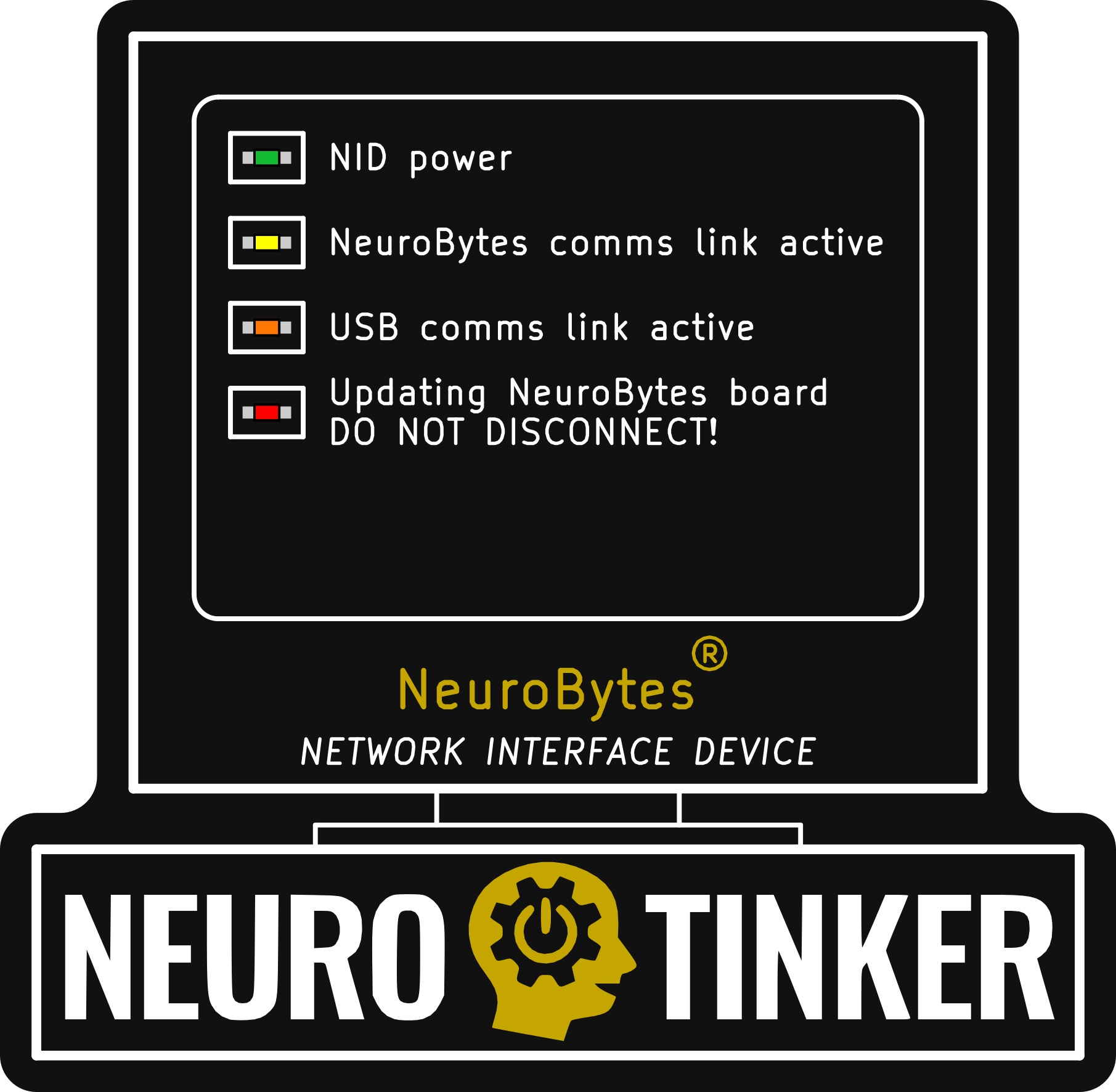
The Network Interface Device, or NID, is used to connect an Android tablet or phone to a NeuroBytes network, using UART and SWD depending on desired function. The NID hardware in conjunction with the NeuroBytes Network Explorer app performs a number of functions, including:
The NID is based on the STM32F103 microcontroller and is derived from the Black Magic Probe, a product developed and sold by Black Sphere Technologies. Black Magic Probe firmware is used primarily for its GDB functions (such as pulling NeuroBytes board fingerprints from flash to identify type and revision); additional code is included to control the NID's LEDs and beeper, and to handle other NeuroBytes-specific tasks.
This product was designed in KiCad and Inkscape and is released under the terms of the Creative Commons Attribution-ShareAlike 4.0 license, available here: http://creativecommons.org/licenses/by-sa/4.0/. The NeuroBytes Network Interface Device is Certified Open Source Hardware as defined by OSHWA, certification number US000115.


| Qty | Value | Footprint | References |
|---|---|---|---|
| 10 | 100n | KiCad_Footprints:ZF_SMD_NonPol_0402_cap | C1, C2, C3, C4, C8, C10, C14, C17, C18, C19 |
| 7 | R | KiCad_Footprints:ZF_SMD_NonPol_0402 | R10, R11, R12, R13, R14, R16, R17 |
| 4 | 1u | KiCad_Footprints:ZF_SMD_NonPol_0603 | C9, C11, C12, C15 |
| 3 | Conn_01x03 | KiCad_Footprints:ZF_CONN_SERVO_HDR_SMT | J2, J5, J7 |
| 3 | Conn_01x03_Female | KiCad_Footprints:ZF_CONN_FHDR_SMD_3 | J4, J6, J8 |
| 3 | Ferrite_Bead | KiCad_Footprints:ZF_SMD_NonPol_0603 | L3, L4, L5 |
| 2 | 10k | KiCad_Footprints:ZF_SMD_NonPol_0402 | R6, R8 |
| 2 | 1k | KiCad_Footprints:ZF_SMD_NonPol_0402 | R9, R15 |
| 2 | 22R | KiCad_Footprints:ZF_SMD_NonPol_0402 | R4, R5 |
| 2 | 47p | KiCad_Footprints:ZF_SMD_NonPol_0402_cap | C6, C7 |
| 2 | 4u7 | KiCad_Footprints:ZF_SMD_NonPol_0603 | C5, C13 |
| 2 | Ferrite_Bead | KiCad_Footprints:ZF_SMD_nonpol_1206 | L1, L2 |
| 1 | 100u | KiCad_Footprints:ZF_SMD_nonpol_1210 | C16 |
| 1 | 1k5 | KiCad_Footprints:ZF_SMD_NonPol_0402 | R1 |
| 1 | 243k | KiCad_Footprints:ZF_SMD_NonPol_0402 | R3 |
| 1 | 2N7002 | KiCad_Footprints:ZF_SOT23-3L | Q2 |
| 1 | 3v3 | KiCad_Footprints:ZF_CONN_1-5mm_pad | TP5 |
| 1 | 57k6 | KiCad_Footprints:ZF_SMD_NonPol_0402 | R7 |
| 1 | 8 MHz | KiCad_Footprints:ZF_XTAL_CSTCE_G | Y1 |
| 1 | CONN_01X05 | KiCad_Footprints:ZF_CONN_JST_GH_5POS | J1 |
| 1 | D | KiCad_Footprints:ZF_SMD_pol_0805 | D5 |
| 1 | EMI_Filter_LL-rev | KiCad_Footprints:ZF_SMD_CMC_0805 | FL1 |
| 1 | GND | KiCad_Footprints:ZF_CONN_1-5mm_pad | TP4 |
| 1 | JMP | KiCad_Footprints:ZF_SMD_NonPol_0402 | R2 |
| 1 | LD3985G | KiCad_Footprints:ZF_SOT23-5L | U3 |
| 1 | LED_NB | KiCad_Footprints:ZF_SMD_NonPol_0402 | D2 |
| 1 | LED_POWER | KiCad_Footprints:ZF_SMD_NonPol_0402 | D1 |
| 1 | LED_PROG | KiCad_Footprints:ZF_SMD_NonPol_0402 | D4 |
| 1 | LED_USB | KiCad_Footprints:ZF_SMD_NonPol_0402 | D3 |
| 1 | LOGO | KiCad_Footprints:ZF_LOGO_OSHW | G*** |
| 1 | LOGO | KiCad_Footprints:ZF_LOGO_MN_justmask | G*** |
| 1 | MMBT3904 | KiCad_Footprints:ZF_SOT23-3L | Q1 |
| 1 | NRST | KiCad_Footprints:ZF_CONN_1-5mm_pad | TP1 |
| 1 | RClamp0503F | KiCad_Footprints:ZF_SMD_SOT-353 | U4 |
| 1 | STM32F103CBUx | KiCad_Footprints:ZF_IC_UFQFPN48 | U2 |
| 1 | SWCLK | KiCad_Footprints:ZF_CONN_1-5mm_pad | TP2 |
| 1 | SWDIO | KiCad_Footprints:ZF_CONN_1-5mm_pad | TP3 |
| 1 | Speaker_Crystal | KiCad_Footprints:ZF_Piezo_PKMCS | LS1 |
| 1 | TPS2550 | KiCad_Footprints:ZF_SOT23-6L | U1 |
| 1 | USB_OTG | KiCad_Footprints:ZF_CONN_USB-MICRO-B-SMD | J3 |
The 70 most common of 74 parts.
NeuroTinker/NeuroBytes_NID
The Network Interface Device, or NID, is used to connect an Android tablet or phone to a NeuroBytes network, using UART and SWD depending on desired function.

NeuroTinker/NeuroBytes_NID
The Network Interface Device, or NID, is used to connect an Android tablet or phone to a NeuroBytes network, using UART and SWD depending on desired function.

NeuroTinker/NeuroBytes_NID
The Network Interface Device, or NID, is used to connect an Android tablet or phone to a NeuroBytes network, using UART and SWD depending on desired function.

NeuroTinker/NeuroBytes_Force_Sensor
All NeuroBytes products are based on the ST32L0x series of ARM Cortex-M0+ 32-bit microcontrollers. The boards were designed in KiCad and Inkscape and are released under the terms of the Creative Commons…

NeuroTinker/NeuroBytes_Motor_Neuron
All NeuroBytes products are based on the ST32L0x series of ARM Cortex-M0+ 32-bit microcontrollers. The boards were designed in KiCad and Inkscape and are released under the terms of the Creative Commons…

NeuroTinker/NeuroBytes_Tonic_Neuron
All NeuroBytes products are based on the ST32L0x series of ARM Cortex-M0+ 32-bit microcontrollers. The boards were designed in KiCad and Inkscape and are released under the terms of the Creative Commons…


vincentBenet/keyboard_steamdeck
This project aim to create a minimalist custom keyboard using standard keycaps. The goal is to have no keys restriction compare to a 120% keyboard.

NeuroTinker/NeuroBytes_Photoreceptor
All NeuroBytes products are based on the ST32L0x series of ARM Cortex-M0+ 32-bit microcontrollers. The boards were designed in KiCad and Inkscape and are released under the terms of the Creative Commons…

TalismanDesign/PocketMage_PDA
An E-Ink PDA device using the ESP32 S3.

fossasia/pslab-hardware
PSLab Hardware Design and Schematics https://pslab.io
It measures 31.8 × 72.2 mm and has 2 copper layers, 1.6 mm thick.
74 parts, built around the RCLAMP0503F.TCT, TPS2550DBV and MMBT3904. The full list of its parts is on this page, with links to each part's symbol and footprint where PCBKit's library has them.
From the NeuroTinker/NeuroBytes_NID repository on GitHub, at the commit this page was made from: the board is HARDWARE/Enclosed/NeuroBytes_NID_Enclosed.kicad_pcb. PCBKit opens the board in the browser, with nothing to install.
Its repository states no licence, so its author keeps all rights: ask NeuroTinker before reusing the design.