2 layers127 × 69.9 mm
Ezcgi
baldengineer/bit-preserve
Project for capturing vintage, classic, aka old computer schematics in KiCad.
34 parts446
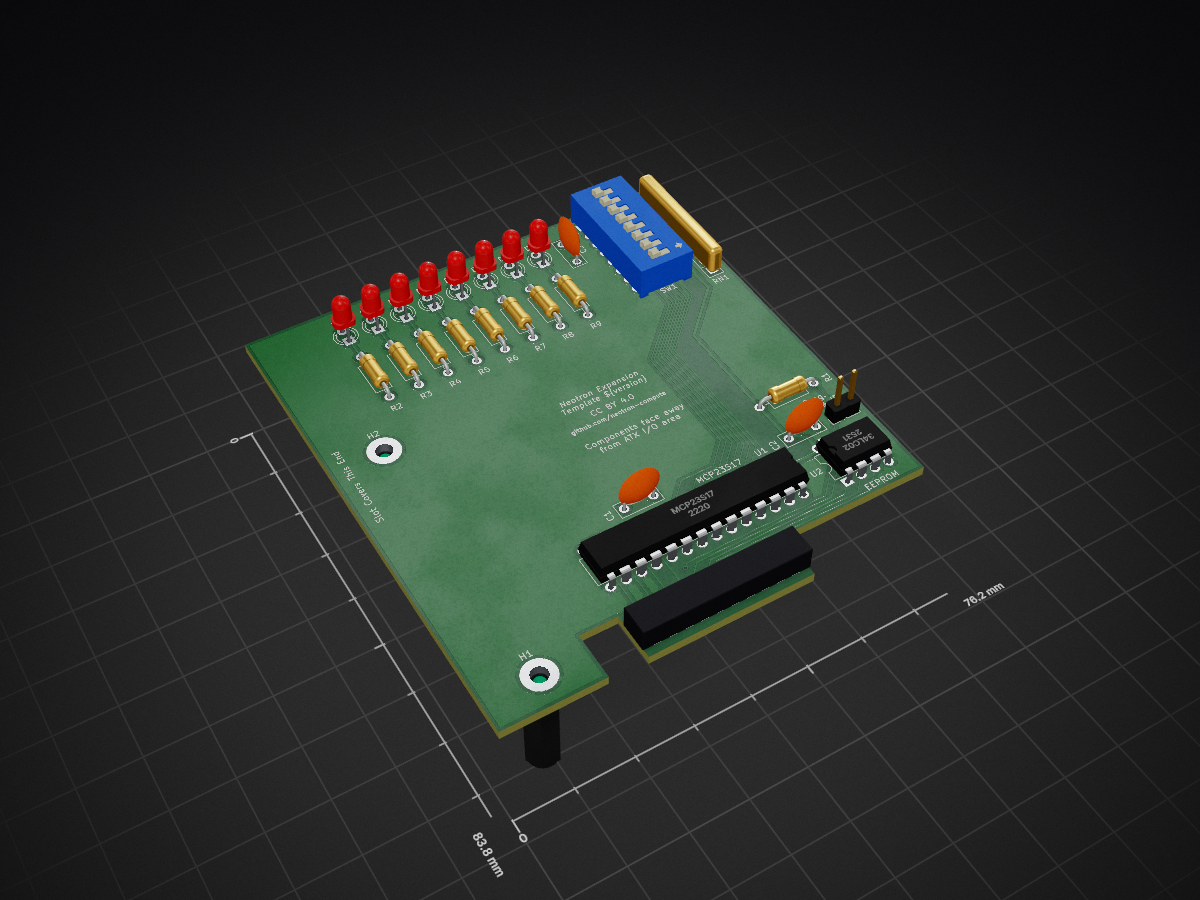
 Neotron-Compute/Neotron-Expansion-Template1
Example Neotron Expansion card
Neotron Expansion Template is an open-source printed circuit board by Neotron-Compute, from the Neotron-Compute/Neotron-Expansion-Template repository on GitHub. It is a 2-layer board of 76.2 × 83.8 mm with 28 parts on 40 nets, routed with 212 tracks and 5 vias.
It is built around the 34LC02-I/P, MCP23S17-E/SP and CF14JT330R, with the C315C104M5U5TA, CF14JT10K0 and 4609X-101-103LF among its other parts. Its parts include 9 resistors, 8 diodes, 3 capacitors, 2 ICs and 1 connector.


This repository contains a template PCB you can use as the start of a new Neotron Expansion Card design.
It contains an MCP23S17 SPI I/O expander, connected to the SPI bus. It also contains an I²C EEPROM connected to the I²C bus and the unique slot address lines. The I/O expander has eight LEDs and eight switches fitted.
There is a jumper which will allow you to program the EEPROM from your Neotron system. Normally this jumper is not fitted, making the EEPROM read-only. The contents of the EEPROM are TBD, but will describe the expansion card to the Neotron OS so that it can be auto-configured and any necessary drivers loaded.
To use this template, simply copy the files in this repository and edit away! You'll probably want to delete everything on the schematic except the edge connector and the EEPROM (unless you really need an SPI I/O exander...).
This schematic and PCB design is Copyright (c) 2022 The Neotron Developers, et al.

This work is licensed under a Creative Commons Attribution 4.0 International License.
Unless you explicitly state otherwise, any contribution intentionally submitted for inclusion in the work by you, as defined in the Apache-2.0 license, shall be licensed as above, without any additional terms or conditions.
| Qty | Value | Footprint | References |
|---|---|---|---|
| 8 | 330 | Resistor_THT:R_Axial_DIN0207_L6.3mm_D2.5mm_P10.16mm_Horizontal | R2, R3, R4, R5, R6, R7, R8, R9 |
| 8 | LED | LED_THT:LED_D3.0mm | D1, D2, D3, D4, D5, D6, D7, D8 |
| 3 | 100n | Capacitor_THT:C_Disc_D7.0mm_W2.5mm_P5.00mm | C1, C2, C3 |
| 2 | MountingHole_Pad | MountingHole:MountingHole_2.7mm_M2.5_Pad | H1, H2 |
| 1 | 10k | Resistor_THT:R_Axial_DIN0207_L6.3mm_D2.5mm_P10.16mm_Horizontal | R1 |
| 1 | 10k | Resistor_THT:R_Array_SIP9 | RN1 |
| 1 | 34LC02 | Package_DIP:DIP-8_W7.62mm | U2 |
| 1 | MCP23S17 | Package_DIP:DIP-28_W7.62mm | U1 |
| 1 | Neotron-Expansion-Edge | Neotron-Common-Hardware:Neotron-Expansion-Edge | J1 |
| 1 | SW_DIP_x08 | Package_DIP:DIP-16_W7.62mm_LongPads | SW1 |
| 1 | Two-way Jumper | Connector_PinHeader_2.54mm:PinHeader_1x02_P2.54mm_Vertical | JP1 |
baldengineer/bit-preserve
Project for capturing vintage, classic, aka old computer schematics in KiCad.

dennowiggle/ESP32_Interface
Facilitate learning the Z80 Retro! hardware and software.


Neotron-Compute/Neotron-Common-Hardware
Contains KiCad footprints and symbols shared across multiple Neotron projects.


ChromiumOS-Guy/ZVS-Driver
A ZVS Driver (1-Layer) PCB I Designed so I can use a PCB instead of making a mess of wires

Engineering-House/Project-Synthia
The programs used are as follows: - STMCube32MX - Visual Studio Code - STM32CubeIDE for Visual Studio Code (Extension Pack)

gloveboxes/pcb-z80
pcb-z80 is a container-only, repeatable build of the four-layer Z80 ROMless SBC PCB engineering design. It regenerates the KiCad schematic, places the four-layer board, routes a fresh Specctra session, imports and fills…
It measures 76.2 × 83.8 mm and has 2 copper layers, 1.6 mm thick.
28 parts, built around the 34LC02-I/P, MCP23S17-E/SP, CF14JT330R and C315C104M5U5TA. The full list of its parts is on this page, with links to each part's symbol and footprint where PCBKit's library has them.
From the Neotron-Compute/Neotron-Expansion-Template repository on GitHub, at the commit this page was made from: the board is Kicad/Neotron-Expansion-Template.kicad_pcb and its schematic Kicad/Neotron-Expansion-Template.kicad_sch. PCBKit opens the board in the browser, with nothing to install.
Its repository states no licence, so its author keeps all rights: ask Neotron-Compute before reusing the design.