2 layers32 × 40 mm
Fork placed backup
MLeggiero/taxelscan
TaxelScan reads a 16 × 32 pressure surface (512 taxels) at 80 frames per second by default and has been measured at 200 fps.
12 partsMIT

 MLeggiero/taxelscan
TaxelScan reads a 16 × 32 pressure surface (512 taxels) at 80 frames per second by default and has been measured at 200 fps.
Routed final is an open-source printed circuit board by MLeggiero, from the MLeggiero/taxelscan repository on GitHub, published under the MIT licence. It is a 4-layer board of 52 × 46 mm with 27 parts on 87 nets, routed with 1,006 tracks and 178 vias.
It is built around the TLV9062ID, 74LVC595AD and CD74HC4067SM96. Its parts include 9 capacitors, 7 ICs, 5 resistors and 2 connectors. It belongs with the RP2350 boards of this library.


An open reader board and embedded conditioning stack for flexible Velostat tactile matrices.
TaxelScan reads a 16 × 32 pressure surface (512 taxels) at 80 frames per second by default and has been measured at 200 fps. A XIAO RP2350 turns the raw matrix into a cleaned pressure map and contact records—area, force proxy, peak, centroid, and bounds—before the data reaches the host.
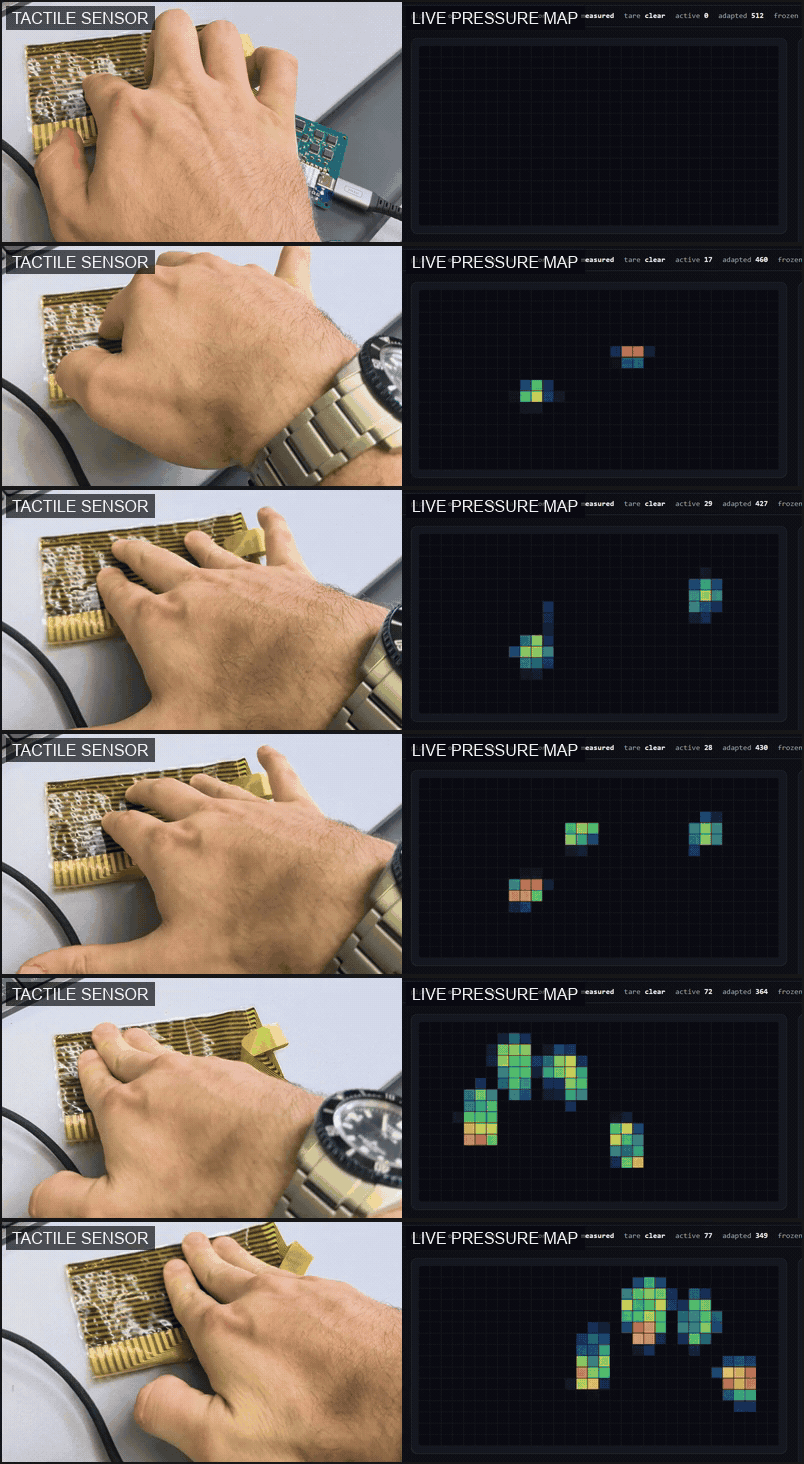
The project is more than a matrix multiplexer. Its main contribution is the combination of a purpose-built analog readout and a contact-safe conditioning pipeline that handles electronic drift, Velostat creep, impulses, and isolated phantoms without absorbing a sustained grasp.
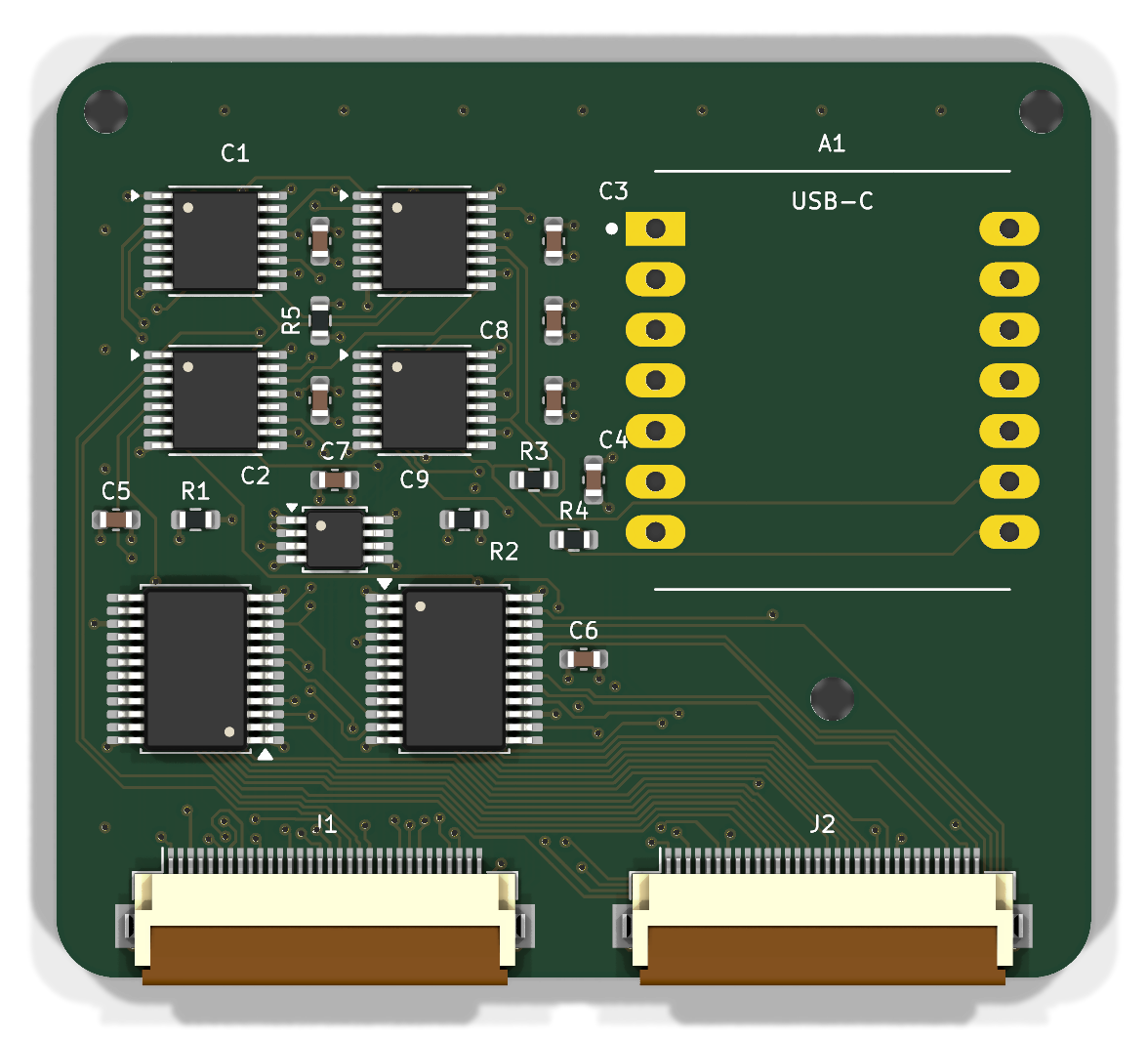
| Block | Implementation |
|---|---|
| Controller | Seeed XIAO RP2350; 12-bit ADC; USB-C |
| Row drive | 4 × SN74LVC595A, 32 actively driven rows |
| Column readout | 2 × CD74HC4067, 32 columns across two ADC banks |
| Analog front end | 3.3 kΩ sense pulldowns and TLV9062 unity-gain buffers |
| Sensor interface | Two 32-way, 0.5 mm FFC connectors |
| PCB | Four layers with dedicated ground and power planes |
Unselected rows remain actively low, so matrix sneak paths terminate at a low impedance instead of floating. The LVC row drivers also retain their output level under the combined current of a heavily loaded row; that prevents drive sag from appearing as lost pressure.
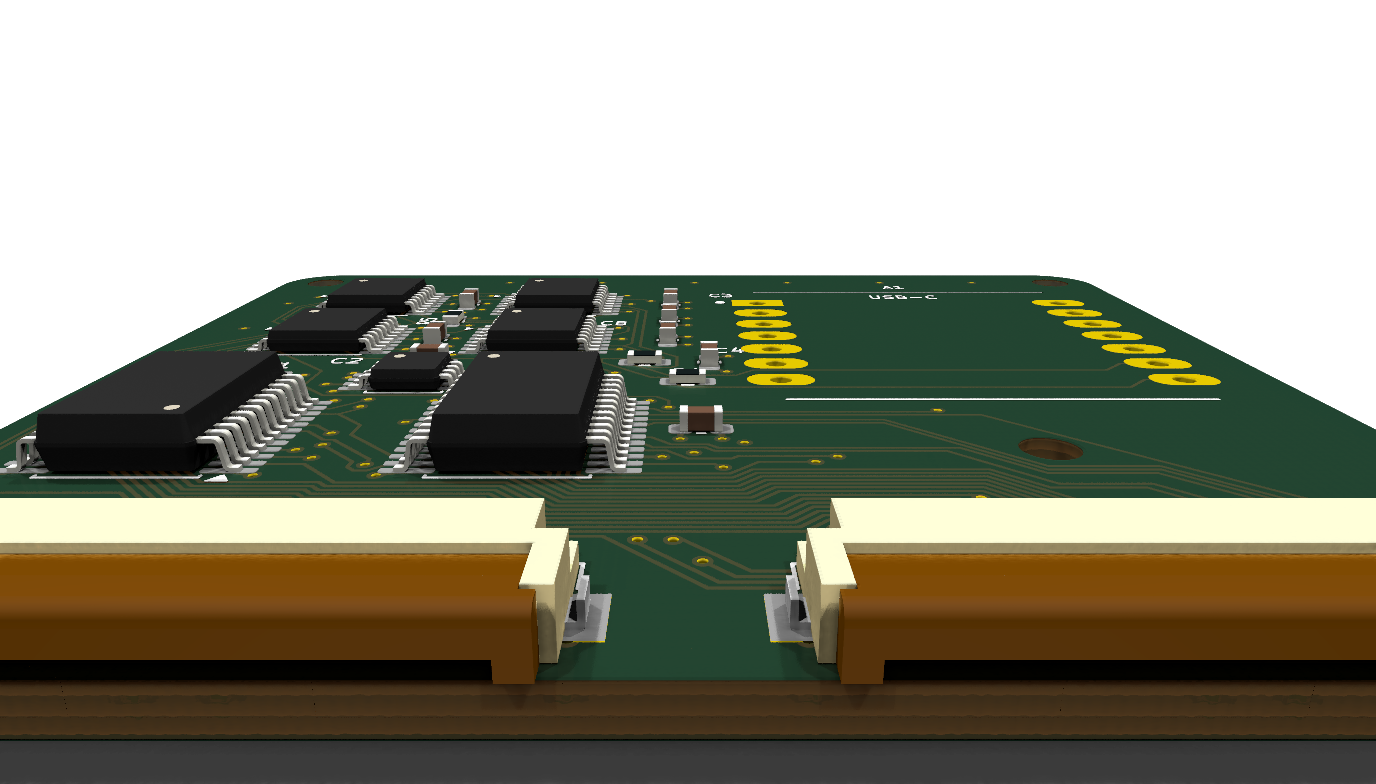
The KiCad project includes the schematic, routed PCB, production Gerbers, BOM, placement data, and a passive two-finger fork adapter.
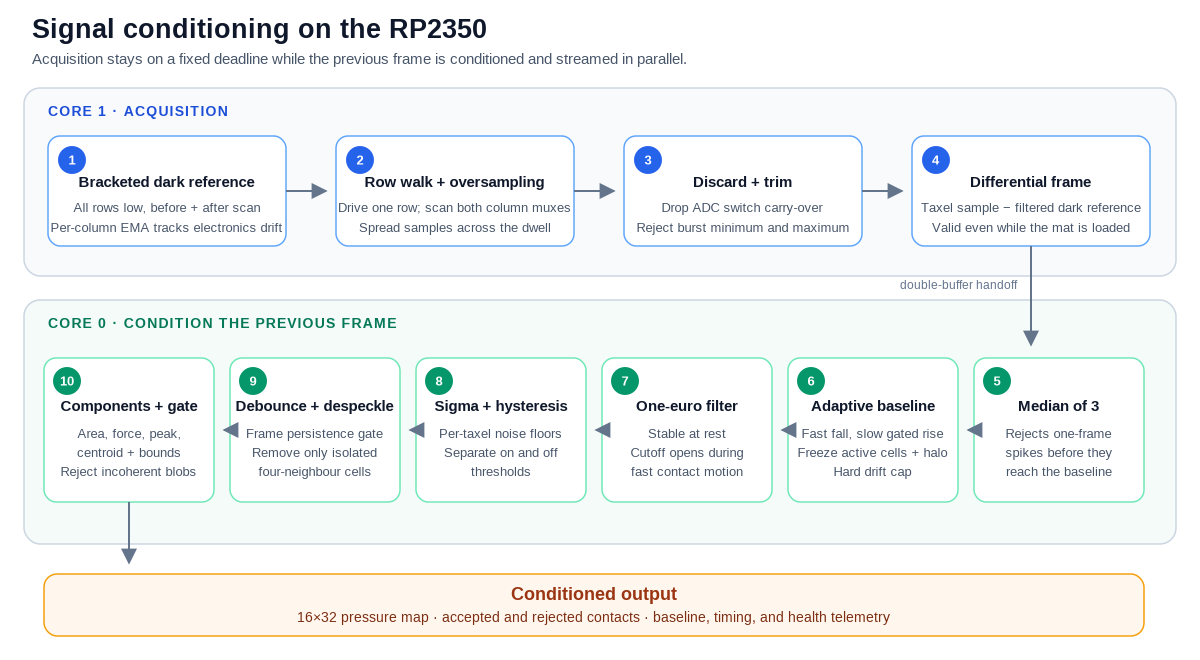
Core 1 scans on a fixed deadline while core 0 conditions and transmits the previous frame. The scan therefore keeps a stable sample clock even when USB or the host stalls.
Three details carry most of the design:
At the default 12.5 ms frame period, the measured 16 × 32 scan takes 10.86 ms and conditioning takes 1.76 ms on the other core. The fastest measured setting completed 2,999 frames in 15 seconds at 200 fps with no new overruns. See the firmware documentation for the full timing table, calibration procedure, diagnostics, runtime options, protocol, and simulator results.
board/           KiCad reader board, manufacturing files, BOM, renders
fork-adapter/    Passive two-finger sensor adapter
firmware/        RP2350 firmware, native simulator, host tools
assets/          README animation and pipeline diagram
The board and firmware are working hardware, and all performance numbers above were measured rather than estimated. One tested assembly still has imperfect column-tail seating; the no-press connectivity sweep and troubleshooting steps are documented in firmware/README.md. The live viewer and protocol tools are covered in firmware/tools/README.md.
cd firmware
arduino-cli compile --fqbn rp2040:rp2040:seeed_xiao_rp2350 --build-path "$PWD/build" taxelscan
arduino-cli upload -p COM10 --fqbn rp2040:rp2040:seeed_xiao_rp2350 --input-dir "$PWD/build" taxelscan
python tools/taxelscan_live.py --port COM10
The viewer serves the live heatmap at http://localhost:8000.
The sensor pads, electrode geometry, and original readout topology come from the FlexiTac project. TaxelScan is an independent reader board and firmware implementation. The repository is MIT licensed; see LICENSE.
| Qty | Value | Footprint | References |
|---|---|---|---|
| 8 | 100nF | C_0603_1608Metric | C1, C2, C3, C4, C5, C6, C7, C8 |
| 4 | 74LVC595A | TSSOP-16_4.4x5mm_P0.65mm | U1, U2, U3, U4 |
| 3 | MountingHole_2.2mm_M2 | MountingHole_2.2mm_M2 | H1, H2, H3 |
| 2 | 3.3k | R_0603_1608Metric | R1, R2 |
| 2 | 33R | R_0603_1608Metric | R3, R4 |
| 2 | CD74HC4067SM | SSOP-24_5.3x8.2mm_P0.65mm | U5, U6 |
| 2 | FFC_32P_0.5mm | FFC_0.5mm_FH12_32_16_12way_Composite | J1, J2 |
| 1 | 0R | R_0603_1608Metric | R5 |
| 1 | 10uF | C_0603_1608Metric | C9 |
| 1 | TLV9062 | MSOP-8_3x3mm_P0.65mm | U7 |
| 1 | XIAO_RP2350 | XIAO_RP2350_Hybrid_Castellated_or_Header | A1 |
MLeggiero/taxelscan
TaxelScan reads a 16 × 32 pressure surface (512 taxels) at 80 frames per second by default and has been measured at 200 fps.

ms0216/hhkb-split
HHKB Professional HYBRID Type-S の使い勝手を再現する完全分割型キーボード(ZMK / XIAO nRF52840 / build123d による寸法駆動CAD)

roberto314/Unicomp2
A modular 8-bit Computer able to recreate (nearly) every Retro computer of the late 70s to mid 80s.

roberto314/Unicomp3
A modular 8-bit Computer able to recreate (nearly) every Retro computer of the late 70s to mid 80s.

Gokasimov/STM32-FOC-Control
A completely from-scratch, bare-metal implementation of Field-Oriented Control (FOC) tailored for ultra-low inductance (3 µH) drone motors (e.g., A2212).


embedded-pro/e-foc-hardware
hardware to be used with https://github.com/embedded-pro/e-foc
It measures 52 × 46 mm and has 4 copper layers, 1.6 mm thick.
27 parts, built around the TLV9062ID, 74LVC595AD and CD74HC4067SM96. The full list of its parts is on this page, with links to each part's symbol and footprint where PCBKit's library has them.
From the MLeggiero/taxelscan repository on GitHub, at the commit this page was made from: the board is board/outputs/routed_final.kicad_pcb and its schematic board/taxelscan.kicad_sch. PCBKit opens the board in the browser, with nothing to install.
Its repository publishes it under the MIT licence: you may reuse it on that licence's terms (keep the author's notice, and for a copyleft licence share your changes alike).