2 layers96 × 70 mm

 Incomprehensible/Mad_PlantBug1
DIY and open source soil moisture sensor 🪴
Mad PlantBug is an open-source printed circuit board by Incomprehensible, from the Incomprehensible/Mad_PlantBug repository on GitHub, published under the MIT licence. It is a 2-layer board of 30 × 126.9 mm with 41 parts on 49 nets, routed with 240 tracks and 54 vias.
It is built around the TLV333IDBVR-MS, TMP102AIDRLR(UMW) and ALS-PDIC15-21B/TR8, with the MSK12C02, 1N5819WS and AO3401A among its other parts. Its parts include 15 resistors, 6 capacitors, 4 diodes, 3 ICs and 3 switches. It belongs with the home automation and IoT and sensors and measurement boards of this library.


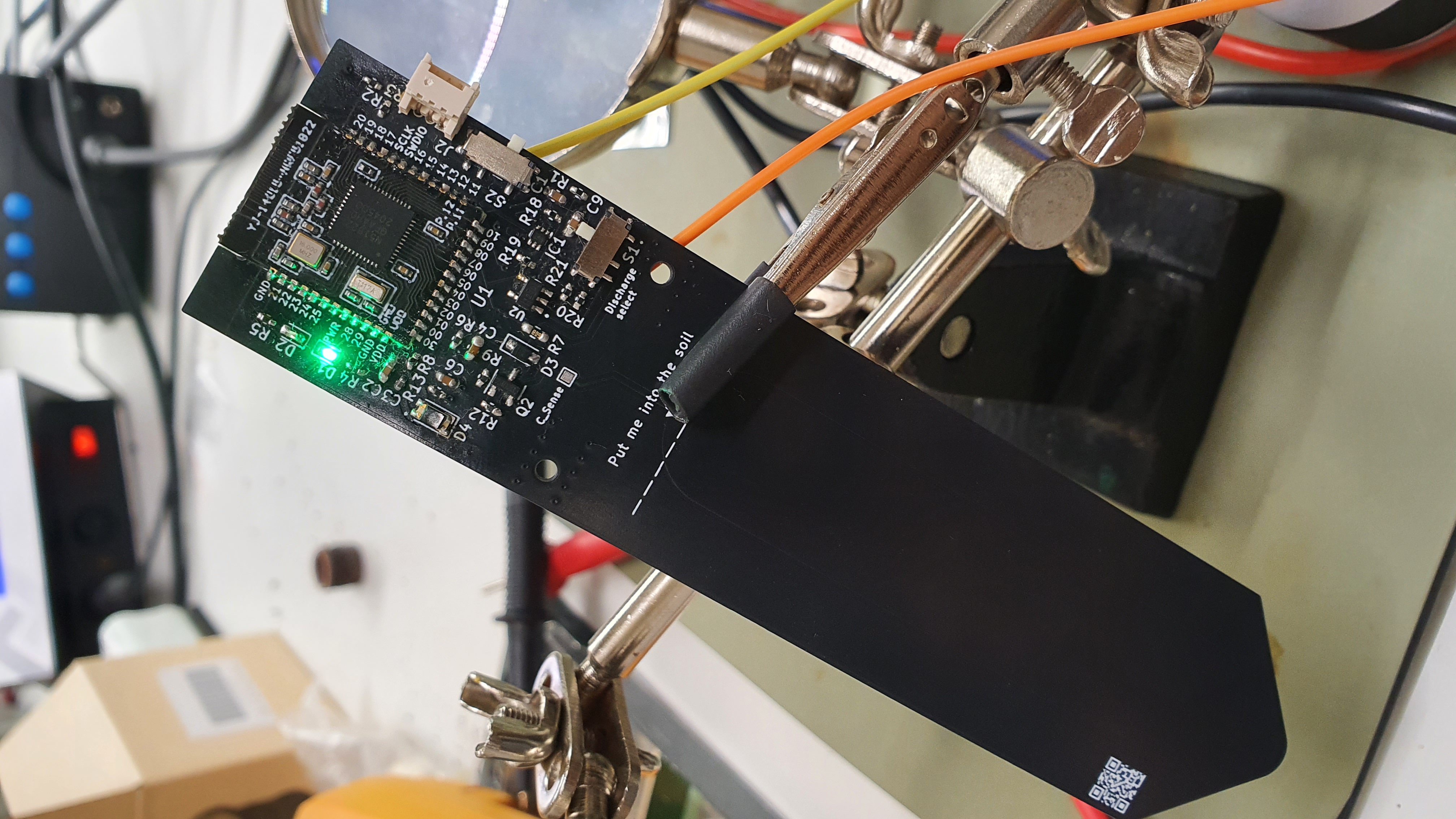
Low-power capacitive soil moisture sensor with BLE connectivity.
| Top | Bottom |
|---|---|
 |  |
This sensor determines the amount of soil moisture by measuring changes in capacitance of the probe submerged in soil.
Insertable part forms a parasitic coplanar capacitor which uses soil as a dielectric medium.
As the environment around the capacitor changes depending on whether the soil becomes wetter or drier, so does it capacitance.
Together with a resistance the probe forms an RC low-pass filter.
Changes in capacitance shape the output waveform observed by the sensor.
Measurement pipeline logic is as follows:
environment changes -> capacitance changes -> cutoff frequency changes -> peak amplitude changes
| Qty | Value | Footprint | References |
|---|---|---|---|
| 3 | R_Pullup | Resistor_SMD:R_0402_1005Metric_Pad0.72x0.64mm_HandSolder | R1, R18, R19 |
| 2 | MSK12C02 | Mad_PlantBug:MSK12C02 | S1, S2 |
| 2 | R_Div | Resistor_SMD:R_0402_1005Metric_Pad0.72x0.64mm_HandSolder | R20, R21 |
| 2 | R_Inrush | Resistor_SMD:R_0402_1005Metric_Pad0.72x0.64mm_HandSolder | R5, R9 |
| 2 | R_Pulldown | Resistor_SMD:R_0402_1005Metric_Pad0.72x0.64mm_HandSolder | R3, R12 |
| 1 | 1N5819WS | Mad_PlantBug:D_SOD-323_HandSoldering | D3 |
| 1 | ALIVE_LED | LED_SMD:LED_0603_1608Metric | D2 |
| 1 | ALS-PDIC15-21B | Mad_PlantBug:ALS-PDIC15-21BTR8 | D4 |
| 1 | AO3401A | Package_TO_SOT_SMD:SOT-23 | Q1 |
| 1 | C_Bypass | Capacitor_SMD:C_0603_1608Metric_Pad1.08x0.95mm_HandSolder | C9 |
| 1 | C_Debounce | Capacitor_SMD:C_0603_1608Metric | C1 |
| 1 | C_Dec | Capacitor_SMD:C_0603_1608Metric_Pad1.08x0.95mm_HandSolder | C2 |
| 1 | C_Dec | Capacitor_SMD:C_0603_1608Metric | C6 |
| 1 | C_Hold | Capacitor_SMD:C_0603_1608Metric | C4 |
| 1 | C_extra | Capacitor_SMD:C_0402_1005Metric | C3 |
| 1 | Conn_01x03 | Mad_PlantBug:MOLEX_530480310 | J2 |
| 1 | LOGO | Mad_PlantBug:brain_logo | G*** |
| 1 | MY-2032-08 | Mad_PlantBug:MY203208 | H1 |
| 1 | PTS526 | Mad_PlantBug:PTS526SK15SMTR2LFS | S3 |
| 1 | PWR_LED | LED_SMD:LED_0603_1608Metric | D1 |
| 1 | RXI | TestPoint:TestPoint_Pad_1.0x1.0mm | TP3 |
| 1 | R_Discharge | Resistor_SMD:R_0402_1005Metric_Pad0.72x0.64mm_HandSolder | R6 |
| 1 | R_Dump | Resistor_SMD:R_0402_1005Metric_Pad0.72x0.64mm_HandSolder | R2 |
| 1 | R_Led | Resistor_SMD:R_0402_1005Metric_Pad0.72x0.64mm_HandSolder | R4 |
| 1 | R_Sense | Resistor_SMD:R_0603_1608Metric_Pad0.98x0.95mm_HandSolder | R7 |
| 1 | R_Sense | Resistor_SMD:R_0402_1005Metric_Pad0.72x0.64mm_HandSolder | R13 |
| 1 | R_protect | Resistor_SMD:R_0402_1005Metric_Pad0.72x0.64mm_HandSolder | R8 |
| 1 | TLV333IDBVR | Mad_PlantBug:TLV333-SOT95P280X145-5N | U2 |
| 1 | TMP102AIDRLR | Mad_PlantBug:SOTFL50P160X60-6N | IC1 |
| 1 | TXO | TestPoint:TestPoint_Pad_1.0x1.0mm | TP2 |
| 1 | Test_C_Sense | TestPoint:TestPoint_Pad_1.0x1.0mm | TP1 |
| 1 | YJ-14015 | Mad_PlantBug:YJ-14015-Module | U1 |
| 1 | YJL2302B | Mad_PlantBug:SOT-23-3 | Q2 |
The 39 most common of 41 parts.

hackclub/OnBoard
💡 Join 1,000 teenagers and make your first PCB with a $100 grant!

deimoscontrols/deimos
Realtime data acquisition and controls ecosystem, including hardware, firmware, and software.


ma-ale/usbc_soldering_iron
synched from https://git.alemauri.eu/alema/usbc_soldering_iron


Queens-Rocket-Engineering-Team/gse-control-node
The GSE control node is the control PCB for GSE systems to integrate with launch control. This includes actuator control, fan control, and a load cell reading.

hicancan/carbentra-smart-plug
CARBENTRA smart plug: AIoT edge device for campus energy orchestration
It measures 30 × 126.9 mm and has 2 copper layers, 1.6 mm thick.
41 parts, built around the TLV333IDBVR-MS, TMP102AIDRLR(UMW), ALS-PDIC15-21B/TR8 and MSK12C02. The full list of its parts is on this page, with links to each part's symbol and footprint where PCBKit's library has them.
From the Incomprehensible/Mad_PlantBug repository on GitHub, at the commit this page was made from: the board is KiCad/Mad_PlantBug.kicad_pcb and its schematic KiCad/Mad_PlantBug.kicad_sch. PCBKit opens the board in the browser, with nothing to install.
Its repository publishes it under the MIT licence: you may reuse it on that licence's terms (keep the author's notice, and for a copyleft licence share your changes alike).