Skip to the content
2 layers110 × 220 mmFin ltm, the printed circuit board in 3D

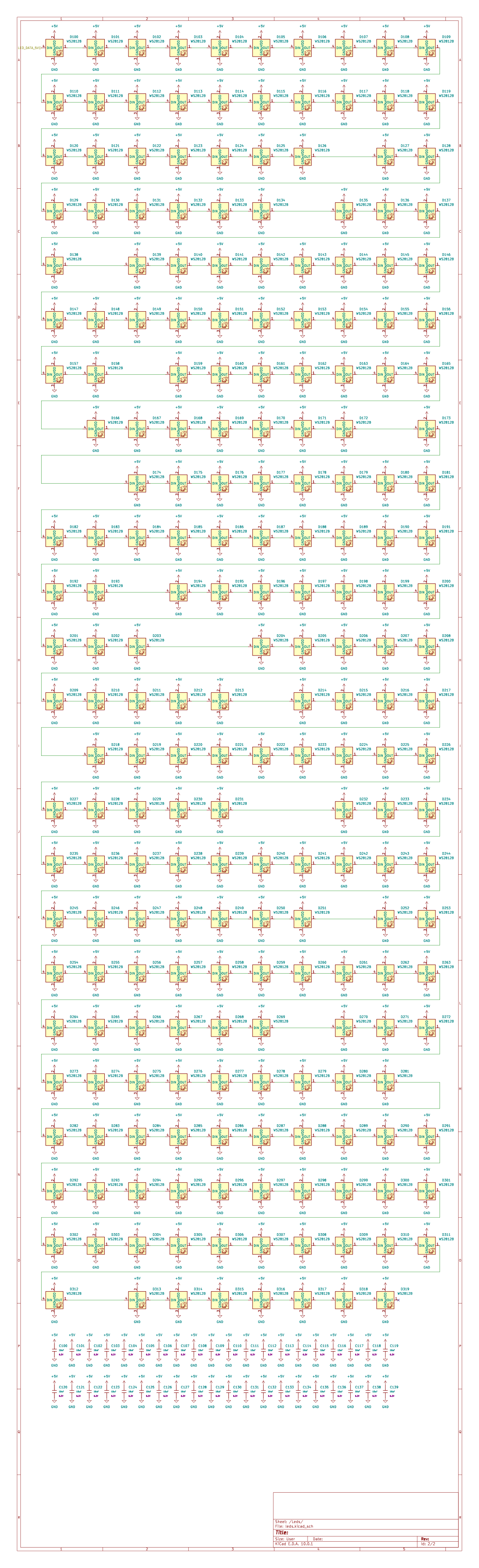
Some of the LEDs are missing because they were removed after making the initial layout

Size
110 × 220 mm
Copper layers
2
Thickness
0.92 mm
Parts
423
Nets
276
Pads
1,204
Tracks, vias
2,528, 523
Pours
4
Routed
Yes
KiCad
KiCad 10.0 (file 20260206)
Created
19 Apr 2026
Updated
3 Nov 2026

Overview

Fin ltm is an open-source printed circuit board by HekiNav, from the HekiNav/finland-live-train-map repository on GitHub, published under the MIT licence. It is a 2-layer board of 110 × 220 mm with 423 parts on 276 nets, routed with 2,528 tracks and 523 vias.

It is built around the ESP32-C3FH4, SN74LV1T34DBV and RT9080-TD, with the WS2812B, MM1W5V6 and H3V3U10B among its other parts. Its parts include 233 diodes, 61 capacitors, 17 resistors, 4 switches and 3 ICs. It belongs with the ESP32 and RISC-V boards of this library.

Main components

9

README

pcb/README.md

Back to main page

PCB Design

  • Made in KiCad with CDFER's JLCPCB KiCad library.
  • Inspiration for antenna and power system taken from CDFER's live train maps. They are very cool!
  • Designed to be fabricated and assembled by JLCPCB
    • PCBA by JLC because tiny components and hundreds of leds are hard to assemble manually. Also, LCSC components are very cheap with JLC.

Main components

  • ESP32-C3FH4 (chip)
    • 4MiB built-in flash
  • Level Shifter (3V3 data from esp to 5V led data)
  • Power management
    • USB VBUS to 5V and 3V3 rails
    • Mosfet to shut down 5V rail
  • 239 ARGB LEDs: Xinglight XL-1615RGBC-2812B-S
    • The -S version is less bright and cheaper than the non -S version.
    • These LEDs are a cheaper alternative (knockoff) to WorldSemi WS2812Bs

KiCanvas viewer

View interactive PCB design in KiCanvas

NOTICE: KiCanvas does not properly render everything, plase hide layers User.1-User.5 to view power circuitry

Schematic
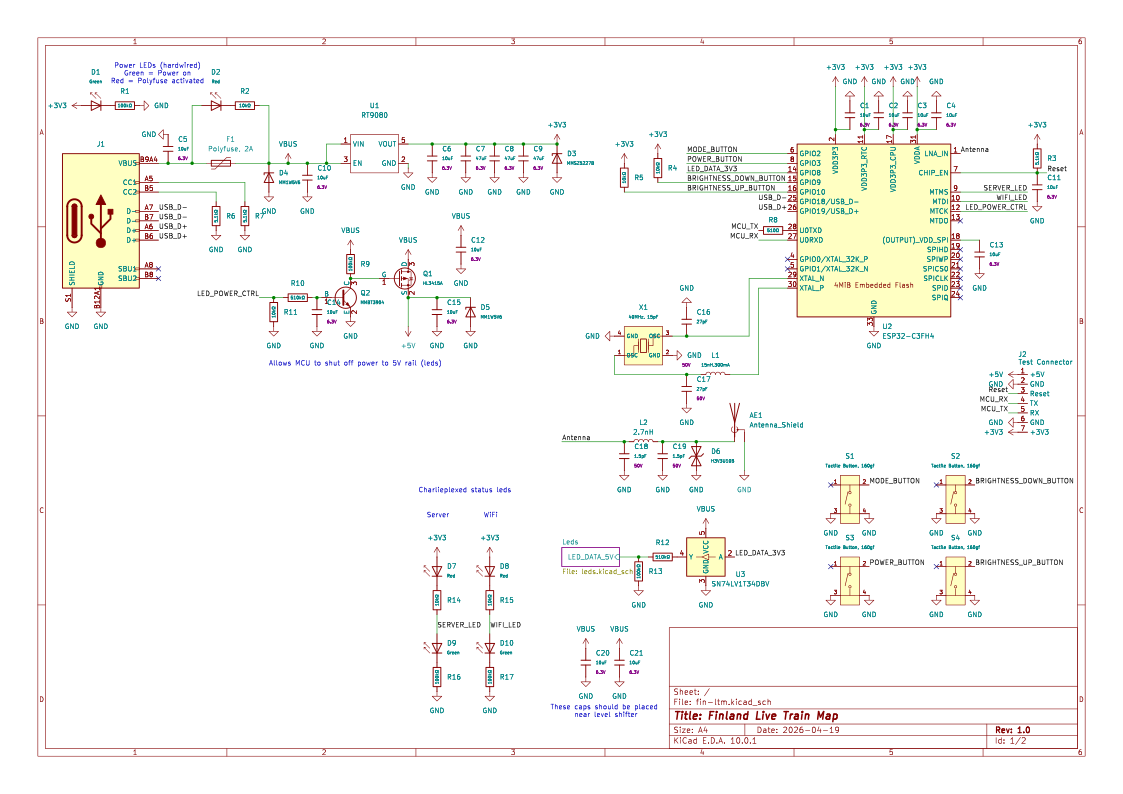
Schematic image

Some of the LEDs are missing because they were removed after making the initial layout Schematic image
Parts

423
QtyValueFootprintReferences
223WS2812BPCM_JLCPCB:LED-SMD_4P-L1.6-W1.5_XL-1615RGBC-WS2812BD100, D101, D102, D103, D104, D105, D106, D107, D108, D109, D110, D111, D112, D113, D114, D115 +207
5410uFPCM_JLCPCB:C_0402C1, C10, C11, C100, C101, C102, C103, C104, C105, C106, C107, C108, C109, C110, C111, C112 +38
610kΩPCM_JLCPCB:R_0402R2, R4, R5, R11, R14, R15
5100kΩPCM_JLCPCB:R_0402R1, R9, R13, R16, R17
4Tactile Button, 160gfPCM_JLCPCB:SW-SMD_4P-L5.1-W5.1-P3.70-LS6.5-TL-2S1, S2, S3, S4
347uFPCM_JLCPCB:C_0805C7, C8, C9
35.1kΩPCM_JLCPCB:R_0402R3, R6, R7
3GreenPCM_JLCPCB:D_0805D1, D9, D10
3RedPCM_JLCPCB:D_0805D2, D7, D8
21.5pFPCM_JLCPCB:C_0402C18, C19
227pFPCM_JLCPCB:C_0402C16, C17
2510ΩPCM_JLCPCB:R_0402R8, R12
2MM1W5V6PCM_JLCPCB:D_SOD-123D4, D5
115nH,300mAPCM_JLCPCB:L_0402L1
12.7nHPCM_JLCPCB:L_0402L2
140MHz, 15pFPCM_JLCPCB:OSC-SMD_4P-L3.2-W2.5-BL_SIT8008BIX1
1510kΩPCM_JLCPCB:R_0402R10
1Antenna_ShieldCustom:Inverted_F_Antenna_2.4Ghz_1.0mmPCB_TI_CC2430DB.prettyAE1
1Connector, USB-TYPE-C-16PPCM_JLCPCB:TYPE-C-SMD_HX-TYPE-C-16PINJ1
1ESP32-C3FH4PCM_JLCPCB:QFN-32-1EP_5x5mm_P0.5mm_EP3.7x3.7mm_ThermalViasU2
1H3V3U10BPCM_JLCPCB:D_DFN1006-2LD6
1HL3415APCM_JLCPCB:Q_SOT-23Q1
1LOGOCustom:Power_iconG***
1LOGOCustom:Brightness_1G***
1LOGOCustom:WiFi_iconG***
1LOGOCustom:Brightness_0G***
1LOGOCustom:Mode_Off_ON_iconG***
1MMBT3904PCM_JLCPCB:Q_SOT-23Q2
1MMSZ5227BPCM_JLCPCB:D_SOD-123D3
1Polyfuse, 2AFuse:Fuse_1206_3216MetricF1
1RT9080Package_TO_SOT_SMD:TSOT-23-5U1
1SN74LV1T34DBVPackage_TO_SOT_SMD:SOT-23-5U3
1Test ConnectorCustom:Test_connectorJ2
1internet_iconCustom:internet_iconG***

The 333 most common of 423 parts.

Similar boards

  • 2 layers249 × 69.5 mmHelsinki LED Train Map, the printed circuit board in 3D

    Helsinki LED Train Map

    CDFER/helsinki-live-train-map

    A physical, real-time LED map of the Auckland train network, powered by an ESP32-C3 microcontroller. Train movements are displayed using addressable RGB LEDs, with live data fetched over Wi-Fi.

    441 partsMIT
  • 2 layers330 × 300 mmMelbourne Live Train Map, the printed circuit board in 3D

    Melbourne Live Train Map

    CDFER/Melbourne-Live-Train-Map

    A curcuit board with RGB leds to show the live position of trains in Melbourne!

    1,260 parts5GPL-3.0
  • 4 layers85 × 56 mmBratwurstPower, the printed circuit board in 3D

    BratwurstPower

    Qeteshpony/BratwurstPower

    A power supply for a complete, Raspberry Pi based ADS-B Receiver Setup with independent power rails for the different components.

    143 parts1BSD-2-Clause
  • 4 layers86 × 34 mmBsl drv v1, the printed circuit board in 3D

    Bsl drv v1

    jackw01/scanlight

    A better light source for scanning color negative film

    157 parts397CERN-OHL-W-2.0
  • 4 layers92.5 × 70 mmClock, the printed circuit board in 3D

    Clock

    stevel1212-droid/stm32-rtc-climate-controller

    Kicad project of an STM32-based board climate controller utilizing an RTC module for time-scheduled environmental reading of temperature/humidity with SHT30 sensor and optional small relay for control.

    69 partsMIT
  • 4 layers114.1 × 100.2 mmPanelised, the printed circuit board in 3D

    Panelised

    pnn69/Kicad_PCB

    Schematics and PCB's designed with Kicad

    252 parts
  • 4 layers194 × 40 mmRobobouoy V4.0, the printed circuit board in 3D

    Robobouoy V4.0

    pnn69/NicE-Buoy

    This device sails autonome to a given location.

    258 parts

Questions

How big is the Fin ltm PCB?

It measures 110 × 220 mm and has 2 copper layers, 0.92 mm thick.

What parts does the Fin ltm use?

423 parts, built around the ESP32-C3FH4, SN74LV1T34DBV, RT9080-TD and WS2812B. The full list of its parts is on this page, with links to each part's symbol and footprint where PCBKit's library has them.

Where can I download the Fin ltm KiCad files?

From the HekiNav/finland-live-train-map repository on GitHub, at the commit this page was made from: the board is pcb/fin-ltm.kicad_pcb and its schematic pcb/fin-ltm.kicad_sch. PCBKit opens the board in the browser, with nothing to install.

Can I use the Fin ltm design in my own project?

Its repository publishes it under the MIT licence: you may reuse it on that licence's terms (keep the author's notice, and for a copyleft licence share your changes alike).