

2 layers41 × 59.5 mm
Edge-AI Autonomous Search and Rescue Drone System
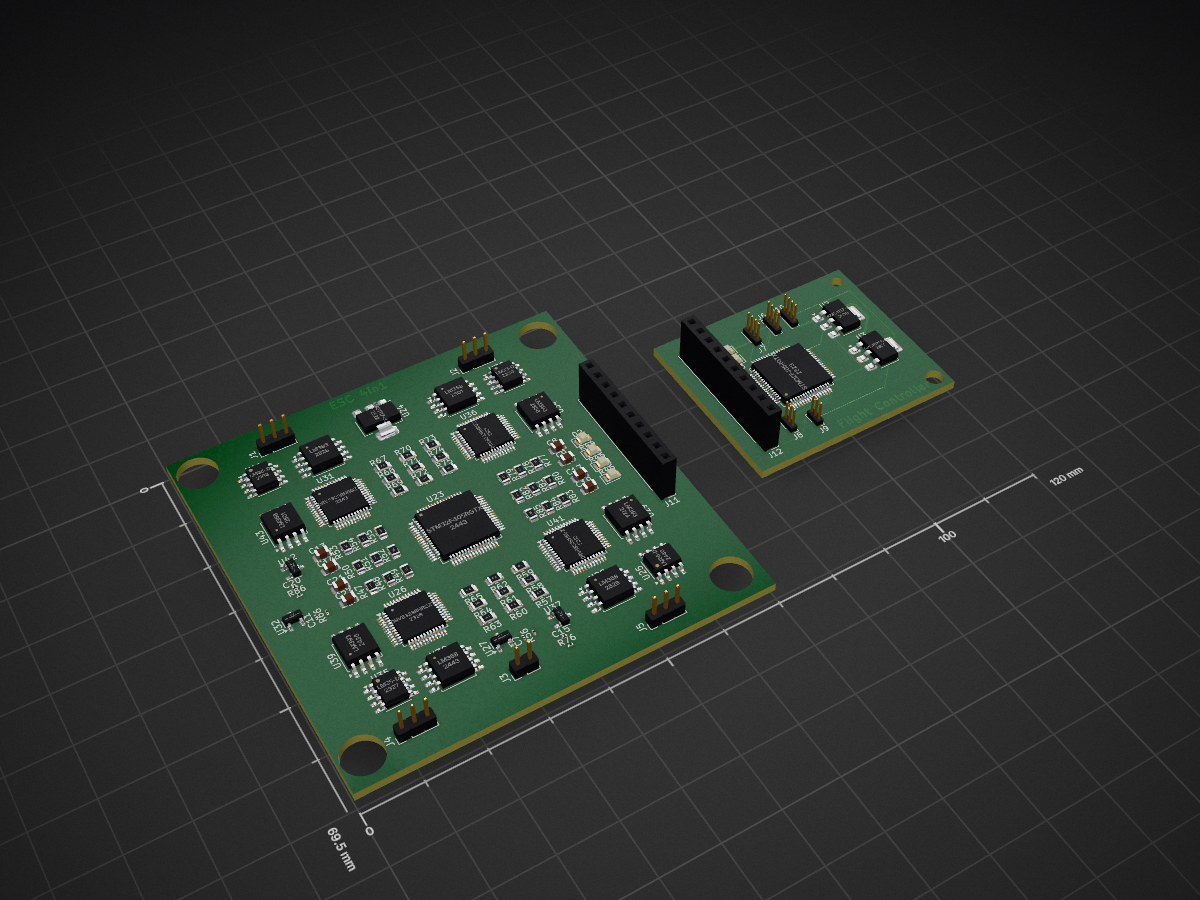
ESC is an open-source printed circuit board by Gravvx, from the Gravvx/Project-Raahat repository on GitHub. It is a 4-layer board of 120 × 69.5 mm with 121 parts on 314 nets, routed with 157 tracks and 1 via.
It is built around the LM358, LM393 and AMS1117-3.3, with the AMS1117CD-5.0 among its other parts. Its parts include 45 resistors, 25 ICs, 24 transistors, 12 capacitors and 12 connectors. It belongs with the robots and motor control boards and the STM32 boards of this library.


Rapid Aerial AI for Hazard Assessment & Tracking
Developed by Team Sutra for the Smart India Hackathon





Project RAAHAT is an Edge-AI powered autonomous UAV reconnaissance system designed for rapid disaster search-and-rescue (SAR) operations.
Built for the Smart India Hackathon, the platform utilizes a Software-in-the-Loop (SITL) architecture to simulate drone flight physics, perform entirely offline on-device AI inference, and mathematically map 2D video pixel detections into precise 3D real-world GPS coordinates for emergency responders — backed by a validated custom hardware payload designed for real-world deployment.
To ensure safety, rapid iteration, and hardware-readiness, Project RAAHAT is built on 4 foundational pillars:
Project RAAHAT's hardware stack is engineered so all AI inference happens onboard, ensuring functionality even when network connectivity is entirely unavailable at a disaster site.
| Component | Role |
|---|---|
| NVIDIA Jetson Orin Nano | Edge AI compute — runs YOLOv8n inference locally (CUDA-accelerated) |
| RGB Camera | Visual-spectrum survivor and hazard detection |
| Thermal Camera (LWIR) | Heat-signature detection for survivors under debris / low-visibility conditions |
| Pixhawk / STM32 | Real-time flight stabilization, independent of the AI compute layer |
| NEO-M8N GPS Module | Positioning data for geo-tagging detections |
| IMU + Barometer | Orientation and altitude sensing, feeds flight controller |
| SX1276 LoRa Transceiver | Long-range, low-bandwidth telemetry link to ground station (868 MHz) |
| Component | Spec |
|---|---|
| Main Battery | 4S / 6S LiPo |
| Buck Converter (Compute Rail) | 19V / 5A → Jetson Orin Nano |
| Buck Converter (Avionics Rail) | 5V / 4A → Flight controller, IMU, GPS |
| Power Distribution Board (PDB) | Routes raw battery voltage to ESCs/motors and both converted rails |
.STEP CAD files for the airframe, Jetson Orin Nano, and FPV camera module to verify 30.5 × 30.5 mm standoff mounting feasibility and dual payload bay clearance.[RGB + Thermal Cameras] ──▶ Jetson Orin Nano (YOLOv8 Inference)
│
[Pixhawk GPS/IMU] ─────────▶ MAVLink │
Telemetry│
▼
[Compact JSON Alert]
│
(UART)
│
▼
[LoRa Transmitter (SX1276)]
│
(868 MHz RF)
│
▼
[Ground Base Station]
│
▼
[ARES-C2 Dashboard]
SIH_DRONE_PROJECT/
├── webots/ # SITL Simulation Environment
│ ├── controllers/
│ │ └── autonomous_patrol/| Qty | Value | Footprint | References |
|---|---|---|---|
| 24 | 10Ω | Resistor_SMD:R_0805_2012Metric | R50, R51, R52, R53, R54, R55, R60, R61, R62, R63, R64, R65, R70, R71, R72, R73 +8 |
| 24 | NMOS | Package_TO_SOT_SMD:SOT-223-3_TabPin2 | Q25, Q26, Q27, Q28, Q29, Q30, Q31, Q32, Q33, Q34, Q35, Q36, Q37, Q38, Q39, Q40 +8 |
| 12 | 10kΩ | Resistor_SMD:R_0805_2012Metric | R47, R48, R49, R57, R58, R59, R67, R68, R69, R77, R78, R79 |
| 4 | 0.01Ω | Resistor_SMD:R_0201_0603Metric | R56, R66, R76, R86 |
| 4 | 100nF | Capacitor_SMD:C_0201_0603Metric | C7, C11, C15, C20 |
| 4 | 10uF | Capacitor_SMD:C_0805_2012Metric | C9, C14, C19, C23 |
| 4 | 1uF | Capacitor_SMD:C_0805_2012Metric | C8, C13, C17, C21 |
| 4 | Conn_01x03_Pin | Connector_PinHeader_2.00mm:PinHeader_1x03_P2.00mm_Vertical | J1, J2, J4, J5 |
| 4 | DRV8323RHRGZT | Package_QFP:TQFP-48_7x7mm_P0.5mm | U26, U31, U36, U41 |
| 4 | LM35-D | Package_SO:SOIC-8_3.9x4.9mm_P1.27mm | U25, U30, U35, U40 |
| 4 | LM358 | Package_SO:SOIC-8_5.3x5.3mm_P1.27mm | U28, U33, U38, U43 |
| 4 | LM393 | Package_SO:SOIC-8_5.3x5.3mm_P1.27mm | U29, U34, U39, U44 |
| 4 | LM4040DBZ-2.0 | Package_TO_SOT_SMD:SOT-23 | U27, U32, U37, U42 |
| 2 | 10kΩ | LED_SMD:LED_0805_2012Metric | R45, R46 |
| 2 | 330Ω | Resistor_SMD:R_0201_0603Metric | R2, R3 |
| 2 | AMS1117-3.3 | Package_TO_SOT_SMD:SOT-223-3_TabPin2 | U2, U24 |
| 2 | STM32F405RGTx | Package_QFP:LQFP-64_10x10mm_P0.5mm | U1, U23 |
| 1 | 1kΩ | LED_SMD:LED_0805_2012Metric | R44 |
| 1 | AMS1117CD-5.0 | Package_TO_SOT_SMD:SOT-223-3_TabPin2 | U3 |
| 1 | Conn_01x02_Pin | Connector_PinHeader_2.00mm:PinHeader_1x02_P2.00mm_Vertical | J3 |
| 1 | ESC_PIN | Connector_PinHeader_2.54mm:PinHeader_1x10_P2.54mm_Vertical | J11 |
| 1 | ESC_status | LED_SMD:LED_0805_2012Metric | D3 |
| 1 | FC_PIN | Connector_PinHeader_2.54mm:PinHeader_1x10_P2.54mm_Vertical | J12 |
| 1 | FVP_CAMERA | Connector_PinHeader_1.00mm:PinHeader_1x03_P1.00mm_Vertical | J9 |
| 1 | GPS NEO6M | Connector_PinHeader_1.00mm:PinHeader_1x04_P1.00mm_Vertical | J7 |
| 1 | LED | LED_SMD:LED_0805_2012Metric | D2 |
| 1 | OC_STATUS | LED_SMD:LED_0805_2012Metric | D4 |
| 1 | RC_erciever | Connector_PinHeader_1.00mm:PinHeader_1x03_P1.00mm_Vertical | J8 |
| 1 | UART connector | Connector_PinHeader_1.00mm:PinHeader_1x04_P1.00mm_Vertical | J6 |
| 1 | VTx | Connector_PinHeader_1.00mm:PinHeader_1x04_P1.00mm_Vertical | J10 |

dentenplay5555/Electrical-Status-Notification-System
Notification in LOA(Line Offical Account) and website. Refersh every 15-30 seconds

Lonelybarbarian0/stm32-line-follower
An advanced line follower based on STM32f446RE. This design consists of 12 Analog IR sensors (CNY70) , a dual H-bridge driver (TB6612FNG) , has I2C ports for oled display , push buttons , 12V battery accomodation , SWD…

maximus64/opendiag-hardware
OpenDIAG - Open Source OBD2 Interface (Hardware)

Scalable-Open-Source-Labs/Mass-Spring-Damper-SysID-Lab
An open source Mass-Spring-Damper to assist with teaching System Identification

epim/circsim
Post-routed PCB+Schematic circuit simulator. Because I have trust issues.


funkfinger/gio
A 2 HP Eurorack generative arpeggiator module built around the Seeed XIAO RP2350. Produces scale-quantised V/Oct pitch CV and gate outputs driven by a probability-layered generative engine.
It measures 120 × 69.5 mm and has 4 copper layers, 1.6 mm thick.
121 parts, built around the LM358, LM393, AMS1117-3.3 and AMS1117CD-5.0. The full list of its parts is on this page, with links to each part's symbol and footprint where PCBKit's library has them.
From the Gravvx/Project-Raahat repository on GitHub, at the commit this page was made from: the board is ESC.kicad_pcb and its schematic DRONE_SIH.kicad_sch. PCBKit opens the board in the browser, with nothing to install.
Its repository states no licence, so its author keeps all rights: ask Gravvx before reusing the design.