
2 layers54.6 × 29.2 mm
 GTPL-Testing/MonopropUAV4
Project files + resources for the Monoprop UAV project
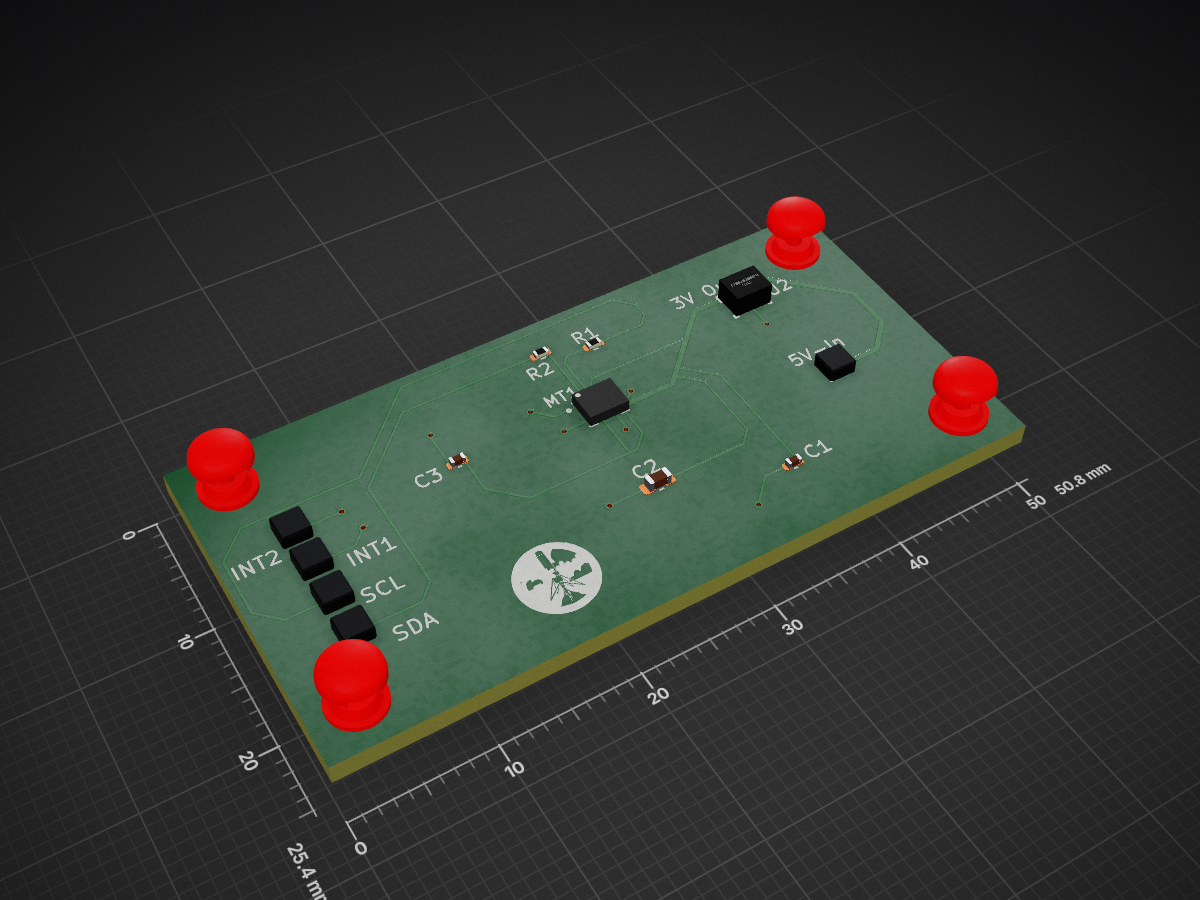
6-axisIMU is an open-source printed circuit board by GTPL-Testing, from the GTPL-Testing/MonopropUAV repository on GitHub, published under the MPL-2.0 licence. It is a 2-layer board of 50.8 × 25.4 mm with 17 parts on 13 nets, routed with 80 tracks and 10 vias.
It is built around the ICM-42670-P. Its parts include 3 capacitors, 2 resistors and 1 IC.
Project files + resources for the Monoprop UAV project
Google Drives: Please check these Drive folders for meeting slides, resources, etc.
| Qty | Value | Footprint | References |
|---|---|---|---|
| 5 | SolderWire-0.1sqmm_1x01_D0.4mm_OD1mm | Connector_Wire:SolderWire-0.1sqmm_1x01_D0.4mm_OD1mm | 5V-In, INT1, INT2, SCL, SDA |
| 2 | 10kΩ | Resistor_SMD:R_0402_1005Metric | R1, R2 |
| 1 | 0.1µF | Capacitor_SMD:C_0402_1005Metric | C1 |
| 1 | 10 nF | Capacitor_SMD:C_0402_1005Metric | C3 |
| 1 | 2.2µF | Capacitor_SMD:C_0603_1608Metric | C2 |
| 1 | ICM-42670-P | 6-axisIMU_footprints:XDCR_ICM-42670-P | MT1 |
| 1 | LOGO | LOGO | G*** |
| 1 | TPS82698SIPR | footprints:SIP0008A | U2 |
The 13 most common of 17 parts.

ajwock/quadcopter
Quadcopter designed and programmed thoroughly from scratch


EbenenBonobo/ICM-42670-P-Breakout-Board
Breakout Board Design for the ICM-42670-P but should work with similar ICM 42... Sensors. Designed by me, improved by Reddit

swayerloren/KICAD_ENGINE
AI-assisted KiCad PCB design workflow for schematics, PCB layouts, DRC, BOM/CPL, and fabrication outputs using Codex or Claude.

UBIEEE/FrankenMouse
FrankenMouse is a MicroMouse robot that was designed, built, and programmed from scratch by members of the University at Buffalo's IEEE Student Branch.


thePunderWoman/SnipsControllers
The controllers built to work with Amidala

It measures 50.8 × 25.4 mm and has 2 copper layers, 1.6 mm thick.
17 parts, built around the ICM-42670-P. The full list of its parts is on this page, with links to each part's symbol and footprint where PCBKit's library has them.
From the GTPL-Testing/MonopropUAV repository on GitHub, at the commit this page was made from: the board is Electronics/6-axisIMU/6-axisIMU.kicad_pcb and its schematic Electronics/6-axisIMU/6-axisIMU.kicad_sch. PCBKit opens the board in the browser, with nothing to install.
Its repository publishes it under the MPL-2.0 licence: you may reuse it on that licence's terms (keep the author's notice, and for a copyleft licence share your changes alike).