4 layers68.6 × 46 mm
NoiseAMP V2.3
Floyd-Fish/Noise-Amplifier
An ultra-low noise amplifier to measure low-noise LDO/OPA's wide band output noise, and many other interesting measurements. Referred to AN-159.
150 parts36GPL-3.0

 Floyd-Fish/Noise-Amplifier36
An ultra-low noise amplifier to measure low-noise LDO/OPA's wide band output noise, and many other interesting measurements. Referred to AN-159.
EmoeNAP is an open-source printed circuit board by Floyd-Fish, from the Floyd-Fish/Noise-Amplifier repository on GitHub, published under the GPL-3.0 licence. It is a 4-layer board of 75 × 36 mm with 189 parts on 69 nets, routed with 624 tracks and 300 vias.
It is built around the OPA1612AID, OPA1679ID and PS-12E05, with the TP4057 among its other parts. Its parts include 73 capacitors, 55 resistors, 12 ICs and 8 connectors. It belongs with the audio and music and sensors and measurement boards of this library.


An ultra-low noise amplifier (named EmoeNAP) capable to measure low-noise LDO/OPA's wide band output noise, and many other interesting measurements. Referred to AN-159.
The full article about the initial version of Noise Amp can be found here:How to build a Noise Amplifier. And to step further, to build the current version named EmoeNAP,please follow Noise Amplifier Step further
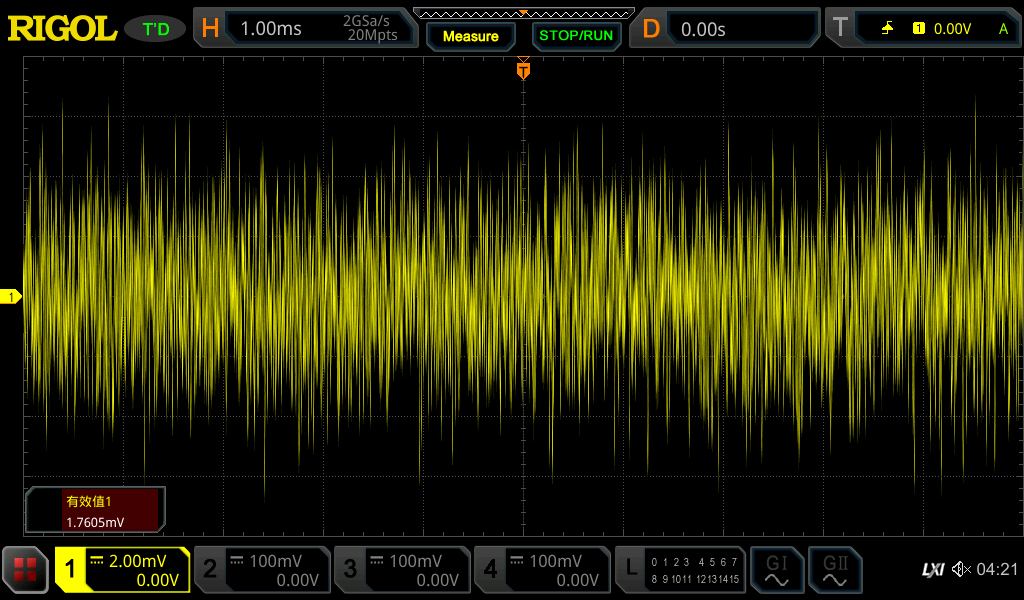
Test result show that: with input shorted, the total output noise in 100kHz bandwidth is 1.76mVrms, and the EmoeNAP's Gain equals to 80dB, which results in 176nVrms input noise.
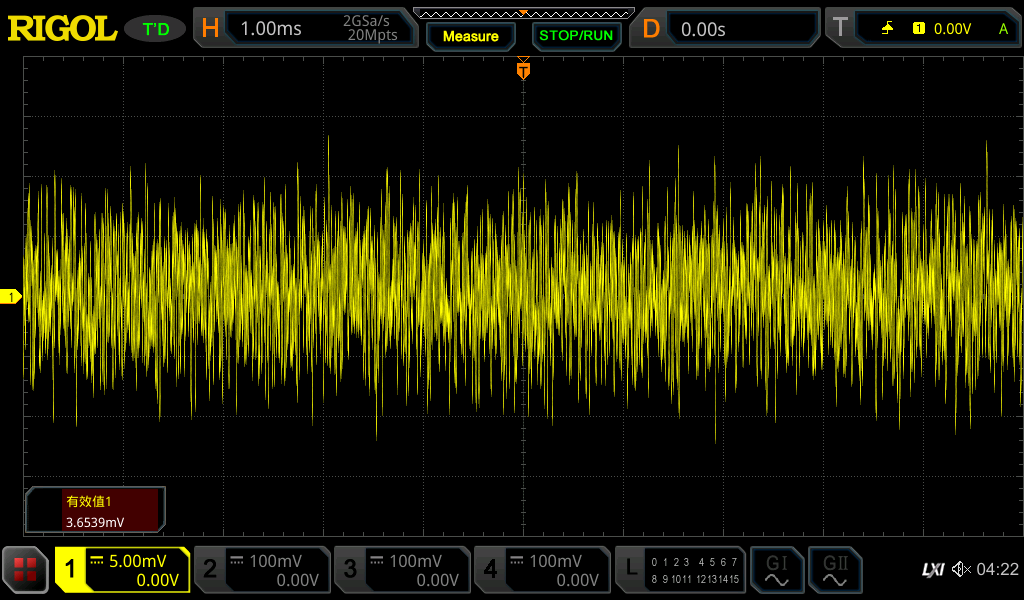
Then connect a 50 ohms SMA Load to input, the total output noise in 100kHz bandwidth is 3.65mVrms, which equals in 365nVrms input noise.
A 50 ohms resistor's Johnson-Nyquist Noise(Themal noise) in 100kHz is 316nVrms(Theoretical), and 316nVrms combine with 176nVrms, resulting 361nVrms total output noise. This test verified the EmoeNAP's extraordinary ability to measure a 50 ohms resistor's Thermal Noise precisely.
V2.3 has been verified but still needs improving.
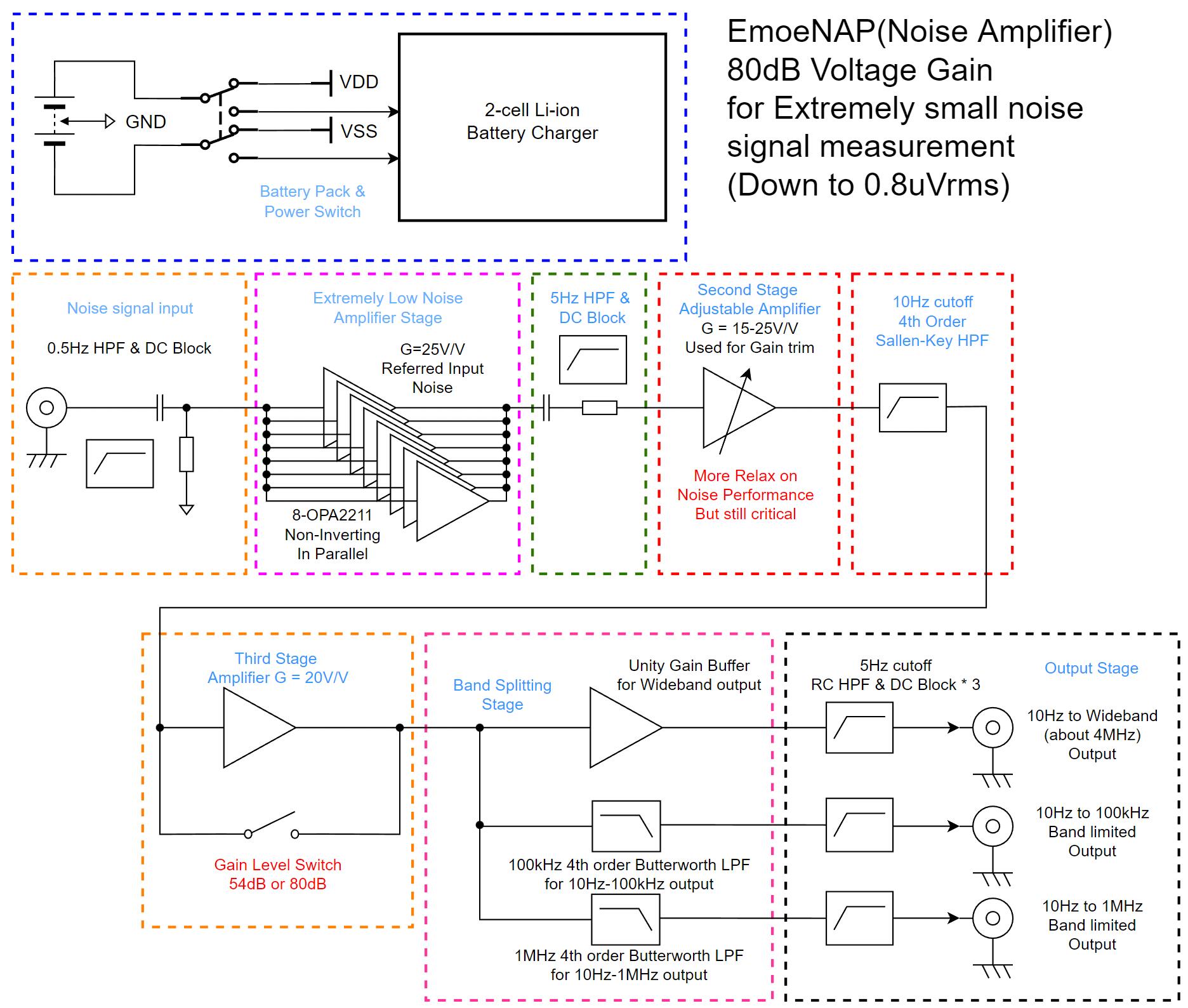
In next version of EmoeNAP, I plan to change its architecture a little to the form below:
| Qty | Value | Footprint | References |
|---|---|---|---|
| 21 | 10uF MLCC | Capacitor_SMD:C_0805_2012Metric | C4, C10, C13, C17, C19, C22, C25, C27, C29, C32, C35, C36, C38, C40, C41, C42 +5 |
| 16 | 0.1uF | Capacitor_SMD:C_0402_1005Metric | C43, C44, C45, C46, C47, C48, C49, C54, C55, C56, C57, C58, C59, C60, C70, C71 |
| 10 | 16V 68uF TANTALUM | Capacitor_Tantalum_SMD:CP_EIA-6032-20_AVX-F | C11, C12, C15, C18, C20, C23, C26, C28, C30, C31 |
| 9 | 2.2uF | Capacitor_Tantalum_SMD:CP_EIA-3216-10_Kemet-I | C50, C51, C52, C53, C61, C62, C63, C64, C65 |
| 8 | 10R | Resistor_SMD:R_0402_1005Metric | R6, R13, R16, R20, R27, R31, R35, R42 |
| 8 | 1R | Resistor_SMD:R_0402_1005Metric | R3, R12, R15, R18, R24, R30, R34, R41 |
| 8 | 249R | Resistor_SMD:R_0402_1005Metric | R9, R14, R17, R21, R28, R33, R40, R44 |
| 7 | 100pF | Capacitor_SMD:C_0402_1005Metric | C24, C66, C67, C68, C69, C72, C73 |
| 6 | 10k | Resistor_SMD:R_0402_1005Metric | R45, R46, R48, R49, R53, R54 |
| 6 | OPA1612 | Package_SON:WSON-8-1EP_3x3mm_P0.5mm_EP1.2x2mm | U1, U2, U3, U5, U7, U8 |
| 4 | 1k | Resistor_SMD:R_0402_1005Metric | R47, R50, R52, R55 |
| 4 | 499R | Resistor_SMD:R_0805_2012Metric | R19, R29, R32, R43 |
| 4 | M3 | MountingHole:MountingHole_3.2mm_M3_Pad_TopOnly | H1, H2, H3, H4 |
| 4 | TestPoint_Probe | TestPoint:TestPoint_Pad_D1.0mm | TP1, TP2, TP3, TP4 |
| 3 | 0R | Resistor_SMD:R_0805_2012Metric | RISO1, RISO2, RISO4 |
| 3 | 100R | Resistor_SMD:R_0402_1005Metric | R2, R8, R11 |
| 3 | 100R | Resistor_SMD:R_0603_1608Metric | RISO5, RISO6, RISO7 |
| 2 | 1.24k | Resistor_SMD:R_0402_1005Metric | R26, R39 |
| 2 | 1.69k | Resistor_SMD:R_0402_1005Metric | R25, R38 |
| 2 | 1.6k | Resistor_SMD:R_0402_1005Metric | R1, R4 |
| 2 | 2.15k | Resistor_SMD:R_0402_1005Metric | R23, R37 |
| 2 | 2k | Resistor_SMD:R_0402_1005Metric | R7, R51 |
| 2 | 4.02k | Resistor_SMD:R_0402_1005Metric | R22, R36 |
| 2 | 4.7uF | Capacitor_SMD:C_0805_2012Metric | C2, C3 |
| 2 | PS-12E05 | EmoeNAP_FootPrint_Lib:PS-12E05 | U4, U10 |
| 1 | 1000pF | Capacitor_SMD:C_0402_1005Metric | C39 |
| 1 | 10Hz to 100kHz | Connector_Coaxial:U.FL_Molex_MCRF_73412-0110_Vertical | J5 |
| 1 | 10Hz to 1MHz | Connector_Coaxial:U.FL_Molex_MCRF_73412-0110_Vertical | J3 |
| 1 | 10Hz to WIDEBAND | Connector_Coaxial:U.FL_Molex_MCRF_73412-0110_Vertical | J2 |
| 1 | 10R | Resistor_SMD:R_0805_2012Metric | RISO3 |
| 1 | 1200pF | Capacitor_SMD:C_0402_1005Metric | C34 |
| 1 | 120pF | Capacitor_SMD:C_0402_1005Metric | C16 |
| 1 | 1500pF | Capacitor_SMD:C_0402_1005Metric | C33 |
| 1 | 150pF | Capacitor_SMD:C_0402_1005Metric | C14 |
| 1 | 1k | Potentiometer_THT:Potentiometer_Bourns_3266W_Vertical | RV1 |
| 1 | 220pF | Capacitor_SMD:C_0402_1005Metric | C37 |
| 1 | 22pF | Capacitor_SMD:C_0402_1005Metric | C21 |
| 1 | 300R | Resistor_SMD:R_0402_1005Metric | R5 |
| 1 | 330uF TANTALUM | Capacitor_Tantalum_SMD:CP_EIA-6032-20_AVX-F | C1 |
| 1 | 5.76k | Resistor_SMD:R_0402_1005Metric | R10 |
| 1 | Battery | Connector_JST:JST_XA_B02B-XASK-1_1x02_P2.50mm_Vertical | J1 |
| 1 | G*** | kibuzzard-63EE51DC | kibuzzard-63EE51DC |
| 1 | G*** | kibuzzard-6378AB16 | kibuzzard-6378AB16 |
| 1 | G*** | kibuzzard-63EE5345 | kibuzzard-63EE5345 |
| 1 | G*** | kibuzzard-6378AA98 | kibuzzard-6378AA98 |
| 1 | G*** | kibuzzard-6378A91A | kibuzzard-6378A91A |
| 1 | G*** | kibuzzard-6378A7F5 | kibuzzard-6378A7F5 |
| 1 | G*** | kibuzzard-6378AAC6 | kibuzzard-6378AAC6 |
| 1 | G*** | kibuzzard-63EE512D | kibuzzard-63EE512D |
| 1 | G*** | kibuzzard-6378A590 | kibuzzard-6378A590 |
| 1 | G*** | kibuzzard-6378A691 | kibuzzard-6378A691 |
| 1 | G*** | kibuzzard-6378A94A | kibuzzard-6378A94A |
| 1 | G*** | kibuzzard-63EE51C1 | kibuzzard-63EE51C1 |
| 1 | G*** | kibuzzard-63EE53DB | kibuzzard-63EE53DB |
| 1 | G*** | kibuzzard-63EE5216 | kibuzzard-63EE5216 |
| 1 | G*** | kibuzzard-6378A8E8 | kibuzzard-6378A8E8 |
| 1 | G*** | kibuzzard-6378A997 | kibuzzard-6378A997 |
| 1 | G*** | kibuzzard-6378A7EA | kibuzzard-6378A7EA |
| 1 | G*** | kibuzzard-63ED0A5F | kibuzzard-63ED0A5F |
| 1 | G*** | kibuzzard-6378A7DC | kibuzzard-6378A7DC |
| 1 | G*** | kibuzzard-63EE520C | kibuzzard-63EE520C |
| 1 | GREEN | TestPoint:TestPoint_2Pads_Pitch2.54mm_Drill0.8mm | J6 |
| 1 | Input | Connector_Coaxial:U.FL_Molex_MCRF_73412-0110_Vertical | J4 |
| 1 | LOGO | Symbol:Analog_Devices_20mmx20mm | G*** |
| 1 | LOGO | Symbol:emoe_logo_7mmx7mm_mask | G*** |
| 1 | LOGO | Symbol:noise_logo_15x8.3mm | G*** |
| 1 | LOGO | Custom_Logo:emoe_qrcode_silk_10x10mm | G*** |
| 1 | LOGO | Custom_Logo:texas_instruments_12x3.6mm | G*** |
| 1 | LT1364 | Package_SO:SOIC-8_3.9x4.9mm_P1.27mm | U9 |
| 1 | OPA1679 | Package_SO:SOIC-14_3.9x8.7mm_P1.27mm | U6 |
| 1 | RED | TestPoint:TestPoint_2Pads_Pitch2.54mm_Drill0.8mm | J7 |
| 1 | SGM321 | Package_TO_SOT_SMD:SOT-23-5 | U12 |
| 1 | TP4057 | Package_TO_SOT_SMD:SOT-23-6 | U11 |
| 1 | USB_CHR | Connector_JST:JST_XA_B02B-XASK-1_1x02_P2.50mm_Vertical | J8 |
Floyd-Fish/Noise-Amplifier
An ultra-low noise amplifier to measure low-noise LDO/OPA's wide band output noise, and many other interesting measurements. Referred to AN-159.

Floyd-Fish/Noise-Amplifier
An ultra-low noise amplifier to measure low-noise LDO/OPA's wide band output noise, and many other interesting measurements. Referred to AN-159.


courtcourtaney/voxEMG
VoxEMG circuit and schematics, plus example code for further digital filtering with Bela, etc.

arthurbenemann/OPA_PHONO
Phono amplifier for MM cartridges, base on TI's OPA lineup

Jeffrey-McCormick/CPTR480-ENGR357_Quadrature_SDR
Quadrature sampling software defined radio for digital signal processing. Project for Embedded and Real Time Systems (CPTR480) and Engineering Electronics II (ENGR357).

stefantquach/steDAC
Open source audio DAC project based on the ES9038Q2M DAC from ESS. Still WIP

AxelMcKenna/AFX-1000
RMX-1000-inspired effects processor for macOS, AU and VST3, built on a shared C++20 engine. Standalone Daisy Seed 3 hardware with two main PCBs and a custom housing is in development.

KLFAMO/relock_Artiq
This project is an electronic device based on the STM32 microcontroller, equipped with an Ethernet port for remote control and data communication.

pasdesignal-zz/rPI_audio_board
a rPi daughter board for audio io and midi
It measures 75 × 36 mm and has 4 copper layers, 1.61 mm thick.
189 parts, built around the OPA1612AID, OPA1679ID, PS-12E05 and TP4057. The full list of its parts is on this page, with links to each part's symbol and footprint where PCBKit's library has them.
From the Floyd-Fish/Noise-Amplifier repository on GitHub, at the commit this page was made from: the board is Hardware_Design/EmoeNAP/EmoeNAP.kicad_pcb and its schematic Hardware_Design/EmoeNAP/EmoeNAP.kicad_sch. PCBKit opens the board in the browser, with nothing to install.
Its repository publishes it under the GPL-3.0 licence: you may reuse it on that licence's terms (keep the author's notice, and for a copyleft licence share your changes alike).