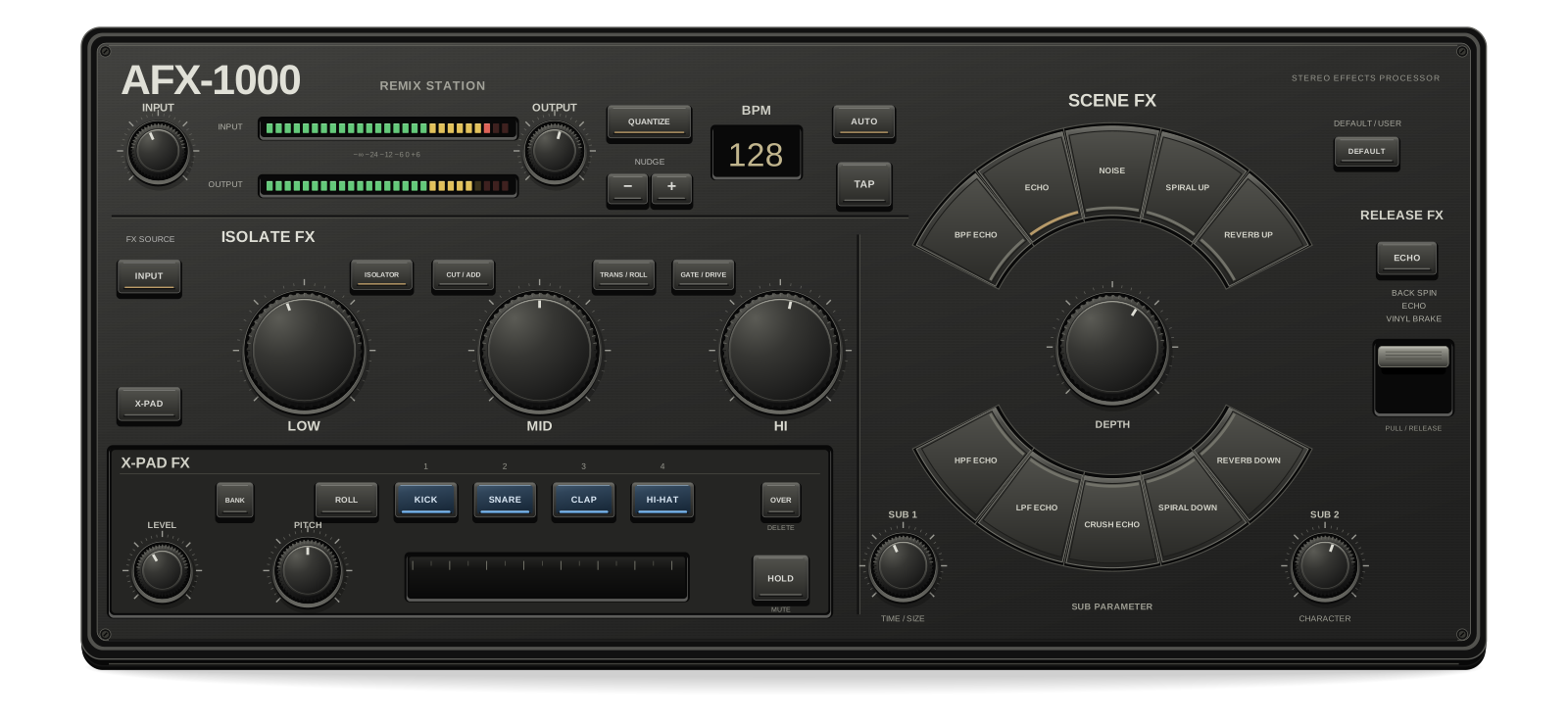
RMX-1000-inspired effects processor for macOS, AU and VST3, built on a shared C++20 engine. Standalone Daisy Seed 3 hardware with two main PCBs and a custom housing is in development.
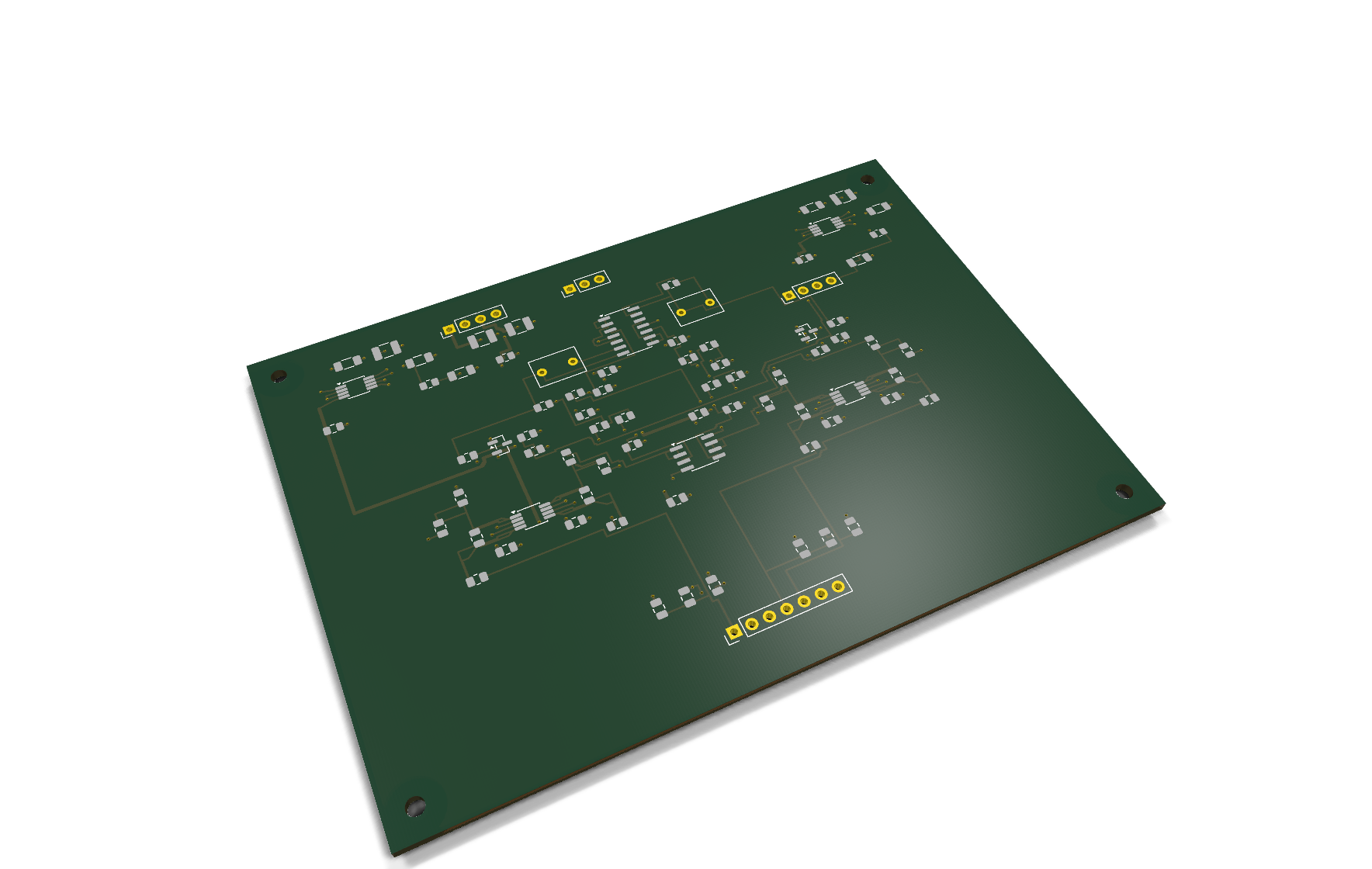
Native refill export is an open-source printed circuit board by AxelMcKenna, from the AxelMcKenna/AFX-1000 repository on GitHub. It is a 6-layer board of 150 × 63 mm with 334 parts on 198 nets, routed with 2,477 tracks and 412 vias.
It is built around the OPA1612AID, OPA1656ID and SN74LVC1G08DCKR, with the AO3400A, SMF9.0A and BAT54S,215 among its other parts. Its parts include 131 resistors, 124 capacitors, 18 ICs, 5 diodes and 4 connectors.
Proprietary — all rights reserved. Original project code, firmware, PCB and housing designs require a separate written license for reuse, builds, manufacture or redistribution. Public access and build instructions do not grant that permission. Third-party licenses and GitHub's applicable platform permissions remain in effect. See LICENSE and dependency notices.
AFX-1000 is an RMX-1000-inspired effects processor built around a shared C++20 audio engine, available as a native Mac app, AU and VST3. A standalone hardware version using Daisy Seed 3 is in development, with a proposed signal PCB and power/protection PCB in a custom housing.
Use it with rekordbox through app capture or an audio interface. The effects and factory drums are original implementations. Matching the reference unit's sound, timing and full feature set is still work in progress.
What's in it
Scene FX: BPF Echo, Echo, Noise, Spiral Up, Reverb Up, HPF Echo, LPF Echo, Crush Echo, Spiral Down and Reverb Down.
Isolate FX: three bands, with Isolator, Cut/Add, Trans/Roll and Gate/Drive modes.
X-Pad: four internal drums and four sample banks, 16 bank variants, WAV import, pitch, rolls, hold and overdub.
Release FX: Back Spin, Echo and Vinyl Brake.
Auto BPM, tap tempo, quantized rolls, assignable X-Pad divisions including triplets, MIDI learn, soft takeover and DAW automation are included.
Loop tempo and pitch have separate playback controls. AUTO can follow detected beat phase, and MIDI clock supports Start, Stop, Continue and Song Position Pointer. See sync and sample stretching for the implementation limits.
Overdub runs a four-beat pattern. Each bank holds 16 seconds of audio; slot 1 supports BPM-tagged loops. Sample editing includes trim, reverse, normalization and BPM/loop settings. Pad one-shots trigger immediately.
Latest sound pass
Rebuilt kick, snare, clap and hat voices, with independent gain, decay and envelope choices. Noise now has a resonant filter sweep, shaped modulation and a damped echo return. Faster pitched playback uses a band-limited reader; a linked stereo peak limiter catches output overshoots.
Pitch travel has separate up/down ranges from 1 to 24 semitones. The extra range is a project extension. These changes are implemented, but have not been matched against recordings of an RMX-1000. DSP notes cover the details and limits.
Hardware design
Current work targets the full 12 V standalone unit. The fabrication preparation inventory identifies the selected development sources and remaining holds across all functional roles. The A12 housing work includes the larger enclosure proposal with 20% more depth and height. The integrated unit remains unfinished.
The latest two-main-board placement candidate consolidates the eight development boards into a 268 × 63 mm signal PCB and a 320 × 181.1 mm C-shaped power/protection PCB. It retains the Daisy Seed 3 module and accounts for all 1,543 currently placed electrical components. Panel boards and bought-in modules remain additional. Both placements pass the recorded native geometry/library checks, but the combined schematics, routing, ESS codec land pattern, cooling, supports and complete installed fit are unfinished. This is an engineering candidate, not a fabrication release.
The latest integrated signal-board checkpoint now joins the audio and Daisy circuits in one schematic and preserves their original routing. It has 251 open connections, zero native geometry/ERC findings and one missing ESS codec footprint. The power board still needs circuit integration and routing; neither board is released for fabrication.
The earlier A11 design has a 334 × 157 × 38 mm chassis, 29 guided buttons, ten knobs, selector caps, optical inserts and the release mechanism. It includes mounts and clearances for its routed main supply and placed E25 disconnect board.
Native KiCad layouts from the standalone electronics work. These are engineering candidates; they have not been manufactured or electrically qualified. Click a layout for the full-resolution image.
Combined main audio routing and reference plane · 150 × 63 mm · four-layer candidate
Top local copper
Bottom local copper, viewed from below
The six-section audio candidate retains 328 assigned electrical footprints, including four bare test pads, and six proposed mounts. All 131 declared local signal/supply endpoints and all 200 placed ground pads are native-connected. Opens have fallen from 724 to 208, including 57 verified low-speed control joins and 17 retained earlier control pairs. Its 2,425 tracks and 382 conventional vias preserve every amplifier placement and direct compensation capacitor track. The watchdog and settling-supervisor cells have renewed receiving; their private timing paths are connected, and the settling pull-up is local to its driver. Further codec-run/timer-ready, bypass-sense/bias-window and ANALOG_OK branches retain every component pose and earlier copper object; the longer controls still require installed timing/noise/loading qualification. Native geometry and ERC findings remain zero with all categories enabled. The ESS codec footprint is missing and global routing is unfinished. Full parts/process, analog, power/thermal and assembly verification remain open.
The newer, unselected CODEC_PGOOD comparison with four copper views reaches 203 opens and two remaining control gaps. It retains the 205-open bypass rework, adds a short CHIP_EN bridge and completes the power-good branch after an independently checked SENSE-entry reroute. Native geometry/ERC are 0/0 with all earlier checked terminals retained. SENSE accuracy/noise, the earlier long INPUT_ENABLE repair and installed performance remain review holds; it is not a fabrication release.
The unselected six-layer local-routing trial reaches 180 opens with the control nets connected. A dedicated signal layer and additional AGND plane first close the remaining control routes; 21 short surface links then complete six buffer feedback loops and local passive connections without adding more vias. Native geometry/ERC remain 0/0, and the local delta audit preserves all existing copper and 930 native pad shapes.
The 173-open comparator-input trial adds seven bias-window input joins. Its original enlarged-spacing review is superseded: a 0.5 mm search radius missed four relationships that violated the intended 0.71 mm policy. Native DRC/ERC and connection counts were unaffected; the measured erratum records the defect.
The newer GAIN_REQ clearance rework and all six copper views reaches 172 opens. It renews the obstructing digital branch with one standard via and bridges the right bias input without another hole. A separate exhaustive check measures 14,303 pairs across all 41 comparator-input tracks and finds no violations of the 0.71 mm trace-centreline policy. All unretired geometry, 930 native pad shapes and earlier connection witnesses remain intact; native geometry/ERC are 0/0. The earlier layer-conversion audit checks all 19 keepouts and native inner lands. The physical stack/cost is unapproved, U201 is missing, electrical noise/fault performance is unqualified and the wider analogue routing remains incomplete. The selected four-layer checkpoint above is unchanged.
After the comparator-input closure and supervisor bus routing, the latest amplifier power-down repair and six copper views reaches 162 opens. All PD control nets and four comparator-input nets are native-connected. Two existing pull resistors move to the front, their land shapes match native templates, and two interrupted connections are restored. Every earlier connection witness remains intact; native geometry/ERC are 0/0. All 15,996 measured comparator-track/noisy-copper pairs meet the spacing policy. There are 926 unchanged native pad shapes and four declared moved pads. The codec footprint, negative-bias and wider board routing, accepted stack and electrical qualification remain unfinished. This remains an unselected six-layer trial.
Actual In3 routing, renewed GAIN_REQ branch in cyan
Actual additional In4 AGND copper
All 161 placed supply/sense pads now connect to their designated source through inner and outer copper. Native-refilled ground retains all 200 ground connections. Missing codec lands and complete capacity/drop/return qualification remain open.
The pictured E26 checkpoint has 21 open connections and 30 native DRC warnings. The ADC driver is a separate characterization board, and the main supply shown predates the proposed P02 source redesign. These layouts do not yet form one integrated assembly. See the E26 source and findings and current development handoff.
The three-board qualification review identifies additional electrical/layout failures, a separate ADC repair trial and a new disconnect routing candidate. Qualification is withheld for all three pictured boards; they are not fabrication-ready.
The pictured E28 checkpoint has zero open connections, zero hard DRC errors and zero ERC/parity findings, with all native rule categories enabled. It retains 52 warnings. A newer candidate removes ten geometrically redundant track objects and has 49 warnings, with the same zero opens/hard errors/ERC/parity findings. See the current fabrication inventory and pictured checkpoint review. Manufacturing, P03 interface acceptance and physical qualification remain open. This is an actual KiCad plot, not manufactured hardware or a fabrication release.
Matching P03 source with integrated RUN transmitter · 160 × 45 mm · six layers
The separate 264-part P03 candidate has zero native DRC errors, warnings, opens, ERC and parity findings. Its integration review records the actual local bypass paths, E28 pin map and outstanding manufacturing, harness and physical qualification. Canonical P03 and the preserved source projects remain unchanged; the complete unit is not fabrication-ready.
Sequenced stereo bypass candidate · 110 × 55 mm · four layers
The new E11 layout contains 55 circuit parts and four mounts, with zero native DRC, ERC, schematic-parity or connectivity findings. It retains the independent input-settling and fresh-permit bypass circuit. The source-bound handoff and package corrections record the checks and limits. Installed fit, exact parts/connectors, assembly process and measured operation remain unqualified.
Eight-window rail monitor candidate · 80 × 70 mm · four layers
The selected E13 layout preserves the original 181-part circuit and four mounts, with zero native DRC, ERC, schematic-parity or connectivity findings. Reserving the supply escapes and adding 3.3 V branches on the inner supply layer closed routing while retaining the dedicated ground plane. The bottom copper, supply copper, source-bound handoff and drill-to-SMD screen are available for review. Precision parts, power/noise review, installed fit and assembly/process acceptance remain open. This is a development layout, not a fabrication release.
3D bare-board preview · E12 ADC driver
An unpopulated board rendered directly from the KiCad PCB. This is a CAD preview, not a photograph of manufactured hardware.
Requires macOS 12+, Xcode Command Line Tools and CMake 3.24+. The default native app needs no third-party SDK. Ableton Link is optional and disabled by default.
sh
git clone git@github.com:AxelMcKenna/afx-1000.git
cd afx-1000
./build-app.sh
open build/RMX.app
Cmd+, opens audio setup. Pick an input and output, then start audio.
Audio setup remembers devices, channel pairs and buffer size. A previously active route can resume on launch when its devices are available. Stop Audio disables that automatic resume.
Space bypasses. Esc resets the effects. T taps tempo. 1-4 trigger the pads. Hold Shift while dragging for fine adjustments.
With rekordbox
On macOS 14.2+, select rekordbox - direct app capture as the RMX input and choose your speakers or headphones as the output. Start audio, approve macOS capture access if prompted, then play a track in rekordbox.
The capture route mutes duplicate dry playback while active. Stopping it restores normal rekordbox playback. The AU/VST3 versions are for plugin hosts; rekordbox integration uses audio routing.
uv uses Python 3.12 from .python-version and creates an ignored .venv/. The root pyproject.toml declares NumPy, Pillow, SciPy, Shapely and trimesh; uv.lock pins the resolved environment. Run Python tools with uv run --locked python .... Use uv add <package>==<version> to change a pinned dependency, and commit both project metadata and the lockfile.
Configure CMake through uv run --locked cmake ... so its Python tests use this environment. An existing CMake build may retain a previously selected interpreter; use a fresh build directory or explicitly set -DPython3_EXECUTABLE=/absolute/path/to/.venv/bin/python when reconfiguring.
The six hardware requirements.txt files remain frozen dependency snapshots referenced by historical source hashes. New development and CI use the root uv project. OpenSCAD, KiCad and the ARM toolchain remain separate native dependencies; checks that need KiCad's pcbnew module still use KiCad's own Python interpreter.
Fetches JUCE 8.0.6. Use -DRMX_JUCE_PATH=/path/to/JUCE for a local checkout. Outputs are in build-plugins/RMXPlugin_artefacts/Release/.
For a universal Mac build, use a fresh build directory and add '-DCMAKE_OSX_ARCHITECTURES=arm64;x86_64'. Distribution signing and notarization need your Apple credentials. The native build script signs ad hoc for local use.
JUCE's license applies to distribution of the plugin builds.
Core, checks and offline rendering
The core builds on macOS and Linux, independently of the UI.
Choose a new output directory each time. These clips use the current engine; they are not recordings of the original hardware.
Status
Area
Current state
Native Mac audio
Direct rekordbox capture and speaker output have worked in a live session. The latest saved-route/restart behavior still needs a live check.
AU / VST3
Build locally. Earlier universal artifacts include Apple Silicon and Intel slices; the latest sound review builds are arm64. Full DAW validation and Intel runtime checks remain open.
Engine and firmware
F06 records 16 passing host groups and clean ARM builds for onboard and external-converter profiles. The source snapshot also records five focused sanitizer groups. Actual MCU timing and hardware operation remain unverified.
Synchronization
AUTO, tap, host transport and MIDI clock are implemented. Optional Link builds and controlled local peer tempo/phase checks pass; live rekordbox and audio-loopback alignment remain unverified. See sync.
Sound matching
Latest drum/Noise changes are ready for listening. No reference-unit comparison or claim of identical effects.
Live use
Physical FLX4/FLX6 routing, cue separation, a live two-hour soak and measured round-trip latency remain open.
The engine uses stereo floating-point audio and preallocated processing buffers. The core audio callback does no allocation, locking, file I/O or UI work. Signal checks cover 44.1, 48, 88.2 and 96 kHz. Results belong to the revisions and configurations documented in validation; they do not establish MCU deadlines or hardware-equivalent specifications. See specifications for the remaining measurements.
Daisy Seed with 64 MB SDRAM, physical controls, touch strip, SD loading and watchdog-qualified relay bypass.
Pin-connected KiCad schematics, BOM and a routed 100 x 100 mm four-layer audio/power/bypass carrier. Recorded native ERC and DRC are clean; draft Gerbers and drill files are included for engineering review.
Split panel STL files, seam joiner, shaft coupon, DXF/SVG and OpenSCAD enclosure source. Full tray/control solids and assembled fit still need validation.
Boot-time sample banks, User settings and ADC calibration, plus a 50 ms startup fade. Firmware cross-builds with pinned dependencies and checked ELF placement; it has not been flashed or measured on a board.
The provisional cost ledger is NZ$295.77, assuming free printing, DIY assembly and reused power/cables. It is not a confirmed delivered basket. B1 targets consumer line levels and does not retain the original's high-level analogue headroom. The earlier A0.2 higher-headroom carrier is a separate design.
No hardware has been ordered or assembled. Audio performance, relay fault timing, power/thermal behavior, card I/O and physical fit remain unmeasured. Draft fabrication files are not a production release. Start with the hardware guide and clone roadmap.
sh
./build/rmx_memory_budget
uv run --locked python tools/generate_hardware.py --check
./build/rmx_card_export Performance.rmx /path/to/new-card-folder
The exporter writes the project's card layout. --settings-only exports User settings without needing audio files; --samples-only exports samples. Original RSD/SD interoperability, USB MIDI, live card insertion and complete lighting feedback remain unfinished. See the hardware guide for supported formats and calibration instructions.
The historical browser prototype is kept in prototypes/web/. Its guide is here. The retired Swift prototype is available in Git history.
Assets and licensing
Original project material is covered by the AFX-1000 Proprietary Rights Notice, copyright 2026 Axel McKenna, all rights reserved. It covers the project's original software, firmware, legacy prototypes, PCB and mechanical design files, documentation and assets to the extent the owner holds the relevant rights. Reuse, personal builds, manufacture and redistribution require separate written permission, subject to the exceptions in the notice.
Factory drums and the current panel artwork are made by this project. The native and plugin interfaces use a panel generated from drawing code, with no manufacturer photograph in current builds. Third-party software, footprints and other supplied material retain their own terms. JUCE and optional Link need a compatible licensing route for distribution; the project notice does not override their copyleft obligations. See source and dependency notices.
RMX-1000-inspired effects processor for macOS, AU and VST3, built on a shared C++20 engine. Standalone Daisy Seed 3 hardware with two main PCBs and a custom housing is in development.
RMX-1000-inspired effects processor for macOS, AU and VST3, built on a shared C++20 engine. Standalone Daisy Seed 3 hardware with two main PCBs and a custom housing is in development.
RMX-1000-inspired effects processor for macOS, AU and VST3, built on a shared C++20 engine. Standalone Daisy Seed 3 hardware with two main PCBs and a custom housing is in development.
RMX-1000-inspired effects processor for macOS, AU and VST3, built on a shared C++20 engine. Standalone Daisy Seed 3 hardware with two main PCBs and a custom housing is in development.
RMX-1000-inspired effects processor for macOS, AU and VST3, built on a shared C++20 engine. Standalone Daisy Seed 3 hardware with two main PCBs and a custom housing is in development.
RMX-1000-inspired effects processor for macOS, AU and VST3, built on a shared C++20 engine. Standalone Daisy Seed 3 hardware with two main PCBs and a custom housing is in development.
RMX-1000-inspired effects processor for macOS, AU and VST3, built on a shared C++20 engine. Standalone Daisy Seed 3 hardware with two main PCBs and a custom housing is in development.
RMX-1000-inspired effects processor for macOS, AU and VST3, built on a shared C++20 engine. Standalone Daisy Seed 3 hardware with two main PCBs and a custom housing is in development.
RMX-1000-inspired effects processor for macOS, AU and VST3, built on a shared C++20 engine. Standalone Daisy Seed 3 hardware with two main PCBs and a custom housing is in development.
RMX-1000-inspired effects processor for macOS, AU and VST3, built on a shared C++20 engine. Standalone Daisy Seed 3 hardware with two main PCBs and a custom housing is in development.
RMX-1000-inspired effects processor for macOS, AU and VST3, built on a shared C++20 engine. Standalone Daisy Seed 3 hardware with two main PCBs and a custom housing is in development.
RMX-1000-inspired effects processor for macOS, AU and VST3, built on a shared C++20 engine. Standalone Daisy Seed 3 hardware with two main PCBs and a custom housing is in development.
A circuit board for driving PDLC film from 12 V DC
127 parts7MIT
Questions
How big is the Native refill export PCB?
It measures 150 × 63 mm and has 6 copper layers, 1.6 mm thick.
What parts does the Native refill export use?
334 parts, built around the OPA1612AID, OPA1656ID, SN74LVC1G08DCKR and AO3400A. The full list of its parts is on this page, with links to each part's symbol and footprint where PCBKit's library has them.
Where can I download the Native refill export KiCad files?
From the AxelMcKenna/AFX-1000 repository on GitHub, at the commit this page was made from: the board is hardware/fabrication/staging/audio-main-six-monitor-01/native-refill-export.kicad_pcb. PCBKit opens the board in the browser, with nothing to install.
Can I use the Native refill export design in my own project?
Its repository states no licence, so its author keeps all rights: ask AxelMcKenna before reusing the design.