2 layers304.8 × 116.3 mm
 Baigel/Keyboard-PCB
A collection of PCB keyboards that run QMK
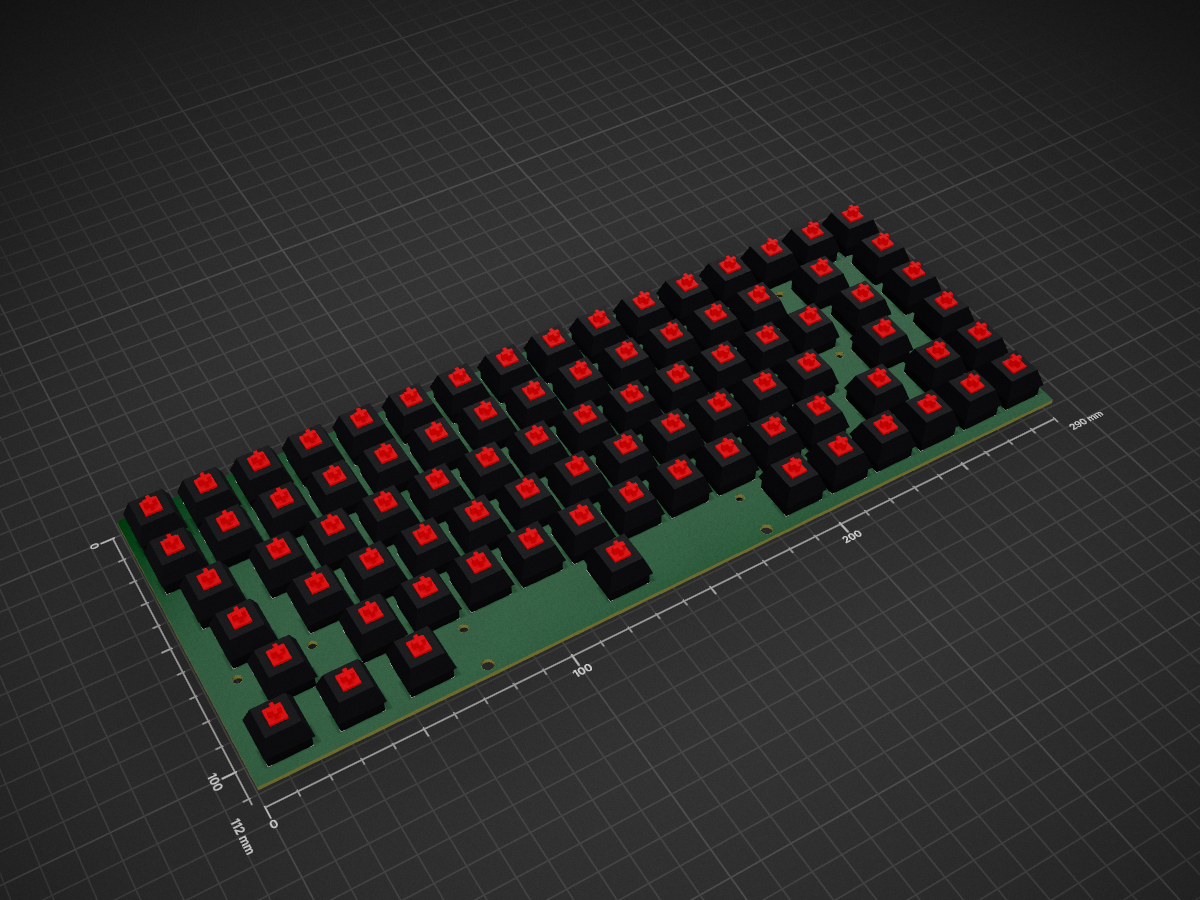
Keyboard-75percent v1 is an open-source printed circuit board by Baigel, from the Baigel/Keyboard-PCB repository on GitHub, published under the GPL-3.0 licence. It is a 2-layer board of 290 × 112 mm with 280 parts on 291 nets.
It is built around the ATMEGA32U4-AU and SK6812-EC20. Its parts include 84 diodes, 84 inductors, 71 switches, 11 resistors and 7 capacitors. It belongs with the keyboards and input boards and the AVR (ATmega, ATtiny) boards of this library.


A collection of PCB keyboards that run QMK - all in various states of completion
To PCBs
To Firmware:
| Qty | Value | Footprint | References |
|---|---|---|---|
| 84 | 1N4148 | 1N4148W-7:SOD3715X135N | D1, D2, D10, D11, D12, D13, D14, D15, D16, D17, D18, D19, D20, D21, D22, D23 +68 |
| 84 | SK6812-E | SK6812-E:LED_SK6812-E | L1, L2, L10, L11, L12, L13, L14, L15, L16, L17, L18, L19, L20, L21, L22, L23 +68 |
| 7 | 10k | Resistor_SMD:R_0805_2012Metric | R1, R5, R7, R8, R9, R10, R11 |
| 3 | 1uF | Capacitor_SMD:C_0805_2012Metric | C2, C4, C5 |
| 2 | 0.1uF | Capacitor_SMD:C_0805_2012Metric | C1, C3 |
| 2 | 20pF | Capacitor_SMD:C_0805_2012Metric | C6, C7 |
| 2 | 22R | Resistor_SMD:R_0805_2012Metric | R2, R3 |
| 2 | 5.1k | Resistor_SMD:R_0805_2012Metric | R4, R6 |
| 2 | Alt | Switch:Kailh_socket_MX | SW76, SW79 |
| 2 | Ctrl | Switch:Kailh_socket_MX | SW75, SW81 |
| 2 | Shift | Switch:Kailh_socket_MX | SW61, SW72 |
| 1 | '" | Switch:Kailh_socket_MX | SW58 |
| 1 | ,< | Switch:Kailh_socket_MX | SW69 |
| 1 | -_ | Switch:Kailh_socket_MX | SW28 |
| 1 | .> | Switch:Kailh_socket_MX | SW70 |
| 1 | /? | Switch:Kailh_socket_MX | SW71 |
| 1 | 0 | Switch:Kailh_socket_MX | SW27 |
| 1 | 1 | Switch:Kailh_socket_MX | SW18 |
| 1 | 16MHz | Crystal:Crystal_SMD_5032-2Pin_5.0x3.2mm_HandSoldering | Y1 |
| 1 | 2 | Switch:Kailh_socket_MX | SW19 |
| 1 | 3 | Switch:Kailh_socket_MX | SW20 |
| 1 | 4 | Switch:Kailh_socket_MX | SW21 |
| 1 | 5 | Switch:Kailh_socket_MX | SW22 |
| 1 | 500mA | Resistor_SMD:R_0805_2012Metric_Pad1.20x1.40mm_HandSolder | F1 |
| 1 | 6 | Switch:Kailh_socket_MX | SW23 |
| 1 | 7 | Switch:Kailh_socket_MX | SW24 |
| 1 | 8 | Switch:Kailh_socket_MX | SW25 |
| 1 | 9 | Switch:Kailh_socket_MX | SW26 |
| 1 | ;: | Switch:Kailh_socket_MX | SW57 |
| 1 | =+ | Switch:Kailh_socket_MX | SW29 |
| 1 | A | Switch:Kailh_socket_MX | SW48 |
| 1 | ATMEGA32U4-AU | Atmega32U4:QFP80P1200X1200X120-44N | U1 |
| 1 | B | Switch:Kailh_socket_MX | SW66 |
| 1 | BkSp | Switch:Kailh_socket_MX | SW30 |
| 1 | C | Switch:Kailh_socket_MX | SW64 |
| 1 | Caps | Switch:Kailh_socket_MX | SW47 |
| 1 | D | Switch:Kailh_socket_MX | SW50 |
| 1 | Del | Switch:Kailh_socket_MX | SW16 |
| 1 | Down | Switch:Kailh_socket_MX | SW83 |
| 1 | E | Switch:Kailh_socket_MX | SW35 |
| 1 | ESC | Switch:Kailh_socket_MX | SW1 |
| 1 | End | Switch:Kailh_socket_MX | SW46 |
| 1 | Enter | Switch:Kailh_socket_MX | SW59 |
| 1 | F | Switch:Kailh_socket_MX | SW51 |
| 1 | F1 | Switch:Kailh_socket_MX | SW2 |
| 1 | F10 | Switch:Kailh_socket_MX | SW11 |
| 1 | F11 | Switch:Kailh_socket_MX | SW12 |
| 1 | F12 | Switch:Kailh_socket_MX | SW13 |
| 1 | F2 | Switch:Kailh_socket_MX | SW3 |
| 1 | F3 | Switch:Kailh_socket_MX | SW4 |
| 1 | F4 | Switch:Kailh_socket_MX | SW5 |
| 1 | F5 | Switch:Kailh_socket_MX | SW6 |
| 1 | F6 | Switch:Kailh_socket_MX | SW7 |
| 1 | F7 | Switch:Kailh_socket_MX | SW8 |
| 1 | F8 | Switch:Kailh_socket_MX | SW9 |
| 1 | F9 | Switch:Kailh_socket_MX | SW10 |
| 1 | Fn | Switch:Kailh_socket_MX | SW80 |
| 1 | G | Switch:Kailh_socket_MX | SW52 |
| 1 | GND | TestPoint:TestPoint_Pad_D2.0mm | TP2 |
| 1 | H | Switch:Kailh_socket_MX | SW53 |
| 1 | Home | Switch:Kailh_socket_MX | SW31 |
| 1 | I | Switch:Kailh_socket_MX | SW40 |
| 1 | J | Switch:Kailh_socket_MX | SW54 |
| 1 | K | Switch:Kailh_socket_MX | SW55 |
| 1 | L | Switch:Kailh_socket_MX | SW56 |
| 1 | Left | Switch:Kailh_socket_MX | SW82 |
| 1 | M | Switch:Kailh_socket_MX | SW68 |
| 1 | N | Switch:Kailh_socket_MX | SW67 |
| 1 | O | Switch:Kailh_socket_MX | SW41 |
| 1 | P | Switch:Kailh_socket_MX | SW42 |
| 1 | PgDn | Switch:Kailh_socket_MX | SW74 |
| 1 | PgUp | Switch:Kailh_socket_MX | SW60 |
| 1 | PrtSc | Switch:Kailh_socket_MX | SW14 |
| 1 | Q | Switch:Kailh_socket_MX | SW33 |
| 1 | R | Switch:Kailh_socket_MX | SW36 |
| 1 | Right | Switch:Kailh_socket_MX | SW84 |
| 1 | S | Switch:Kailh_socket_MX | SW49 |
| 1 | ScrLk | Switch:Kailh_socket_MX | SW15 |
| 1 | Space | Switch:Kailh_socket_MX | SW78 |
| 1 | Super | Switch:Kailh_socket_MX | SW77 |
The 261 most common of 280 parts.


theohg/PD240W
PD240W is a complete hardware and firmware project converting USB-C Power Delivery into a programmable 240W (48V 5A) bench power supply, featuring C++ code for Raspberry Pi Pico, custom PCB Gerbers, and a 3D-printable…

ageppert/Brushless-Motor-Biz-Card
A brushless motor and driver built in to a business card form-factor for learning and experimenting!

mizma/ergoSHIFT
11 button leverless controller with shifted home position

ReSummit/Seismos
A split keyboard that evolves the concept of the Zebra keyboard, but fancier

user-will/PCB_CANNONBALL
An ESP32-C3 dev board with more sensors and features then you could know what to do with


It measures 290 × 112 mm and has 2 copper layers, 1.6 mm thick.
280 parts, built around the ATMEGA32U4-AU and SK6812-EC20. The full list of its parts is on this page, with links to each part's symbol and footprint where PCBKit's library has them.
From the Baigel/Keyboard-PCB repository on GitHub, at the commit this page was made from: the board is 75 Percent Keyboard RGB v1/Keyboard-75percent-v1/Keyboard-75percent-v1.kicad_pcb and its schematic 60 Percent Keyboard v1/Keyboard-60percent-v1/Key_Switches.kicad_sch. PCBKit opens the board in the browser, with nothing to install.
Its repository publishes it under the GPL-3.0 licence: you may reuse it on that licence's terms (keep the author's notice, and for a copyleft licence share your changes alike).