2 layers73.7 × 38.1 mm

 AllenNeuralDynamics/harp.peripheral.poke-port
0356: poke port companion PCBA for Delphi-style mouse cages
Harp.peripheral.poke port is an open-source printed circuit board by AllenNeuralDynamics, from the AllenNeuralDynamics/harp.peripheral.poke-port repository on GitHub. It is a 2-layer board with 24 parts on 14 nets, routed with 99 tracks and 22 vias.
It is built around the 74LVCH2T45DC, EE-SX1140 and TPS63060DSC. Its parts include 8 capacitors, 6 resistors, 3 ICs, 1 connector and 1 inductor.


companion circuit board for Mouse "Poke" Port.
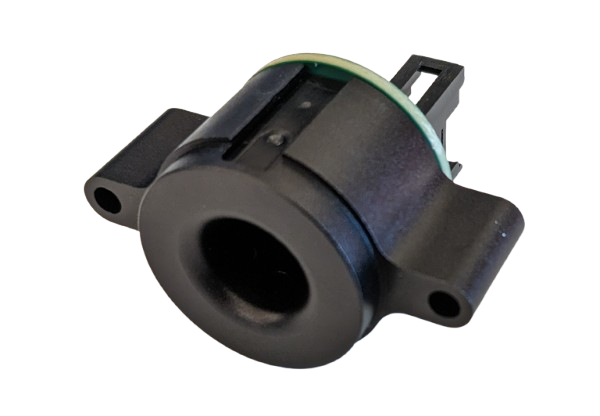
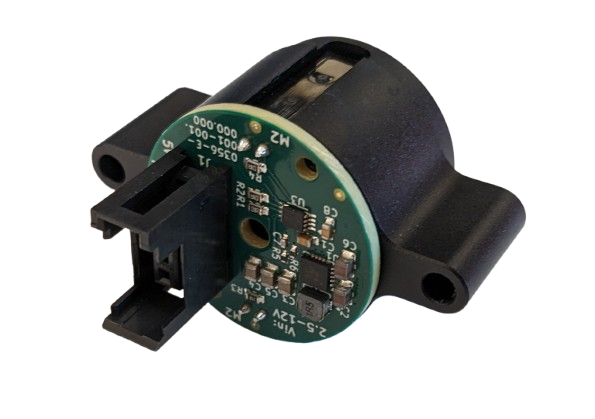
[!NOTE] This repository is for the electronics hardware only. For the physical Poke Port, see the CAD Model (Onshape).
For installing the Poke Port into a mouse home cage, we recommend drilling out a 25mm hole with a hole saw (example), and installing M3 heat-set inserts into the home cage for threaded mounting.
| Qty | Value | Footprint | References |
|---|---|---|---|
| 3 | 100 | Resistor_SMD:R_0603_1608Metric | R1, R2, R4 |
| 3 | 22uF | Capacitor_SMD:C_0805_2012Metric | C3, C4, C5 |
| 2 | 0.1uF | Capacitor_SMD:C_0603_1608Metric | C1, C8 |
| 2 | 10uF | Capacitor_SMD:C_0805_2012Metric | C2, C6 |
| 1 | 1.5uH | kicad-lib:L_Murata_1226AS-H-1R5N=P2 | L1 |
| 1 | 10pF | Capacitor_SMD:C_0402_1005Metric | C7 |
| 1 | 111K | Resistor_SMD:R_0402_1005Metric | R6 |
| 1 | 127 | Resistor_SMD:R_0603_1608Metric | R3 |
| 1 | 1M | Resistor_SMD:R_0402_1005Metric | R5 |
| 1 | 74LVCH2T45DC | Package_SO:VSSOP-8_2.3x2mm_P0.5mm | U3 |
| 1 | Conn_01x03_Socket | kicad-lib:3M_Mini-Clamp-Socket-37203-62B3-003PL-1x3_Vertical | J1 |
| 1 | EE-SX1140 | kicad-lib:EE-SX1140 | U2 |
| 1 | TPS63060 | Package_SON:Texas_S-PWSON-N10_ThermalVias | U1 |
The 19 most common of 24 parts.

AllenNeuralDynamics/harp.device.lickety-split
0360: an ephys-compliant capacitive lick detector

AllenNeuralDynamics/harp.device.treadmill-driver
0326: a Harp-compatible device for controlling an instrumented mouse treadmill

AllenNeuralDynamics/harp.device.sniff-detector
0382: Signal conditioning board for an implanted thermistor

MohamedAlDeep/RGB-Mechanical-KEEB-
This is my custom made 75% rgb mechanical keyboard

AllenNeuralDynamics/harp.device.cuttlefish
0414: an octal, TTL input/output device with programmable square wave output.

AllenNeuralDynamics/harp.device.pico-template
an RP2040-based Harp hardware/firmware project template

24 parts, built around the 74LVCH2T45DC, EE-SX1140 and TPS63060DSC. The full list of its parts is on this page, with links to each part's symbol and footprint where PCBKit's library has them.
From the AllenNeuralDynamics/harp.peripheral.poke-port repository on GitHub, at the commit this page was made from: the board is hardware/board/harp.peripheral.poke-port/harp.peripheral.poke-port.kicad_pcb and its schematic hardware/board/harp.peripheral.poke-port/harp.peripheral.poke-port.kicad_sch. PCBKit opens the board in the browser, with nothing to install.
Its repository states no licence, so its author keeps all rights: ask AllenNeuralDynamics before reusing the design.