2 layers133 × 53.9 mm
Multiplex driver
CCHS-Melbourne/vend-matrix
This is the CCHS Vending Machine motor controller.
47 parts1
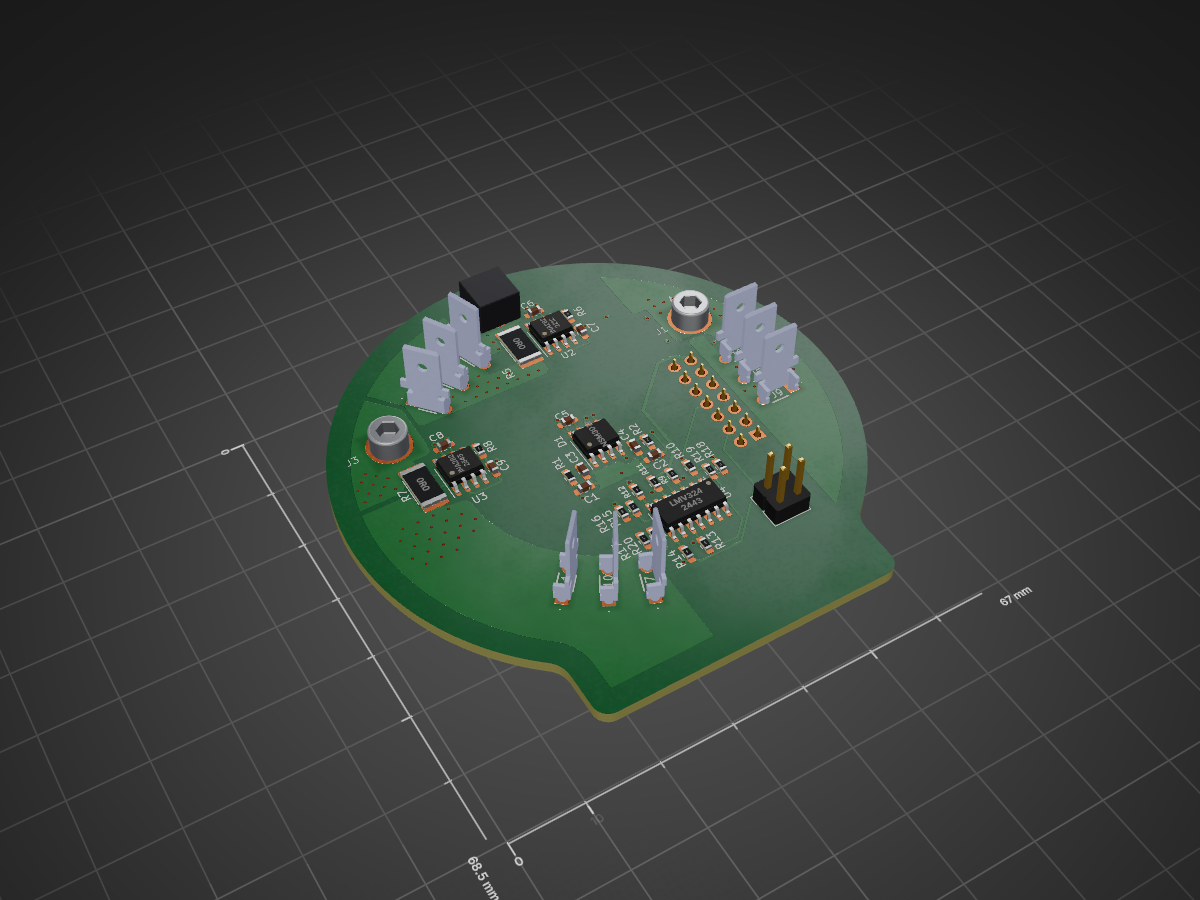
 Alexandr-Filatov/KAMAZ_Sensor_PCB
KAMAZ Sensor PCB is an open-source printed circuit board by Alexandr-Filatov, from the Alexandr-Filatov/KAMAZ_Sensor_PCB repository on GitHub. It is a 4-layer board of 67 × 68.5 mm with 57 parts on 39 nets, routed with 274 tracks and 113 vias.
It is built around the INA282AID and LMV324. Its parts include 20 resistors, 18 capacitors, 14 connectors, 4 ICs and 1 diode. It belongs with the sensors and measurement boards of this library.


| Qty | Value | Footprint | References |
|---|---|---|---|
| 9 | 4900 | Connector_My:4900 | J5, J6, J7, J9, J10, J11, J12, J13, J14 |
| 6 | 100n | Capacitor_SMD:C_0603_1608Metric_Pad1.08x0.95mm_HandSolder | C3, C4, C5, C11, C13, C17 |
| 6 | 120 | Resistor_SMD:R_0603_1608Metric_Pad0.98x0.95mm_HandSolder | R3, R6, R8, R10, R12, R14 |
| 4 | 0.1u | Capacitor_SMD:C_0603_1608Metric_Pad1.08x0.95mm_HandSolder | C6, C8, C15, C18 |
| 3 | 0.5m | Resistor_SMD:R_2512_6332Metric_Pad1.40x3.35mm_HandSolder | R4, R5, R7 |
| 3 | 15k | Resistor_SMD:R_0603_1608Metric_Pad0.98x0.95mm_HandSolder | R9, R11, R13 |
| 3 | 1k | Resistor_SMD:R_0603_1608Metric_Pad0.98x0.95mm_HandSolder | R16, R17, R18 |
| 3 | 1u | Capacitor_SMD:C_0603_1608Metric_Pad1.08x0.95mm_HandSolder | C10, C12, C14 |
| 3 | 56p | Capacitor_SMD:C_0603_1608Metric_Pad1.08x0.95mm_HandSolder | C7, C9, C16 |
| 3 | 9.1k | Resistor_SMD:R_0603_1608Metric_Pad0.98x0.95mm_HandSolder | R15, R19, R20 |
| 3 | INA282 | Package_SO:SOIC-8_3.9x4.9mm_P1.27mm | U1, U2, U3 |
| 2 | 1n | Capacitor_SMD:C_0603_1608Metric_Pad1.08x0.95mm_HandSolder | C1, C2 |
| 1 | 0 | Resistor_SMD:R_0603_1608Metric_Pad0.98x0.95mm_HandSolder | R1 |
| 1 | 51 | Resistor_SMD:R_0603_1608Metric_Pad0.98x0.95mm_HandSolder | R2 |
| 1 | A | Connector_My:Power_Wire | J1 |
| 1 | B | Connector_My:Power_Wire | J2 |
| 1 | C | Connector_My:Power_Wire | J3 |
| 1 | Conn_02x02_Odd_Even | Connector_PinHeader_2.54mm:PinHeader_2x02_P2.54mm_Vertical | J8 |
| 1 | Conn_02x07_Odd_Even | Connector_PinSocket_2.54mm:PinSocket_2x07_P2.54mm_Vertical | J4 |
| 1 | LMV324 | Package_SO:SOIC-14_3.9x8.7mm_P1.27mm | U4 |
| 1 | NSM3012 | Package_SO:SOIC-8_3.9x4.9mm_P1.27mm | D1 |
CCHS-Melbourne/vend-matrix
This is the CCHS Vending Machine motor controller.


Open-Source-Alternator-Regulator/alt-CAD
Support Files for the Alternator Regulator


shreya2717/Solar-Rooftop-Financing-Market-Risk-Analysis
Solar energy is the cleanest and most available renewable energy source. The Modern technology can harness this energy for a variety of uses, including producing electricity, providing light and heating water for…
It measures 67 × 68.5 mm and has 4 copper layers, 1.6 mm thick.
57 parts, built around the INA282AID and LMV324. The full list of its parts is on this page, with links to each part's symbol and footprint where PCBKit's library has them.
From the Alexandr-Filatov/KAMAZ_Sensor_PCB repository on GitHub, at the commit this page was made from: the board is Плата датчиков.kicad_pcb and its schematic Coil_Temperature.kicad_sch. PCBKit opens the board in the browser, with nothing to install.
Its repository states no licence, so its author keeps all rights: ask Alexandr-Filatov before reusing the design.