2 layers
MP Tracker
elektra42/freifunk-open-mppt
Open hard- and software solar maximum power point tracker
70 parts89

 15jgme/NeptuneESC
The goal of this project is to create the smallest possible SMD ESC module. Work is largely based of schematics provided by Blue Robotics in their BlueESC.
NeptuneESC is an open-source printed circuit board by 15jgme, from the 15jgme/NeptuneESC repository on GitHub, published under the LGPL-3.0 licence. It is a 4-layer board of 50 × 29 mm with 73 parts on 50 nets, routed with 387 tracks and 88 vias.
It is built around the ATMEGA8A-AU and AO4407A. Its parts include 32 resistors, 14 connectors, 11 capacitors, 9 transistors and 3 diodes. It belongs with the robots and motor control boards and the AVR (ATmega, ATtiny) boards of this library.


The goal of this project is to create the smallest possible electronic speed controller module for a single motor. This work is essentially Blue Robotic's BlueESC with a different, smaller, board layout.
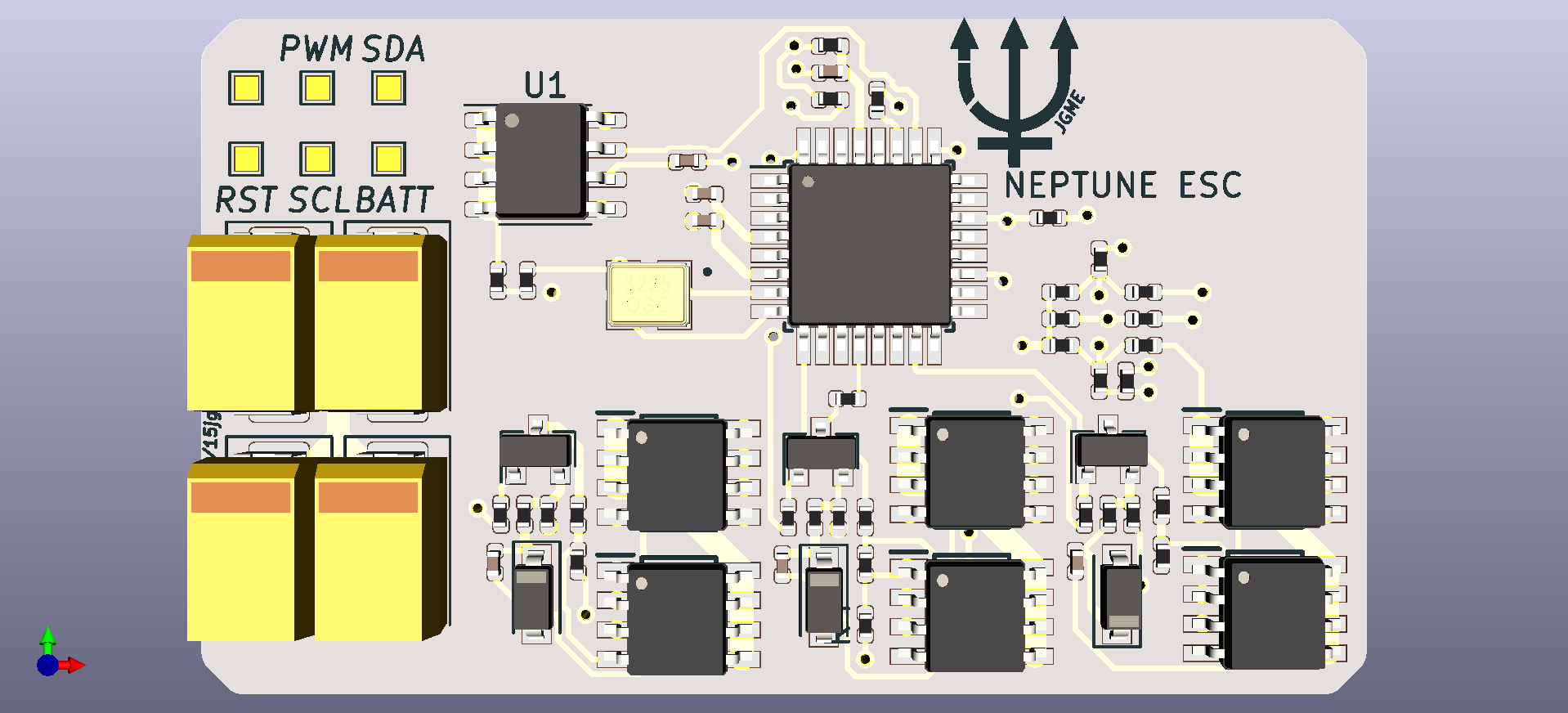
The design is made to be compatable with assembly and board fabrication from [JLCPCB]https://jlcpcb.com/
The current size is about 5cm by 2cm in a single PCB, and is designed to support motors used in midsized UAV applications.
As with the BlueESC, Neptune operates on tgy firmware and can be run off of an I2C connection, making it ideal for daisychaining and tinkering. Note that since this project was in active development tgy is no longer maintained, but the atmega8a-au should allow for a variety of different firmware if desired.
This project was never assembled, however it is nearly complete. Anyone who needs something similar should have no trouble completing it! Here's whats left before completion.
If I need a custom ESC I'll continue work on this but until then it's for anyone who can make use of it. Cheers 🍻
| Qty | Value | Footprint | References |
|---|---|---|---|
| 6 | 100 | Resistor_SMD:R_0402_1005Metric | R19, R22, R24, R27, R29, R32 |
| 6 | 10k | Resistor_SMD:R_0402_1005Metric | R2, R5, R6, R21, R26, R31 |
| 6 | 4.7k | Resistor_SMD:R_0402_1005Metric | R12, R13, R14, R18, R23, R28 |
| 6 | 47k | Resistor_SMD:R_0402_1005Metric | R9, R10, R11, R15, R16, R17 |
| 6 | AO4407A | Used libraries:SOIC127P600X175-8N | Q4, Q5, Q6, Q7, Q8, Q9 |
| 6 | Conn_01x01_Female | TestPoint:TestPoint_Pad_1.0x1.0mm | J9, J10, J11, J12, J13, J14 |
| 6 | Conn_01x01_Female | TestPoint:TestPoint_Pad_4.0x4.0mm | J1, J2, J3, J4, J5, J6 |
| 4 | 100uF | Capacitor_Tantalum_SMD:CP_EIA-7343-43_Kemet-X | C1, C2, C3, C4 |
| 3 | 0.1uF | Capacitor_SMD:C_0402_1005Metric | C5, C7, C8 |
| 3 | 2.2k | Resistor_SMD:R_0402_1005Metric | R20, R25, R30 |
| 3 | C_Small | Capacitor_SMD:C_0402_1005Metric | C9, C10, C11 |
| 3 | D_Schottky | Diode_SMD:D_SOD-123 | D1, D2, D3 |
| 3 | Q_NPN_BCE | Package_TO_SOT_SMD:SOT-23 | Q1, Q2, Q3 |
| 2 | 3.3k | Resistor_SMD:R_0402_1005Metric | R3, R8 |
| 1 | 10k NTC | Resistor_SMD:R_0402_1005Metric | R4 |
| 1 | 16MHz | Used libraries:X322516MLB4SI | Y1 |
| 1 | 18k | Resistor_SMD:R_0402_1005Metric | R7 |
| 1 | 1nF | Capacitor_SMD:C_0402_1005Metric | C6 |
| 1 | 470k | Resistor_SMD:R_0402_1005Metric | R1 |
| 1 | ACS712xLCTR-20A | Package_SO:SOIC-8_3.9x4.9mm_P1.27mm | U1 |
| 1 | ATmega8A-AU | Package_QFP:TQFP-32_7x7mm_P0.8mm | U2 |
| 1 | AVR-ISP-10 | Connector_IDC:IDC-Header_2x05_P2.54mm_Vertical | J7 |
| 1 | Conn_01x03_Male | Connector_PinSocket_1.27mm:PinSocket_1x03_P1.27mm_Vertical_SMD_Pin1Left | J8 |
| 1 | Neptune | Logos:neptuneLogo | L1 |
elektra42/freifunk-open-mppt
Open hard- and software solar maximum power point tracker


baranovskiykonstantin/aquarium
Control the lighting and the heating of the aquarium.

a-sakharov/LptToUsbAdapter
Solution for connecting old LPT device to modern PC via USB


HDR/XenoGC-Flex
Flashing is done over isp, a raspberry pi can be used for this, see https://github.com/HDR/RaspberryPiISP


It measures 50 × 29 mm and has 4 copper layers, 1.6 mm thick.
73 parts, built around the ATMEGA8A-AU and AO4407A. The full list of its parts is on this page, with links to each part's symbol and footprint where PCBKit's library has them.
From the 15jgme/NeptuneESC repository on GitHub, at the commit this page was made from: the board is NeptuneESC/NeptuneESC.kicad_pcb. PCBKit opens the board in the browser, with nothing to install.
Its repository publishes it under the LGPL-3.0 licence: you may reuse it on that licence's terms (keep the author's notice, and for a copyleft licence share your changes alike).