lora-ch1
This project is based on the ESP32-C3 microcontroller that behaves like a bridge between mobile devices and the modules. The connection is established via Bluetooth Low Energy with the phone, then sends the package over the LoRa (RFM98W/SX1278) module at 433 MHz. This combination is able to perform a full internet-independent communication between two or more devices, at a long range.
Hardware Specification & Pinout
The current hardware is based on the ESP32-C3 microcontroller, interfaced with an RFM98W/SX1278 LoRa module, a DRV2605L haptic driver, and a BQ24075 based charging circuit.
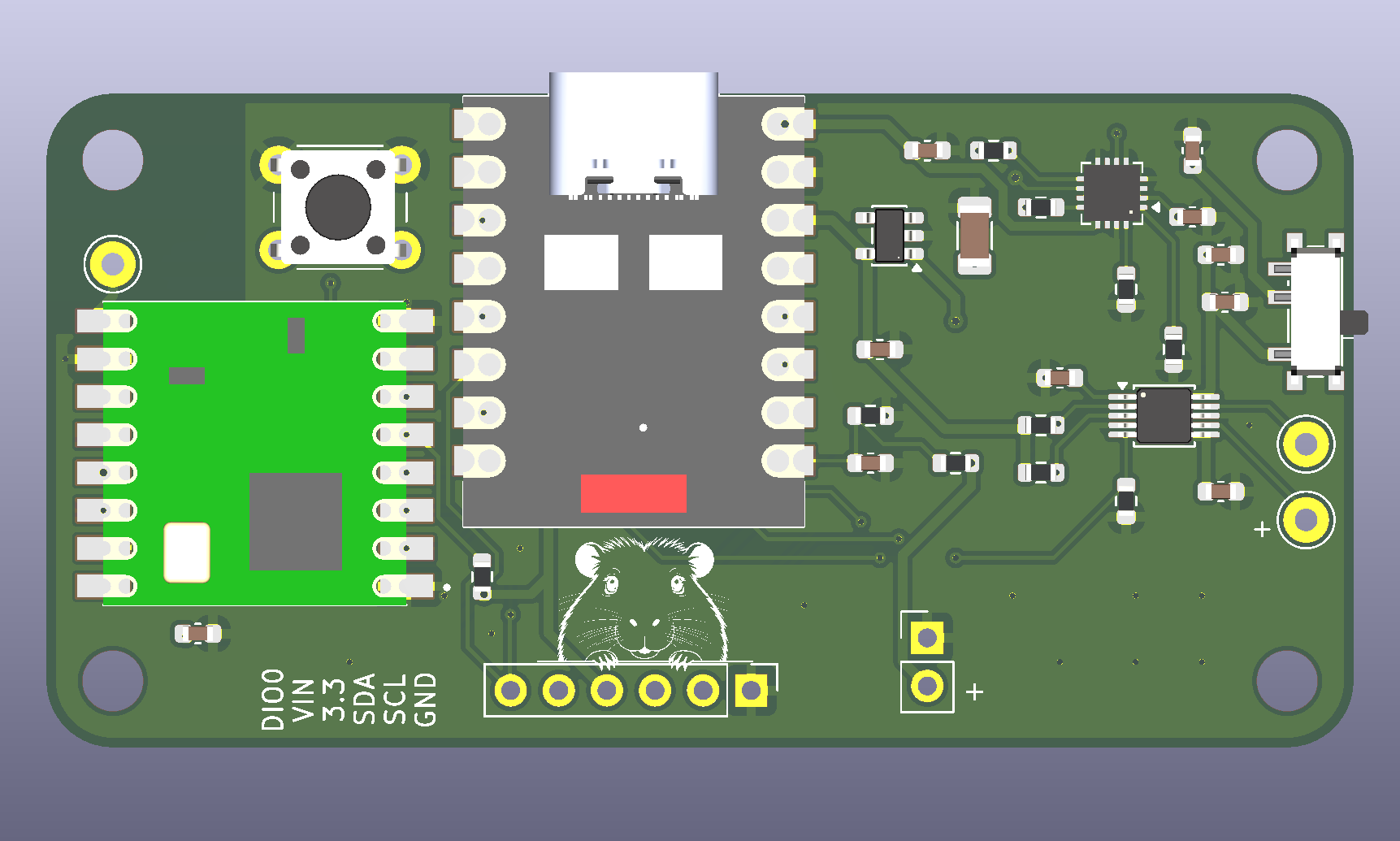
ESP32-C3 GPIO Mapping
| Component | Pin Name | ESP32-C3 GPIO | Description |
|---|
| LoRa (SPI) | MISO | GPIO 5 | Master In Slave Out |
| MOSI | GPIO 6 | Master Out Slave In |
| NSS | GPIO 7 | Chip Select (CS) |
| SCK | GPIO 4 | SPI Clock |
| DIO1 | GPIO 3 | IRQ / Interrupt 1 |
| DIO0 | GPIO 10 | IRQ / Interrupt 0 |
| RST | GPIO 2 | LoRa Reset |
| I2C Bus | SDA | GPIO 8 | I2C Data (DRV2605L) |
| SCL | GPIO 9 | I2C Clock (DRV2605L) |
| Haptic Driver | DRV_EN | GPIO 21 | Enable pin for DRV2605L |
| Power / Battery | CHRG | GPIO 20 | Charging status (BQ24075, LOW = charging) |
| BAT_SENS | GPIO 1 | Battery Voltage ADC (ADC_11db attenuation) |
| User Input | BUTTON | GPIO 0 | Hardware Button (with debouncing) |
Development Environment & Flashing
- IDE: PlatformIO
- Board:
esp32-c3-devkitm-1
Functions
- Reliable Bidirectional Communication: Transmit packages seamlessly between two or more devices. Supports public Broadcasts and private P2P messages with an Automatic Repeat Request (ARQ) mechanism. P2P messages are automatically acknowledged (ACK) and retried up to 3 times if lost in the air. The system utilizes a dynamic ACK timeout mechanism, calculating the exact wait time based on the payload's Time on Air (ToA) and the mandatory 10% Duty Cycle off-time, ensuring reliable retries without regulatory violations.
- Fast TX & Continuous RX Architecture: Optimized for ultra-low latency and high reliability in the prototype phase. By utilizing an optimized preamble (12 symbols), the Time on Air (ToA) is reduced to ~100-132ms (payload dependent), virtually eliminating packet collisions while ensuring zero message drops through continuous background listening. Thread-safe FreeRTOS implementation prevents conflicts between BLE and LoRa tasks.
- End-to-End Encryption Support (Key Exchange): Natively supports routing public keys for E2EE via
KEY_REQ and KEY_RESP commands over the standard data characteristic. The key exchange utilizes the existing ARQ (Hardware ACK) mechanism ensuring reliable and verified key delivery between peers.
- Offline Message Buffer: Safely stores up to 32 incoming direct (P2P) messages in the RAM if the phone is disconnected. Upon BLE reconnection, all buffered messages are instantly pushed to the app. Public Broadcasts are ignored for offline storage to preserve memory.
- Smart Neighbour Discovery: Automatic heartbeat messages are sent out to advertise the active device among other users, storing the RSSI, last active timestamp, and the user's custom RGB UI color. The system automatically cleans up "dead" or out-of-range nodes after a timeout period based on the active power profile.
- Location Sharing & Privacy: Broadcasts the user's GPS coordinates (Latitude and Longitude) to the mesh network via Heartbeat messages. If the user disables location sharing (Privacy Mode), the system dynamically truncates the binary payload by 8 bytes to conserve precious LoRa airtime and battery life.
- Haptic & UI Feedback: Integrated DRV2605L haptic motor driver and hardware button with debouncing. Provides distinct physical feedback for button presses, incoming LoRa messages, and an automatic low battery warning (triggered below 15% while discharging).
- BLE Security (Just Works): Implements physical button-press validation to activate BLE advertising (Pairing Mode) for 60 seconds, preventing unauthorized external connections.
- Dynamic NVS Management: The device name, UUIDs, unique LoRa ID, haptic profile, and user preferences (Username, UI Color, Location) are generated on the first startup and safely stored in the Non-Volatile Storage (NVS).
- Duty Cycle Monitoring: Tracks and logs the Time on Air (ToA) and calculates the current duty cycle percentage to assist with regulatory compliance (e.g., the 10% limit on 433MHz in Europe).
- Automated Power Management: Supports 3 different power profiles (
BATTERY_SAVER, BALANCED, PERFORMANCE) that dynamically scale the CPU frequency (80MHz or 160MHz) and adjust heartbeat intervals (10 min, 5 min, and 1 min respectively). The device defaults to BATTERY_SAVER on boot. Pressing the hardware button temporarily wakes the system into BALANCED mode for BLE communication.
- Real Battery Monitoring: Built-in hardware ADC integration calculates real battery percentage, and monitors the active charging status via the BQ24075 charging IC's open-drain output (GPIO 20).
BLE API Documentation
The mobile app connects to the ESP32 and manages the LoRa module (and some settings).
1. Discovering the device (Scanning & Connection)
- IMPORTANT (MTU Size): The Android application MUST request an MTU size of 512 bytes (
requestMtu(512)) immediately after the connection is established. Without this, Android will truncate incoming messages to 20 bytes! iOS handles this automatically.
- Device Name: The ESP32 starts advertising in this format
lora-ch1-XXXX where the XXXX is the device's MAC address's last 2 bytes (e.g., lora-ch1-A1B2).
- Dynamic UUIDs: IMPORTANT! On the first start, the device generates (Version 4) UUIDs for the services and characteristics. The mobile device should use Service Discovery instead of hardcoded UUIDs!
- Pairing Mode: The device is hidden by default. Press the physical button on the device to enable Bluetooth visibility for 60 seconds.
2. Services and characteristics
The system advertises a single main Service, under which two characteristics (Data and Control) are located. Both characteristics support READ, WRITE, and NOTIFY operations.
A. Data Characteristic
Actual message sending and receiving takes place on this channel. The payload must follow a semicolon-separated format to support message fragmentation and direct addressing.
-
Sending (App -> LoRa):
- Format 1 (Standard Message):
TARGET_MAC;CURRENT_FRAGMENT;TOTAL_FRAGMENTS;PAYLOAD
- Write a String to this characteristic using the format above.
- Target MAC: 8-character HEX string. Use
FFFFFFFF to Broadcast to everyone, or a specific device's LoRa ID for a private P2P message.
- Example (Broadcast):
FFFFFFFF;1;1;Hello everyone!
- Example (P2P Fragmented):
ABCD1234;1;3;This is a long me
- Limitation: The
PAYLOAD length per BLE write should be kept around 240 bytes due to LoRa airtime limitations.
- Format 2 (Key Exchange):
KEY_REQ;TARGET_MAC;PUBLIC_KEY or KEY_RESP;TARGET_MAC;PUBLIC_KEY
- Initiates or responds to an End-to-End Encryption key exchange.
- The ESP32 automatically parses the
TARGET_MAC, forwards the key via LoRa, and awaits a hardware ACK from the target device.
- Example:
KEY_REQ;A1B2C3D4;PU8r8H3BvjiyDNbqtp12Y1LHFvhF+nJI81oWjmFqS1w=
-
Receiving (LoRa -> App):
- The app must subscribe to
NOTIFY events on this characteristic.
- Format 1 (Standard Data):
SENDER_MAC;SENDER_USERNAME;COLOR_HEX;TARGET_MAC;CURRENT_FRAGMENT;TOTAL_FRAGMENTS;TIMESTAMP;RSSI;PAYLOAD
- The app can use the
TARGET_MAC to determine if the received message was a public broadcast (FFFFFFFF) or a private P2P message.
SENDER_USERNAME: The sender's username string automatically resolved from the internal neighbor cache. Returns Unknown if the sender is not in the cache.COLOR_HEX: The sender's custom UI color (e.g., FF0000) resolved from the cache. Defaults to 0088FF if unknown.TIMESTAMP: The UNIX Epoch time in seconds. If the device clock is not synced via SET_TIM, this value returns 0. For fragmented messages (total fragments > 1), all fragments of the same message will share the exact same timestamp (derived from the first received fragment), allowing the mobile app to seamlessly group them.RSSI: The signal strength of the received LoRa package (e.g., -78.00).
- Format 2 (Delivery Success):
ACK_OK;TARGET_MAC
- Sent to the app when a previously sent P2P message (or Key Exchange) is successfully acknowledged by the receiver's hardware.
- Format 3 (Delivery Failed):
ERR_TIMEOUT;TARGET_MAC
- Sent to the app when a P2P message fails to reach the target after maximum retries or channel collisions.
- Format 4 (Key Exchange):
KEY_REQ;SENDER_MAC;PUBLIC_KEY or KEY_RESP;SENDER_MAC;PUBLIC_KEY
- Sent to the app when another device initiates or responds to a key exchange. The app can use the
SENDER_MAC to identify the peer and complete the encryption setup.
B. Control Characteristic
This channel is used to query the network status and manage system preferences.
- Commands (App -> ESP32) & Responses (via NOTIFY):
SET_TIM;UnixSeconds
- Action: Syncs the ESP32's internal RTC to the real-world UNIX epoch time (e.g.,
SET_TIM;1715423000). Must be sent immediately after connecting.
- Response:
TIM_OK
SET_LOC;Latitude;Longitude
- Action: Updates the device's internal location cache with the phone's GPS coordinates to be broadcasted via LoRa (e.g.,
SET_LOC;47.5316;21.6273).
- Response:
LOC_OK or LOC_ERR
GET_LOC
- Response:
LOC;Latitude;Longitude (e.g., LOC;47.531600;21.627300).
NO_LOC
- Action: Disables location sharing for privacy. Resets the coordinates to
0.0 and dynamically truncates the LoRa heartbeat payload to save bandwidth.
- Response:
NO_LOC_OK
GET_NEI
- Response:
NEI|MAC;NEI_USERNAME;COLOR_HEX;RSSI;TIMESTAMP;LATITUDE;LONGITUDE|... (e.g., NEI|A1B2C3D4;lora-ch1-XXXX;FF0000;-45.50;32125;47.531600;21.627300|...) or NEI|NO_NEI if the list is empty.
GET_BAT
- Response:
BAT;Percentage;IsCharging (e.g., BAT;87;1 where 1 means charging, 0 means discharging).
SET_USR;Username
- Action: Saves the string to NVS. Cannot contain
; or | characters, and trims whitespaces. Defaults to Guest if empty or invalid.
- Response:
USR_OK
GET_USR
- Response:
USR;Username (Defaults to Guest if not set).
SET_COL;HexColor
- Action: Saves the UI color HEX string to NVS (e.g.,
FF0000). Reverts to 0088FF if the format is invalid.
- Response:
COL_OK
GET_COL
- Response:
COL;HexColor (Defaults to 0088FF if not set).
SET_PWR;ProfileName
- Action: Sets the active power profile (
BATTERY_SAVER, BALANCED, PERFORMANCE).
- Response:
PWR_OK or PWR_ERR (if the profile name is invalid).
GET_VIB
- Response:
VIB;{0/1} Where 0 means haptics is off, 1 means haptics is on.
SET_VIB;STATUS
- Action:
1 turns on (by default) the haptic feedback actuator, 0 turns off.
- Response:
VIB_OK means the command ran.
GET_ID
- Response:
ID;LOCAL_ID (e.g., ID;3FFE78C0) returns the LoRa local address.
RST
- Action: Restarts the ESP, needs to reconnect after!
- Response:
RST_OK
FACTORY_RESET
- Action: Erases the whole NVS partition, clears color, username, UUIDs, and all settings. The ESP restarts automatically. The LoRa MAC remains unchanged as it is generated from the hardware MAC address.
- Response:
FACTORY_RESET_OK
FIND
- Action: For 5 second, spams the 750 ms Alert 100% haptic vibration.
- Response:
FIND_OK


