
2 layers100 × 160 mm

 zygurt/MIDI-Wind-Controller1
Updates are occasionally posted on Instagram
PicoSax is an open-source printed circuit board by zygurt, from the zygurt/MIDI-Wind-Controller repository on GitHub, published under the MIT licence. It is a 2-layer board of 100 × 160 mm with 82 parts on 62 nets, routed with 526 tracks and 18 vias.
It is built around the 19-C47/RSGHBHC-5V01/2T. Its parts include 19 resistors, 17 capacitors, 15 switches, 14 diodes and 4 connectors. It belongs with the RP2040 boards of this library.
Updates are occasionally posted on Instagram
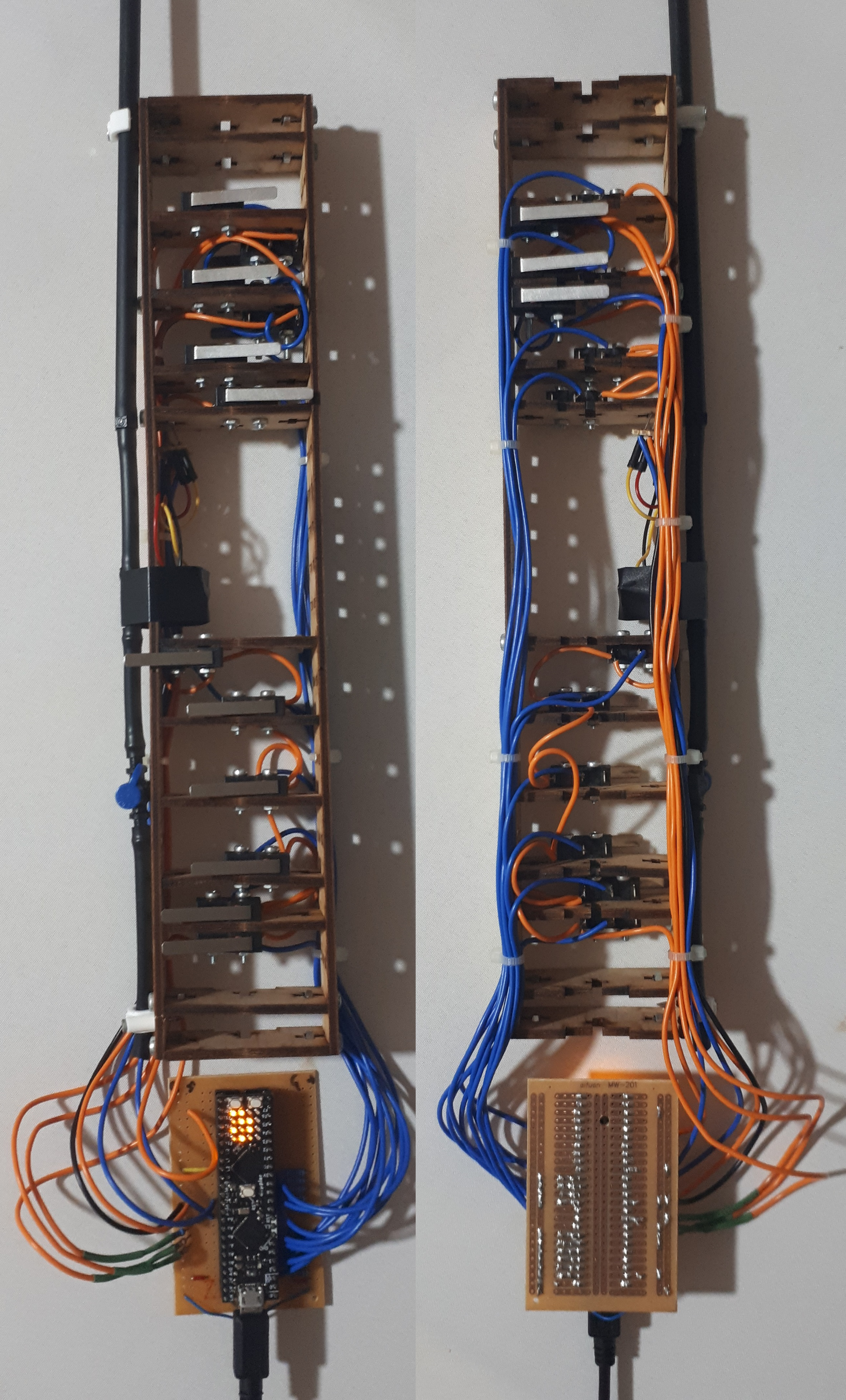
Videos about the initial prototype can be found on Youtube
| Qty | Value | Footprint | References |
|---|---|---|---|
| 17 | 10K | Resistor_SMD:R_0805_2012Metric_Pad1.20x1.40mm_HandSolder | R1, R2, R3, R4, R5, R6, R7, R8, R10, R11, R12, R13, R14, R15, R18, R19 +1 |
| 15 | Omron_B3K_L13L | MyLibrary:Omron B3K L13L | SW8va1, SW8vb1, SWA1, SWB1, SWBb1, SWC1, SWCTRL1, SWD1, SWDup1, SWE1, SWEb1, SWF1, SWG1, SWGs1, SWSPR1 |
| 14 | 0.1uF | Capacitor_SMD:C_0805_2012Metric_Pad1.18x1.45mm_HandSolder | C4, C5, C6, C7, C8, C9, C10, C11, C12, C13, C14, C15, C16, C17 |
| 13 | 19-C47/RSGHBHC-5V01/2T | PicoSax:19-C47_RSGHBHC-5V01-2T | D2, D3, D4, D5, D6, D7, D8, D9, D10, D11, D12, D13, D14 |
| 8 | MountingHole_3.2mm_M3 | MountingHole:MountingHole_3.2mm_M3 | M1, M2, M3, M4, M5, M5, M5, M6 |
| 2 | ~ | MyLibrary:PiPico Header | J1, J4 |
| 1 | 0.01uF | Capacitor_SMD:C_0805_2012Metric_Pad1.18x1.45mm_HandSolder | C2 |
| 1 | 10R 0.25W | Resistor_SMD:R_0805_2012Metric_Pad1.20x1.40mm_HandSolder | R17 |
| 1 | 1N5817 | Diode_THT:D_DO-41_SOD81_P10.16mm_Horizontal | D1 |
| 1 | 1uF | Capacitor_SMD:C_0805_2012Metric_Pad1.18x1.45mm_HandSolder | C1 |
| 1 | 33R 0.5W | Resistor_SMD:R_1210_3225Metric_Pad1.30x2.65mm_HandSolder | R16 |
| 1 | 470pF | Capacitor_SMD:C_0805_2012Metric_Pad1.18x1.45mm_HandSolder | C3 |
| 1 | Conn_01x02 | Connector_PinHeader_2.54mm:PinHeader_1x02_P2.54mm_Vertical | J3 |
| 1 | Perfboard | MyLibrary:Perfboard 10x20 | U1 |
| 1 | RaspberryPi_Pico | Module:RaspberryPi_Pico_Common_Unspecified | A1 |
| 1 | ~ | PicoSax:MIDI_DIN5 | J2 |
| 1 | ~ | MyLibrary:BPS110 AD0P15 | U2 |
| 1 | ~ | MyLibrary:MP3V5004GP | U3 |
The 81 most common of 82 parts.

zygurt/MIDI-Wind-Controller
Updates are occasionally posted on Instagram


loopj/short-stack
World's Smallest Nintendo Wii, using a trimmed motherboard and custom stacked PCBs

azonenberg/misc-devboards
Miscellaneous prototype hardware that wasn't major enough to warrant a dedicated repo


baldengineer/bit-preserve
Project for capturing vintage, classic, aka old computer schematics in KiCad.

It measures 100 × 160 mm and has 2 copper layers, 1.6 mm thick.
82 parts, built around the 19-C47/RSGHBHC-5V01/2T. The full list of its parts is on this page, with links to each part's symbol and footprint where PCBKit's library has them.
From the zygurt/MIDI-Wind-Controller repository on GitHub, at the commit this page was made from: the board is pcb/PicoSax/Backup/260114 PicoSax/PicoSax.kicad_pcb and its schematic pcb/PicoLEDs/PicoLEDs.kicad_sch. PCBKit opens the board in the browser, with nothing to install.
Its repository publishes it under the MIT licence: you may reuse it on that licence's terms (keep the author's notice, and for a copyleft licence share your changes alike).