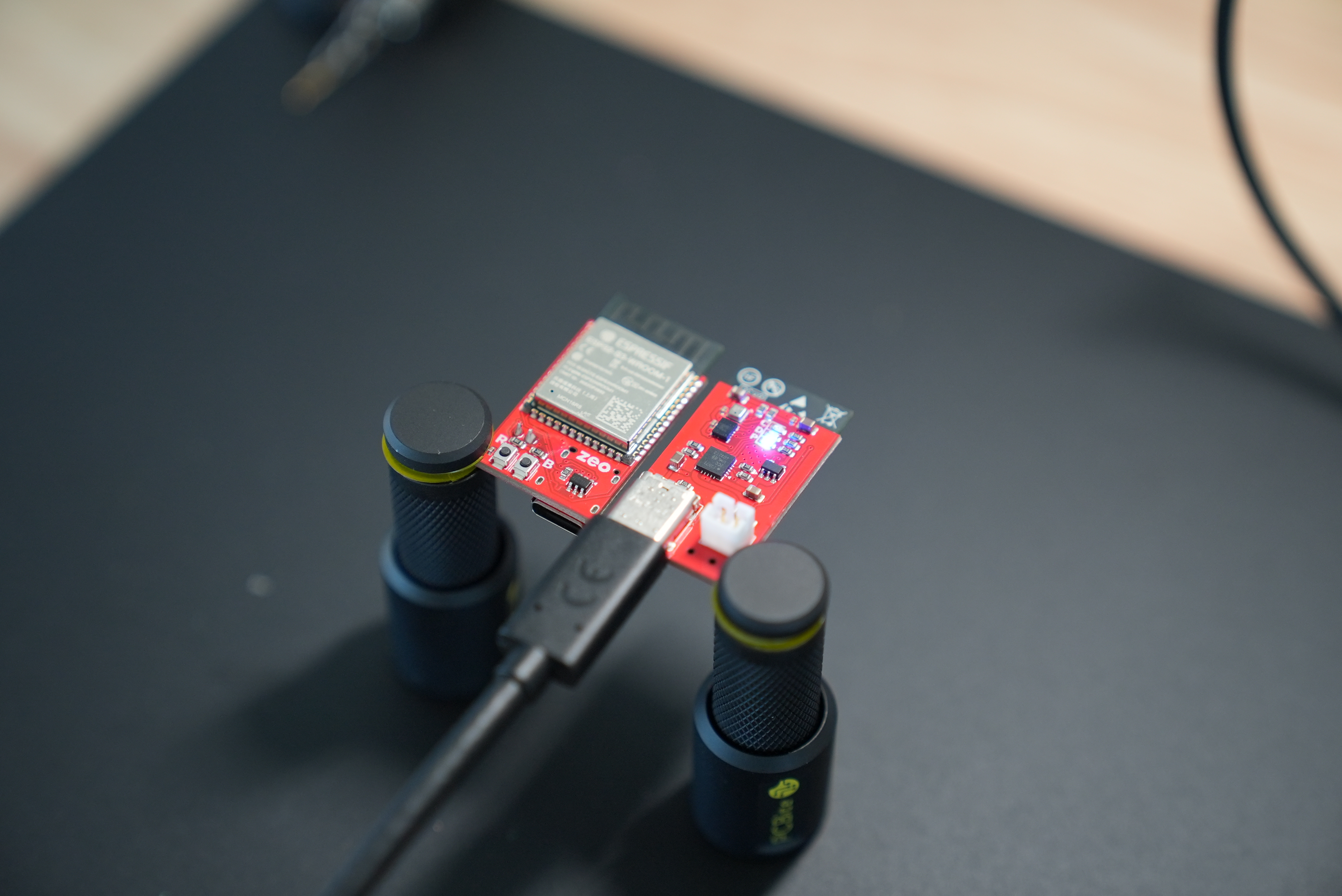
ESP32-S3 development board with onboard BME280 (temperature, humidity, pressure) and LSM6DS3 (6-axis IMU) sensors. This repo contains the designs, ESP-IDF firmware, and a Python plotter for visualization.
Esp cm is an open-source printed circuit board by zeodotdev, from the zeodotdev/zeo-boards repository on GitHub. It is a 2-layer board of 55 × 40 mm with 33 parts on 64 nets, routed with 509 tracks and 61 vias.
It is built around the ESP32-S3, W25Q128JVSIQ and AP2112K-3.3. Its parts include 16 capacitors, 4 resistors, 3 ICs, 2 connectors and 2 crystals. It belongs with the ESP32 boards of this library.
ESP32-S3 development board with onboard BME280 (temperature, humidity, pressure) and LSM6DS3 (6-axis IMU) sensors. This repo contains the designs, ESP-IDF firmware, and a Python plotter for visualization.
Hardware
MCU: ESP32-S3-WROOM-1 (Wi-Fi + BLE)
Sensors: BME280 (I2C 0x76), LSM6DS3 (I2C 0x6A) on shared bus (GPIO8 SDA, GPIO9 SCL)
Power: USB-C with MCP73871 LiPo charger + AP2112K 3.3V LDO — runs from USB or battery
Interface: USB-C for flashing/debug, BOOT + RESET buttons
Firmware
Streams sensor data over Wi-Fi as UDP broadcast JSON packets on port 12345.
ESP32-S3 development board with onboard BME280 (temperature, humidity, pressure) and LSM6DS3 (6-axis IMU) sensors. This repo contains the designs, ESP-IDF firmware, and a Python plotter for visualization.
ESP32-S3 development board with onboard BME280 (temperature, humidity, pressure) and LSM6DS3 (6-axis IMU) sensors. This repo contains the designs, ESP-IDF firmware, and a Python plotter for visualization.
ESP32-S3 development board with onboard BME280 (temperature, humidity, pressure) and LSM6DS3 (6-axis IMU) sensors. This repo contains the designs, ESP-IDF firmware, and a Python plotter for visualization.
ESP32-S3 development board with onboard BME280 (temperature, humidity, pressure) and LSM6DS3 (6-axis IMU) sensors. This repo contains the designs, ESP-IDF firmware, and a Python plotter for visualization.
ESP32-S3 development board with onboard BME280 (temperature, humidity, pressure) and LSM6DS3 (6-axis IMU) sensors. This repo contains the designs, ESP-IDF firmware, and a Python plotter for visualization.
ESP32-S3 development board with onboard BME280 (temperature, humidity, pressure) and LSM6DS3 (6-axis IMU) sensors. This repo contains the designs, ESP-IDF firmware, and a Python plotter for visualization.
ESP32-S3 development board with onboard BME280 (temperature, humidity, pressure) and LSM6DS3 (6-axis IMU) sensors. This repo contains the designs, ESP-IDF firmware, and a Python plotter for visualization.
It measures 55 × 40 mm and has 2 copper layers, 1.6 mm thick.
What parts does the Esp cm use?
33 parts, built around the ESP32-S3, W25Q128JVSIQ and AP2112K-3.3. The full list of its parts is on this page, with links to each part's symbol and footprint where PCBKit's library has them.
Where can I download the Esp cm KiCad files?
From the zeodotdev/zeo-boards repository on GitHub, at the commit this page was made from: the board is multi-board-ex/boards/esp_cm/esp_cm.kicad_pcb and its schematic demo_board/ZeoDevBoard.kicad_sch. PCBKit opens the board in the browser, with nothing to install.
Can I use the Esp cm design in my own project?
Its repository states no licence, so its author keeps all rights: ask zeodotdev before reusing the design.