
4 layers101.6 × 76.2 mm
8051dumper
JohnDMcMaster/8051dumper
by NF6X. Forked from: https://gitlab.com/NF6X_Retrocomputing/8051dumper
41 parts27
 yoppeh/eeprom-programmer10
An Arduino Nano sketch and schematic for an Atmel 28cx programmer.
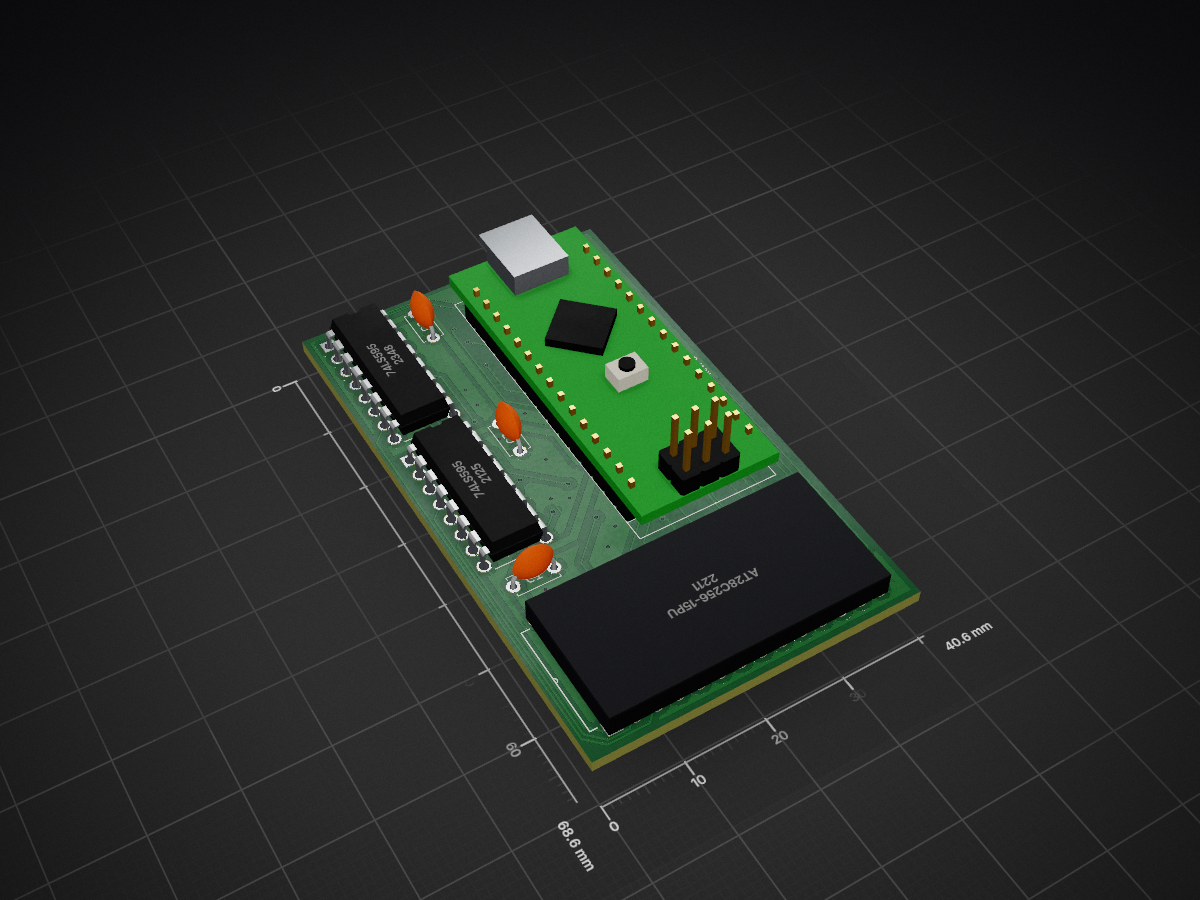
Eeprom programmer is an open-source printed circuit board by yoppeh, from the yoppeh/eeprom-programmer repository on GitHub, published under the MIT licence. It is a 2-layer board of 40.6 × 68.6 mm with 7 parts on 46 nets, routed with 283 tracks and 42 vias.
It is built around the AT28C256-15PU. Its parts include 3 capacitors and 3 ICs. It belongs with the interfaces and adapters boards and the AVR (ATmega, ATtiny) boards of this library.
An Arduino Nano sketch and schematic for an Atmel 28cx programmer. The schematic started out only targeting 8kx8 chips (rev. A) but has been updated to connect all address lines for the 28cx series (rev. B), so any of those eeproms should work up to the 32kx8 chips. The design is based on this one, from Ben Eater.
The Arduino Nano sketch implements a serial interface to the programmer. It accepts one-letter commands:
Any standard terminal program can be used to talk to the programmer. I use the following:
Be sure to set the size of your target eeprom with the s command before doing anything. It doesn't affect the chip in any way, but tells the programmer what size your chip is for the erase, fill and read commands and error checking in the xmodem transfer.
The programmer uses standard x-modem, as provided by any respectable terminal program—and certainly all of the above listed terminal programs—to put binary files onto the eeprom. No other software is required. The programmer will verify every 64 bytes as they are written (the size of an internal eeprom page).
Although the eeprom chips are supposed to come from the factory unlocked, I've heard stories of some chips being purchased off ebay that arrive locked. Try doing an unlock on a chip if you have problems writing to it.
When doing an xmodem transfer to the chip, the program will wait indefinitely for you to start the xmodem transfer from your terminal software. You can abort the transfer at this point by pressing the ESC key. Otherwise, once you have started the transfer, it will continue until the process completes or an error is detected.
If you want to fill the eeprom with a specific byte, say the 6502 nop 0xea, just change
fill[j] = i + j; on line 490 to
fill[j] = 0xea;| Qty | Value | Footprint | References |
|---|---|---|---|
| 3 | .1uf | eeprom-programmer:C_Disc_D5.0mm_W2.5mm_P5.00mm | C1, C2, C3 |
| 2 | 74LS595 | eeprom-programmer:DIP254P762X508-16 | U1, U2 |
| 1 | AT28C256-15PU | eeprom-programmer:DIP254P1524X482-28 | IC1 |
| 1 | Arduino_Nano_v3.x | eeprom-programmer:Arduino_Nano | A1 |
It measures 40.6 × 68.6 mm and has 2 copper layers, 1.6 mm thick.
7 parts, built around the AT28C256-15PU. The full list of its parts is on this page, with links to each part's symbol and footprint where PCBKit's library has them.
From the yoppeh/eeprom-programmer repository on GitHub, at the commit this page was made from: the board is schematic/eeprom-programmer.kicad_pcb. PCBKit opens the board in the browser, with nothing to install.
Its repository publishes it under the MIT licence: you may reuse it on that licence's terms (keep the author's notice, and for a copyleft licence share your changes alike).
JohnDMcMaster/8051dumper
by NF6X. Forked from: https://gitlab.com/NF6X_Retrocomputing/8051dumper

costarc/msxcart_flash32k
A MSX 32K EEPROM AT28C256 cartridge rewritable by software.

rosco-6502/rosco_6502
Design, documentation and software for the Really Old School Computer (6502)


napicella/8-bit-computer
Resources for an 8 bit computer based on the 6502 micro processor

rosco-m68k/rosco_m68k
Design, documentation and software for the Really Old School Computer (M68K)


Aronnax9000/BB816-MATX-PCIE
ATX form factor motherboard for Adrien Kohlbecker's BB816 CPU breakout board (rev. A27)