
2 layers85.9 × 64.9 mm
Stm32 board
ybabs/PorpDAQ
Design Files for a STM32-Based Underwater Acoustics data acquisition board for harbour porpoises
101 parts6MIT
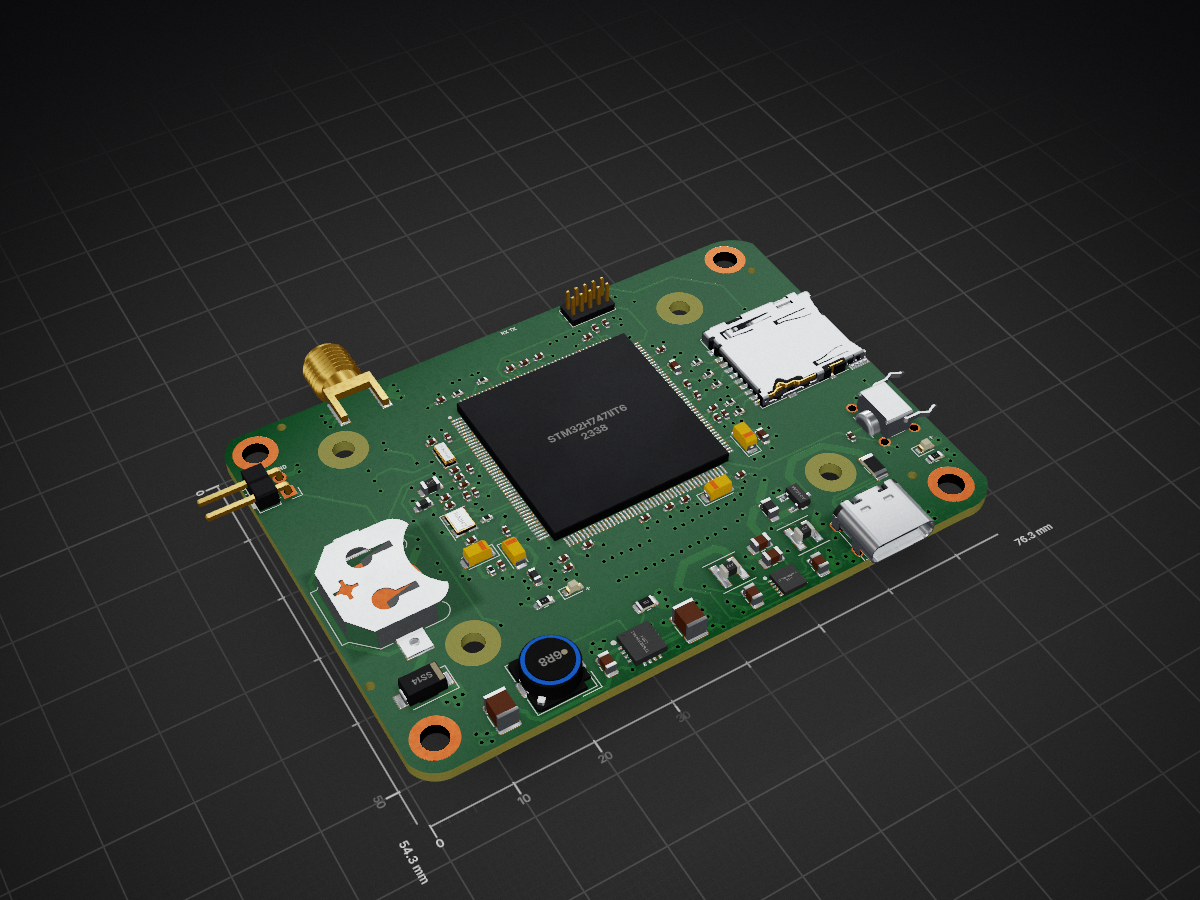
Design Files for a STM32-Based Underwater Acoustics data acquisition board for harbour porpoises
CM4 is an open-source printed circuit board by ybabs, from the ybabs/PorpDAQ repository on GitHub, published under the MIT licence. It is a 4-layer board of 76.3 × 54.3 mm with 113 parts on 305 nets, routed with 1,197 tracks and 264 vias.
It is built around the STM32H747IIT6, TPS62111RSAT and AO3401A, with the SS14 and TL1105CF160Q among its other parts. Its parts include 52 capacitors, 28 resistors, 6 ICs, 6 connectors and 4 inductors. It belongs with the computers and single-board computers boards and the STM32 and Raspberry Pi (Linux) boards of this library.


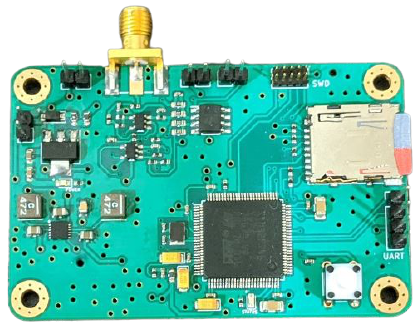
STM32 Based design data acquisition recorder for harbour porpoises. The system is based on a 40dB bandpass preamplifier (90Khz - 150kHz). Records WAV file at a sampling rate of 400 KHz (V1) and 500 KHz (V2) and stores them to a microSD card. The preamplifier was designed using TI's filter designer tool. Preamp output is passed to a summing amplifier to keep signals within 0 - 3.3V with a 1.65V bias. There's a few iterations of the DAQ from the initial prototypes to improved designs.
PorpDAQ has been designed to fit within a small multirotor UAV so current design weighs only 18g. PorpDAQ computes a 1024 point RFFT of incoming hydrophone signals and transmits signals within 90 - 150KHz over a UART Interface
The initial version of the DAQ was based on a STM32F746 chip and had a 400 KHz sample rate and a 12-bit ADC with a SD card write speed of about 20mbps.
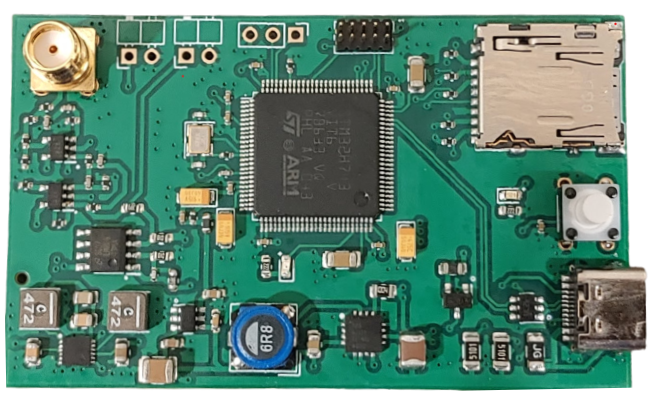
Rev 2 board comes with some improvements namely the the use of the STM32H743 chip, USB-C for power with the addition of a full speed interface. 500 KHz sample rate, SD Card write speed of ~35 Mbps with a 16-bit ADC and better SNR. Also slightly smaller footprint
This repository mostly contains :
board_100pin while Rev 2 design is named h7_board. @article{Babatunde2020, doi = {10.3390/s20216064}, url = {https://doi.org/10.3390/s20216064}, year = {2020}, month = oct, publisher = {{MDPI} {AG}}, volume = {20}, number = {21}, pages = {6064}, author = {Daniel Babatunde and Simon Pomeroy and Paul Lepper and Ben Clark and Rebecca Walker}, title = {Autonomous Deployment of Underwater Acoustic Monitoring Devices Using an Unmanned Aerial Vehicle: The Flying Hydrophone}, journal = {Sensors} }
MIT License Copyright 2020 Daniel Babatunde
| Qty | Value | Footprint | References |
|---|---|---|---|
| 25 | 100n | Capacitor_SMD:C_0402_1005Metric | C14, C15, C16, C17, C18, C19, C20, C21, C22, C24, C26, C27, C28, C29, C30, C31 +9 |
| 5 | 47k | Resistor_SMD:R_0402_1005Metric | R22, R23, R24, R25, R26 |
| 4 | 100p | Capacitor_SMD:C_0402_1005Metric | C1, C2, C3, C4 |
| 4 | MountingHole | MountingHole:MountingHole_3.2mm_M3_ISO14580_Pad | H1, H2, H3, H4 |
| 3 | 10k | Resistor_SMD:R_0402_1005Metric | R6, R19, R27 |
| 3 | 10u | Capacitor_SMD:C_0805_2012Metric | C6, C7, C9 |
| 2 | 1.5p | Capacitor_SMD:C_0402_1005Metric | C51, C52 |
| 2 | 100k | Resistor_SMD:R_0603_1608Metric | R11, R14 |
| 2 | 10u | Capacitor_SMD:C_0402_1005Metric | C39, C42 |
| 2 | 12p | Capacitor_SMD:C_0402_1005Metric | C48, C49 |
| 2 | 187 | Resistor_SMD:R_0402_1005Metric | R7, R9 |
| 2 | 1u | Capacitor_Tantalum_SMD:CP_EIA-3216-18_Kemet-A | C23, C25 |
| 2 | 2.49k | Resistor_SMD:R_0402_1005Metric | R8, R10 |
| 2 | 4.7u | Inductor_SMD:L_Coilcraft_XxL4020 | L1, L2 |
| 2 | 4.7u | Capacitor_Tantalum_SMD:CP_EIA-3216-18_Kemet-A | C13, C47 |
| 2 | 4.7u | Capacitor_SMD:C_0402_1005Metric | C43, C46 |
| 2 | 47 | Resistor_SMD:R_0402_1005Metric | R18, R20 |
| 2 | 5.1k | Resistor_SMD:R_1206_3216Metric | R15, R16 |
| 2 | 50k | Resistor_SMD:R_0603_1608Metric | R12, R13 |
| 2 | OPA659IDBVR | SamacSys_Parts:SOT95P280X145-5N | IC1, IC2 |
| 1 | 100 @ 100 MHz | Inductor_SMD:L_0603_1608Metric | FB2 |
| 1 | 100n | Capacitor_SMD:C_0805_2012Metric | C8 |
| 1 | 10p | Capacitor_SMD:C_0402_1005Metric | C5 |
| 1 | 10u x5R 25V | Capacitor_SMD:C_1210_3225Metric | C10 |
| 1 | 16MHz | Crystal:Crystal_SMD_3225-4Pin_3.2x2.5mm | Y1 |
| 1 | 18 @100Mhz | Inductor_SMD:L_0603_1608Metric | FB3 |
| 1 | 1M | Resistor_SMD:R_0805_2012Metric | R17 |
| 1 | 1u | Capacitor_SMD:C_0805_2012Metric | C12 |
| 1 | 1u_X5R_0603 | Capacitor_SMD:C_0603_1608Metric | C40 |
| 1 | 2.2k | Resistor_SMD:R_0603_1608Metric | R28 |
| 1 | 2.2u | Capacitor_SMD:C_0603_1608Metric | C45 |
| 1 | 2.2uH | Inductor_SMD:L_0805_2012Metric | L4 |
| 1 | 220p | Capacitor_SMD:C_0402_1005Metric | C41 |
| 1 | 22u x7R 10V | Capacitor_SMD:C_1210_3225Metric | C11 |
| 1 | 2k2 | Resistor_SMD:R_0603_1608Metric | R21 |
| 1 | 32.768KHz | Crystal:Crystal_SMD_3215-2Pin_3.2x1.5mm | Y2 |
| 1 | 34.8k | Resistor_SMD:R_0402_1005Metric | R5 |
| 1 | 35.7k | Resistor_SMD:R_0402_1005Metric | R4 |
| 1 | 44.2k | Resistor_SMD:R_0402_1005Metric | R1 |
| 1 | 6.34k | Resistor_SMD:R_0402_1005Metric | R3 |
| 1 | 6.8u | Inductor_SMD:L_TDK_SLF7032 | L3 |
| 1 | 600 @ 100MHz | Inductor_SMD:L_0805_2012Metric | FB1 |
| 1 | 66.5k | Resistor_SMD:R_0402_1005Metric | R2 |
| 1 | AO3401A | SamacSys_Parts:SOT95P280X125-3N | Q1 |
| 1 | Battery_Cell | Battery:BatteryHolder_Keystone_3000_1x12mm | BT1 |
| 1 | ComputeModule4 | CM4IO:Raspberry-Pi-4-Compute-Module | Module1 |
| 1 | Conn_01x02_Female | Connector_PinHeader_2.54mm:PinHeader_1x02_P2.54mm_Horizontal | J6 |
| 1 | Conn_Coaxial | Connector_Coaxial:SMA_Samtec_SMA-J-P-H-ST-EM1_EdgeMount | J1 |
| 1 | DJI UART | Connector_Molex:Molex_PicoBlade_53261-0371_1x03-1MP_P1.25mm_Horizontal | J5 |
| 1 | LED | LED_SMD:LED_0603_1608Metric | D3 |
| 1 | LED_Red | LED_SMD:LED_0603_1608Metric | D2 |
| 1 | LMH6643MAX_NOPB | SamacSys_Parts:SOIC127P600X175-8N | IC3 |
| 1 | Micro_SD_Card | Connector_Card:microSD_HC_Hirose_DM3AT-SF-PEJM5 | J4 |
| 1 | Polyfuse | Fuse:Fuse_1206_3216Metric | F1 |
| 1 | SS14 | Diode_SMD:D_SMA | D1 |
| 1 | STM32H747IIT6 | SamacSys_Parts:QFP50P2600X2600X160-176N | IC6 |
| 1 | SWDIO | Connector_PinHeader_1.27mm:PinHeader_2x05_P1.27mm_Vertical | J3 |
| 1 | TL1105CF160Q | SamacSys_Parts:TL1105CF160Q | S1 |
| 1 | TPS62111RSAT | SamacSys_Parts:QFN65P400X400X100-17N-D | IC5 |
| 1 | TPS65133DPDR | SamacSys_Parts:SON45P300X300X80-13N-D | IC4 |
| 1 | USB_C_Receptacle_USB2.0 | CM4IO:TYPE-C-31-M-12 | J2 |
ybabs/PorpDAQ
Design Files for a STM32-Based Underwater Acoustics data acquisition board for harbour porpoises

ybabs/PorpDAQ
Design Files for a STM32-Based Underwater Acoustics data acquisition board for harbour porpoises

ybabs/PorpDAQ
Design Files for a STM32-Based Underwater Acoustics data acquisition board for harbour porpoises

ybabs/PorpDAQ
Design Files for a STM32-Based Underwater Acoustics data acquisition board for harbour porpoises

ybabs/PorpDAQ
Design Files for a STM32-Based Underwater Acoustics data acquisition board for harbour porpoises

ybabs/PorpDAQ
Design Files for a STM32-Based Underwater Acoustics data acquisition board for harbour porpoises

ybabs/H745FCS
Quadcopter Flight Controller based on the dual core STM32H745 Microcontroller

Sriram-Cheedi/Two_Defuse_Or_Not_Two_Defuse_
This project aims to create an innovative and tense cooperative experience for players by utilising custom hardware.


hubertciebiada/open-ambient-sensor
OAS — Open Ambient Sensor: DIY multi-sensor indoor environmental monitor (CO2, PM, VOC/NOx, temperature/humidity, mmWave presence) on ESP32-C6 with ESPHome / Home Assistant integration

usr-ein/TriMixxx
Open source standalone DJ multimedia player, compatible with Rekordbox

KaliAssistant/Fox-Jack
Portable social-engineering LAN tool for automated payloads and wired audits — based on Luckfox Pico Max

OpenLogicEFI/Hardware
Hardware is based off an open source project called Speeduino by Josh Stewart.

Fluepke/Fluepdot
Project for controlling Annax flipdot panels used by the Berliner Verkehrsbetriebe
It measures 76.3 × 54.3 mm and has 4 copper layers, 1.6 mm thick.
113 parts, built around the STM32H747IIT6, TPS62111RSAT, AO3401A and SS14. The full list of its parts is on this page, with links to each part's symbol and footprint where PCBKit's library has them.
From the ybabs/PorpDAQ repository on GitHub, at the commit this page was made from: the board is CM4 Design/CM4/CM4.kicad_pcb and its schematic CM4 Design/CM4/CM4.kicad_sch. PCBKit opens the board in the browser, with nothing to install.
Its repository publishes it under the MIT licence: you may reuse it on that licence's terms (keep the author's notice, and for a copyleft licence share your changes alike).