
4 layers76.3 × 54.3 mm
CM4
ybabs/PorpDAQ
Design Files for a STM32-Based Underwater Acoustics data acquisition board for harbour porpoises
113 parts6MIT

Design Files for a STM32-Based Underwater Acoustics data acquisition board for harbour porpoises
CM4 is an open-source printed circuit board by ybabs, from the ybabs/PorpDAQ repository on GitHub, published under the MIT licence. It is a 4-layer board of 68.2 × 41.6 mm with 89 parts on 124 nets, routed with 468 tracks and 107 vias.
It is built around the LT6233CS6#TRMPBF, AD8031ARTZ-R2 and ADP7156ARDZ-3.3-R7, with the USBLC6-2SC6, AO3401A and TL1105CF160Q among its other parts. Its parts include 41 capacitors, 24 resistors, 8 ICs, 5 connectors and 2 diodes. It belongs with the computers and single-board computers boards and the STM32 and Raspberry Pi (Linux) boards of this library.


STM32 Based design data acquisition recorder for harbour porpoises. The system is based on a 40dB bandpass preamplifier (90Khz - 150kHz). Records WAV file at a sampling rate of 400 KHz (V1) and 500 KHz (V2) and stores them to a microSD card. The preamplifier was designed using TI's filter designer tool. Preamp output is passed to a summing amplifier to keep signals within 0 - 3.3V with a 1.65V bias. There's a few iterations of the DAQ from the initial prototypes to improved designs.
PorpDAQ has been designed to fit within a small multirotor UAV so current design weighs only 18g. PorpDAQ computes a 1024 point RFFT of incoming hydrophone signals and transmits signals within 90 - 150KHz over a UART Interface
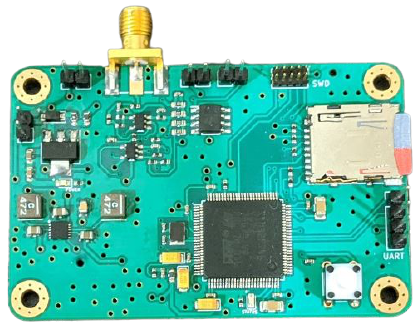
The initial version of the DAQ was based on a STM32F746 chip and had a 400 KHz sample rate and a 12-bit ADC with a SD card write speed of about 20mbps.
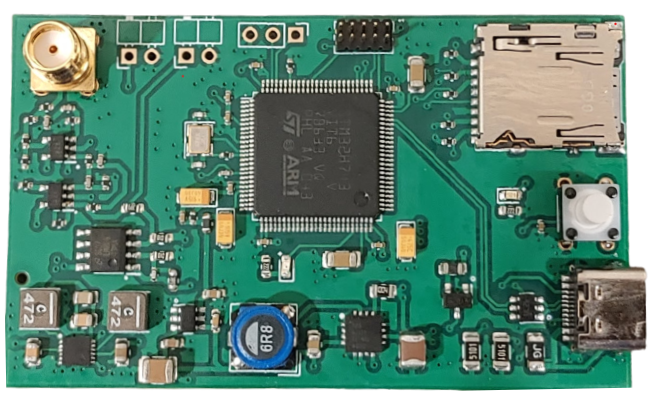
Rev 2 board comes with some improvements namely the the use of the STM32H743 chip, USB-C for power with the addition of a full speed interface. 500 KHz sample rate, SD Card write speed of ~35 Mbps with a 16-bit ADC and better SNR. Also slightly smaller footprint
This repository mostly contains :
board_100pin while Rev 2 design is named h7_board. @article{Babatunde2020, doi = {10.3390/s20216064}, url = {https://doi.org/10.3390/s20216064}, year = {2020}, month = oct, publisher = {{MDPI} {AG}}, volume = {20}, number = {21}, pages = {6064}, author = {Daniel Babatunde and Simon Pomeroy and Paul Lepper and Ben Clark and Rebecca Walker}, title = {Autonomous Deployment of Underwater Acoustic Monitoring Devices Using an Unmanned Aerial Vehicle: The Flying Hydrophone}, journal = {Sensors} }
MIT License Copyright 2020 Daniel Babatunde
| Qty | Value | Footprint | References |
|---|---|---|---|
| 10 | 100n | Capacitor_SMD:C_0402_1005Metric | C14, C16, C17, C18, C20, C21, C24, C26, C34, C50 |
| 6 | 100n | Capacitor_SMD:C_0603_1608Metric | C35, C37, C38, C39, C40, C41 |
| 5 | 10u | Capacitor_SMD:C_0603_1608Metric | C1, C2, C28, C33, C36 |
| 5 | 47k | Resistor_SMD:R_0402_1005Metric | R17, R19, R22, R23, R24 |
| 4 | 1.5n | Capacitor_SMD:C_0402_1005Metric | C10, C12, C30, C32 |
| 4 | 1u | Capacitor_SMD:C_0603_1608Metric | C3, C4, C5, C27 |
| 3 | Fiducial | Fiducial:Fiducial_0.5mm_Mask1.5mm | FID1, FID2, FID3 |
| 3 | LT6233CS6#TRMPBF | SamacSys_Parts:SOT95P280X100-6N | IC2, IC3, IC5 |
| 2 | 1.2n | Capacitor_SMD:C_0402_1005Metric | C11, C31 |
| 2 | 10k | Resistor_SMD:R_0603_1608Metric | R13, R14 |
| 2 | 12p | Capacitor_SMD:C_0402_1005Metric | C48, C49 |
| 2 | 130 | Resistor_SMD:R_0402_1005Metric | R9, R11 |
| 2 | 1u | Capacitor_Tantalum_SMD:CP_EIA-3216-18_Kemet-A | C23, C25 |
| 2 | 2.2u | Capacitor_SMD:C_1206_3216Metric | C15, C19 |
| 2 | 5.1k | Resistor_SMD:R_1206_3216Metric | R1, R2 |
| 2 | 620 | Resistor_SMD:R_0402_1005Metric | R6, R8 |
| 2 | 8.87k | Resistor_SMD:R_0402_1005Metric | R3, R5 |
| 1 | 0 | Resistor_SMD:R_0402_1005Metric | R18 |
| 1 | 1.15k | Resistor_SMD:R_0402_1005Metric | R10 |
| 1 | 100 @ 100 MHz | Inductor_SMD:L_0603_1608Metric | FB2 |
| 1 | 100n X7R | Capacitor_SMD:C_0603_1608Metric | C22 |
| 1 | 10k | Resistor_SMD:R_0402_1005Metric | R27 |
| 1 | 10u | Capacitor_Tantalum_SMD:CP_EIA-3216-18_Kemet-A | C42 |
| 1 | 16MHz | Crystal:Crystal_SMD_3225-4Pin_3.2x2.5mm | Y1 |
| 1 | 2.2k | Resistor_SMD:R_0603_1608Metric | R28 |
| 1 | 294 | Resistor_SMD:R_0402_1005Metric | R7 |
| 1 | 2k2 | Resistor_SMD:R_0603_1608Metric | R21 |
| 1 | 4.42k | Resistor_SMD:R_0402_1005Metric | R4 |
| 1 | 4.7u | Capacitor_Tantalum_SMD:CP_EIA-3216-18_Kemet-A | C13 |
| 1 | 4.99k | Resistor_SMD:R_0603_1608Metric | R12 |
| 1 | 47 | Resistor_SMD:R_0402_1005Metric | R20 |
| 1 | 47p | Capacitor_SMD:C_0402_1005Metric | C29 |
| 1 | 600 @ 100MHz | Inductor_SMD:L_0805_2012Metric | FB1 |
| 1 | AD8031ARTZ-R2 | SamacSys_Parts:SOT95P280X145-5N | IC6 |
| 1 | ADP7156ARDZ-3.3-R7 | SamacSys_Parts:SOIC127P600X175-9N | IC1 |
| 1 | AO3401A | SamacSys_Parts:SOT95P280X125-3N | Q1 |
| 1 | Conn_Coaxial | Connector_Coaxial:SMA_Wurth_60312002114503_Vertical | J2 |
| 1 | LED | LED_SMD:LED_0603_1608Metric | D3 |
| 1 | LED_Red | LED_SMD:LED_0603_1608Metric | D2 |
| 1 | Micro_SD_Card | Connector_Card:microSD_HC_Hirose_DM3AT-SF-PEJM5 | J4 |
| 1 | Polyfuse | Fuse:Fuse_1206_3216Metric | F1 |
| 1 | REF3433IDBVR | REF3433:REF3433IDBVR | U3 |
| 1 | STM32H743VITx | Package_QFP:LQFP-100_14x14mm_P0.5mm | U2 |
| 1 | SWDIO | Connector_PinHeader_1.27mm:PinHeader_2x05_P1.27mm_Vertical | J3 |
| 1 | TL1105CF160Q | SamacSys_Parts:TL1105CF160Q | S1 |
| 1 | USART | Connector_PinHeader_2.54mm:PinHeader_1x03_P2.54mm_Vertical | J7 |
| 1 | USBLC6-2SC6 | Package_TO_SOT_SMD:SOT-23-6 | U4 |
| 1 | USB_C_Receptacle_USB2.0 | CM4IO:TYPE-C-31-M-12 | J1 |
ybabs/PorpDAQ
Design Files for a STM32-Based Underwater Acoustics data acquisition board for harbour porpoises

ybabs/PorpDAQ
Design Files for a STM32-Based Underwater Acoustics data acquisition board for harbour porpoises

ybabs/PorpDAQ
Design Files for a STM32-Based Underwater Acoustics data acquisition board for harbour porpoises

ybabs/PorpDAQ
Design Files for a STM32-Based Underwater Acoustics data acquisition board for harbour porpoises

ybabs/PorpDAQ
Design Files for a STM32-Based Underwater Acoustics data acquisition board for harbour porpoises

ybabs/PorpDAQ
Design Files for a STM32-Based Underwater Acoustics data acquisition board for harbour porpoises

ybabs/H745FCS
Quadcopter Flight Controller based on the dual core STM32H745 Microcontroller


atx/spectrometer
Alpha spectrometer developed during my internship at the Institute at the Experimental and Applied Physics

Sriram-Cheedi/Two_Defuse_Or_Not_Two_Defuse_
This project aims to create an innovative and tense cooperative experience for players by utilising custom hardware.


joeltroughton/uSMU
Credit card-sized, USB-powered 4 quadrant source-measure unit hardware and firmware


MangoIV/le_chiff_ble
A drop-in replacement-PCB for the beautiful le_chiffre
It measures 68.2 × 41.6 mm and has 4 copper layers, 1.6 mm thick.
89 parts, built around the LT6233CS6#TRMPBF, AD8031ARTZ-R2, ADP7156ARDZ-3.3-R7 and USBLC6-2SC6. The full list of its parts is on this page, with links to each part's symbol and footprint where PCBKit's library has them.
From the ybabs/PorpDAQ repository on GitHub, at the commit this page was made from: the board is Hardware/h7_lownoise/CM4/CM4.kicad_pcb and its schematic CM4 Design/CM4/CM4.kicad_sch. PCBKit opens the board in the browser, with nothing to install.
Its repository publishes it under the MIT licence: you may reuse it on that licence's terms (keep the author's notice, and for a copyleft licence share your changes alike).