Skip to the content
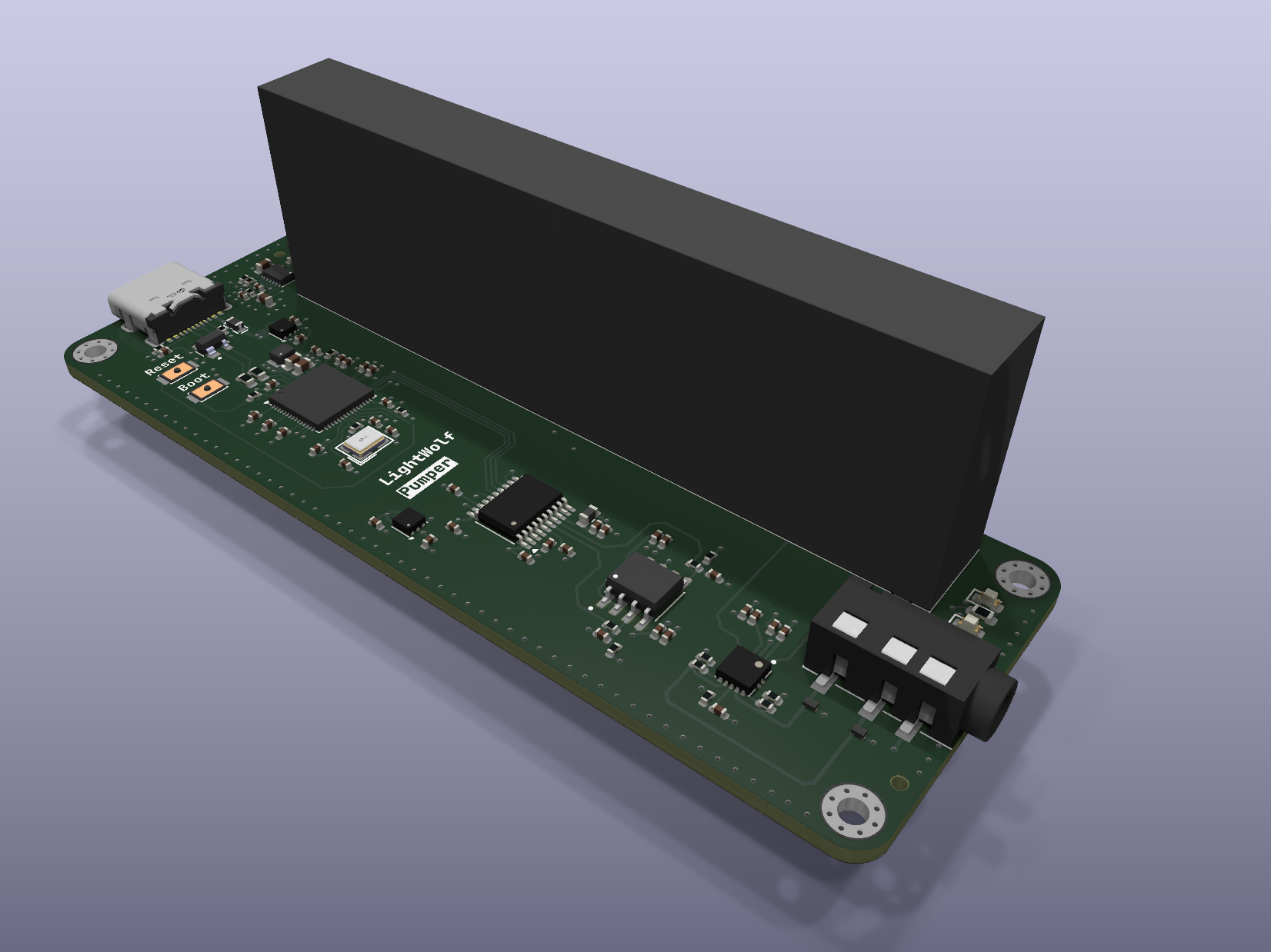
4 layers21 × 51 mmLightwolf, the printed circuit board in 3D

Pumper is an experimental RP2354-based USB Audio Class 2 DAC. The board uses a PCM5102A DAC with OPA1652 and OPA1622 analog stages in a compact design intended for learning about USB audio and DAC hardware.

Size
21 × 51 mm
Copper layers
4
Thickness
1.6 mm
Parts
53
Nets
63
Pads
237
Tracks, vias
431, 68
Pours
9
Routed
Yes
KiCad
KiCad 9.0 (file 20241229)
Created
21 Oct 2025
Updated
15 Oct 2026

Overview

Lightwolf is an open-source printed circuit board by wolf-yuan-6115, from the wolf-yuan-6115/lightwolf repository on GitHub, published under the GPL-3.0 licence. It is a 4-layer board of 21 × 51 mm with 53 parts on 63 nets, routed with 431 tracks and 68 vias.

It is built around the DS1021-1X20SF11-B, 0603L100SLYR and 1TS015A-1400-0600-CT, with the AOTA-B201610S3R3-101-T, TPD2E2U06DCKR-TP and TYPE-C-31-M-12 among its other parts. Its parts include 19 capacitors, 13 resistors, 6 ICs, 5 diodes and 1 transistor. It belongs with the RP2350 boards of this library.

Main components

7

README

pumper/README.md

Pumper

Pumper is an experimental RP2354-based USB Audio Class 2 DAC. The board uses a PCM5102A DAC with OPA1652 and OPA1622 analog stages in a compact design intended for learning about USB audio and DAC hardware.

The firmware provides a ten-band parametric EQ, headphone crossfeed, output processing, USB host volume and mute, and persistent EQ profiles. Settings can be controlled from either the React WebHID controller or the native Android controller. Both controllers preview edits live and save persistent settings only through explicit save actions.

Supported audio formats

Pumper accepts stereo PCM over USB Audio Class 2 in the following formats:

Sample rate16-bit stereoPacked 24-bit stereo
44.1 kHzYesYes
48 kHzYesYes
88.2 kHzYesYes
96 kHzYesYes
176.4 kHzYesNo
192 kHzYesNo

Audio processing and hardware path

Audio packets cross from the USB-facing core into the real-time DSP core through a fixed block pool. After processing, ping-pong DMA feeds the PIO I2S transmitter; the analog stages then filter, buffer, attenuate, and drive the headphone output.

mermaid
flowchart TB
    HOST[USB host<br/>UAC2 stereo PCM]

    subgraph DIGITAL[Digital audio path]
        direction LR
        USB[TinyUSB on RP2354 core 0<br/>receive and decode USB packets]
        QUEUE[Fixed audio-block queue<br/>core 0 to core 1]
        EQ[Preamp and<br/>10-band parametric EQ]
        XF[Headphone crossfeed]
        HOSTCTL[USB host<br/>gain and mute]
        OUTPROC[Output processing<br/>balance, mono, and width]
        LIMIT[Always-on<br/>stereo limiter]
        PACK[Final PCM quantization<br/>and I2S packing]
        I2S[Ping-pong DMA and PIO<br/>I2S transmitter]
        DAC[PCM5102A<br/>I2S DAC]

        USB --> QUEUE --> EQ --> XF --> HOSTCTL --> OUTPROC --> LIMIT --> PACK --> I2S --> DAC
    end

    subgraph ANALOG[Analog audio path]
        direction LR
        FILTER[Passive output filters]
        BUFFER[OPA1652<br/>stereo buffer]
        VOLUME[Dual-gang analog<br/>volume control]

Repository layout

  • firmware/ — RP2354 firmware and portable host tests.
  • web/ — React/TypeScript WebHID controller.
  • android/ — experimental Android USB-host controller.
  • assets/ — board and assembled-device images.
  • KiCad source files in the repository root — schematic and PCB design.

Build and run

Firmware

The firmware requires the Pico SDK, CMake, Ninja, a native C compiler, and the Arm GNU embedded toolchain. See firmware/README.md for SDK setup, supported audio formats, flashing, and troubleshooting.

sh
export PICO_SDK_PATH="${HOME}/Projects/pico-sdk"
cmake -S firmware -B firmware/build -G Ninja \
  -DCMAKE_BUILD_TYPE=Release \
  -DPICO_BOARD=pico2 \
  -DPICO_PLATFORM=rp2350-arm-s \
  -DPICO_FLASH_SIZE_BYTES=2097152
cmake --build firmware/build --target rp2350_usb_dac -j

Flash firmware/build/rp2350_usb_dac.uf2 using the RP2354 BOOTSEL drive.

Web controller

Use a Chromium-based browser. WebHID works on a secure origin and on http://localhost.

sh
cd web
pnpm install
pnpm dev

See web/README.md for Linux HID permissions, tests, production builds, previewing, and deployment.

Android controller

The Android controller requires JDK 17 and Android SDK API 37. Android Studio can open android/ directly.

sh
cd android
./gradlew testDebugUnitTest lintDebug assembleDebug

See android/README.md for the debug simulator and USB device requirements.

Firmware host tests

These tests do not require the Pico SDK:

sh
cmake -S firmware/tests -B /tmp/pumper-firmware-tests
cmake --build /tmp/pumper-firmware-tests
ctest --test-dir /tmp/pumper-firmware-tests --output-on-failure

Hardware

PCB render

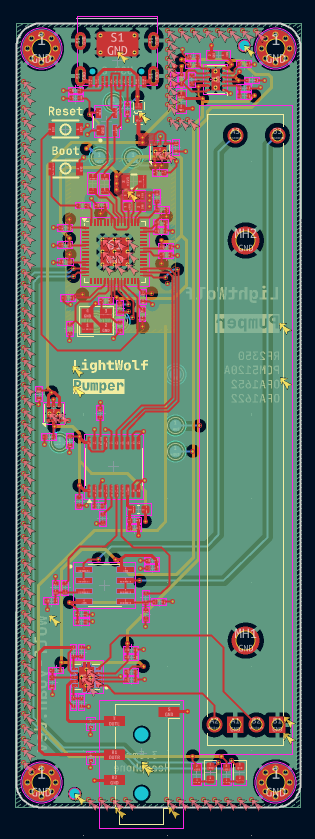
PCB

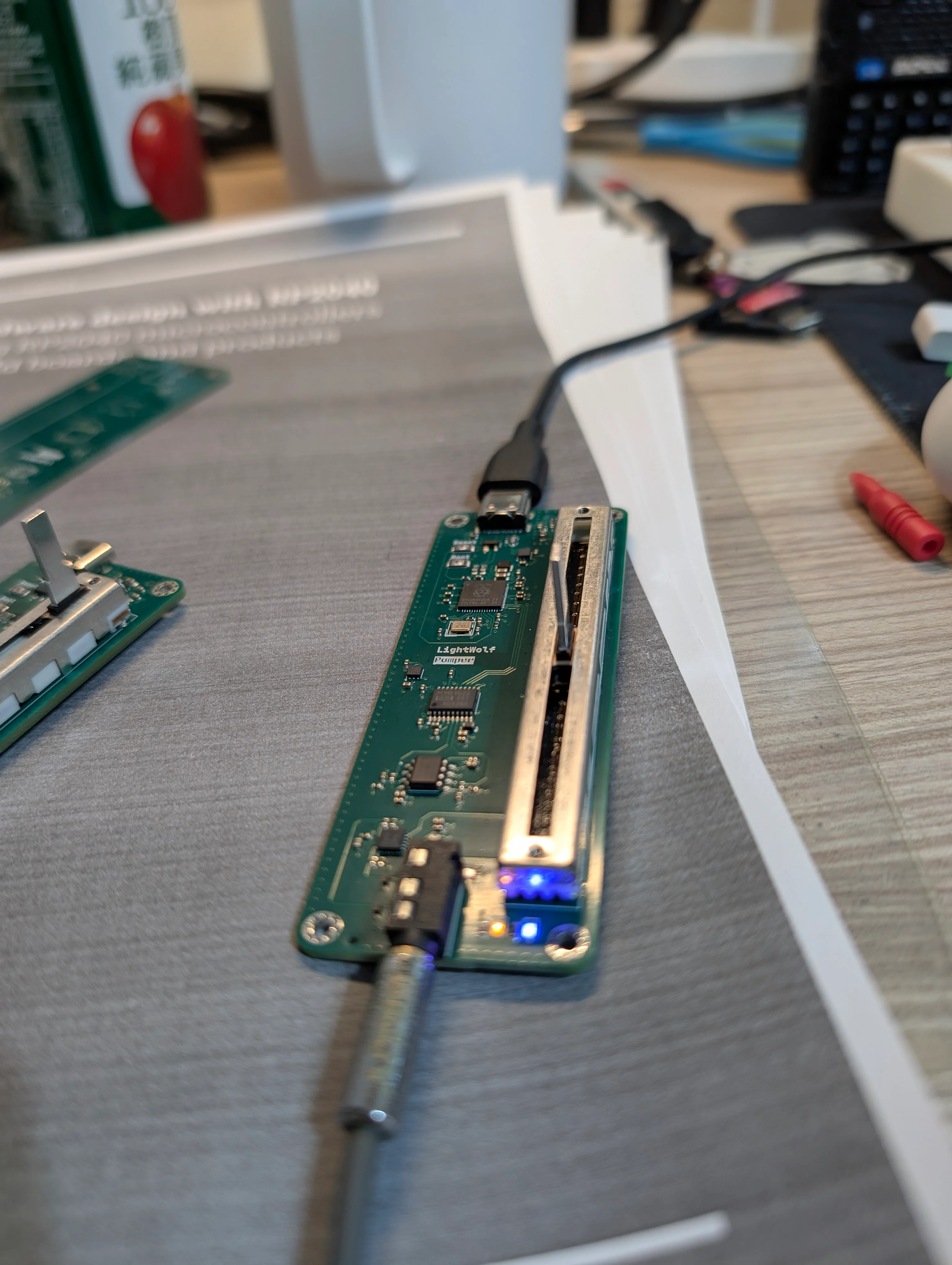
Assembled board

Bill of materials

ItemCost
PCB shipping$6.12
PCB assembly$86.18
PCB$11.43
Total$103.73

Parts

53
QtyValueFootprintReferences
11100nFPCM_JLCPCB:C_0402C2, C3, C4, C5, C6, C7, C8, C13, C14, C15, C16
4470ΩPCM_JLCPCB:R_0402R4, R10, R11, R12
4~PCM_JLCPCB:Hole_Tooling_JLCPCBH1, H2, H3, H4
333ΩPCM_JLCPCB:R_0402R6, R7, R9
210kΩPCM_JLCPCB:R_0402R5, R13
210uFPCM_JLCPCB:C_0402C9, C12
215pFPCM_JLCPCB:C_0402C10, C11
21TS015A-1400-0600-CTeasyeda2kicad:SW-SMD_L3.0-W2.0-LS3.5BOOT1, RESET1
21kΩPCM_JLCPCB:R_0402R1, R8
24.7uFPCM_JLCPCB:C_0603C17, C18
25.1kΩPCM_JLCPCB:R_0402R2, R3
2DS1021-1X20SF11-Beasyeda2kicad:HDR-TH_20P-P2.54-V-MU5, U6
2GreenPCM_JLCPCB:D_0805D4, D5
10603L100SLYReasyeda2kicad:R0603U2
14.7uFPCM_JLCPCB:C_0402C19
1470nFPCM_JLCPCB:C_0402C1
1ABM8-272-T3_C20625731easyeda2kicad:CRYSTAL-SMD_4P-L3.2-W2.5-BLU1
1AOTA-B201610S3R3-101-Teasyeda2kicad:IND-SMD_L2.0-W1.6_AOTA-B201610S3R3-101-TL1
1LOGOLOGOG***
1RP2350A_C42411118Package_DFN_QFN:QFN-60-1EP_7x7mm_P0.4mm_EP3.4x3.4mm_ThermalViasU4
1TPD2E2U06DCKReasyeda2kicad:SC-70-3_L2.0-W1.3-P0.65-LS2.1-BLD1
1TYPE-C-31-M-12easyeda2kicad:USB-C_SMD-TYPE-C-31-M-12_1USBC1
1W25Q64JVSSIQ_C179171easyeda2kicad:SOIC-8_L5.3-W5.3-P1.27-LS8.0-BLU3
1WhitePCM_JLCPCB:D_0603D2
1XC6220B331MR-Geasyeda2kicad:SOT-25_L3.0-W1.6-P0.95-LS2.8-TLQ1
1YellowPCM_JLCPCB:D_0805D3

More from wolf-yuan-6115/lightwolf

2
  • 4 layers61.4 × 38.8 mmFeather, the printed circuit board in 3D

    Feather

    wolf-yuan-6115/lightwolf

    Pumper is an experimental RP2354-based USB Audio Class 2 DAC. The board uses a PCM5102A DAC with OPA1652 and OPA1622 analog stages in a compact design intended for learning about USB audio and DAC hardware.

    153 parts1GPL-3.0
  • 4 layers33.8 × 93.1 mmPumper, the printed circuit board in 3D

    Pumper

    wolf-yuan-6115/lightwolf

    Pumper is an experimental RP2354-based USB Audio Class 2 DAC. The board uses a PCM5102A DAC with OPA1652 and OPA1622 analog stages in a compact design intended for learning about USB audio and DAC hardware.

    105 parts1GPL-3.0

Similar boards

  • 2 layers117.3 × 54.5 mmMegapad, the printed circuit board in 3D

    Megapad

    hackclub/OnBoard

    💡 Join 1,000 teenagers and make your first PCB with a $100 grant!

    69 parts915
  • 2 layers137.2 × 83.8 mmPWA REV2, the printed circuit board in 3D

    PWA REV2

    PubInv/krake

    The Krake™ is a Wi-Fi–enabled server using an MQTT broker, which means it can be controlled remotely by other devices ("clients") via the internet.

    215 parts9AGPL-3.0
  • 2 layers71.5 × 33 mmCEI TOOL, the printed circuit board in 3D

    CEI TOOL

    radiostart/CEI-TOOL

    62 parts
  • 4 layers52 × 27 mmEcp5-mini, the printed circuit board in 3D

    Ecp5-mini

    kitspace-test-repos/kicad6-file-collection

    111 partsMIT
  • 2 layers95 × 55 mmEsp32-access control reader, the printed circuit board in 3D

    Esp32-access control reader

    romkey/esp32-access-control

    ESP32-based hardware access control reader for PDX Hackerspace

    56 partsMIT
  • 2 layers142 × 208 mmPanel, the printed circuit board in 3D

    Panel

    romkey/sensr

    Sensor project hardware - ESP32-S3 base board, light and air sensors

    616 partsMIT
  • 2 layers70 × 100 mmLower, the printed circuit board in 3D

    Lower

    sbarisic/MagMouse

    Open source hall-effect based mouse - no mechanical contacts - no failure points

    128 parts2
  • 4 layers45 × 45 mmESP32-P4-CAM MAIN, the printed circuit board in 3D

    ESP32-P4-CAM MAIN

    momszx/esp32-p4-cam

    ESP32-P4 compact WiFi streaming camera - KiCad 10 hardware (MAIN rev A, 4-layer 45x45 mm) and design docs

    120 parts

Questions

How big is the Lightwolf PCB?

It measures 21 × 51 mm and has 4 copper layers, 1.6 mm thick.

What parts does the Lightwolf use?

53 parts, built around the DS1021-1X20SF11-B, 0603L100SLYR, 1TS015A-1400-0600-CT and AOTA-B201610S3R3-101-T. The full list of its parts is on this page, with links to each part's symbol and footprint where PCBKit's library has them.

Where can I download the Lightwolf KiCad files?

From the wolf-yuan-6115/lightwolf repository on GitHub, at the commit this page was made from: the board is 2350/lightwolf.kicad_pcb and its schematic 2350/lightwolf.kicad_sch. PCBKit opens the board in the browser, with nothing to install.

Can I use the Lightwolf design in my own project?

Its repository publishes it under the GPL-3.0 licence: you may reuse it on that licence's terms (keep the author's notice, and for a copyleft licence share your changes alike).