2 layers44.7 × 93.6 mm

 VinylTechnology/VSPKR1
Vinyl Speaker 1 | Alexa like Smart speaker
VSPKR1 is an open-source printed circuit board by VinylTechnology, from the VinylTechnology/VSPKR1 repository on GitHub. It is a 2-layer board of 140 × 80 mm with 35 parts on 55 nets, routed with 859 tracks and 90 vias.
It is built around the ESP32-S3-WROOM-1-N8, PAM8403DR and AMS1117-3.3, with the PCM5102APW and ICS-43432 among its other parts. Its parts include 13 capacitors, 8 resistors, 4 ICs, 3 connectors and 2 switches. It belongs with the audio and music boards and the ESP32 boards of this library.


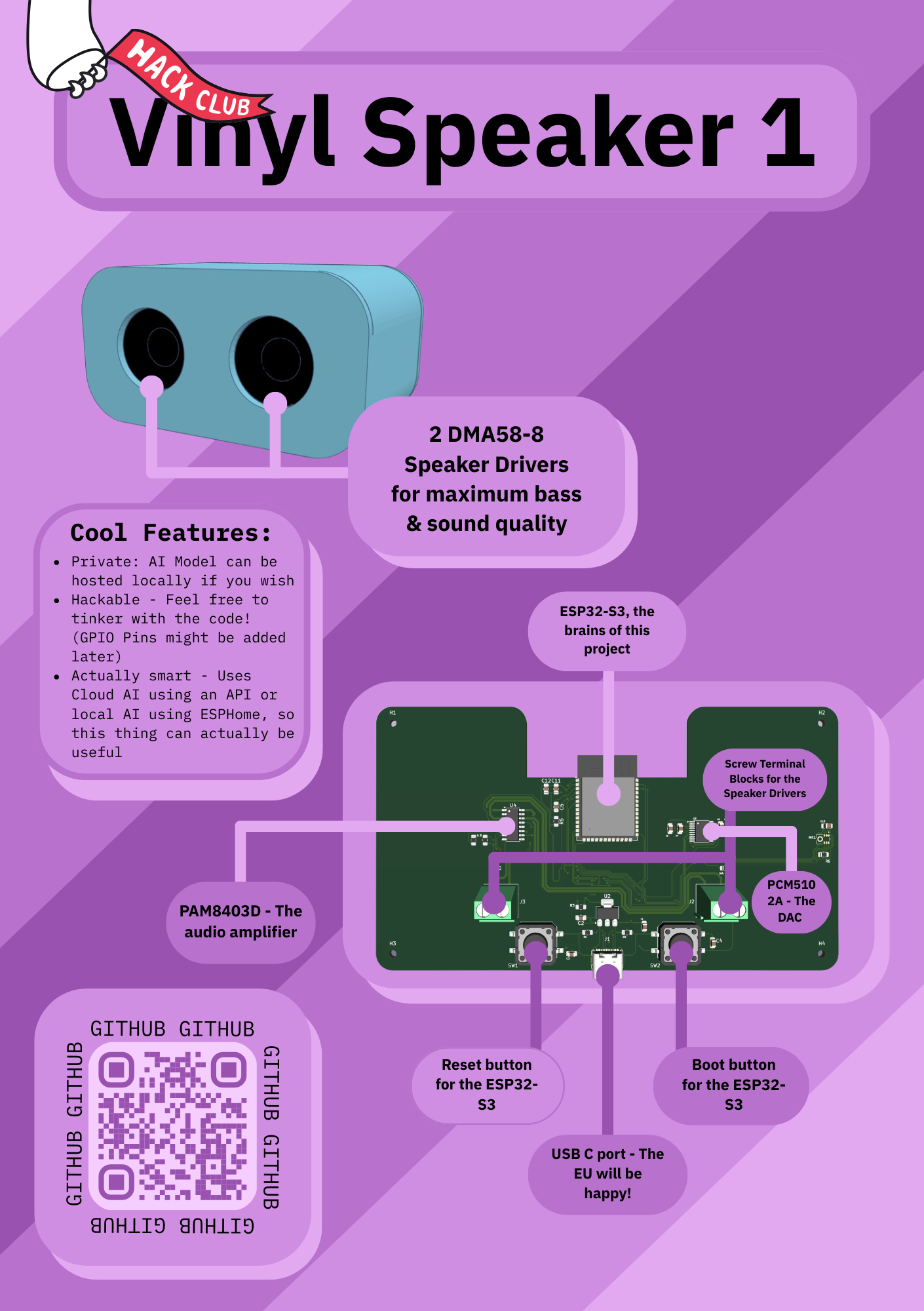
The VSPKR1 (Vinyl Speaker 1) is an open source alternative to Alexa, Google Home, or a Homepod, but open source (similar to the Home Assistant Voice Preview edition, but also made for music and not only Assist!)
It can / will be able to be used with either cloud AI or local Ollama AI (or alternatives), making it maybe smarter than your existing smart speakers!
There are 2 reasons that I decided to make this; First, I wanted to for HackClub! Second, privacy. I have heard that Google Home speakers can spy on you, and listen in to your conversations. I think that is true 100%, so that's why I made this! To De-Google!
[!NOTE] I unfortunately got a hairline fracture on my arm while working on this project.
Sorry if this guide is bad in any way!
Also, this guide assumes you have either a hot plate or a hot air rework station
Step 1. Getting the parts
All of the parts (except the PCB) are in the BOM.csv file with Digikey Part ID's for each part and quantities.
Order those to get started!
Make sure to also get the case 3D printed from somewhere (PCBWay can make the PCB + 3D Printed case!)
Step 2. Ordering PCB
For this, open the pcb folder in the root of this repo as a project in KiCad. Then, you can export the gerber files from the File menu.
From there, you can then order that PCB from your preferred PCB manufacturer.
Step 3. Build it!
Once all the parts and PCB have arrived, you can then use a hot plate or hot air rework station, assuming you have one to solder all the parts to the PCB. For easier soldering, take a look at the PCB viewer in KiCad on a monitor while soldering.
Step 4. Flash ESPHome
Follow the guide at esphome.io to flash the board with ESPHome firmware
Step 5. VSPKR1 Firmware
Connect the PCB to your computer and drag and drop the ESPHome.yaml file from the firmware folder to the PCB, when it shows up as a USB Drive. You are done! Enjoy your speaker!
| Qty | Value | Footprint | References |
|---|---|---|---|
| 5 | 0.1uF | Capacitor_SMD:C_0805_2012Metric_Pad1.18x1.45mm_HandSolder | C3, C4, C7, C10, C13 |
| 4 | MountingHole | MountingHole:MountingHole_2.2mm_M2 | H1, H2, H3, H4 |
| 3 | 10k | Resistor_SMD:R_0805_2012Metric_Pad1.20x1.40mm_HandSolder | R3, R4, R5 |
| 2 | 1uF | Capacitor_SMD:C_0805_2012Metric_Pad1.18x1.45mm_HandSolder | C5, C8 |
| 2 | 2.2uF | Capacitor_SMD:C_0805_2012Metric_Pad1.18x1.45mm_HandSolder | C6, C9 |
| 2 | 22uF | Capacitor_SMD:C_0805_2012Metric_Pad1.18x1.45mm_HandSolder | C2, C11 |
| 2 | 5.1k | Resistor_SMD:R_0805_2012Metric_Pad1.20x1.40mm_HandSolder | R1, R2 |
| 2 | Screw_Terminal_01x02 | TerminalBlock_Phoenix:TerminalBlock_Phoenix_MKDS-1,5-2_1x02_P5.00mm_Horizontal | J2, J3 |
| 1 | 100k | Resistor_SMD:R_0805_2012Metric_Pad1.20x1.40mm_HandSolder | R6 |
| 1 | 100nF | Capacitor_SMD:C_0805_2012Metric_Pad1.18x1.45mm_HandSolder | C12 |
| 1 | 10K | Resistor_SMD:R_0805_2012Metric_Pad1.20x1.40mm_HandSolder | R8 |
| 1 | 10uF | Capacitor_SMD:C_0805_2012Metric_Pad1.18x1.45mm_HandSolder | C1 |
| 1 | 1K | Resistor_SMD:R_0805_2012Metric_Pad1.20x1.40mm_HandSolder | R7 |
| 1 | AMS1117-3.3 | Package_TO_SOT_SMD:SOT-223-3_TabPin2 | U2 |
| 1 | BOOT | Button_Switch_SMD:SW_Push_1P1T_NO_CK_PTS125Sx43SMTR | SW2 |
| 1 | ESP32-S3-WROOM-1 | RF_Module:ESP32-S3-WROOM-1 | U1 |
| 1 | ICS-43432 | ICS-43432:MIC_ICS-43432 | MK1 |
| 1 | PAM8403D | Package_SO:SOIC-16_3.9x9.9mm_P1.27mm | U4 |
| 1 | PCM5102A | Package_SO:TSSOP-20_4.4x6.5mm_P0.65mm | U3 |
| 1 | RESET | Button_Switch_SMD:SW_Push_1P1T_NO_CK_PTS125Sx43SMTR | SW1 |
| 1 | USB_C_Receptacle_USB2.0_14P | Connector_USB:USB_C_Receptacle_GCT_USB4105-xx-A_16P_TopMnt_Horizontal | J1 |
It measures 140 × 80 mm and has 2 copper layers, 1.6 mm thick.
35 parts, built around the ESP32-S3-WROOM-1-N8, PAM8403DR, AMS1117-3.3 and PCM5102APW. The full list of its parts is on this page, with links to each part's symbol and footprint where PCBKit's library has them.
From the VinylTechnology/VSPKR1 repository on GitHub, at the commit this page was made from: the board is pcb/VSPKR1.kicad_pcb and its schematic pcb/VSPKR1.kicad_sch. PCBKit opens the board in the browser, with nothing to install.
Its repository states no licence, so its author keeps all rights: ask VinylTechnology before reusing the design.

garvita4/synthesizer
Snap-Synth is a custom-built modular synthesizer featuring mechanical keys, rotary encoders, per-key RGB lighting, and a custom-designed PCB, combining hands-on sound synthesis with an expandable hardware architecture.


PROTONMM/YR_0.3.1
This project includes only the PCB and the enclosure; it does not include any software. MIT License.


Crem2y/pico-console-v2-pcb
pico console v2 board (firmware : https://github.com/Crem2y/pico-console-v2)
