
2 layers96.6 × 82.8 mm

 vincentchen18/starbie
my first hardware project (a desktop pet)
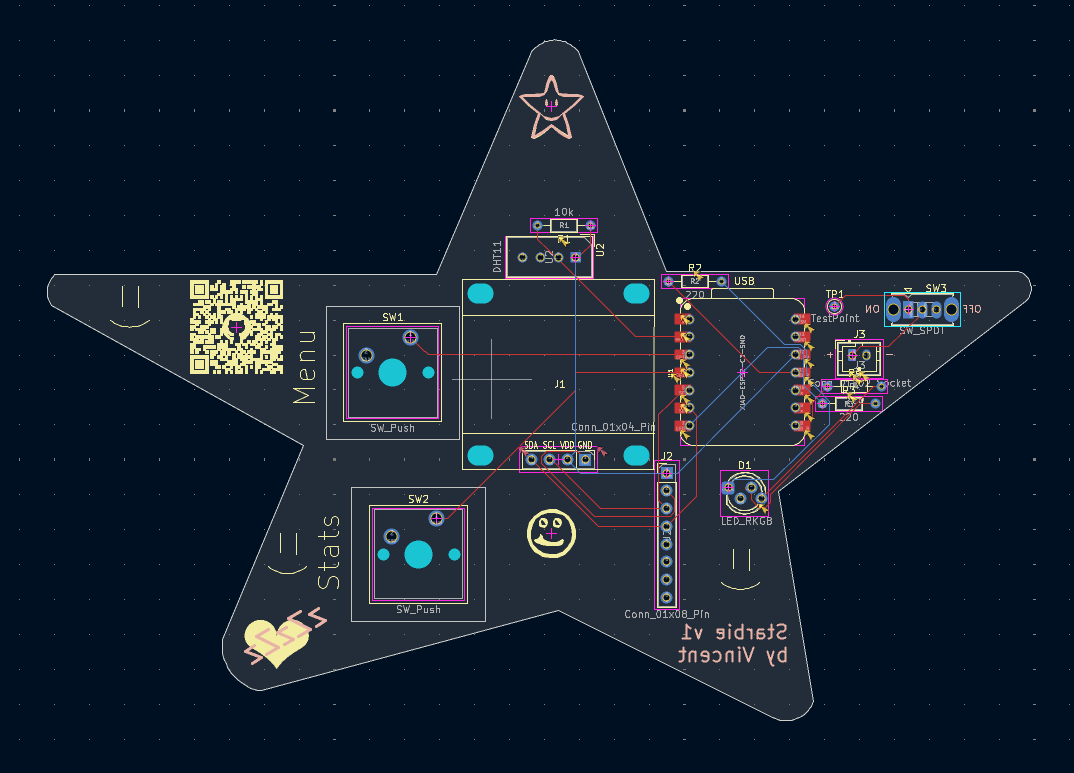
Starbie is an open-source printed circuit board by vincentchen18, from the vincentchen18/starbie repository on GitHub. It is a 2-layer board of 140.1 × 97 mm with 18 parts on 28 nets, routed with 87 tracks and 0 vias.
It is built around the DHT11. Its parts include 4 resistors, 3 connectors, 3 switches, 2 ICs and 1 diode. It belongs with the ESP32 and RISC-V boards of this library.
Starbie is a tiny motion controlled desktop pet, powered by USB or battery. It is a star-shaped PCB hosting a little digital creature on an OLED Screen. It includes multiple interactive functionalities. Tilt it to navigate menus, shake it to wake it up, and watch its mood light change as you neglect it. (you probably shouldn't neglect it but this is also a functionality, not a recommendation.) Also has multiple sensors that track gyroscopic and accelerometric position, as well as tracking temperature and humidity.
This project was built for Hack Club's hardware program Half Life, a 10 week YSWS to help beginners learn hardware project, and incidentally, it is my first hardware project!!! :DDD
I will also note that this is based off a tutorial from one of Half Life's organisers, and you can find the tutorial repo here. I added some additional features myself, but thank you SharKingStudios this tutorial as it was a great starting point.
Additionally, I have also created a storage case for Starbie (although it is irregularly shaped due to how I shaped the printed circuit board)
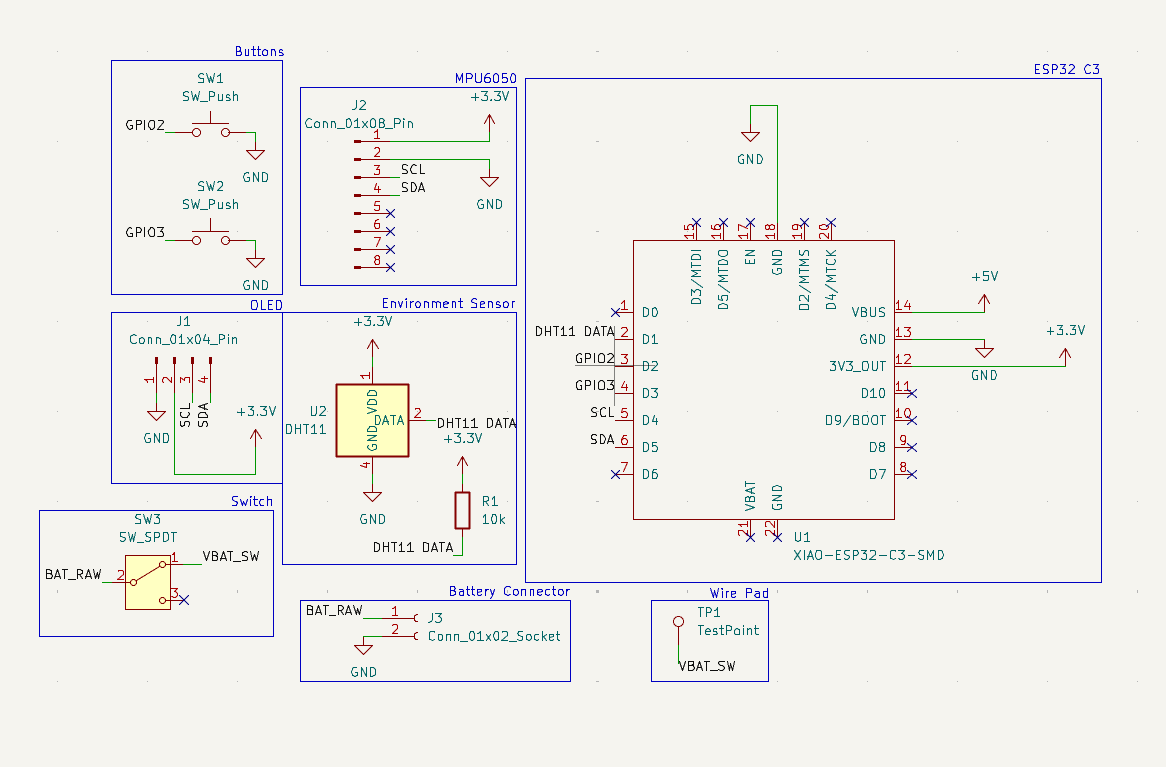
The final schematic is shown in the above picture, featuring a XIAO-ESP32-C3, Environment and MPU6050 sensor, as well as a menu button and an on/off switch as well as a battery connector.
The desktop pet can be powered both by battery or by USB connection
A storage case for Starbie has also been included, and you can find the box and lid STEP files in 3D Models
Full list in BOM.csv. Gerbers in gerbers/.
Arduino IDE was used to program Starbie.
AI was not used in any way for this project besides as a guide to help me learn to use KiCad
| Item | Purpose | Qty | Unit (USD) | Total (USD) | Link |
|---|---|---|---|---|---|
| Starbie PCB (2-layer, 97.3×140.3mm) | Custom star-shaped board | 5 | 2.12 | 10.60 | JLCPCB |
| JLCPCB New User PCB coupon | Discount | 1 | -6.00 | -6.00 | — |
| JLCPCB shipping (Global Standard Direct Line → AU) | Shipping | 1 | 8.52 | 8.52 | JLCPCB |
| Seeed Studio XIAO ESP32-C3 | Main microcontroller | 1 | 6.31 | 6.31 | AliExpress |
| 0.96" 128×64 I2C OLED (SSD1306) | Display | 1 | 2.20 | 2.20 | AliExpress |
| DHT11 (bare 4-pin) | Temp + humidity sensor | 1 | 1.60 | 1.60 | AliExpress |
| MPU-6050 (GY-521) | Accelerometer/gyro for tilt + shake | 1 | 1.03 | 1.03 | AliExpress |
| 5mm RGB LED, common cathode (pack) | Mood light | 1 | 2.17 | 2.17 | AliExpress |
| Resistor kit, 1/4W 300pcs (10k + 220Ω used) | DHT11 pull-up + LED current limiting | 1 | 3.23 | 3.23 | AliExpress |
| Grant total | 29.66 |
| Item | Purpose | Qty | Unit (USD) | Total (USD) | Link |
|---|---|---|---|---|---|
| Gateron G Pro 3.0 MX switches (pack) | MENU + STATS buttons | 1 | 4.02 | 4.02 | AliExpress |
| AliExpress shipping + 10% GST | Shipping + tax | 1 | 6.51 | 6.51 | — |
| Out-of-pocket total | 10.53 |
Project total: $40.19
| Qty | Value | Footprint | References |
|---|---|---|---|
| 3 | 220 | Resistor_THT:R_Axial_DIN0204_L3.6mm_D1.6mm_P7.62mm_Horizontal | R2, R3, R4 |
| 2 | LOGO | Imported_Parts:star_silkscreen | , |
| 2 | SW_Push | Button_Switch_Keyboard:SW_Cherry_MX_1.00u_PCB | SW1, SW2 |
| 1 | 10k | Resistor_THT:R_Axial_DIN0204_L3.6mm_D1.6mm_P7.62mm_Horizontal | R1 |
| 1 | Conn_01x02_Socket | Connector_JST:JST_PH_B2B-PH-K_1x02_P2.00mm_Vertical | J3 |
| 1 | Conn_01x04_Pin | Imported_Parts:Display_128x64_096_I2C | J1 |
| 1 | Conn_01x08_Pin | Connector_PinHeader_2.54mm:PinHeader_1x08_P2.54mm_Vertical | J2 |
| 1 | DHT11 | Sensor:Aosong_DHT11_5.5x12.0_P2.54mm | U2 |
| 1 | LED_RKGB | LED_THT:LED_D5.0mm-4_RGB_Staggered_Pins | D1 |
| 1 | LOGO | Imported_Parts:uplook | |
| 1 | LOGO | Imported_Parts:gh_qr | |
| 1 | SW_SPDT | Button_Switch_THT:SW_Slide_SPDT_Straight_CK_OS102011MS2Q | SW3 |
| 1 | TestPoint | TestPoint:TestPoint_THTPad_D1.5mm_Drill0.7mm | TP1 |
| 1 | XIAO-ESP32-C3-SMD | Imported_Parts:XIAO-ESP32-C6-DIP | U1 |
It measures 140.1 × 97 mm and has 2 copper layers, 1.6 mm thick.
18 parts, built around the DHT11. The full list of its parts is on this page, with links to each part's symbol and footprint where PCBKit's library has them.
From the vincentchen18/starbie repository on GitHub, at the commit this page was made from: the board is Starbie/Starbie.kicad_pcb and its schematic Starbie/Starbie.kicad_sch. PCBKit opens the board in the browser, with nothing to install.
Its repository states no licence, so its author keeps all rights: ask vincentchen18 before reusing the design.

lansidev/conveyor-belt
Miniature 3D printed conveyor belt for simulation and fun working with sensors, all controllable with Raspberry Pi


ebrithiljonas/OMG_PCB
All in One PCB for the OpenMQTTGateway Project

GeorgK/SniffingTrinket
A room climate monitor using the Adafruit Trinket Pro

bhaskar9980/Guardian
Guardian is an advanced, fully automated hydroponics system designed to optimize plant growth and maximize yield.

Twistx77/Firefly
Open WIFI-enabled RGB lamp with temperature, humidity, suspended air particles and eCO2 sensors.

unla-investigacion-desarrollo/ecosistema-iot
Antes de desarrollar el sistema final, realizamos una etapa de exploración donde investigamos y experimentamos con las siguientes tecnologías: