4 layers53.2 × 53.2 mm
Smart lcc
variegated-coffee/open-lcc-board
Schematics and PCB files for the Open LCC hardware
117 parts30CERN-OHL-P-2.0

 variegated-coffee/all-purpose-espresso-controller14
Espresso electronics are usually proprietary affairs with little to no expandability. The purpose of this project is to give everyone an open source alternative with lots of features and flexibility.
Open control board is an open-source printed circuit board by variegated-coffee, from the variegated-coffee/all-purpose-espresso-controller repository on GitHub, published under the CERN-OHL-P-2.0 licence. It is a 6-layer board of 69 × 54 mm with 201 parts on 197 nets, routed with 2,257 tracks and 308 vias.
It is built around the RP2040, TPS82130SIL and ESP32-S3-WROOM-1-N8, with the W25Q16JVUXIQ, ADS124S08IPBSR and DMG1012T-7 among its other parts. Its parts include 60 resistors, 54 capacitors, 23 connectors, 16 transistors and 13 ICs. It belongs with the ESP32 and RP2040 boards of this library.


Espresso electronics are usually proprietary affairs with little to no expandability. The purpose of this project is to give everyone an open source alternative with lots of features and flexibility.
It is designed to be useful in many different espresso machines, and for many different hardware configurations. It has the same PCB size as many very common Gicar controllers, making it fairly easy to swap this board into your existing enclosure. It also comes with screw holes, so a 3D printed enclosure is another option.
There's also a corresponding 100-240 VAC board, with relays and an AC/DC converter, designed to also fit into those same Gicar enclosures.
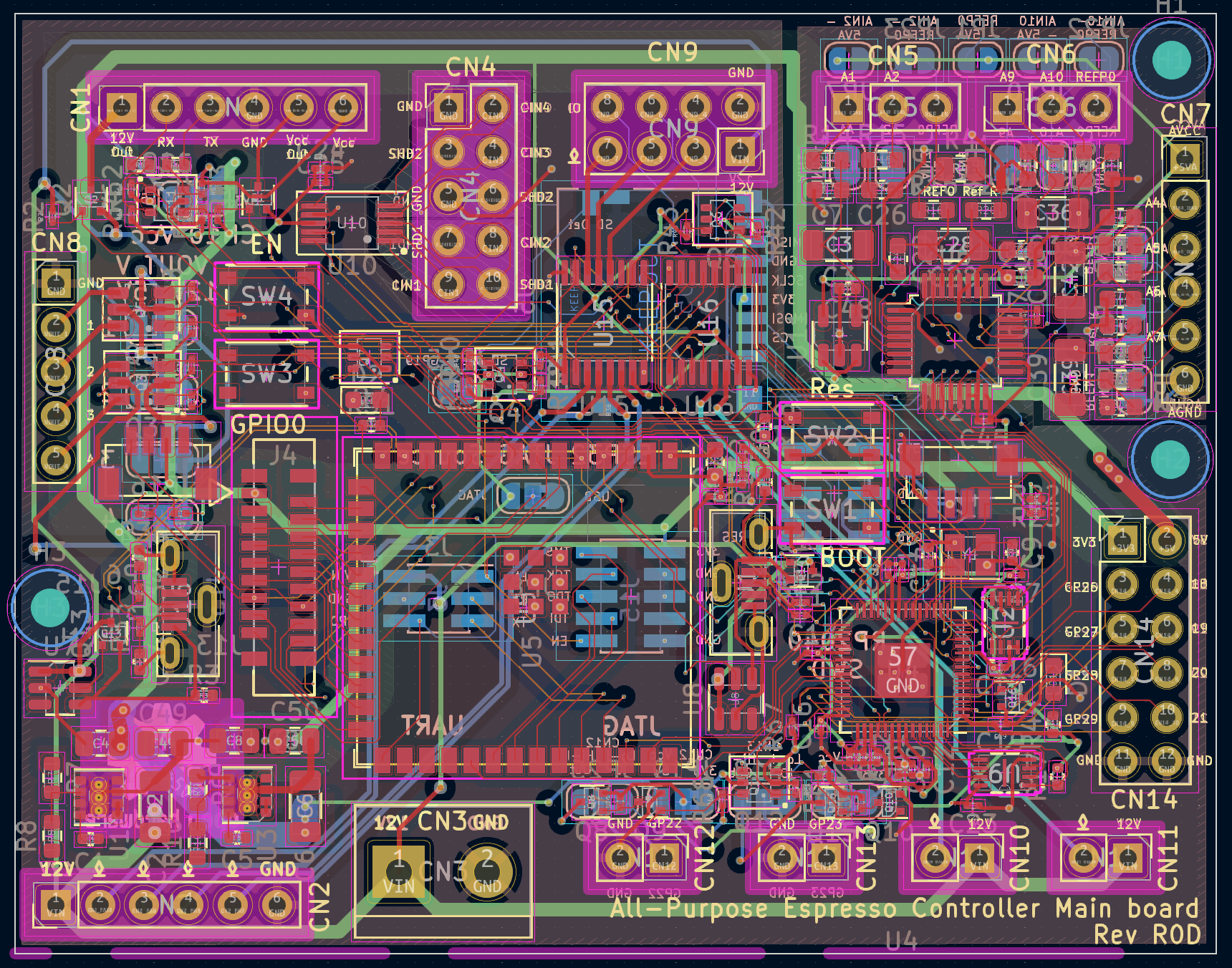
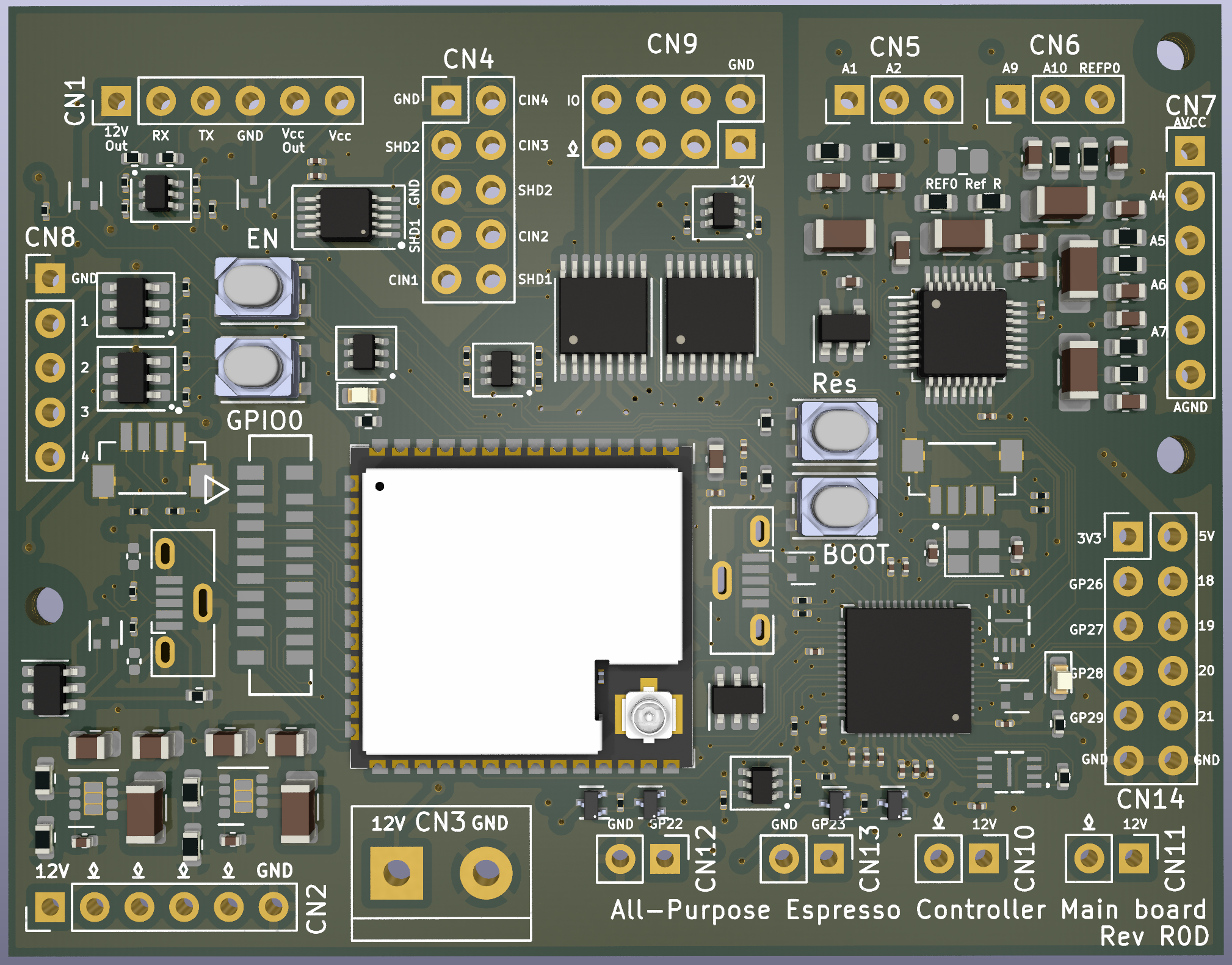
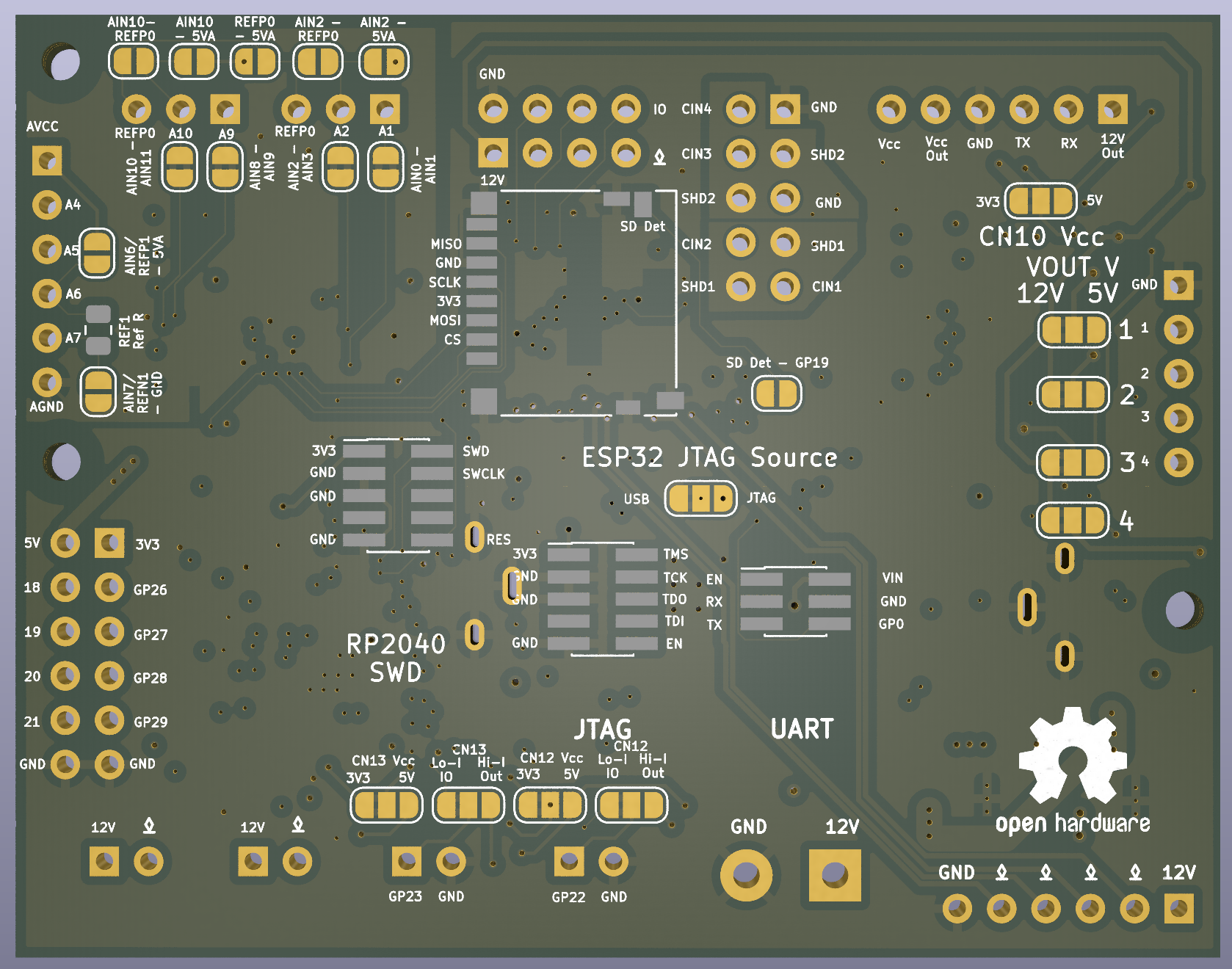
The current hardware revision is R0D. It hasn't been manufactured yet, and you shouldn't be the first one to do it.
Anything you do with this, you do at your own risk. This hardware hasn't even been manufactured by it's creator yet. Your machine uses both line voltage power, high pressured hot water, steam and other dangerous components. You really shouldn't be using this yet; in fact, you shouldn't even consider it. Risks include but are not limited to, damaging your machine, personal injury, property damage and summoning dead Cthulhu from his sleep at R'lyeh.
By default, CN5 and CN6 are configured for a ratiometric measurement. In order to use it as such, you need to fit a reference resistor for REF0. The reference resistor needs to be larger than the measured values (e.g. for a PT100, use a 400 ohm resistor), and needs to be high accuracy and low drift.
AIN1-2, AIN4-7, and AIN9-10 are all outfitted with RC filters, as is REF0. The board is also designed in such a way that you can, by sacrificing an RC filter, convert a channel to instead use an upstream resistor divider.
The ADS124S08 features two external references (REF0 and REF1), as well as an internal 2.5V reference. AIN6-7 double as REFP1/REFN1. The board is designed with footprints for a reference resistor.
| Qty | Value | Footprint | References |
|---|---|---|---|
| 27 | 10K | Resistor_SMD:R_0201_0603Metric | R1, R2, R19, R22, R23, R28, R29, R30, R34, R36, R37, R38, R39, R40, R41, R42 +11 |
| 17 | 100 nF, >10V, X6S | Capacitor_SMD:C_0201_0603Metric | C12, C13, C14, C15, C16, C17, C18, C19, C20, C21, C23, C24, C27, C31, C45, C53 +1 |
| 10 | 5.1 nF, C0G | Capacitor_SMD:C_0603_1608Metric | C7, C26, C29, C35, C37, C38, C40, C41, C43, C44 |
| 10 | SolderJumper_3_Bridged12 | Jumper:SolderJumper-3_P1.3mm_Bridged2Bar12_RoundedPad1.0x1.5mm_NumberLabels | JP4, JP5, JP6, JP8, JP9, JP16, JP18, JP19, JP24, JP25 |
| 8 | 6K04 1% | Resistor_SMD:R_0603_1608Metric | R14, R15, R21, R24, R25, R26, R27, R35 |
| 8 | SolderJumper_2_Open | Jumper:SolderJumper-2_P1.3mm_Open_RoundedPad1.0x1.5mm | JP1, JP2, JP3, JP7, JP10, JP15, JP22, JP23 |
| 6 | 1 uF, >6.3V, X5R | Capacitor_SMD:C_0201_0603Metric | C11, C22, C25, C30, C47, C51 |
| 5 | 47R | Resistor_SMD:R_0201_0603Metric | R45, R46, R47, R48, R49 |
| 5 | DMG1012T-7 | Package_TO_SOT_SMD:SOT-523 | Q9, Q10, Q13, Q14, Q16 |
| 5 | DMN63D8LDW | PCM_Package_TO_SOT_SMD_AKL:SOT-363_SC-70-6 | Q4, Q6, Q7, Q11, Q12 |
| 4 | 22 uF, 10V, X7T | Capacitor_SMD:C_0805_2012Metric | C4, C8, C49, C50 |
| 4 | DMP21D0UT-7 | Package_TO_SOT_SMD:SOT-523 | Q1, Q2, Q8, Q15 |
| 4 | SW_Push | ul_PTS815-SJM-250-SMTR-LFS:SW4_PTS815 SJM 250 SMTR LFS_CNK | SW1, SW2, SW3, SW4 |
| 4 | SolderJumper_2_Bridged | Jumper:SolderJumper-2_P1.3mm_Bridged2Bar_RoundedPad1.0x1.5mm | JP13, JP17, JP20, JP21 |
| 4 | ~ | Connector_PinHeader_2.54mm:PinHeader_1x02_P2.54mm_Vertical | CN10, CN11, CN12, CN13 |
| 3 | 51 nF, C0G | Capacitor_SMD:C_1206_3216Metric | C3, C28, C36 |
| 3 | 6.8 nF, 50V | Capacitor_SMD:C_0402_1005Metric | C1, C5, C48 |
| 3 | MountingHole | MountingHole:MountingHole_2.2mm_M2 | H1, H2, H3 |
| 2 | 0R | Resistor_SMD:R_0201_0603Metric | R32, R33 |
| 2 | 10 μF, 25 V, X7R | Capacitor_SMD:C_1206_3216Metric | C2, C6 |
| 2 | 12 pF | Capacitor_SMD:C_0402_1005Metric | C9, C10 |
| 2 | 120R | Resistor_SMD:R_0402_1005Metric | R31, R44 |
| 2 | 18K7 | Resistor_SMD:R_0402_1005Metric | R3, R13 |
| 2 | 1K | Resistor_SMD:R_0402_1005Metric | R5, R6 |
| 2 | 27R | Resistor_SMD:R_0201_0603Metric | R11, R12 |
| 2 | 4K7 | Resistor_SMD:R_0402_1005Metric | R17, R18 |
| 2 | 4K99 1% | Resistor_SMD:R_0603_1608Metric | R16, R20 |
| 2 | BM04B-SRSS-TB(LF)(SN) | BM04B-SRSS-TB_LF__SN_:JST_BM04B-SRSS-TB(LF)(SN) | J2, J17 |
| 2 | C_Small | Capacitor_SMD:C_1206_3216Metric_Pad1.33x1.80mm_HandSolder | C39, C42 |
| 2 | Conn_01x06_Pin | Connector_PinHeader_2.54mm:PinHeader_1x06_P2.54mm_Vertical | CN2, CN7 |
| 2 | Conn_02x05_Odd_Even | Connector_PinHeader_1.27mm:PinHeader_2x05_P1.27mm_Vertical_SMD | J13, J15 |
| 2 | KT-0603W | LED_SMD:LED_0603_1608Metric | D1, D2 |
| 2 | LM5050-1 | Package_TO_SOT_SMD:TSOT-23-6 | U7, U8 |
| 2 | NC | Capacitor_SMD:C_0402_1005Metric | C33, C34 |
| 2 | Q_PMOS-E_DUAL_Generic_SEP_S1G1D2S2G2D1 | PCM_Package_TO_SOT_SMD_AKL:TSOT-23-6 | Q3, Q5 |
| 2 | R_Small | Resistor_SMD:R_0805_2012Metric | R4, R66 |
| 2 | STPIC6C595TTR | Package_SO:TSSOP-16_4.4x5mm_P0.65mm | U15, U16 |
| 2 | TPS82130 | Package_LGA:Texas_SIL0008D_MicroSiP-8-1EP_2.8x3mm_P0.65mm_EP1.1x1.9mm_ThermalVias | U1, U3 |
| 2 | USB_B_Micro | Connector_USB:USB_Micro-B_Molex-105133-0001 | J1, J16 |
| 2 | W25Q16JVUXIQ | ul_W25Q16JVUXIQ:W25Q16JVUXIQ_WIN | U2, U9 |
| 1 | 12V Separate Supply | TerminalBlock:TerminalBlock_bornier-2_P5.08mm | CN3 |
| 1 | 13K3 | Resistor_SMD:R_0603_1608Metric | R8 |
| 1 | 22 uF, 6.3V, X5R | Capacitor_SMD:C_0603_1608Metric | C32 |
| 1 | 24K | Resistor_SMD:R_0603_1608Metric | R10 |
| 1 | 330 nF | Capacitor_SMD:C_0603_1608Metric | C46 |
| 1 | 47 uF | Capacitor_SMD:C_1206_3216Metric_Pad1.33x1.80mm_HandSolder | C52 |
| 1 | 71K5 | Resistor_SMD:R_0603_1608Metric | R7 |
| 1 | 75K | Resistor_SMD:R_0603_1608Metric | R9 |
| 1 | ADS124S08IPBSR | Package_QFP:LQFP-32_5x5mm_P0.5mm | U6 |
| 1 | Conn_01x05_Pin | Connector_PinHeader_2.54mm:PinHeader_1x05_P2.54mm_Vertical | CN8 |
| 1 | Conn_02x03_Odd_Even | Connector_PinHeader_1.27mm:PinHeader_2x03_P1.27mm_Vertical_SMD | J3 |
| 1 | Conn_02x05_Counter_Clockwise | Connector_PinHeader_2.54mm:PinHeader_2x05_P2.54mm_Vertical | CN4 |
| 1 | Conn_02x06_Odd_Even | Connector_PinHeader_2.54mm:PinHeader_2x06_P2.54mm_Vertical | CN14 |
| 1 | ESP32-S3-WROOM-1 | PCM_Espressif:ESP32-S3-WROOM-1U | U5 |
| 1 | FDC1004 | PCM_Package_SO_AKL:VSSOP-10_3x3mm_P0.5mm | U10 |
| 1 | LCC Port | Connector_PinHeader_2.54mm:PinHeader_1x06_P2.54mm_Vertical | CN1 |
| 1 | Micro_SD_Card_Det_Hirose_DM3AT | Connector_Card:microSD_HC_Hirose_DM3D-SF | J5 |
| 1 | Molex_0525591853 | CON_525591853_MOL:CON_525591853_MOL | J4 |
| 1 | NTC Brew Boiler | Connector_PinHeader_2.54mm:PinHeader_1x03_P2.54mm_Vertical | CN5 |
| 1 | NTC Service Boiler | Connector_PinHeader_2.54mm:PinHeader_1x03_P2.54mm_Vertical | CN6 |
| 1 | NetTie_2 | NetTie:NetTie-2_SMD_Pad0.5mm | NT1 |
| 1 | RP2040 | Package_DFN_QFN:QFN-56-1EP_7x7mm_P0.4mm_EP3.2x3.2mm | U4 |
| 1 | TC2014-5.0VxCTTR | Package_TO_SOT_SMD:SOT-23-5 | U11 |
| 1 | XYDBPCNANF-12MHZ | Crystal:Crystal_SMD_2520-4Pin_2.5x2.0mm | Y1 |
| 1 | ~ | HugeConnector:Conn_3x04 | CN9 |
The 199 most common of 201 parts.
variegated-coffee/open-lcc-board
Schematics and PCB files for the Open LCC hardware


GerardGascon/fanzine-ds-hardware
This repository is based on LNH-team's DSpico Hardware repository. It removes the microSD card slot and microUSB port from the cartridge in order to make it be a potential reprogramable board for the NDS.


sabogalc/project-piCo
Because it should be a crime to release a product with Micro-USB in the 2020s

taskx6004/limejig
Open-source LimeJig fixture firmware, host tools, KiCad source, and synthetic test examples

tscircuit/dataset-srj24
Ten production-oriented KiCad boards converted to Simple Route JSON

JohnNeville/SunSprout
An esp32-c5 powered board that adds dual source battery charging, fuel management, and differential i2c bus. This was largely developed to be a complement with my other soil sensor project.
It measures 69 × 54 mm and has 6 copper layers, 1.56 mm thick.
201 parts, built around the RP2040, TPS82130SIL, ESP32-S3-WROOM-1-N8 and W25Q16JVUXIQ. The full list of its parts is on this page, with links to each part's symbol and footprint where PCBKit's library has them.
From the variegated-coffee/all-purpose-espresso-controller repository on GitHub, at the commit this page was made from: the board is open-control-board.kicad_pcb and its schematic open-control-board.kicad_sch. PCBKit opens the board in the browser, with nothing to install.
Its repository publishes it under the CERN-OHL-P-2.0 licence: you may reuse it on that licence's terms (keep the author's notice, and for a copyleft licence share your changes alike).