
2 layers138.1 × 114.3 mm
Left
twangodev/dsk
The developer's split keyboard (dsk) is an open-source, ergonomic, and customizable keyboard for developers.
90 partsCERN-OHL-S-2.0

 twangodev/dsk
The developer's split keyboard (dsk) is an open-source, ergonomic, and customizable keyboard for developers.
I2c trrs is an open-source printed circuit board by twangodev, from the twangodev/dsk repository on GitHub, published under the CERN-OHL-S-2.0 licence. It is a 2-layer board of 27 × 10 mm with 3 parts on 4 nets, routed with 18 tracks and 0 vias.
It is built around the PJ-320D. It belongs with the keyboards and input boards of this library.
The developer's split keyboard.
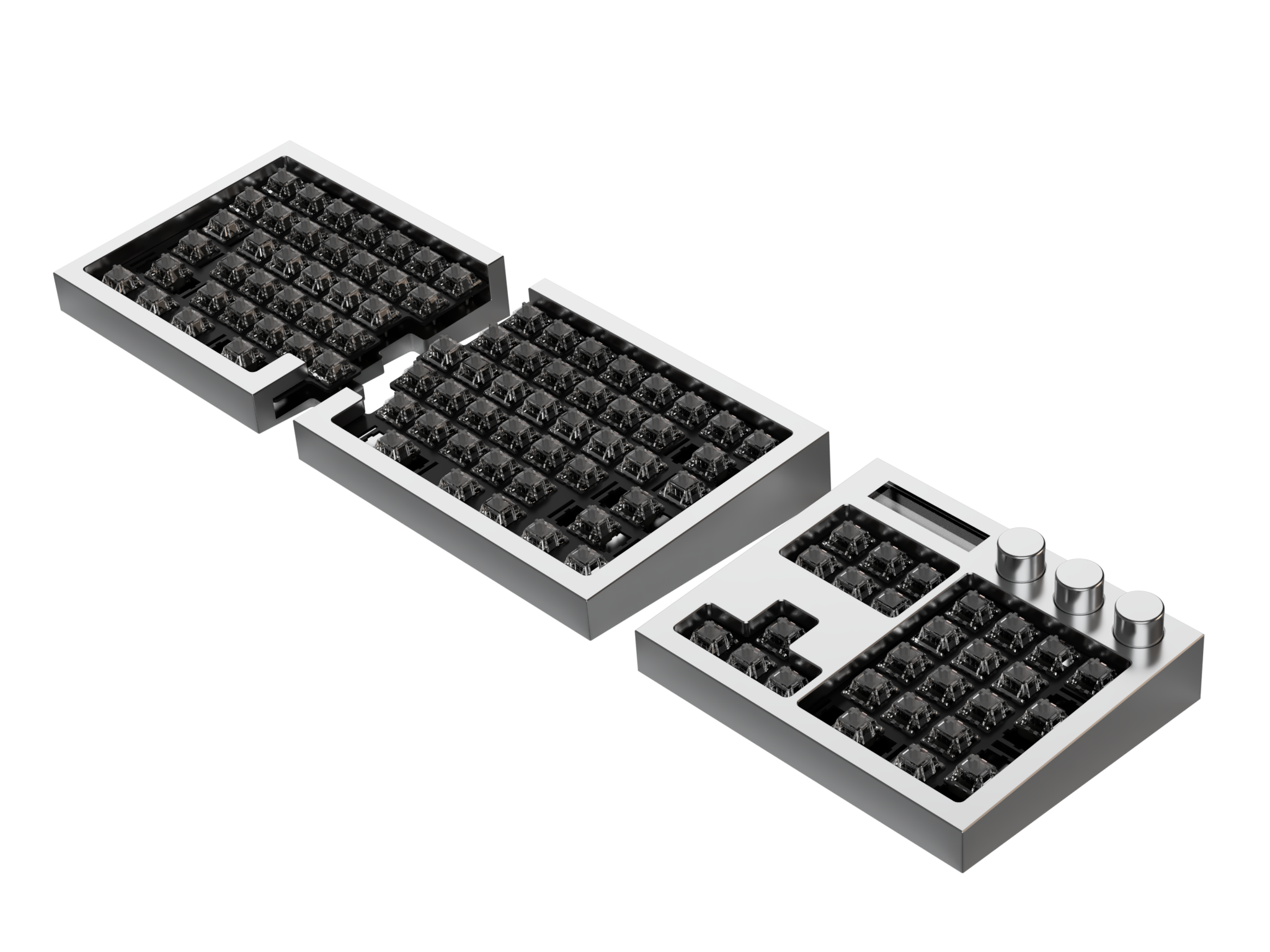


The Developer's Split Keyboard (dsk) is an open-source, ergonomic, and customizable keyboard for developers.
dsk is a modular split keyboard built for developers, offering both ergonomic flexibility and a traditional typing experience. It consists of:
The dsk project is built around the following core principles:
[!NOTE]
This project is still in development and manufacturing details and documentation will be added soon!
dsk can be easily made using additive methods (3D printing, resin, SLS) or CNC milling. Full details at dsk.twango.dev/docs.
[!TIP] Students and educators commonly have access to 3D printers and CNC machines through their institutions! Check with your school or local makerspace for more information.
| Qty | Value | Footprint | References |
|---|---|---|---|
| 1 | 781710004 | Connector_Molex:Molex_Pico-EZmate_78171-0004_1x04-1MP_P1.20mm_Vertical | J2 |
| 1 | MountingHole_Pad | MountingHole:MountingHole_3.2mm_M3_Pad | H1 |
| 1 | PJ-320D | Connector_Audio:Jack_3.5mm_PJ320D_Horizontal | J1 |
twangodev/dsk
The developer's split keyboard (dsk) is an open-source, ergonomic, and customizable keyboard for developers.

twangodev/dsk
The developer's split keyboard (dsk) is an open-source, ergonomic, and customizable keyboard for developers.

twangodev/dsk
The developer's split keyboard (dsk) is an open-source, ergonomic, and customizable keyboard for developers.

Twotoz/C5VRX
Ultra-minimal, zero-CPU 5.8 GHz analog FPV video receiver using ESP32-C5 Wi-Fi 6 PHY MODEM_DIAG, BitScrambler WBFM demodulation & resistor DAC CVBS

GeekFunkLabs/squishbox
Software and design files for a Raspberry Pi sound module enclosure


SharKingStudios/Fracture
An infinitely expandable, velocity sensing split midi keyboard.


rh1tech/frank-lab
FRANK Board Laboratory (work-in-progress board prototopyes)

It measures 27 × 10 mm and has 2 copper layers, 1.6 mm thick.
3 parts, built around the PJ-320D. The full list of its parts is on this page, with links to each part's symbol and footprint where PCBKit's library has them.
From the twangodev/dsk repository on GitHub, at the commit this page was made from: the board is pcb/i2c-trrs/i2c-trrs.kicad_pcb and its schematic pcb/i2c-trrs/i2c-trrs.kicad_sch. PCBKit opens the board in the browser, with nothing to install.
Its repository publishes it under the CERN-OHL-S-2.0 licence: you may reuse it on that licence's terms (keep the author's notice, and for a copyleft licence share your changes alike).