
2 layers50 × 25 mm
 tronixio/modules
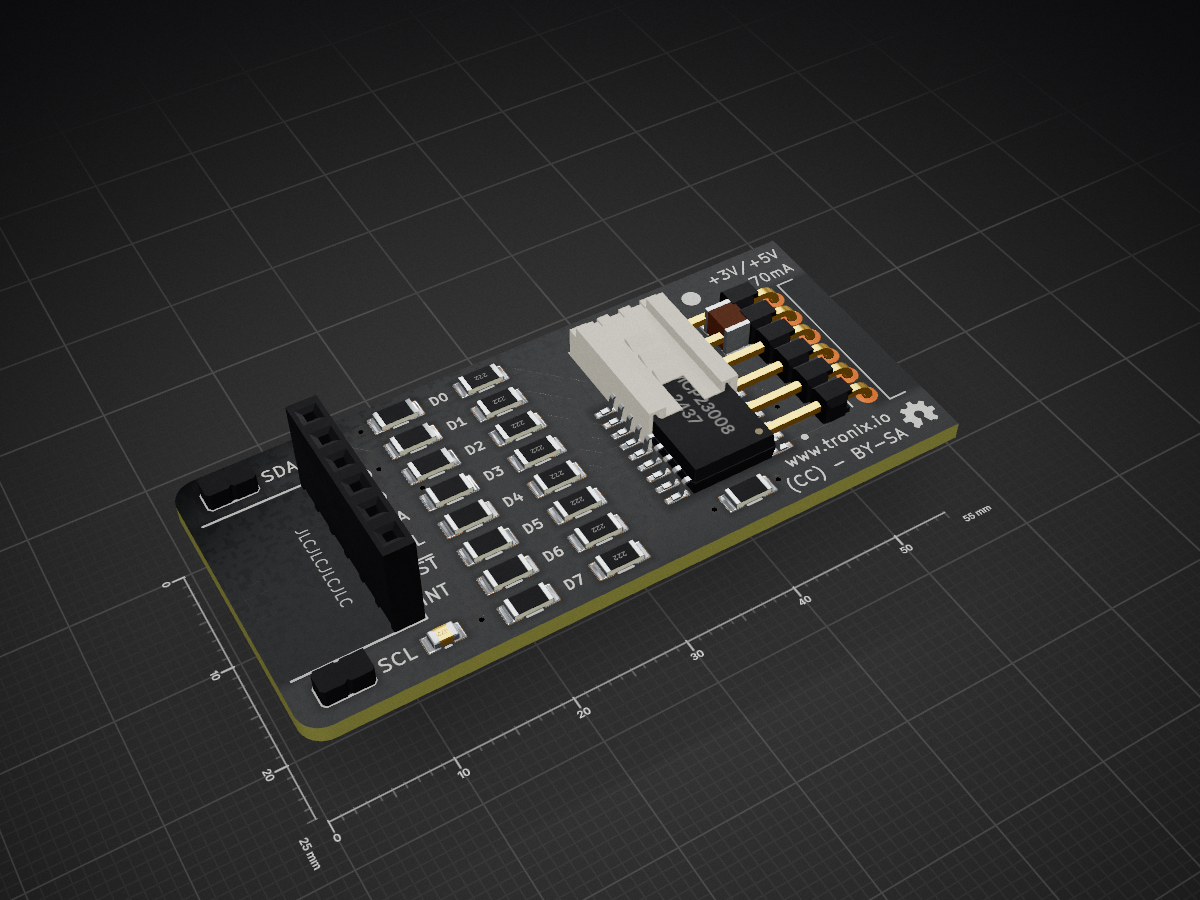
Mcp23008-led is an open-source printed circuit board by tronixio, from the tronixio/modules repository on GitHub. It is a 2-layer board of 55 × 25 mm with 35 parts on 28 nets, routed with 113 tracks and 9 vias.
It is built around the MCP23008-E/P. Its parts include 10 resistors, 8 diodes, 2 capacitors, 2 ICs and 2 switches.
| Qty | Value | Footprint | References |
|---|---|---|---|
| 8 | 2k2 | tronixio:RESISTOR-SMD-1206 | R3, R4, R5, R6, R7, R8, R9, R10 |
| 2 | 4k7 | tronixio:RESISTOR-SMD-0805 | R1, R2 |
| 1 | 100n | tronixio:CAPACITOR-SMD-1206 | C1 |
| 1 | 10µ | tronixio:CAPACITOR-SMD-CASE-B | C2 |
| 1 | 3M-SJ5376 | tronixio:3M-SJ5376 | U2 |
| 1 | A0 | tronixio:HARWIN-M22-25103xx | JP5 |
| 1 | A1 | tronixio:HARWIN-M22-25103xx | JP4 |
| 1 | A2 | tronixio:HARWIN-M22-25103xx | JP3 |
| 1 | D0 | tronixio:LED-SMD-1206 | LED1 |
| 1 | D1 | tronixio:LED-SMD-1206 | LED2 |
| 1 | D2 | tronixio:LED-SMD-1206 | LED3 |
| 1 | D3 | tronixio:LED-SMD-1206 | LED4 |
| 1 | D4 | tronixio:LED-SMD-1206 | LED5 |
| 1 | D5 | tronixio:LED-SMD-1206 | LED6 |
| 1 | D6 | tronixio:LED-SMD-1206 | LED7 |
| 1 | D7 | tronixio:LED-SMD-1206 | LED8 |
| 1 | G*** | kibuzzard-62B79DF9 | kibuzzard-62B79DF9 |
| 1 | G*** | kibuzzard-62B79E59 | kibuzzard-62B79E59 |
| 1 | G*** | kibuzzard-62B79EC3 | kibuzzard-62B79EC3 |
| 1 | G*** | kibuzzard-62B79EB2 | kibuzzard-62B79EB2 |
| 1 | GPIO IN | tronixio:HARWIN-M20-975064x | K1 |
| 1 | GPIO OUT | tronixio:SAMTEC-SSW-106-02-T-S-RA | K2 |
| 1 | LOGO | tronixio:OSHW-5MM | G*** |
| 1 | LOGO | tronixio:OSHW-3MM | G*** |
| 1 | MCP23008 | tronixio:SOIC-18W | U1 |
| 1 | SCL | tronixio:HARWIN-M22-25102xx | JP1 |
| 1 | SDA | tronixio:HARWIN-M22-25102xx | JP2 |


nategri/chernobyl_dice
A quantum random number generator with a Cold War aesthetic.

mathisschmieder/HL2-MRF101
Hermes-Lite2 Power Amplifier/Filter board using MRF-101

pa3gsb/Radioberry-2.x-extensions
Hardware extensions to the Radioberry Ham Radio

dm2lct/tlnixie
PCB files for the Turmlabor nixie clock 2.0

dm2lct/Nixieclock_kit
This is a Nixie-clock controlled by a ESP8266 module with NTP and MQTT support.


Sheepybloke2-0/alpacaboard
An Open Source keyboard designed for Kailh Low Profile Switches

It measures 55 × 25 mm and has 2 copper layers, 1.6 mm thick.
35 parts, built around the MCP23008-E/P. The full list of its parts is on this page, with links to each part's symbol and footprint where PCBKit's library has them.
From the tronixio/modules repository on GitHub, at the commit this page was made from: the board is Kicad/gpio-mcp23008-led/mcp23008-led.kicad_pcb and its schematic Kicad/gpio-breadbaord/main.kicad_sch. PCBKit opens the board in the browser, with nothing to install.
Its repository states no licence, so its author keeps all rights: ask tronixio before reusing the design.