2 layers94.9 × 76 mm
ToadsTempest
tikinson/ToadsTempest
Super small custom 42-keys column-staggered ergonomic mechanical keyboard powered by CH552T microcontroller, created for pocket keyboard design contest #00
113 parts11CC0-1.0

 tikinson/kazhan
custom 28-keys ergonomic mechanical keyboard powered by CH552T microcontroller
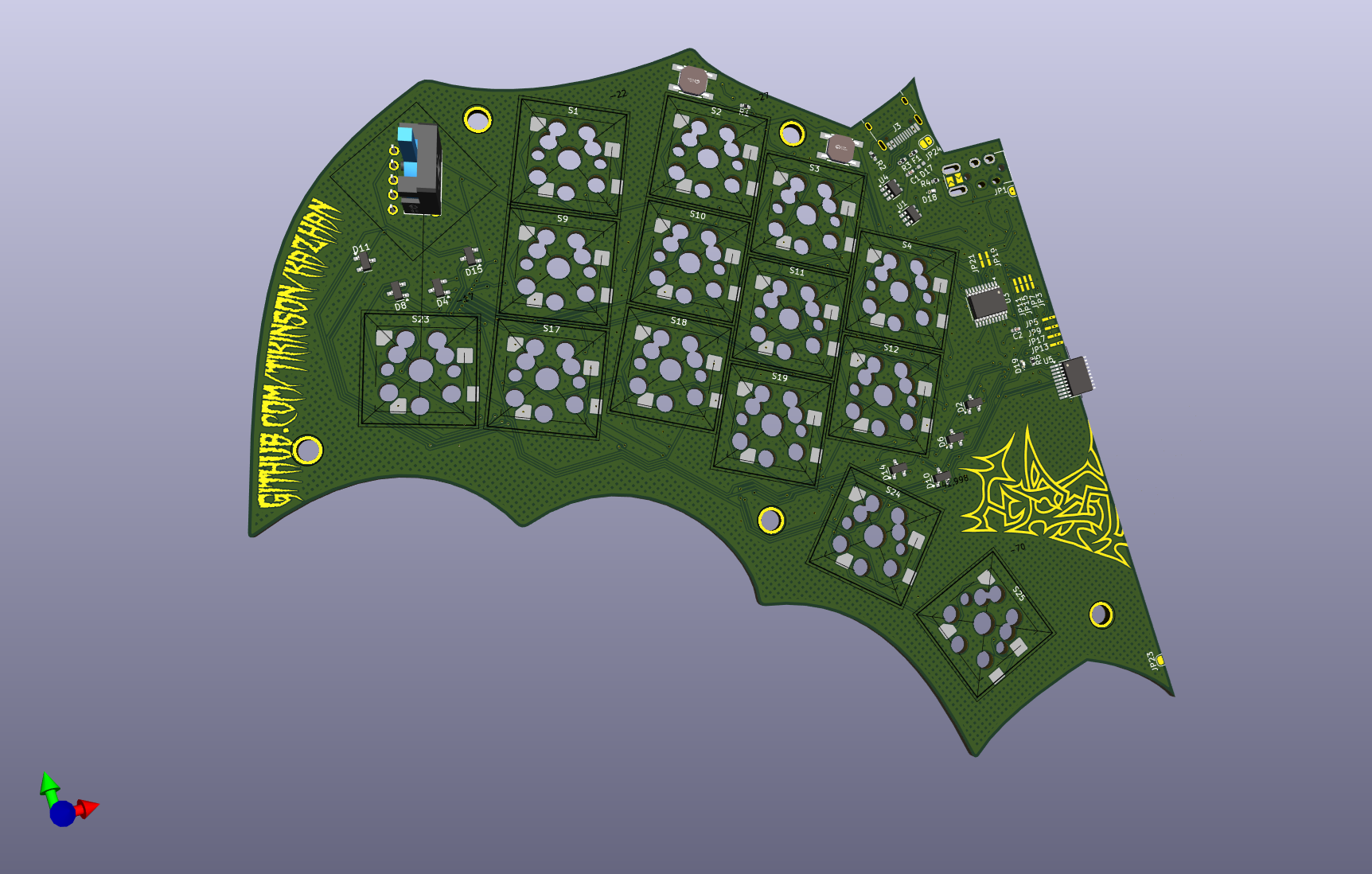
Kazhan oldCopy is an open-source printed circuit board by tikinson, from the tikinson/kazhan repository on GitHub, published under the GPL-3.0 licence. It is a 2-layer board of 143.6 × 139.6 mm with 98 parts on 105 nets, routed with 230 tracks and 40 vias.
It is built around the CH552T, USBLC6-2SC6 and PMEG2010EA. Its parts include 34 switches, 19 diodes, 6 resistors, 5 ICs and 3 connectors. It belongs with the 8051 (CH55x, STC, AT89) boards of this library.



WIP. Current PCB is still need a rewiev!
28 Keys. MX and Choc compatible keyboard with CH552T controller. This is the next logical step after my experimental keyboard ToadsTempest.
Kazhan (Кажан) is derived from the Ukrainian word meaning "bat". As a fan of ZilpZalp/Hummingbird projects i decided make something with same layout but more personalized. Same but different.
Opening local copy of ibom.html could save some times while soldering.
| Reference | Value | Footprint | Qty | LCSC |
|---|---|---|---|---|
| C1, C2 | 100nF | Capacitor_SMD:C_0402_1005Metric_Pad0.74x0.62mm_HandSolder | 2 | C1525 |
| D1, D4, D5, D8, D9, D11, D13, D15 | BAS70-06-CAnode | Package_TO_SOT_SMD:SOT-23 | 8 | C8651 |
| D2, D3, D6, D7, D10, D12, D14, D16 | BAS70-05-CCatode | Package_TO_SOT_SMD:SOT-23 | 8 | C34489 |
| D17 | PMEG2010EA | Diode_SMD:D_0402_1005Metric_Pad0.77x0.64mm_HandSolder | 1 | C2837790 |
| D18, D19 | PWR LED | LED_SMD:LED_0402_1005Metric | 2 | C130724 |
| F1 | 500mA | Fuse:Fuse_0402_1005Metric_Pad0.77x0.64mm_HandSolder | 1 | C210357 |
| J3 | USB_C_Receptacle_USB2.0 | Connector_USB:USB_C_Receptacle_HRO_TYPE-C-31-M-12 | 1 | C2765186 |
| R1, R6 | 10k | Resistor_SMD:R_0402_1005Metric_Pad0.72x0.64mm_HandSolder | 2 | C25744 |
| R2, R3 | 5.1k | Resistor_SMD:R_0402_1005Metric_Pad0.72x0.64mm_HandSolder | 2 | C25905 |
| R4, R5 | 1k | Resistor_SMD:R_0402_1005Metric | 2 | C11702 |
| SW1, SW2 | ~ | MyFootprintsCollection:SW-TH_SSCF110100 | 2 | C470322 |
| SW4, SW6 | RESET | KEY-SMD_4P-L4.8-W4.8-P3.70-LS6.4-TL | 2 | C2888968 |
| S1–S28 | Keyswitch | SW_Hotswap_Kailh_Choc_MX_1.00u_One_Sided | 28 | |
| U1, U4 | USBLC6-2SC6 | Package_TO_SOT_SMD:SOT-23-6 | 2 | C2687116 |
| U2, U3, U5 | CH552T | -- mixed footprints -- | 3 | C111367 |
| Qty | Value | Footprint | References |
|---|---|---|---|
| 28 | Keyswitch | MyFootprintsCollection:SW_Hotswap_Kailh_Choc_MX_1.00u_One_Sided | S1, S2, S10, S11, S12, S13, S14, S15, S16, S17, S18, S19, S20, S21, S22, S23 +12 |
| 20 | SolderJumper_2_Open | MyFootprintsCollection:SolderJumper-1.25x0.5 | JP3, JP4, JP5, JP10, JP11, JP12, JP13, JP14, JP15, JP16, JP17, JP18, JP19, JP20, JP21, JP22 +4 |
| 8 | BAS70-05-CCatode | Package_TO_SOT_SMD:SOT-23 | D2, D3, D6, D7, D10, D12, D14, D16 |
| 8 | BAS70-06-CAnode | Package_TO_SOT_SMD:SOT-23 | D1, D4, D5, D8, D9, D11, D13, D15 |
| 5 | Mounting_Hole | MyFootprintsCollection:MountingHole_3.5mmX4.5mm_Pad | H1, H2, H3, H4, H5 |
| 2 | 100nF | Capacitor_SMD:C_0402_1005Metric_Pad0.74x0.62mm_HandSolder | C1, C2 |
| 2 | 10k | Resistor_SMD:R_0402_1005Metric_Pad0.72x0.64mm_HandSolder | R1, R6 |
| 2 | 1k | Resistor_SMD:R_0402_1005Metric | R4, R5 |
| 2 | 5.1k | Resistor_SMD:R_0402_1005Metric_Pad0.72x0.64mm_HandSolder | R2, R3 |
| 2 | BOOT | MyFootprintsCollection:KEY-SMD_4P-L4.8-W4.8-P3.70-LS6.4-TL | SW3, SW5 |
| 2 | CH552T | Package_SO:TSSOP-20_4.4x6.5mm_P0.65mm | U2, U3 |
| 2 | RESET | MyFootprintsCollection:KEY-SMD_4P-L4.8-W4.8-P3.70-LS6.4-TL | SW4, SW6 |
| 2 | USBLC6-2SC6 | Package_TO_SOT_SMD:SOT-23-6 | U1, U4 |
| 2 | ~ | MyFootprintsCollection:SW-TH_SSCF110100 | SW1, SW2 |
| 1 | 500mA | Fuse:Fuse_0402_1005Metric_Pad0.77x0.64mm_HandSolder | F1 |
| 1 | AudioJack4 | MyFootprintsCollection:PJ-320A-REVERSIBLE-B.Cu-placing | J2 |
| 1 | AudioJack4 | MyFootprintsCollection:PJ-320A-REVERSIBLE-F.Cu-placing | J1 |
| 1 | CH552T | MyFootprintsCollection:TSSOP-20_4.4x6.5mm_P0.65mm-REVERSIBLE | U5 |
| 1 | LOGO | MyFootprintsCollection:kazhantest2_1_1_1 | G*** |
| 1 | PMEG2010EA | Diode_SMD:D_0402_1005Metric_Pad0.77x0.64mm_HandSolder | D17 |
| 1 | PWR LED | LED_SMD:LED_0402_1005Metric | D18 |
| 1 | SolderJumper_2_Open | Jumper:SolderJumper-2_P1.3mm_Open_RoundedPad1.0x1.5mm | JP24 |
| 1 | SolderJumper_2_Open | MyFootprintsCollection:SolderJumper-F.Cu-B.Cu | JP23 |
| 1 | USB_C_Receptacle_USB2.0 | Connector_USB:USB_C_Receptacle_HRO_TYPE-C-31-M-12 | J3 |
| 1 | USR LED | LED_SMD:LED_0402_1005Metric | D19 |
tikinson/ToadsTempest
Super small custom 42-keys column-staggered ergonomic mechanical keyboard powered by CH552T microcontroller, created for pocket keyboard design contest #00

bgkendall/Alufo
Small split keyboard using stacked one-layer aluminium core boards with an on-board CH552T controller.

kilipan/miao
A cheap and hand-solderable drop-in replacement for the XIAO using ch552t


chinawrj/FarmMesh-Node
Developing an integrated hardware and software solution for farm-wide Mesh networking: RP2350B/ESP32-C5 nodes, firmware, network protocols, and Wi-Fi/BLE sensor access.

It measures 143.6 × 139.6 mm and has 2 copper layers, 1.6 mm thick.
98 parts, built around the CH552T, USBLC6-2SC6 and PMEG2010EA. The full list of its parts is on this page, with links to each part's symbol and footprint where PCBKit's library has them.
From the tikinson/kazhan repository on GitHub, at the commit this page was made from: the board is kazhan_oldCopy.kicad_pcb and its schematic kazhan.kicad_sch. PCBKit opens the board in the browser, with nothing to install.
Its repository publishes it under the GPL-3.0 licence: you may reuse it on that licence's terms (keep the author's notice, and for a copyleft licence share your changes alike).