

2 layers17.8 × 21 mm
Miao
kilipan/miao
A cheap and hand-solderable drop-in replacement for the XIAO using ch552t
18 parts33CERN-OHL-S-2.0

 kilipan/miao33
A cheap and hand-solderable drop-in replacement for the XIAO using ch552t
Kicad miao panel is an open-source printed circuit board by kilipan, from the kilipan/miao repository on GitHub, published under the CERN-OHL-S-2.0 licence. It is a 2-layer board of 209.8 × 147 mm with 2,645 parts on 1,650 nets, routed with 19,000 tracks and 2,150 vias.
It is built around the USBLC6-2SC6 and PMEG2010EA. Its parts include 250 resistors, 150 ICs, 100 capacitors, 100 diodes and 100 switches.
2023-09-29 initial commit
2023-09-30 fixed pinout to correspond to Xiao, added jumper to choose between RX/CS on pin 8, completely rerouted
| :zap: The hardware design is tested and confirmed working as of the latest commit. Nevertheless I cannot guarantee anything. Use at your own risk! |
|---|
MIAO is a cheap drop-in replacement for the Seeeduino Xiao series.
喵 is the Hanzi for "miāo", which is Mandarin for "meow".
The board is available in two variants:
hw_handsolder (since castellated holes are expensive, this version doesn't support them.)hw_pcba, featuring castellated holesRenders of the handsolderable version and a screenshot of the schematic can be unfolded below.
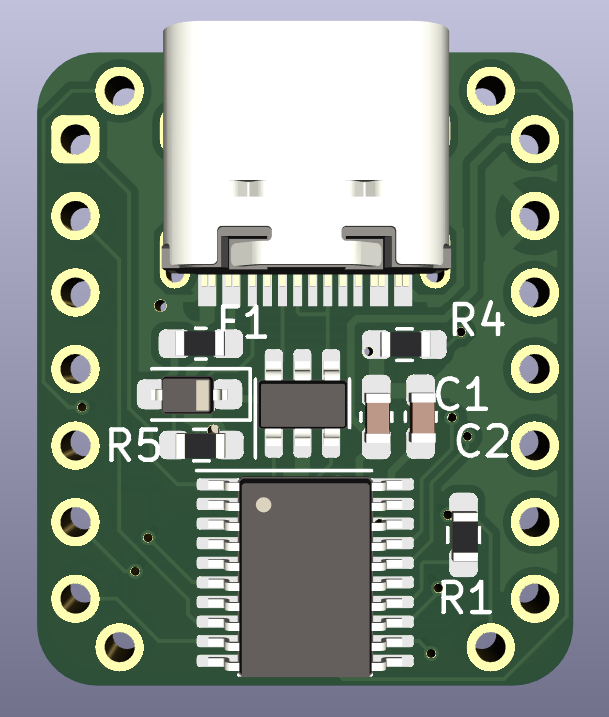


MIAO features:
As production files are open sourced, you can get these manufactured at your favorite PCB-manufacturer. Alternatively, keeb.supply is selling the PCBA version usage-ready for a great price! Thanks guys! <3 Non-affiliate link: Miao page on keeb.supply
This BOM is for the handsolderable version only. For the PCBA version please refer to the given files.
| Amount | Part | LCSC part number | Silkscreen Reference | Comment |
|---|---|---|---|---|
| 1 | ch552t microcontroller | C111367 | U1 | |
| 1 | top-mount USB-C receptacle | C2765186 | [none] | |
| 1 | SOT-23 ESD protection diode | C6807798 | U2 | |
| 1 | SOD-323 Schottky diode | C193668 | D2 | |
| 1 | 0603 Fuse | C311055 | F1 | |
| 1 | 0603 10kΩ Resistor | C25804 | R1 | |
| 2 | 0603 5.1kΩ Resistor | C23186 | R4, R5 | |
| 2 | 0603 100nF Capacitors | C384773 | C1, C2 | Take care, these need to be soldered in vertically, as indicated by the small dashes on the silkscreen! |
| [1] | [optional] 1kΩ Resistor | C21190 | R2 | on the backside |
| [2] | [optional] push buttons | C115357 | B, R | on the backside |
| [1] | [optional] LED | C434442 | D1 | on the backside |
The project is inspired by and designed for usage with semickolon's FAK firmware, but it's obviously not limited to that! Refer to the ch552t documentation and the many other ch55x projects for more details.
The hardware design is licensed under the CERN-OHL-v2-S license, so feel free to look at the sources and remix to your heart's content! :)
| Qty | Value | Footprint | References |
|---|---|---|---|
| 100 | 100nF | Capacitor_SMD:C_0402_1005Metric | C1, C1, C1, C1, C1, C1, C1, C1, C1, C1, C1, C1, C1, C1, C1, C1 +84 |
| 100 | 5.1k | Resistor_SMD:R_0402_1005Metric | R4, R4, R4, R4, R4, R4, R4, R4, R4, R4, R4, R4, R4, R4, R4, R4 +84 |
| 50 | 0 | Resistor_SMD:R_0402_1005Metric | R3, R3, R3, R3, R3, R3, R3, R3, R3, R3, R3, R3, R3, R3, R3, R3 +34 |
| 50 | 10k | Resistor_SMD:R_0402_1005Metric | R1, R1, R1, R1, R1, R1, R1, R1, R1, R1, R1, R1, R1, R1, R1, R1 +34 |
| 50 | 1k | Resistor_SMD:R_0402_1005Metric | R2, R2, R2, R2, R2, R2, R2, R2, R2, R2, R2, R2, R2, R2, R2, R2 +34 |
| 50 | 500mA | Fuse:Fuse_0402_1005Metric | F1, F1, F1, F1, F1, F1, F1, F1, F1, F1, F1, F1, F1, F1, F1, F1 +34 |
| 50 | BOOT | Button_Switch_SMD:SW_Push_SPST_NO_Alps_SKRK | SW1, SW1, SW1, SW1, SW1, SW1, SW1, SW1, SW1, SW1, SW1, SW1, SW1, SW1, SW1, SW1 +34 |
| 50 | PMEG2010EA | Diode_SMD:D_0402_1005Metric | D2, D2, D2, D2, D2, D2, D2, D2, D2, D2, D2, D2, D2, D2, D2, D2 +34 |
| 50 | PWR LED vs USR LED | BeiBob:SolderJumper-3_P1.3mm_Open_RoundedPad1.0x1.5mm_NumberLabels | JP1, JP1, JP1, JP1, JP1, JP1, JP1, JP1, JP1, JP1, JP1, JP1, JP1, JP1, JP1, JP1 +34 |
| 50 | PWR/USR LED | LED_SMD:LED_0402_1005Metric | D1, D1, D1, D1, D1, D1, D1, D1, D1, D1, D1, D1, D1, D1, D1, D1 +34 |
| 50 | RESET | Button_Switch_SMD:SW_Push_SPST_NO_Alps_SKRK | SW2, SW2, SW2, SW2, SW2, SW2, SW2, SW2, SW2, SW2, SW2, SW2, SW2, SW2, SW2, SW2 +34 |
| 50 | UART vs SPI | BeiBob:SolderJumper-3_P1.3mm_Open_RoundedPad1.0x1.5mm_NumberLabels | JP2, JP2, JP2, JP2, JP2, JP2, JP2, JP2, JP2, JP2, JP2, JP2, JP2, JP2, JP2, JP2 +34 |
| 50 | USBLC6-2SC6 | Package_TO_SOT_SMD:SOT-23-6 | U2, U2, U2, U2, U2, U2, U2, U2, U2, U2, U2, U2, U2, U2, U2, U2 +34 |
| 50 | USB_C_Receptacle_USB2.0 | Connector_USB:USB_C_Receptacle_HRO_TYPE-C-31-M-12 | J1, J1, J1, J1, J1, J1, J1, J1, J1, J1, J1, J1, J1, J1, J1, J1 +34 |
| 50 | xiao_drop-in_gpio_usb_no_cutout | apfellib:xiao_drop-in_gpio_plus_4_castellated | U3, U3, U3, U3, U3, U3, U3, U3, U3, U3, U3, U3, U3, U3, U3, U3 +34 |
| 50 | ~ | Package_SO:TSSOP-20_4.4x6.5mm_P0.65mm | U1, U1, U1, U1, U1, U1, U1, U1, U1, U1, U1, U1, U1, U1, U1, U1 +34 |
The 900 most common of 2,645 parts.
kilipan/miao
A cheap and hand-solderable drop-in replacement for the XIAO using ch552t

kilipan/miao
A cheap and hand-solderable drop-in replacement for the XIAO using ch552t


tikinson/ToadsTempest
Super small custom 42-keys column-staggered ergonomic mechanical keyboard powered by CH552T microcontroller, created for pocket keyboard design contest #00


chinawrj/FarmMesh-Node
Developing an integrated hardware and software solution for farm-wide Mesh networking: RP2350B/ESP32-C5 nodes, firmware, network protocols, and Wi-Fi/BLE sensor access.

tikinson/kazhan
custom 28-keys ergonomic mechanical keyboard powered by CH552T microcontroller


mck1117/wr-rusefi
Georgia Tech Wreck Racing's implementation of a Rusefi compatible ECU
It measures 209.8 × 147 mm and has 2 copper layers, 1.6 mm thick.
2,645 parts, built around the USBLC6-2SC6 and PMEG2010EA. The full list of its parts is on this page, with links to each part's symbol and footprint where PCBKit's library has them.
From the kilipan/miao repository on GitHub, at the commit this page was made from: the board is hw_pcba/kikit/panel/kicad_miao-panel.kicad_pcb and its schematic hw_handsolder/miao.kicad_sch. PCBKit opens the board in the browser, with nothing to install.
Its repository publishes it under the CERN-OHL-S-2.0 licence: you may reuse it on that licence's terms (keep the author's notice, and for a copyleft licence share your changes alike).