
4 layers80 × 35 mm

 the78mole/jumpstarter-mono
This is a monorepo containing all jumpstarter tools and (hopefully) adds a standalone server soon.
Dutlink is an open-source printed circuit board by the78mole, from the the78mole/jumpstarter-mono repository on GitHub, published under the Apache-2.0 licence. It is a 4-layer board of 170 × 170 mm with 144 parts on 114 nets, routed with 1,576 tracks and 227 vias.
It is built around the STM32F411CEU6, ACS725LLCTR-05AB-T and AP2127N-3.3TRG1, with the TMUXHS221NKGR, TMUXHS4212RKSR and RTT02331JTH among its other parts. Its parts include 40 resistors, 38 capacitors, 14 connectors, 6 ICs and 6 diodes. It belongs with the STM32 boards of this library.


This is a monorepo containing all Jumpstarter components unified into a single, manageable repository. The goal is to simplify development, improve cross-component integration, and streamline the release process.
# Clone the repository
git clone https://github.com/the78mole/jumpstarter-mono.git
cd jumpstarter-mono

# Setup development environment
make setup

# Build all components
make build

# Run tests
make testjumpstarter-mono/
├── core/ # Core Jumpstarter components
│ ├── jumpstarter/ # Main Python library and CLI
│ ├── controller/ # Kubernetes controller (Go)
│ └── protocol/ # Protocol definitions
├── hardware/ # Hardware-related components
│ ├── dutlink-board/ # Hardware design files
│ └── dutlink-firmware/ # Rust firmware
├── integrations/ # CI/CD and tooling integrations
│ ├── tekton/ # Tekton tasks and pipelines
│ ├── vscode/ # VS Code extension
│ └── devspace/ # Development environments
├── templates/ # Templates and scaffolding
│ └── driver/ # Driver development template
├── testing/ # Testing infrastructure
│ └── e2e/ # End-to-end tests
└── lab-config/ # Lab configuration toolsflowchart LR
subgraph "Setup"
CLONE[Clone Repo]
SETUP[make setup]
end
subgraph "Development Cycle"
CODE[Write Code]
BUILD[make build]
TEST[make test]
LINT[make lint]
COMMIT[Commit]
end
subgraph "Multi-language Support"
PY[Python<br/>UV Workspace]
GO[Go<br/>Go Workspace]
RUST[Rust<br/>Cargo]
WEB[TypeScript<br/>NPM]
end
CLONE --> SETUP
SETUP --> CODE
CODE --> BUILDmake help # Show all available commands
make setup # Setup development environment
make build # Build all components
make test # Run all tests
make lint # Run all linters
make fmt # Format all code
make clean # Clean build artifacts
make docs # Build documentation# Python
make build-python # Build Python components
make test-python # Run Python tests
make lint-python # Lint Python code
# Go
make build-go # Build Go components
make test-go # Run Go tests
make lint-go # Lint Go code
# Rust
make build-rust # Build Rust components
make test-rust # Run Rust tests
make lint-rust # Lint Rust code
# Web/TypeScript
make build-web # Build web components
make lint-web # Lint TypeScript codeDetailed documentation is available in the following documents:
# Install all Python components
pip install -e .

# Install Go components
cd core/controller && make installPre-built packages will be available for:
The monorepo includes comprehensive testing at multiple levels:
Run tests with:
make test           # All tests
make test-e2e # End-to-end tests onlyJumpstarter provides a unified platform for hardware-in-the-loop testing with:
graph TB
    subgraph "User Interface Layer"
        CLI[CLI Tools]
        API[REST API]
        WEB[Web Dashboard]
    end

    subgraph "Core Platform"
        LIB[Python Core Library<br/>Device Drivers & Automation]
        CTL[Kubernetes Controller<br/>Cloud-native Orchestration]
        PROTO[Protocol Definitions<br/>Cross-component Communication]
    end

    subgraph "Hardware Layer"
        FW[Rust Firmware<br/>Real-time Control]
        BOARD[DUTLink Hardware<br/>Test Harness Board]
        DUT[Device Under Test]
    end

    subgraph "Integration & CI/CD"
        TEKTON[Tekton Pipelines]
        VSCODE[VS Code Extension]
        GITHUB[GitHub Actions]
endWe welcome contributions! Please see our contributing guidelines for details on:
This project is licensed under the Apache License 2.0 - see the LICENSE file for details.
Note: This monorepo consolidates components from the jumpstarter-dev organization. Individual component repositories remain available for reference but active development will occur in this monorepo.
| Qty | Value | Footprint | References |
|---|---|---|---|
| 17 | 100nF | Capacitor_SMD:C_0603_1608Metric | C13, C14, C15, C16, C17, C18, C20, C22, C24, C26, C28, C33, C34, C35, C36, C37 +1 |
| 12 | 1uF | Capacitor_SMD:C_0603_1608Metric | C1, C2, C3, C4, C6, C11, C12, C19, C21, C23, C25, C31 |
| 9 | Board MountingHole | MountingHole:MountingHole_2.7mm_M2.5_Pad_Via | H5, H6, H7, H8, H9, H10, H11, H12, H14 |
| 7 | TestPoint | TestPoint:TestPoint_Pad_D1.0mm | 3v3, 3v3A1, 5V1, GND1, TP11, TP12, TP13 |
| 6 | 330 | Resistor_SMD:R_0402_1005Metric | R17, R18, R32, R33, R34, R40 |
| 6 | 470 | Resistor_SMD:R_0603_1608Metric | R9, R35, R36, R37, R38, R39 |
| 5 | 100 | Resistor_SMD:R_0603_1608Metric | R11, R12, R13, R14, R31 |
| 5 | 47uF 32V | Capacitor_SMD:CP_Elec_6.3x5.4_Nichicon | C5, C27, C29, C30, C38 |
| 5 | LED | LED_SMD:LED_0603_1608Metric | D2, D3, D4, D5, D6 |
| 4 | 1k | Resistor_SMD:R_0603_1608Metric | R16, R20, R21, R23 |
| 4 | 2k2 | Resistor_SMD:R_0603_1608Metric | R4, R6, R28, R30 |
| 4 | 47k | Resistor_SMD:R_0603_1608Metric | R3, R5, R27, R29 |
| 4 | FDC6330L | Package_TO_SOT_SMD:TSOT-23-6 | Q1, Q2, Q3, Q4 |
| 4 | ITX MountingHole | MountingHole:MountingHole_4.3mm_M4_Pad_Via | H1, H2, H3, H4 |
| 3 | 50 | Resistor_SMD:R_0603_1608Metric | R1, R2, R7 |
| 2 | 0 | Resistor_SMD:R_0603_1608Metric | R25, R26 |
| 2 | 10k | Resistor_SMD:R_0603_1608Metric | R15, R22 |
| 2 | 10uH | Inductor_SMD:L_0805_2012Metric | L1, L3 |
| 2 | 12pF | Capacitor_SMD:C_0603_1608Metric | C8, C9 |
| 2 | 7427932 | FOOTPRINTS:7427932 | L2, L4 |
| 2 | AP2127N-3.3 | Package_TO_SOT_SMD:SOT-23 | U2, U3 |
| 2 | Barrel_Jack_MountingPin | Connector_BarrelJack:BarrelJack_Horizontal | J2, J3 |
| 2 | SW_Push | Button_Switch_SMD:SW_SPST_B3S-1000 | SW2, SW3 |
| 2 | USB_C_Receptacle_PowerOnly_6P | FOOTPRINTS:USB_C_Receptacle_G-Switch_GT-USB-7010ASV_fix | J1, J5 |
| 1 | 1N4148WT | Diode_SMD:D_SOD-523 | D1 |
| 1 | 1nF | Capacitor_SMD:C_0603_1608Metric | C32 |
| 1 | 2.2uF | Capacitor_SMD:C_0603_1608Metric | C10 |
| 1 | 25 Mhz Crystal | Oscillator:Oscillator_SMD_EuroQuartz_XO32-4Pin_3.2x2.5mm | Y2 |
| 1 | 2k | Resistor_SMD:R_0603_1608Metric | R24 |
| 1 | 2k4 | Resistor_SMD:R_0603_1608Metric | R8 |
| 1 | 4k7 | Resistor_SMD:R_0603_1608Metric | R10 |
| 1 | 5k1 | Resistor_SMD:R_0603_1608Metric | R19 |
| 1 | 6x2 2.54mm header | Connector_PinHeader_2.54mm:PinHeader_2x06_P2.54mm_Vertical | J17 |
| 1 | ACS725LLCTR-05AB-T | Package_SO:SOIC-8_3.9x4.9mm_P1.27mm | U4 |
| 1 | Conn_01x02_Pin | Connector_PinHeader_2.54mm:PinHeader_1x02_P2.54mm_Vertical | J16 |
| 1 | Conn_01x05_Pin | Connector_PinHeader_2.54mm:PinHeader_1x05_P2.54mm_Vertical | J6 |
| 1 | Conn_01x09_Pin | Connector_PinHeader_2.54mm:PinHeader_1x09_P2.54mm_Horizontal | J4 |
| 1 | Hirose USB3_B_Micro | FOOTPRINTS:ZX360DB10P30 | J8 |
| 1 | I2C connector | Connector_PinHeader_2.54mm:PinHeader_2x03_P2.54mm_Vertical | J10 |
| 1 | LOGO | LOGO | G*** |
| 1 | SPI/TPM connector | Connector_PinHeader_2.54mm:PinHeader_2x05_P2.54mm_Vertical | J11 |
| 1 | STM32F411CEUx | Package_DFN_QFN:QFN-48-1EP_7x7mm_P0.5mm_EP5.6x5.6mm | U1 |
| 1 | SW_Push | Button_Switch_THT:SW_Tactile_SPST_Angled_PTS645Vx58-2LFS | SW1 |
| 1 | TMUXHS221NKGR | Package_DFN_QFN:UQFN-10_1.4x1.8mm_P0.4mm | U5 |
| 1 | TMUXHS4212 | Package_DFN_QFN:DHVQFN-20-1EP_2.5x4.5mm_P0.5mm_EP1x3mm | U6 |
| 1 | USB3_A | Connector_USB:USB3_A_Molex_48393-001 | J9 |
| 1 | USB3_B | USB3Wurth:Wurth WR-COM USB 3.0 692221030100 | J7 |
| 1 | USB_C_Plug_USB2.0 | Connector_USB:USB_C_Receptacle_G-Switch_GT-USB-7010ASV | P1 |
The 137 most common of 144 parts.

PaulBichl/vibepcb-smu
VibePCB example: 4-quadrant SMU (+-30 V / +-1 A, USB-C PD, Ethernet) designed with an LLM


TIGP-Experimental-Methods/class-board-2026
TIGP class instrument 2026: one board, five blocks - KiCad hardware, ESP32-S3 firmware, phone PWA, Python API, workbook

ohmtech-rdi/eurorack-blocks
Software to Hardware Prototyping for Eurorack using C++, Max/Gen~ or Faust
loopj/short-stack
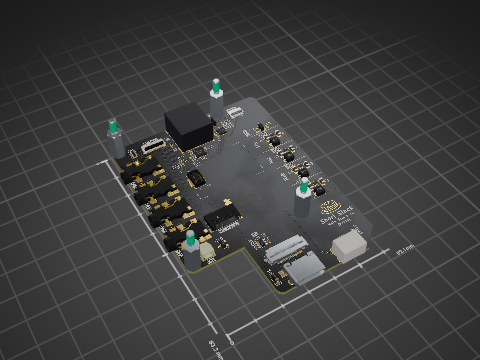
World's Smallest Nintendo Wii, using a trimmed motherboard and custom stacked PCBs

cheyao/ch32-logic-analyzer
200MHz USB 3.1 logic analyzer and 20MHz ADC w/ pulseview
It measures 170 × 170 mm and has 4 copper layers, 1.6 mm thick.
144 parts, built around the STM32F411CEU6, ACS725LLCTR-05AB-T, AP2127N-3.3TRG1 and TMUXHS221NKGR. The full list of its parts is on this page, with links to each part's symbol and footprint where PCBKit's library has them.
From the the78mole/jumpstarter-mono repository on GitHub, at the commit this page was made from: the board is hardware/dutlink-board/dutlink.kicad_pcb and its schematic hardware/dutlink-board/board_control.kicad_sch. PCBKit opens the board in the browser, with nothing to install.
Its repository publishes it under the Apache-2.0 licence: you may reuse it on that licence's terms (keep the author's notice, and for a copyleft licence share your changes alike).