
2 layers99.9 × 51.4 mm
GR AVR Programmer
GadgetReboot/AVR_Programmer
Atmel AVR programmer based on Arduino Pro Micro, intended for development into ISP and HVSP using various AVR programming interfaces and protocols.
52 parts7

 thainnos/LICSTER122
A Low-cost ICS Security Testbed for Education and Research
KiCad Shield is an open-source printed circuit board by thainnos, from the thainnos/LICSTER repository on GitHub. It is a 2-layer board of 68.6 × 53.3 mm with 76 parts on 63 nets, routed with 302 tracks and 60 vias.
It is built around the BSS138 and BSS83P. Its parts include 52 resistors, 10 connectors, 4 diodes, 4 transistors and 1 capacitor.


The project aims to help setup a minimal, low-cost Industrial Control System (ICS) testbest for students, researchers, or anyone with an interest in industrial security. The project contains a list of affordable hardware to build the minimalistic ICS with, instructions, configurations and installation scripts to instantiate the system as well as various attacker scenarios and their implications.

|
Our goal is to ease the entry into the industrial security sector. Industrial hardware is usually quite expensive as well as mostly proprietary, both of which do not encourage easy learning. With the upcoming of Industry 4.0, however, it has become imperative that the security of industrial networks and components is up to par with the modern cyber risks of the connected world. Practice and knowledge has to be accessible and affordable to empower engineers and developers to master the challenges of the fourth industrial revolution.
Although the testbed only comprises of the bare minimum components necessary for an ICS, the concepts and more importantly, the attack scenarios are mostly the same.
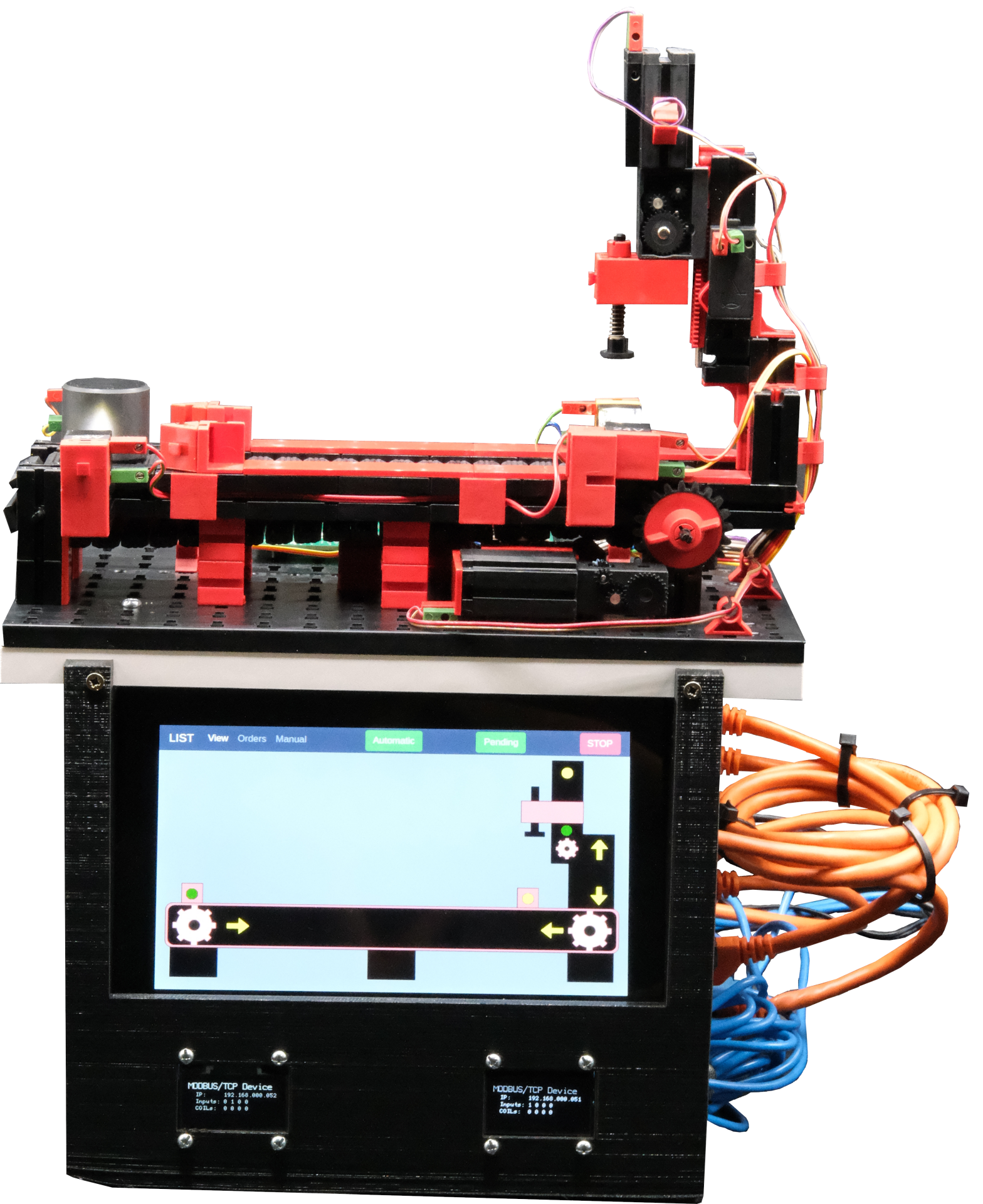
The picture shows the setup of the testbed with the HMI and the physical process.
|
This project was set up with the following requirements in mind:
We try to keep the prerequisites as little as possible to reduce the hurdle for beginners.
At the beginning you may be a bit confused by the many different components. However, the assembly is not as difficult as expected.
| Name | Contribution |
|---|---|
| Matthias Niedermaier | Maintainer |
| Felix Sauer | Developer |
| Susanne Kießling | Learning concepts |
| Dominik Merli | Coordinator |
| Fabian Klemm | Secure webapplication for HMI |
| Eric Hoffmann | Intrusion detection system |
| Raphael Hausmanninger | Secure communication between PLC and Remote-IO |
| Michael Janzer | Intrusion detection system |
| Muhammet Bilbey | Secure communication between PLC and Remote-IO |
| Athanasios Luludis | Secure webapplication for HMI |
| Janis Schickram | Intrusion detection system |
You find the research paper here. To cite the work you can use the official bibtex entry:
@article{ScienceOpenVid:4fa78131-80f5-4fca-b45a-bfd6a04ae2cc,\ author = {Sauer, Felix and Niedermaier, Matthias and Kießling, Susanne and Merli, Dominik},\ title = {LICSTER – A Low-cost ICS Security Testbed for Education and Research},\ journal = {},\ year = 2019,\ volume = {},\ number = {},\ pages = {1-10},\ doi = {10.14236/ewic/icscsr19.1}\ }| Qty | Value | Footprint | References |
|---|---|---|---|
| 36 | R | Resistor_SMD:R_0603_1608Metric | R1, R2, R3, R10, R15, R16, R17, R18, R19, R20, R25, R26, R27, R28, R29, R30 +20 |
| 10 | 10k | Resistor_SMD:R_0603_1608Metric | R11, R12, R13, R14, R45, R46, R48, R49, R50, R52 |
| 4 | CONN_1 | Socket_Arduino_Uno:Arduino_1pin | P5, P6, P7, P8 |
| 4 | LED | LED_SMD:LED_0603_1608Metric | D1, D2, D3, D4 |
| 4 | R | Resistor_SMD:R_0603_1608Metric_Pad1.05x0.95mm_HandSolder | R21, R22, R23, R24 |
| 2 | 2k2 | Resistor_SMD:R_0603_1608Metric | R47, R51 |
| 2 | BSS138 | Package_TO_SOT_SMD:SOT-23 | Q1, Q3 |
| 2 | BSS83P | Package_TO_SOT_SMD:SOT-23 | Q2, Q4 |
| 1 | ATECC508A | Package_SO:SOIC-8_3.9x4.9mm_P1.27mm | IC1 |
| 1 | Analog | Socket_Arduino_Uno:Socket_Strip_Arduino_1x06 | P2 |
| 1 | C | Capacitor_SMD:C_0603_1608Metric_Pad1.05x0.95mm_HandSolder | C1 |
| 1 | CONN_01X10 | Pin_Headers:Pin_Header_Straight_1x10 | P9 |
| 1 | Conn_01x04_Male | Connector_PinHeader_2.54mm:PinHeader_1x04_P2.54mm_Horizontal | J1 |
| 1 | Digital | Socket_Arduino_Uno:Socket_Strip_Arduino_1x10 | P3 |
| 1 | Digital | Socket_Arduino_Uno:Socket_Strip_Arduino_1x08 | P4 |
| 1 | Power | Socket_Arduino_Uno:Socket_Strip_Arduino_1x08 | P1 |
The 72 most common of 76 parts.
It measures 68.6 × 53.3 mm and has 2 copper layers, 1.6 mm thick.
76 parts, built around the BSS138 and BSS83P. The full list of its parts is on this page, with links to each part's symbol and footprint where PCBKit's library has them.
From the thainnos/LICSTER repository on GitHub, at the commit this page was made from: the board is devices/remote_io/hardware/KiCad_Shield.kicad_pcb. PCBKit opens the board in the browser, with nothing to install.
Its repository states no licence, so its author keeps all rights: ask thainnos before reusing the design.
GadgetReboot/AVR_Programmer
Atmel AVR programmer based on Arduino Pro Micro, intended for development into ISP and HVSP using various AVR programming interfaces and protocols.


proveskit/development_boards
Miscellaneous dev boards to test the components of the PROVES Kit on a smaller scale.

