2 layers55 × 90 mm
IPodClone
mojo626/iPodClone
This is a clone of an iPod video based on the Allwinner V3s processor
163 parts

 tenderlove/initial-v1k
It's a BMW shifter converted to a Bluetooth Keyboard that you use with Vim
Initial v is an open-source printed circuit board by tenderlove, from the tenderlove/initial-v repository on GitHub, published under the Apache-2.0 licence. It is a 2-layer board of 40.5 × 58 mm with 30 parts on 58 nets, routed with 177 tracks and 27 vias.
It is built around the ESP32-MINI-1-H4, MPM3610GQV-Z and SN65HVD230D, with the PJ-032A among its other parts. Its parts include 8 resistors, 7 capacitors, 4 ICs, 3 diodes and 3 connectors. It belongs with the radio and wireless and keyboards and input boards and the ESP32 boards of this library.



Initial V is a BMW shifter that has been converted to a Bluetooth keyboard. In this repository, you'll find schematics and PCB designs, stl files, a Vim plugin, and client software for turning a BMW shifter in to a Bluetooth keyboard that can control Vim.
Think of this project as a very over-engineered Vim clutch.
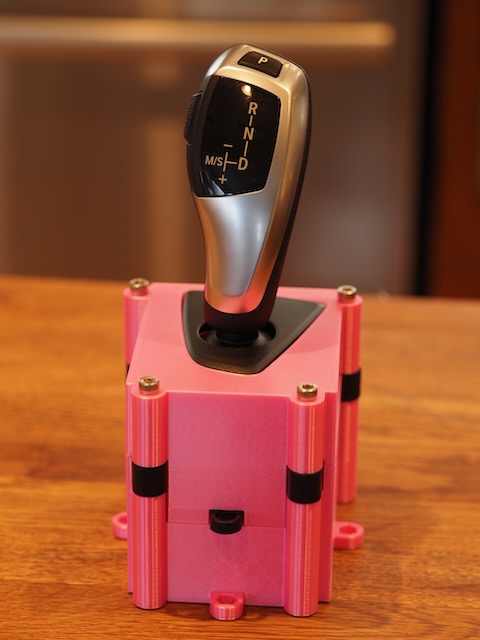
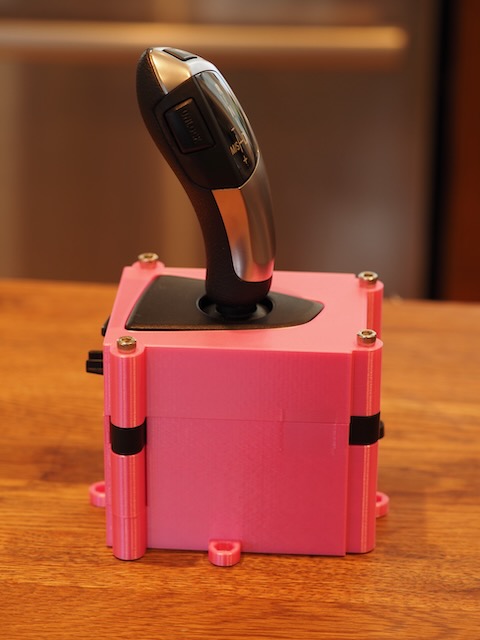
Initial V is a Bluetooth Keyboard specialized for controlling Vim. The key presses sent depend on Vim's state. The table below describes the key presses for each handle position according to the state of the editor:
| Park | Up | Down | Double Up | Double Down | Move Left | Left Up | Left Down | Move Right (back to center) | |
|---|---|---|---|---|---|---|---|---|---|
| Normal Mode (Drive) | :w on a modified buffer, :wq on unmodified buffer | Up key | Down key | i | o | CTRL-V | Up Key | Down key | ESC |
| Insert Mode (Neutral) | ESC | Up key | Down key | Page Up | Page Down |
"Drive" on the handle means "Normal Mode" in Vim. "Neutral" on the handle means "Insert Mode" in Vim. It's not possible to move the handle to the left when the handle is in Neutral mode, so there are no key combinations. I'm not sure what mode in Vim would map to Reverse on the handle, so there's no way to transition to Reverse at the moment.
Saving a buffer in Normal mode will put the handle in to the "Park" position. The Park position behaves the same way as Drive (Normal mode in Vim) except that if you hit Park again, it will exit Vim.
The BMW handle communicates via CAN bus. The PCB uses an ESP-MINI-1 chip with Bluetooth capabilities, and an SN65HVD230D for CAN bus communication. The handle runs on 12v, so I used a MPM3610GQV buck converter to step the voltage down to 3.3v for the ESP.
I must give a huge thanks to @projectgus for decoding the CAN bus data. This project would not be possible without their hard work.
The handle appears as a Bluetooth keyboard to the operating system, but it in order to change the handle state we require a way to communicate data back to the handle.
I used HID data APIs to send bytes back to the handle, requesting the handle to change state.
There is a client written in Zig here, and also a Ruby client here.
Finally, I wrote a Vim plugin that sends commands to the handle whenever Vim changes modes.
This means that the handle will maintain state along with Vim's state even if the user changes state via keyboard (like hitting i on their keyboard, etc).
The general flow is (from Normal mode):
iI had a ton of fun building this project. I will update each directory with a README for more detailed build instructions. I'm also going to make a promotional video as well, but I felt I needed to fill out the README since the project is public at this point anyway!!
| Qty | Value | Footprint | References |
|---|---|---|---|
| 3 | 0.1uf | Capacitor_SMD:C_1206_3216Metric_Pad1.33x1.80mm_HandSolder | C3, C6, C7 |
| 2 | 10k | Resistor_SMD:R_1206_3216Metric_Pad1.30x1.75mm_HandSolder | R6, R9 |
| 2 | 22uf | Capacitor_SMD:C_1206_3216Metric_Pad1.33x1.80mm_HandSolder | C2, C5 |
| 2 | LOGO | artwork:mise | G***, G*** |
| 2 | SW_SPST | Button_Switch_THT:SW_PUSH_6mm | SW1, SW2 |
| 1 | 100 | Resistor_SMD:R_1206_3216Metric | R14 |
| 1 | 100k | Resistor_SMD:R_1206_3216Metric_Pad1.30x1.75mm_HandSolder | R11 |
| 1 | 10uf | Capacitor_SMD:C_1206_3216Metric_Pad1.33x1.80mm_HandSolder | C8 |
| 1 | 120 | Resistor_SMD:R_1206_3216Metric_Pad1.30x1.75mm_HandSolder | R10 |
| 1 | 12v | LED_SMD:LED_1206_3216Metric | D1 |
| 1 | 1k | Resistor_SMD:R_1206_3216Metric | R12 |
| 1 | 1uf | Capacitor_SMD:C_1206_3216Metric_Pad1.33x1.80mm_HandSolder | C4 |
| 1 | 24k | Resistor_SMD:R_1206_3216Metric_Pad1.30x1.75mm_HandSolder | R7 |
| 1 | 3v | LED_SMD:LED_1206_3216Metric | D3 |
| 1 | 75k | Resistor_SMD:R_1206_3216Metric_Pad1.30x1.75mm_HandSolder | R8 |
| 1 | Conn_01x10 | Connector_PinSocket_2.54mm:PinSocket_1x10_P2.54mm_Horizontal | J3 |
| 1 | D_Schottky | Diode_SMD:D_1206_3216Metric_Pad1.42x1.75mm_HandSolder | D4 |
| 1 | ESP32-MINI-1-H4 | footprints:ESP32-MINI-1-H4 | U3 |
| 1 | LOGO | artwork:logo | G*** |
| 1 | MCP1700-1202E_SOT89 | Package_TO_SOT_SMD:SOT-89-3 | U2 |
| 1 | MPM3610GQV-Z | footprints:MPM3610GQV-Z | U4 |
| 1 | PJ-032A | PJ-032A:CUI_PJ-032A | J2 |
| 1 | Prog | Connector_PinHeader_2.54mm:PinHeader_1x04_P2.54mm_Horizontal | J1 |
| 1 | SN65HVD230 | Package_SO:SOIC-8_3.9x4.9mm_P1.27mm | U5 |
It measures 40.5 × 58 mm and has 2 copper layers, 1.6 mm thick.
30 parts, built around the ESP32-MINI-1-H4, MPM3610GQV-Z, SN65HVD230D and PJ-032A. The full list of its parts is on this page, with links to each part's symbol and footprint where PCBKit's library has them.
From the tenderlove/initial-v repository on GitHub, at the commit this page was made from: the board is pcb/initial-v.kicad_pcb and its schematic pcb/initial-v.kicad_sch. PCBKit opens the board in the browser, with nothing to install.
Its repository publishes it under the Apache-2.0 licence: you may reuse it on that licence's terms (keep the author's notice, and for a copyleft licence share your changes alike).
mojo626/iPodClone
This is a clone of an iPod video based on the Allwinner V3s processor


menloresearch/asimov-1
v1 of Asimov, an open-source humanoid robot

