
4 layers16.9 × 119.4 mm

 sthivaios/odsci
An STM32-based USB interface for DS18B20 temperature sensors
Odsci is an open-source printed circuit board by sthivaios, from the sthivaios/odsci repository on GitHub. It is a 4-layer board of 50 × 70 mm with 35 parts on 43 nets, routed with 172 tracks and 30 vias.
It is built around the USBLC6-2SC6. Its parts include 12 capacitors, 8 resistors, 4 connectors, 3 ICs and 3 diodes. It belongs with the sensors and measurement and interfaces and adapters boards and the STM32 boards of this library.


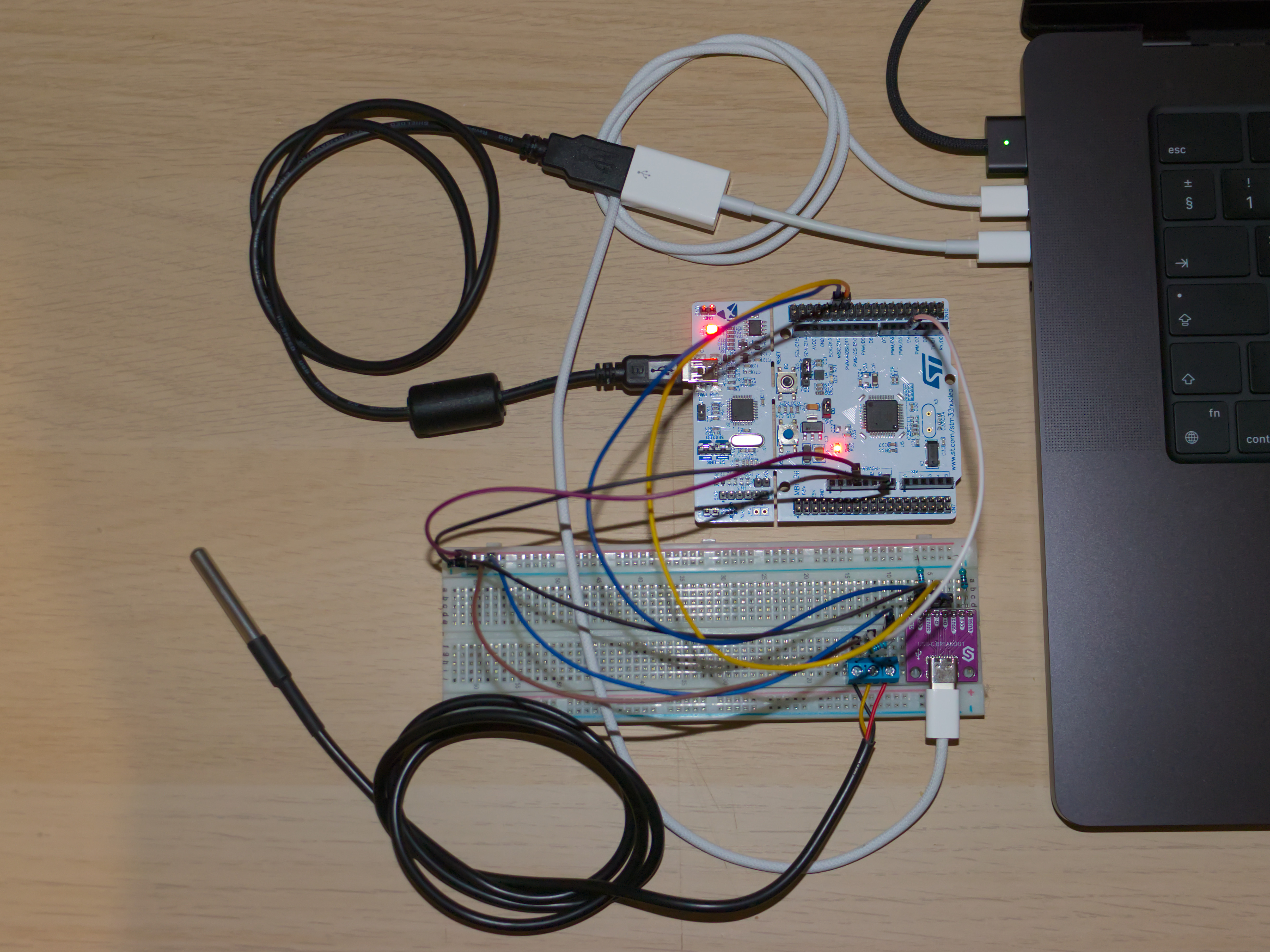
If you want to get started using ODSCI quickly, and don't care about the project, this is the only section of the README that matters to you.
You can grab a pre-built CLI binary from the releases page for your platform/OS, or build from source. The CLI is written in Go and is located in the /cli directory.
Connect the ODSCI probe to your computer, and find the serial port that it uses (COM port on Windows, or a /dev/tty device on Linux and MacOS).
Then, you can use the capture command to save a given amount of samples as a CSV file.
./odsci --port THE_SERIAL_PORT_HERE --samples 100 --interval 10 --output "./output.csv"The CLI has more features than just the capture command. Run ./odsci --help for more information on the commands, or read the documentation.
ODSCI is an STM32-based USB interface for DS18B20 sensors. It stands for OneWire DS18B20 Computer Interface.
It connects to any computer through a USB-C port and exposes a USB CDC virtual serial port, through which the MCU can send temperature readings back to the computer.
I am mainly working on this project, in order to teach myself Go (which the CLI uses), while also using it as an excuse to attempt to write my own OneWire "driver" for the STM32 to communicate with the sensor.
You can find each "part" of ODSCI in its corresponding folder.
The firmware that runs on the STM32 is written in C and configured with CubeMX and uses CMake. It is located in the /firmware directory.
The hardware (PCB) is a KiCad project. It is located under /hardware.
The enclosure was designed in Fusion360. The project file, as well as any STL exports are located under the /enclosure.
The CLI is written in Go. You can find its source under /cli. I will attempt to cross-compile it for different platforms. Check the repo releases for pre-built binaries.
The docs are written with VitePress. You can find them under /docs.
You are welcome to report any issues that you find with any part of ODSCI, or open pull requests to fix them.
If you are actually contributing code to the project, make sure that you understand the license terms.
Different parts of the project are licensed under different licenses.
Under each directory, you will find a separate LICENSE file for that part of the project.
While that may seem a little confusing at first, please understand that some parts like the PCB simply aren't very compatible with the usual licenses like MIT, GPL, etc.
See LICENSE for more info.
| Qty | Value | Footprint | References |
|---|---|---|---|
| 6 | 100nF | Capacitor_SMD:C_0402_1005Metric | C3, C4, C5, C6, C7, C9 |
| 4 | MountingHole_Pad | MountingHole:MountingHole_2.2mm_M2_Pad | H1, H2, H3, H4 |
| 3 | 330 | Resistor_SMD:R_0402_1005Metric | R6, R7, R8 |
| 3 | 4.7uF | Capacitor_SMD:C_0805_2012Metric | C8, C10, C12 |
| 3 | LED | LED_THT:LED_D3.0mm | D1, D2, D3 |
| 2 | 10k | Resistor_SMD:R_0402_1005Metric | R3, R4 |
| 2 | 5.1k | Resistor_SMD:R_0402_1005Metric | R1, R2 |
| 1 | 10uF | Capacitor_SMD:C_0805_2012Metric | C2 |
| 1 | 1uF | Capacitor_SMD:C_0805_2012Metric | C1 |
| 1 | 4.7k | Resistor_SMD:R_0402_1005Metric | R5 |
| 1 | 47uF | Capacitor_SMD:C_0805_2012Metric | C11 |
| 1 | Conn_01x03_Pin | Connector_PinHeader_2.54mm:PinHeader_1x03_P2.54mm_Vertical | J2 |
| 1 | Conn_01x04_Pin | Connector_PinHeader_2.54mm:PinHeader_1x04_P2.54mm_Vertical | J3 |
| 1 | STM32F042K6Tx | Package_QFP:LQFP-32_7x7mm_P0.8mm | U2 |
| 1 | SW_Push | Button_Switch_THT:SW_SPST_Omron_B3F-315x_Angled | SW1 |
| 1 | Screw_Terminal_01x03 | TerminalBlock_Phoenix:TerminalBlock_Phoenix_MPT-0,5-3-2.54_1x03_P2.54mm_Horizontal | J4 |
| 1 | TPS7A4701xRGW | Package_DFN_QFN:Texas_RGW0020A_VQFN-20-1EP_5x5mm_P0.65mm_EP3.15x3.15mm_ThermalVias | U1 |
| 1 | USBLC6-2SC6 | Package_TO_SOT_SMD:SOT-23-6 | U3 |
| 1 | USB_C_Receptacle | Connector_USB:USB_C_Receptacle_GCT_USB4105-xx-A_16P_TopMnt_Horizontal | J1 |


TalismanDesign/PocketMage_PDA
An E-Ink PDA device using the ESP32 S3.


shorepine/tulipcc
The Tulip Creative Computer and AMYboard - portable Python synthesizers


LeoDJ/FW-EC-DongleHiderPlus
Framework Expansion Card that includes a USB hub to hide a bare dongle inside and still have a USB-A port externally
It measures 50 × 70 mm and has 4 copper layers, 1.6 mm thick.
35 parts, built around the USBLC6-2SC6. The full list of its parts is on this page, with links to each part's symbol and footprint where PCBKit's library has them.
From the sthivaios/odsci repository on GitHub, at the commit this page was made from: the board is hardware/odsci.kicad_pcb and its schematic hardware/odsci.kicad_sch. PCBKit opens the board in the browser, with nothing to install.
Its repository states no licence, so its author keeps all rights: ask sthivaios before reusing the design.