
4 layers51.4 × 40.8 mm

This project focuses on developing a wearable Electroencephalogram (EEG) device, integrating key concepts from Internet of Things (IoT) and embedded systems for biopotential acquisition.
Eeg is an open-source printed circuit board by stephan-biomedical-engineer, from the stephan-biomedical-engineer/Electroencephalogram repository on GitHub. It is a 4-layer board of 67.3 × 41.7 mm with 147 parts on 168 nets, routed with 691 tracks and 315 vias.
It is built around the STM32H730VBT6, MCP602-I/P and TPS62162QDSGRQ1, with the LT3042IMSE#PBF and PCM12SMTBR among its other parts. Its parts include 46 resistors, 43 capacitors, 19 ICs, 4 diodes and 3 connectors. It belongs with the wearables boards and the STM32 boards of this library.


A wearable EEG system for real-time brain activity monitoring, designed with embedded systems and IoT principles.
This project presents a wearable Electroencephalogram (EEG) device developed for the Biomedical Instrumentation I course. It aims to acquire and process low-amplitude human brain signals (5µV to 300µV) across standard EEG frequency bands:
This is a full-stack biomedical system, integrating analog signal conditioning, high-resolution digital conversion, and wireless data transmission for real-time EEG visualization.
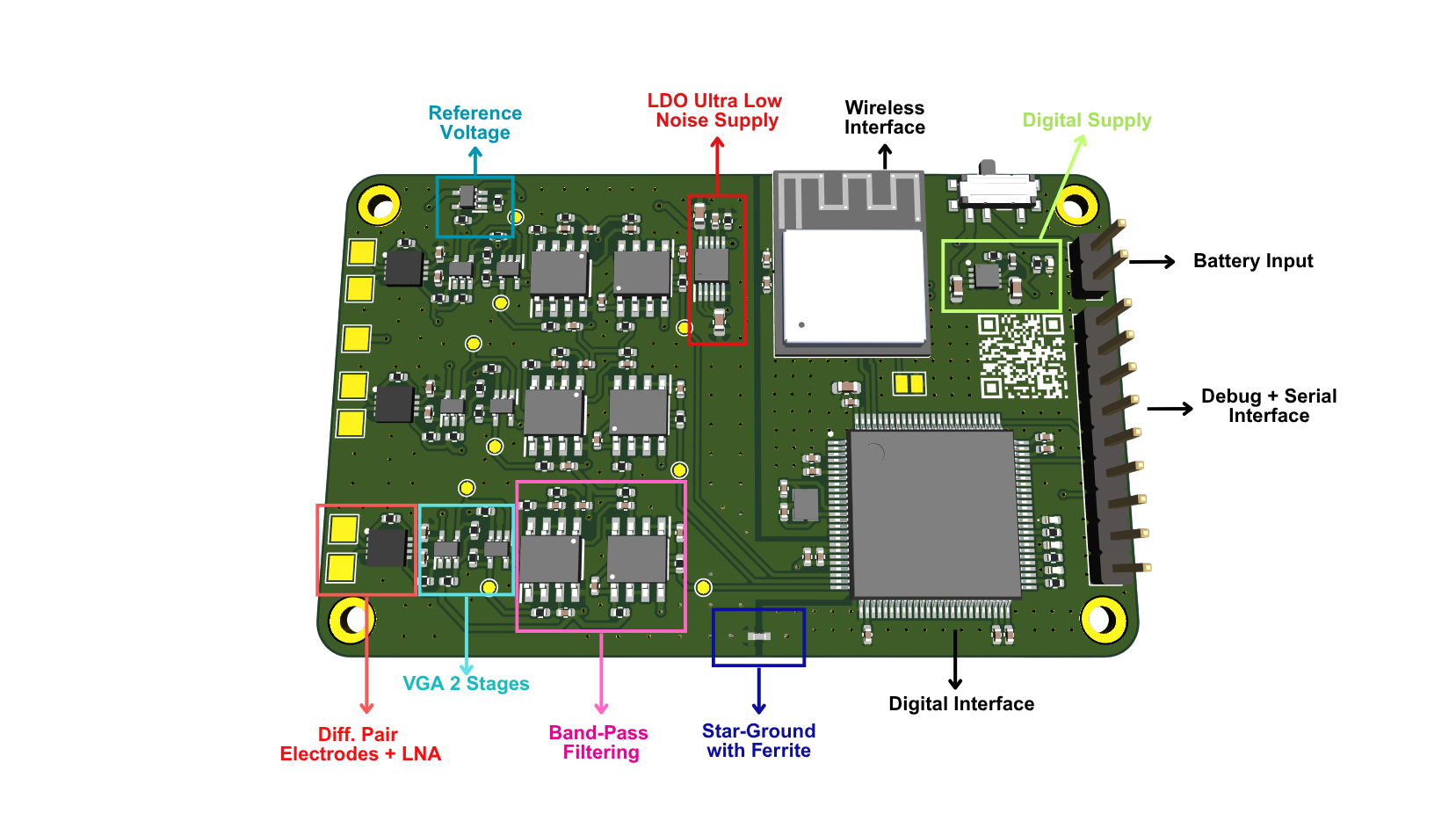
EEG Hardware Prototype
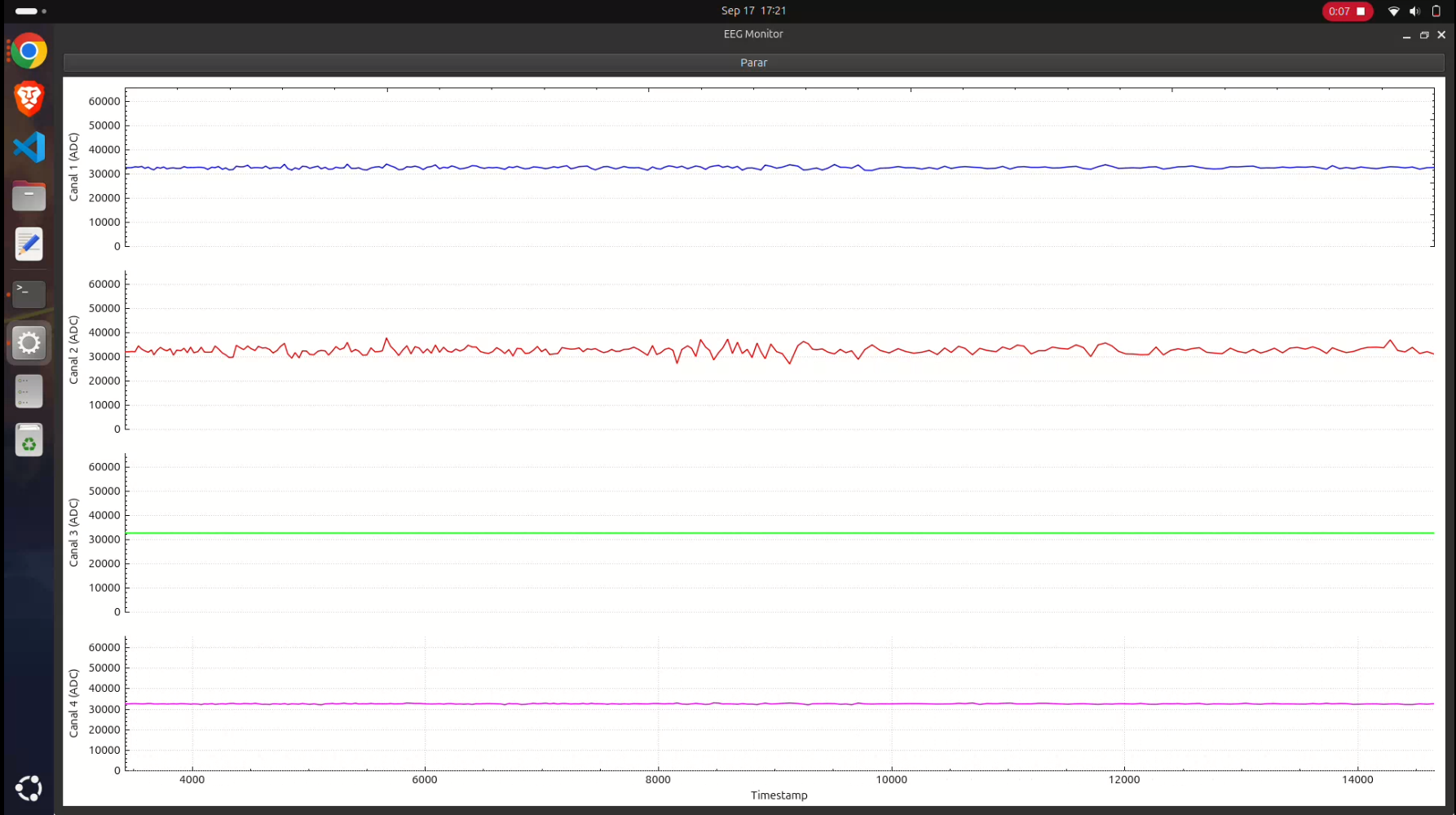
Real-Time EEG Interface in Qt
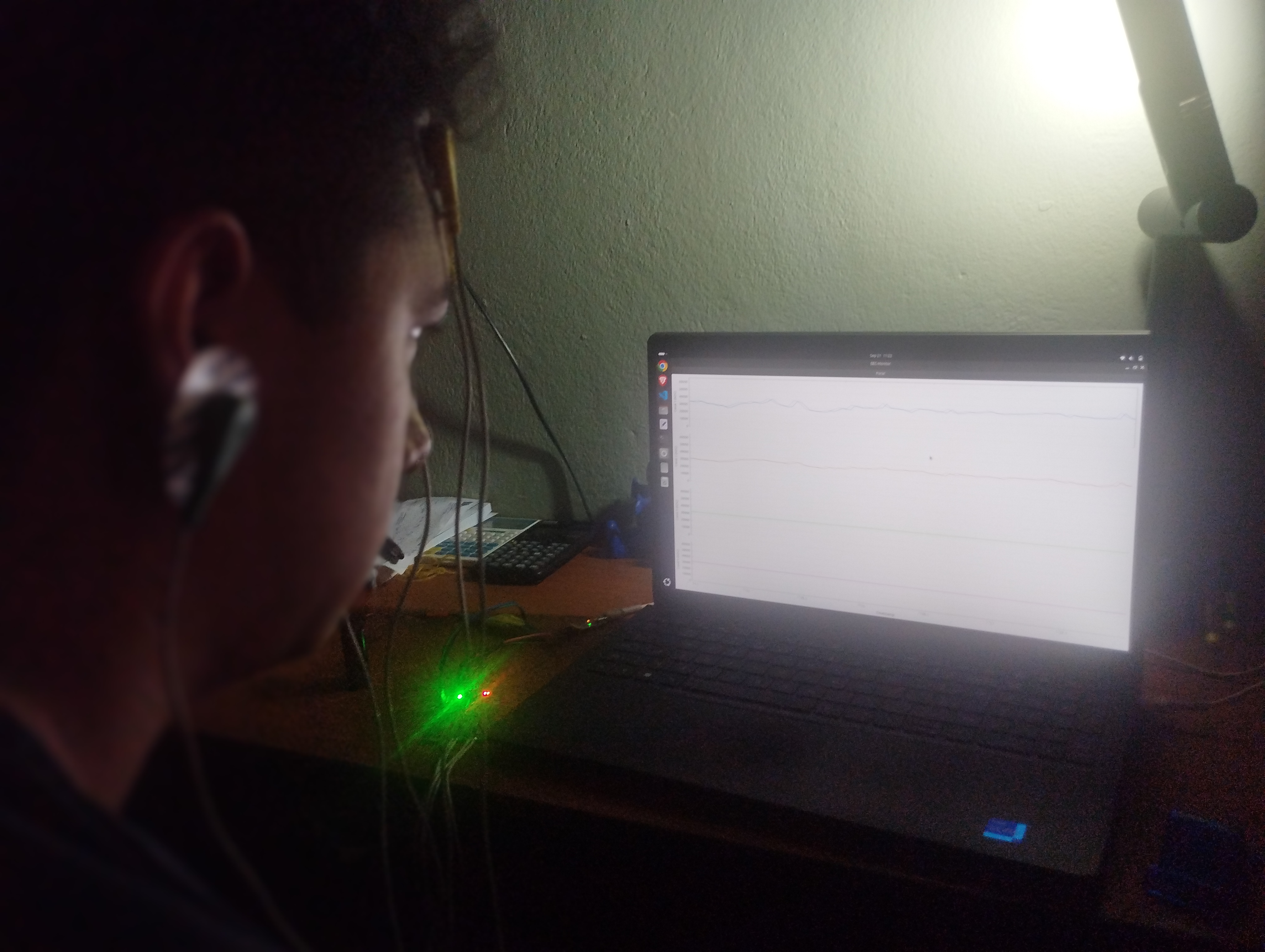
Physical Setup
EEG signals are amplified ~12000x and filtered in a 3-stage analog pipeline:
Developed using ESP-IDF and FreeRTOS
Handles:
On the host side:
| Layer | Tools & Components |
|---|---|
| Microcontroller | STM32H730VBT, STM32CubeIDE |
| Analog Circuitry | INA333, OPA333, RC Filters |
| Wireless | ESP32-C6, FreeRTOS (Not yet implemented) |
| Protocols | UART, MQTT, Wi-Fi |
| Host Interface | Qt, C++, HTML5, WebSocket/MQTT |
Stephan Costa Barros - Electrical Engineering Department – Federal University of Uberlândia (UFU), Brazil
Marcelo Barros de Almeida - Electrical Engineering Department – Federal University of Uberlândia (UFU), Brazil
Alcimar Barbosa Soares - Electrical Engineering Department – Federal University of Uberlândia (UFU), Brazil
| Qty | Value | Footprint | References |
|---|---|---|---|
| 9 | 300nF | Capacitor_SMD:C_0402_1005Metric | C6, C7, C8, C14, C15, C16, C22, C23, C24 |
| 9 | TestPoint | TestPoint:TestPoint_Pad_D1.0mm | TP1, TP2, TP3, TP4, TP5, TP6, TP7, TP8, TP9 |
| 7 | 100nF | Capacitor_SMD:C_0402_1005Metric | C25, C26, C27, C28, C29, C31, C35 |
| 7 | TestPoint | TestPoint:TestPoint_Pad_2.0x2.0mm | CH1-, CH1+, CH2-, CH2+, CH3-, CH3+, REF |
| 6 | 1.5k | Resistor_SMD:R_0402_1005Metric | R5, R7, R17, R19, R29, R31 |
| 6 | 36nF | Capacitor_SMD:C_0402_1005Metric | C3, C5, C11, C13, C19, C21 |
| 6 | 750k | Resistor_SMD:R_0402_1005Metric | R6, R8, R18, R20, R30, R32 |
| 6 | MCP602 | mcp602:SOIC127P600X175-8N | U3, U4, U7, U8, U11, U12 |
| 6 | OPA333xxDCK | opa333:SOT65P210X110-5N | U2, U6, U10, U17, U18, U19 |
| 5 | 1k | Resistor_SMD:R_0402_1005Metric | R39, R40, R41, R42, R44 |
| 4 | 0.1uF | Capacitor_SMD:C_0402_1005Metric | C1, C9, C17, C39 |
| 4 | LED | LED_SMD:LED_0402_1005Metric | D1, D2, D3, D4 |
| 4 | MountingHole_Pad | MountingHole:MountingHole_2.2mm_M2_DIN965_Pad | H1, H2, H3, H4 |
| 3 | 1.93M | Resistor_SMD:R_0402_1005Metric | R13, R25, R37 |
| 3 | 149K | Resistor_SMD:R_0402_1005Metric | R10, R22, R34 |
| 3 | 2.04k | Resistor_SMD:R_0402_1005Metric | R3, R15, R27 |
| 3 | 276K | Resistor_SMD:R_0402_1005Metric | R11, R23, R35 |
| 3 | 330nF | Capacitor_SMD:C_0402_1005Metric | C2, C10, C18 |
| 3 | 4.7uF | Capacitor_SMD:C_0603_1608Metric | C30, C40, C42 |
| 3 | 484k | Resistor_SMD:R_0402_1005Metric | R14, R26, R38 |
| 3 | 8.2nF | Capacitor_SMD:C_0402_1005Metric | C4, C12, C20 |
| 3 | 910k | Resistor_SMD:R_0402_1005Metric | R4, R16, R28 |
| 3 | 967k | Resistor_SMD:R_0402_1005Metric | R12, R24, R36 |
| 3 | 97k | Resistor_SMD:R_0402_1005Metric | R9, R21, R33 |
| 3 | INA333xxDRG | ina333:SON50P300X300X80-9N-D | U1, U5, U9 |
| 2 | 1M | Resistor_SMD:R_0402_1005Metric | R1, R2 |
| 2 | 2.2uF | Capacitor_SMD:C_0402_1005Metric | C33, C34 |
| 2 | 20pF | Capacitor_SMD:C_0402_1005Metric | C37, C38 |
| 1 | 0.47uF | Capacitor_SMD:C_0402_1005Metric | C41 |
| 1 | 100k | Resistor_SMD:R_0402_1005Metric | R46 |
| 1 | 10k | Resistor_SMD:R_0402_1005Metric | R43 |
| 1 | 10uF | Capacitor_SMD:C_0603_1608Metric | C43 |
| 1 | 1uF | Capacitor_SMD:C_0402_1005Metric | C32 |
| 1 | 2.2uH | Inductor_SMD:L_0402_1005Metric | L1 |
| 1 | 22uF | Capacitor_SMD:C_0603_1608Metric | C44 |
| 1 | 33.2k | Resistor_SMD:R_0402_1005Metric | R45 |
| 1 | Battery LiPO | Connector_PinHeader_2.54mm:PinHeader_1x02_P2.54mm_Vertical | J1 |
| 1 | Conn_01x05 | Connector_PinHeader_2.54mm:PinHeader_1x05_P2.54mm_Vertical | J2 |
| 1 | Crystal_GND24_Small | crystal30M:830107284409 | Y1 |
| 1 | FerriteBead_Small | ferritebead:BEADC1005X55N | FB1 |
| 1 | LOGO | logo:brain_2 | G*** |
| 1 | LOGO | logo:st | G*** |
| 1 | LOGO | logo:pinguim | G*** |
| 1 | LOGO | logo:repo | G*** |
| 1 | LOGO | logo:logoFEELT_3 | G*** |
| 1 | LOGO | logo:logoUFU_2 | G*** |
| 1 | LT3042IMSE#PBF | lt3042:SOP50P490X110-11N | IC2 |
| 1 | OPA333AIDCKRG4 | opa333:SOT65P210X110-5N | IC4 |
| 1 | PCM12SMTBR | sw_tactile:PCM12SMTBR | S1 |
| 1 | STM32H730VBT6 | stm32h730vbt6:QFP50P1600X1600X160-100N | IC3 |
| 1 | SW_Push_Dual | tactile_button:TL1030AF350AQJ | SW3 |
| 1 | SW_Push_Dual | tactile_button:TL1030AF160BQJ | SW2 |
| 1 | Serial | Connector_PinHeader_2.54mm:PinHeader_1x03_P2.54mm_Vertical | J4 |
| 1 | TPS62162QDSGRQ1 | tps62162:SON50P200X200X80-9N | IC1 |

jayis1/hacker-devices
Full-cycle hardware designs for security research devices — each device is a subfolder with its own README, schematics, PCB layout, and software stack

OneAudio/OSVA
Open source versatible analyzer (24bits 1.536MSPS 2 Channels)

siru409/Dilf-seeker
A near field multi beam ultra wideband fmcw radar detector using a novel near field focussed rotman lens

ben5049/cm-carrier-hardware
Compact CM5 carrier board with an M.2 E-key connector and a 1000BASE-T1 Ethernet PHY, as well as other optional IO.

ben5049/Keyboard
Features: - Wireless - 900mAh battery - Bluetooth (nRF52) - ZMK - 4 Port USB hub - BLDC Knob for haptic feedback - Kailh Choc V1 switches

YikeStone/pereda-kbd
Pereda is a custom wireless mechanical keyboard designed for Kailh Choc V1 switches.

NilsEngelbach/air-quality-pcb
Seventh iteration: ESP8266 → ESP32-C3 (native USB, no UART bridge), fixes from the v6 design review, right-angle switches with longer actuators, a STEMMA QT port for optional sensors, and charge-status sensing.
It measures 67.3 × 41.7 mm and has 4 copper layers, 1.6 mm thick.
147 parts, built around the STM32H730VBT6, MCP602-I/P, TPS62162QDSGRQ1 and LT3042IMSE#PBF. The full list of its parts is on this page, with links to each part's symbol and footprint where PCBKit's library has them.
From the stephan-biomedical-engineer/Electroencephalogram repository on GitHub, at the commit this page was made from: the board is hardware/eeg.kicad_pcb and its schematic hardware/afe.kicad_sch. PCBKit opens the board in the browser, with nothing to install.
Its repository states no licence, so its author keeps all rights: ask stephan-biomedical-engineer before reusing the design.