2 layers98.9 × 78 mm
Siot gateway particle io
simpleiot/hardware
Hardware designs for IoT devices and sensor nodes.
28 parts9Apache-2.0
 simpleiot/hardware9
Hardware designs for IoT devices and sensor nodes.
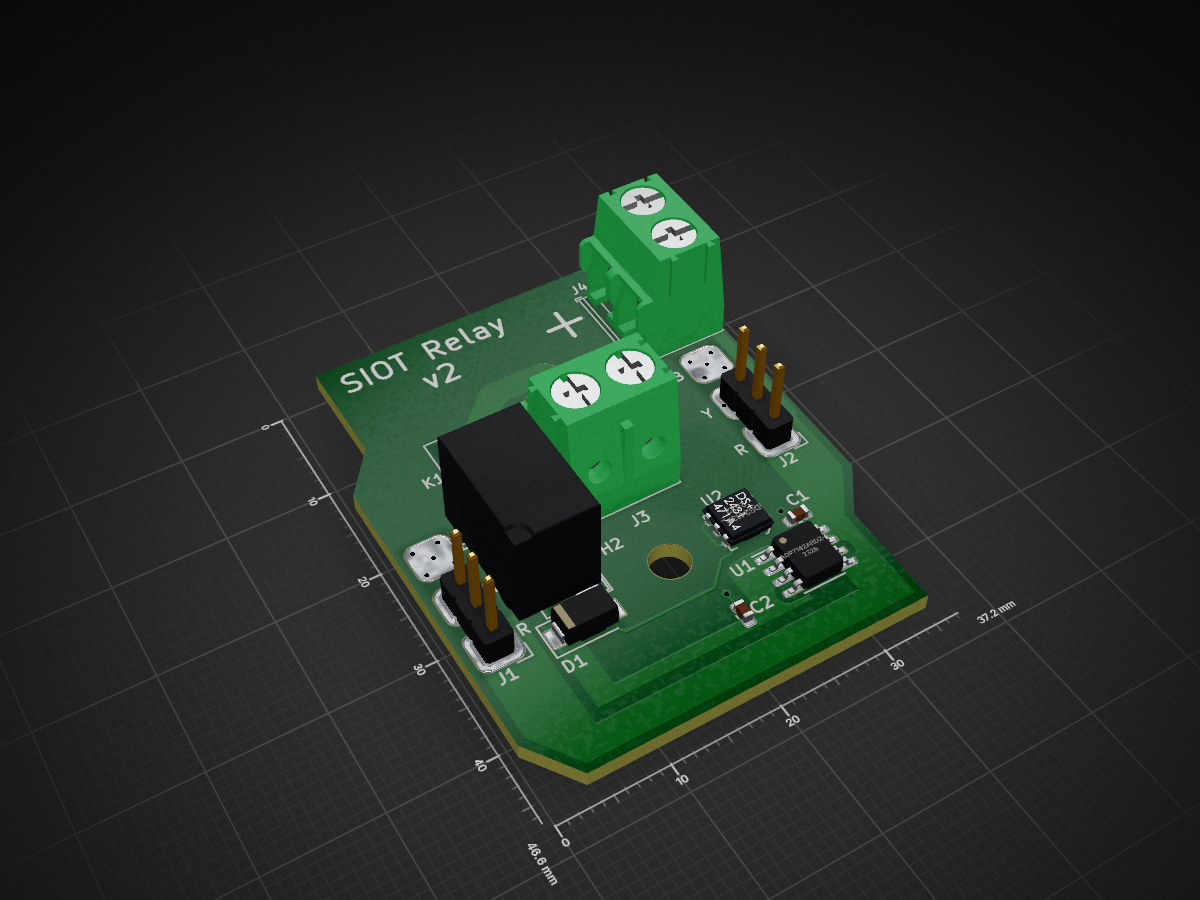
Siot node relay is an open-source printed circuit board by simpleiot, from the simpleiot/hardware repository on GitHub, published under the Apache-2.0 licence. It is a 2-layer board of 37.2 × 46.6 mm with 12 parts on 9 nets, routed with 61 tracks and 17 vias.
It is built around the DS2413P+T&R and ADP7142ARDZ-5.0. Its parts include 4 connectors, 2 capacitors, 2 ICs, 1 diode and 1 switch. It belongs with the home automation and IoT boards of this library.


This board is designed to provide a number of expansion features to Raspberry PI and ODROID-C4 SBCs.
There is a UART and SPI ports (todo) wired between the host MPU and the MCU on the expansion board.
A STM32F042K4Tx MCU is used to implement the following functionality:
Reference
Can is typically implemented using a SPI CAN controller (ex MCP2517), but these devices do not offer any buffering so are a poor choice for non real-time operating systems like Linux. Thus, we've chosen to use a MCU to provide the CAN interface and hopefully leverage firmware from the following projects:
| Qty | Value | Footprint | References |
|---|---|---|---|
| 2 | 2.2uF_50V | Capacitor_SMD:C_0603_1608Metric | C1, C2 |
| 2 | MountingHole | MountingHole:MountingHole_3.5mm | H1, H2 |
| 2 | Screw_Terminal_5mm_01x02 | TerminalBlock_Phoenix:TerminalBlock_Phoenix_PT-1,5-2-5.0-H_1x02_P5.00mm_Horizontal | J3, J4 |
| 2 | xConnect_smd | BEC:xConnect_smd | J1, J2 |
| 1 | ADP7142ARDZ-5.0 | BEC:SOIC-8-1EP_3.9x4.9mm_P1.27mm_EP2.29x3mm_ThermalVias | U2 |
| 1 | DS2413P_ | digikey-footprints:LSOJ-6_W3.76mm | U1 |
| 1 | G6DN-1A-L-DC5 | BEC:OMRON-G6DN-1A-L | K1 |
| 1 | RECT_50V_1A | Diode_SMD:D_SMA | D1 |
It measures 37.2 × 46.6 mm and has 2 copper layers, 1.6 mm thick.
12 parts, built around the DS2413P+T&R and ADP7142ARDZ-5.0. The full list of its parts is on this page, with links to each part's symbol and footprint where PCBKit's library has them.
From the simpleiot/hardware repository on GitHub, at the commit this page was made from: the board is siot-node-relay/siot-node-relay.kicad_pcb. PCBKit opens the board in the browser, with nothing to install.
Its repository publishes it under the Apache-2.0 licence: you may reuse it on that licence's terms (keep the author's notice, and for a copyleft licence share your changes alike).
simpleiot/hardware
Hardware designs for IoT devices and sensor nodes.

simpleiot/hardware
Hardware designs for IoT devices and sensor nodes.

simpleiot/hardware
Hardware designs for IoT devices and sensor nodes.

simpleiot/hardware
Hardware designs for IoT devices and sensor nodes.

simpleiot/hardware
Hardware designs for IoT devices and sensor nodes.

simpleiot/hardware
Hardware designs for IoT devices and sensor nodes.

simpleiot/hardware
Hardware designs for IoT devices and sensor nodes.


github-linguist/linguist
Language Savant. If your repository's language is being reported incorrectly, send us a pull request!


google/mozc-devices
Circuit diagrams and firmware source code for Gboard DIY keyboards


hackclub/OnBoard
💡 Join 1,000 teenagers and make your first PCB with a $100 grant!