Skip to the content
4 layers80 × 78 mmPi5 m2 reference, the printed circuit board in 3D

SystemVerilog DAQ simulation portfolio: 63 tests, 33 E2E scenarios, DDR3 behavioral and PCIe transaction-level models. Separate PCB design study with retained FAILs; no hardware or timing-closure claims.

Size
80 × 78 mm
Copper layers
4
Thickness
1.6 mm
Parts
34
Nets
58
Pads
183
Tracks, vias
337, 87
Pours
4
Routed
Yes
KiCad
KiCad 9.0 (file 20241229)
Created
13 Oct 2026
Updated
13 Oct 2026

Overview

Pi5 m2 reference is an open-source printed circuit board by searchyourmind, from the searchyourmind/fpga-highspeed-daq repository on GitHub. It is a 4-layer board of 80 × 78 mm with 34 parts on 58 nets, routed with 337 tracks and 87 vias.

It is built around the TPS62130ARGTR, NC7SB3157P6X and DMG1012T-7. Its parts include 11 resistors, 8 capacitors, 4 connectors, 3 transistors and 2 ICs. It belongs with the fPGA and programmable logic and computers and single-board computers boards and the FPGA and CPLD boards of this library.

Main components

3

README

README.md

FPGA High-Speed DAQ — RTL simulation portfolio

SystemVerilog · cocotb · Verilator · Python · Yosys

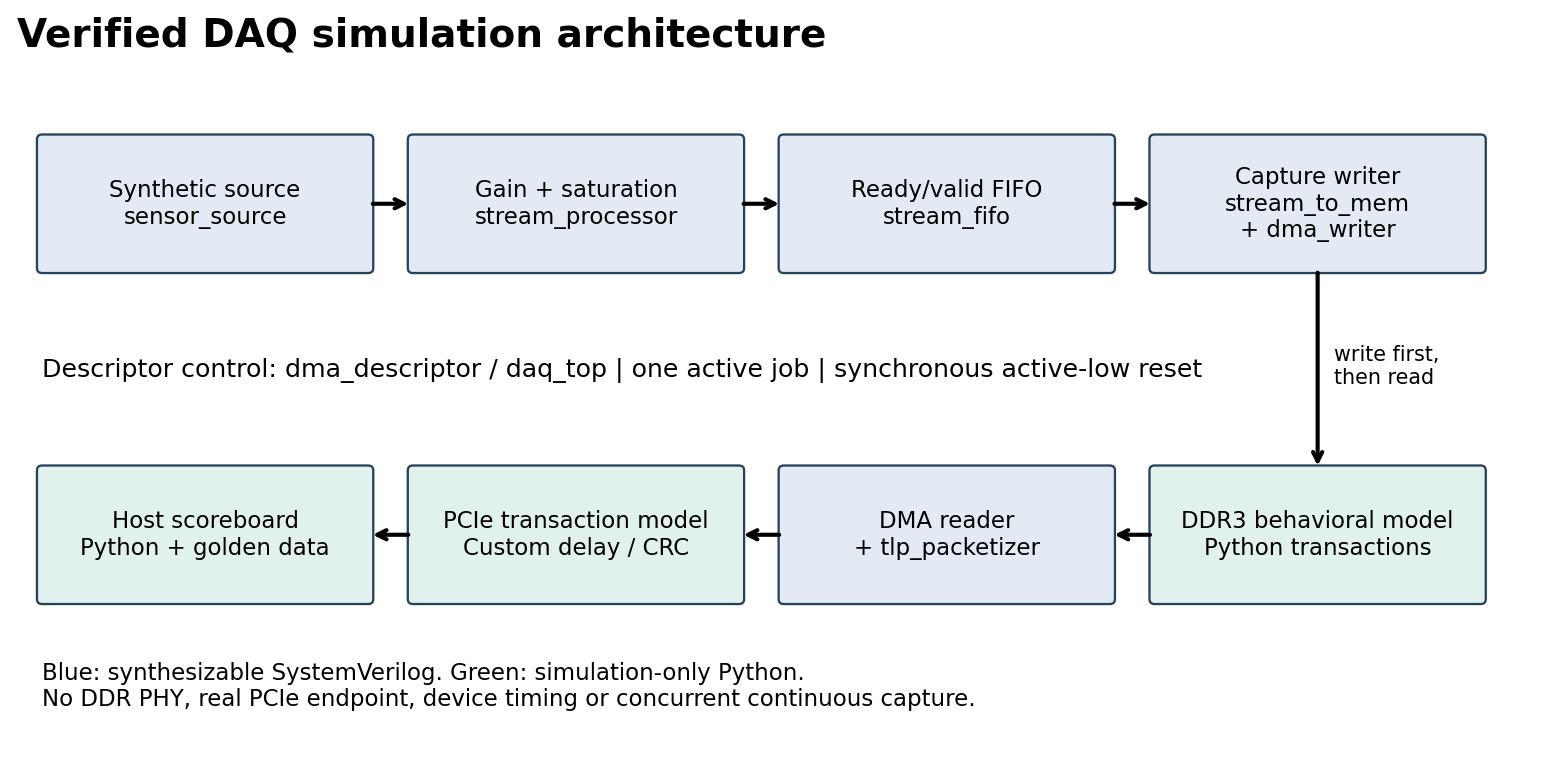
A single-clock acquisition pipeline with ready/valid buffering, saturating gain, ring-buffer DMA and packetized host readback. 63 tests pass; 33 end-to-end scenarios match independent expected records. DDR3 is a behavioral model; PCIe is a custom transaction-level model, not a hardware endpoint.

System architecture: synthesizable RTL and simulation models

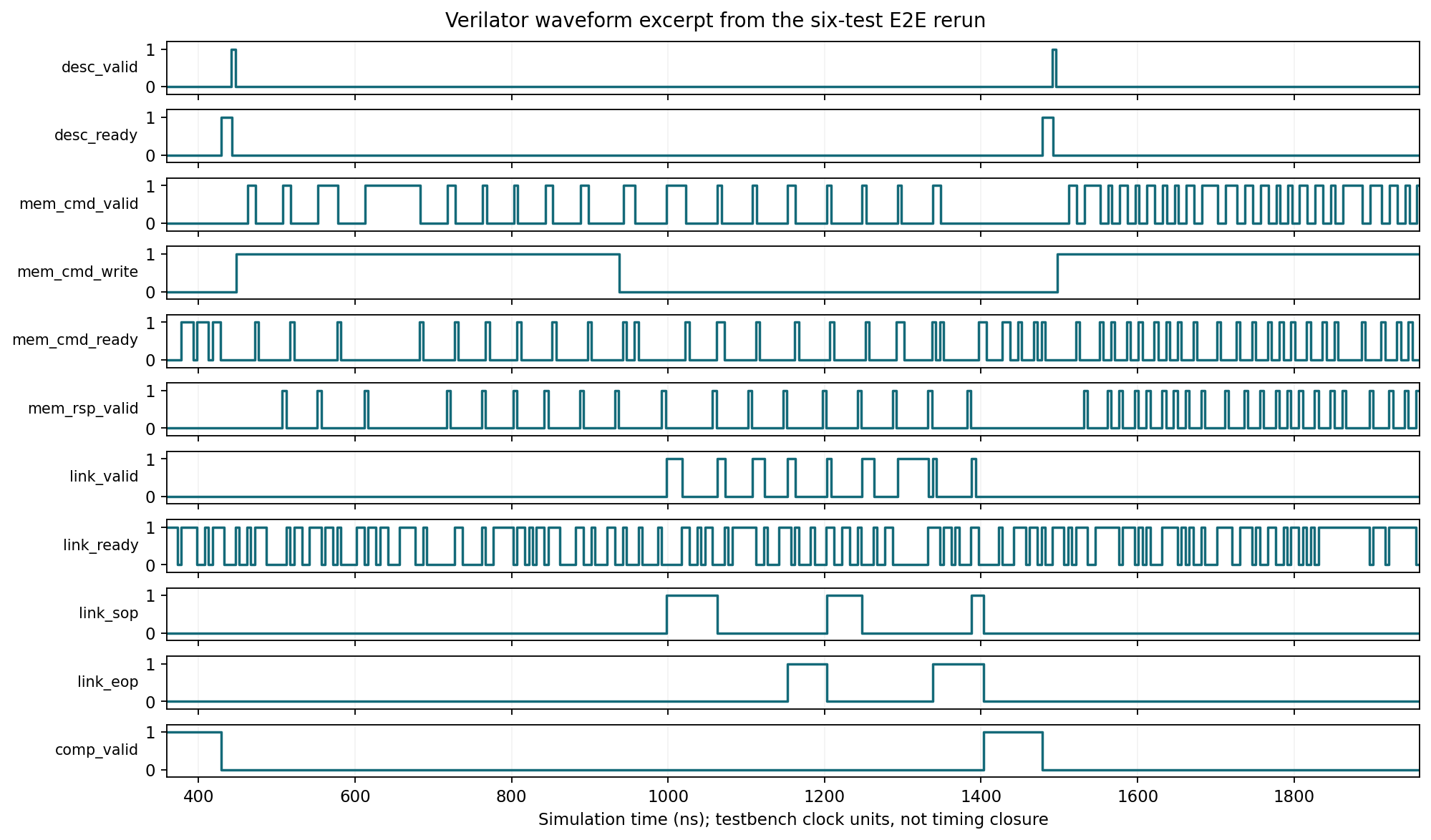
Actual Verilator VCD: descriptor, memory and link handshakes

The waveform comes from an executed regression. Full VCD · Trace provenance

Verified resultEvidence
63/63 PASS, zero failures/skips39 pytest + 24 cocotb; actual clean-checkout log
33/33 MATCH15 baseline + 18 extended scenarios within those tests; results
Independent checks detect six injected defectsMutation results and coverage limits
Generic synthesis: 1,447 flip-flops, no latches/loopsYosys evidence; 42-cell topological path, not device timing closure

Debugging findings

  • 4 KiB crossing: a packet starting at 0x1ff8 crossed a page. Bound payload length by page remainder; original failing assertion retained.
  • Address boundary: fixed rejection of the final legal 8-byte record at 2^64−8 by validating the last addressed byte.
  • Delayed delivery: retained host tag ownership until data consumption, even after RTL completion.
  • False-success runner: reject failed/stale/empty/skipped JUnit; a real failing fixture verifies the gate. Review

Reproduce

Requires Docker, Make and Python 3. Run from the repository root:

sh
make tools
make verify                 # lint, 63 tests / 33 scenarios, generic synthesis
make timing                 # structural checks; no device delays or slack

Recorded versions: Verilator 5.040, cocotb 2.0.0, pytest 8.4.2, Yosys 0.33. Commands, versions and clean-checkout scope · Simulation benchmark

Explore the engineering

Architecture and RTL modules · Verification review · Portfolio summary · Resume bullets · Release summary

One descriptor is active at a time; capture finishes before readback. The source honors backpressure. No physical ADC, DDR PHY, real PCIe TLP/LCRC, FPGA implementation, device STA or measured throughput is claimed. Interface contracts · Synthesis scope

Separate PCB Rev 0.3.1 design study

The Pi 5 FFC-to-M.2 carrier is not the FPGA DAQ board. Native CAD checks pass; engineering acceptance remains FAIL:

RequirementRetained result
Voltage: 3.135–3.465 V3.130447–3.487610 V; margins −4.553 / −22.610 mV
Thermal screen: ≤125 °C6/24 FAIL; fine-grid worst 160.303 °C, margin −35.303 °C
Differential impedance: 81–99 ΩBroad high corner 106.126 Ω, margin −7.126 Ω

These are modeled rejection indicators, not measurements or qualified operating conditions. All cases and root causes · Pass/fail matrix. No fabrication, purchases or physical validation. Published as a simulation portfolio with a separate design study. Local verification evidence is retained; live CI status is available in GitHub Actions.

Parts

34
QtyValueFootprintReferences
4M2.5 board mountMountingHole_2.7mm_M2.5H1, H2, H3, H4
3100nFCapacitor_SMD:C_0402_1005MetricC5, C7, C8
310kResistor_SMD:R_0402_1005MetricR4, R9, R10
3DMG1012T-7Package_TO_SOT_SMD:SOT-523Q1, Q2, Q3
210uF 25V X7RCapacitor_SMD:C_1206_3216MetricC1, C2
222uF 10V X7RCapacitor_SMD:C_1206_3216MetricC3, C4
233RResistor_SMD:R_0402_1005MetricR7, R11
1100kResistor_SMD:R_0402_1005MetricR3
110k 0.1% 25ppmResistor_SMD:R_0402_1005MetricR2
12.2kResistor_SMD:R_0402_1005MetricR8
12.2uH XAL4020-222MECInductor_SMD:L_Coilcraft_XAL4020-XXXL1
13.3nF soft startCapacitor_SMD:C_0402_1005MetricC6
13.6k 1%Resistor_SMD:R_0402_1005MetricR5
131.6k 0.1% 25ppmResistor_SMD:R_0402_1005MetricR1
16.8k 1%Resistor_SMD:R_0402_1005MetricR6
1External regulated 5V / 3AConnector_PinHeader_2.54mm:PinHeader_1x02_P2.54mm_VerticalJ3
1NC7SB3157P6XPackage_TO_SOT_SMD:SOT-363_SC-70-6U2
1Optional 32.768kHz inputConnector_PinHeader_2.54mm:PinHeader_1x03_P2.54mm_VerticalJ4
1TE 1-1734839-6 (top contact)Connector_FFC-FPC:TE_1-1734839-6_1x16-1MP_P0.5mm_HorizontalJ1
1TE 1-2199230-4 M-keyDAQ:TE_M2_M_1-2199230-4J2
1TPS62130ARGTRPackage_DFN_QFN:VQFN-16-1EP_3x3mm_P0.5mm_EP1.6x1.6mmU1
1Wurth 9774025243R / M2 / H2.5mmMounting_Wuerth:Mounting_Wuerth_WA-SMSI-M2_H2.5mm_9774025243H5

Similar boards

  • 4 layers95.9 × 90.2 mmKENSAT EPS v1.2, the printed circuit board in 3D

    KENSAT EPS v1.2

    kenchangh/kensat

    KENSAT, Edge-AI Compute in Orbit - A 2U CubeSat that runs a large language model on-orbit. A power-gated NVIDIA Jetson Orin Nano executes neural-network inference in space, and the results are downlinked over a custom…

    218 parts119
  • 2 layers52.3 × 50.3 mm1016-Breadboard Power Supply, the printed circuit board in 3D

    1016-Breadboard Power Supply

    wilsondr9999/1016-Breadboard-Power-Supply

    An add-on module for powering your breadboard with selectable rail voltages.

    82 parts14AGPL-3.0
  • 4 layers20.3 × 22.9 mmVr module, the printed circuit board in 3D

    Vr module

    mck1117/vr-interface

    44 parts2
  • 6 layers211 × 192.7 mmAraneae, the printed circuit board in 3D

    Araneae

    TheusHen/Araneae

    Open Router. No Spyware. Privacy First.

    346 parts1Unlicense
  • 2 layers40 × 20 mmB TPS62130A 3V3-BRK R1.0, the printed circuit board in 3D

    B TPS62130A 3V3-BRK R1.0

    Boardoza/Boardoza_TPS62130A_3V3_3A_Buck_Converter_Breakout_Board

    High-efficiency 4V–17V to 3.3V, 3A synchronous buck converter breakout board based on the TPS62130A.

    19 partsCC-BY-SA-4.0
  • 4 layers100 × 72 mmRtl8367-switch, the printed circuit board in 3D

    Rtl8367-switch

    Deco025/rtl8367-switch

    Five-port gigabit unmanaged Ethernet switch based on the Realtek RTL8367RB - 4-layer KiCad 10 design with fabrication outputs

    229 partsCERN-OHL-S-2.0
  • 6 layers160 × 100 mmCourant.before colored actual models 20260918T190457, the printed circuit board in 3D

    Courant.before colored actual models 20260918T190457

    KrasForge/Courant

    A 2D finite-difference physical-modeling synthesis engine in structural VHDL: a vibrating membrane/plate/gong solved on FPGA fabric, with a nonlinear chaos term, playable polyphonically over MIDI/CV.

    199 partsMIT

Questions

How big is the Pi5 m2 reference PCB?

It measures 80 × 78 mm and has 4 copper layers, 1.6 mm thick.

What parts does the Pi5 m2 reference use?

34 parts, built around the TPS62130ARGTR, NC7SB3157P6X and DMG1012T-7. The full list of its parts is on this page, with links to each part's symbol and footprint where PCBKit's library has them.

Where can I download the Pi5 m2 reference KiCad files?

From the searchyourmind/fpga-highspeed-daq repository on GitHub, at the commit this page was made from: the board is hardware/reference_pcie_adapter/kicad/pi5_m2_reference.kicad_pcb and its schematic hardware/reference_pcie_adapter/kicad/pi5_m2_reference.kicad_sch. PCBKit opens the board in the browser, with nothing to install.

Can I use the Pi5 m2 reference design in my own project?

Its repository states no licence, so its author keeps all rights: ask searchyourmind before reusing the design.